
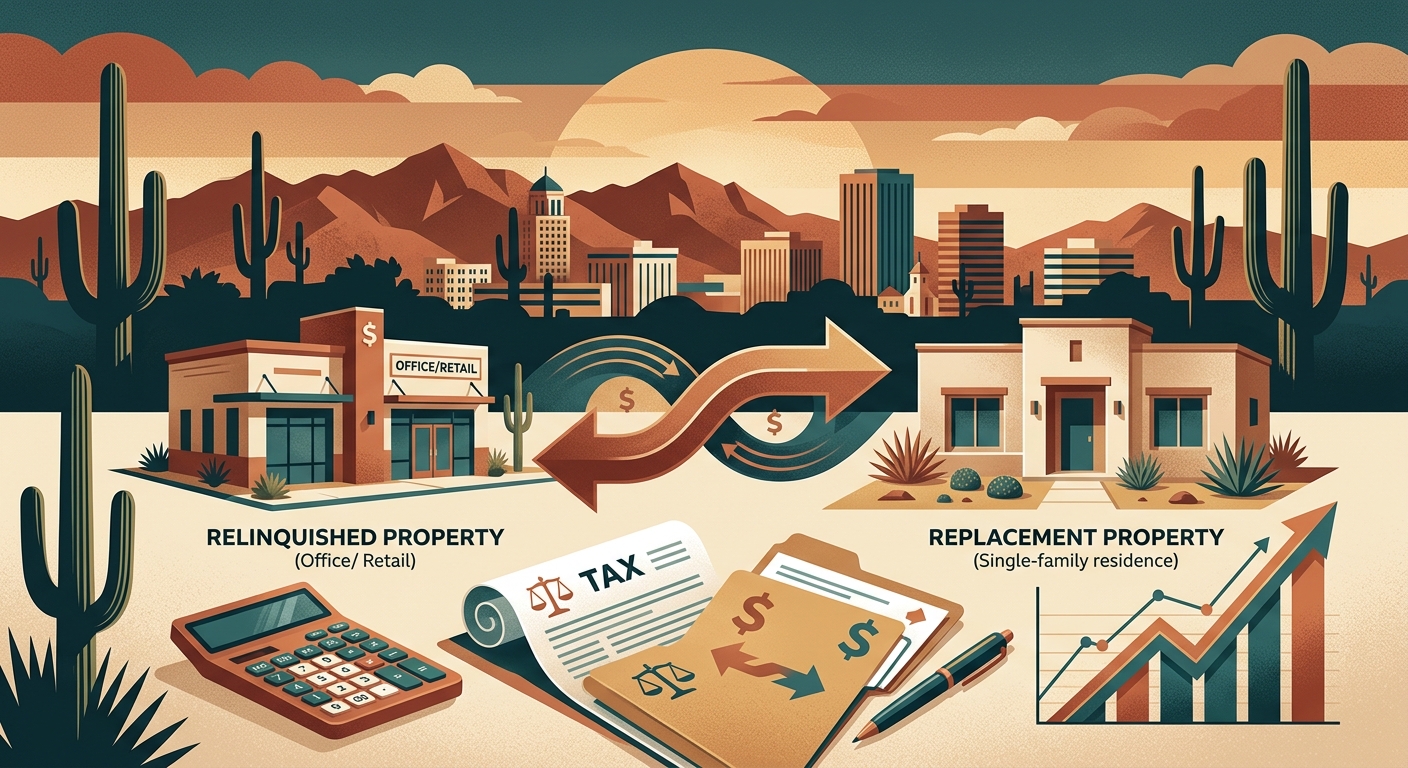
Quick Answer
Finding the best 1031 exchange CPA in Pima County means choosing an advisor who understands both federal like-kind exchange rules and Arizona real estate tax nuances. A qualified CPA helps you defer capital gains, coordinate with your qualified intermediary, hit the strict 45-day and 180-day deadlines, and structure replacement property to protect your wealth. Done right, a single exchange on a $600,000 property can defer well over $90,000 in combined federal and state taxes.
This information is current as of 8/27/2026. Tax laws change frequently. Verify updates with the IRS or the Arizona Department of Revenue if reading this later.
If you own investment real estate in and around Tucson, Marana, Oro Valley, Sahuarita, or anywhere in the broader county, choosing the right advisor is the single most important decision you will make before selling. A 1031 exchange is not a form you file after the fact. It is a tightly choreographed sequence of moves that starts before the sale even closes. Miss one step and the entire tax deferral collapses. That is why so many investors search for the best 1031 exchange CPA Pima County has to offer before they ever list a property. This guide walks you through exactly what a 1031 exchange is, how it works in Arizona, what separates a great CPA from a mediocre one, and how to avoid the mistakes that cost investors tens of thousands of dollars every year.
What Is a 1031 Exchange? (In Plain English)
A 1031 exchange (named after Section 1031 of the Internal Revenue Code) lets you sell an investment property and reinvest the proceeds into another “like-kind” property without paying capital gains tax at the time of sale. In plain English: it is a legal way to swap one investment property for another and push your tax bill down the road, sometimes indefinitely.
Here is the core idea. Normally, when you sell an appreciated rental or commercial property, you owe federal capital gains tax, depreciation recapture tax, the net investment income tax, and Arizona state income tax. A properly executed exchange defers all of it. You keep your equity working instead of handing a chunk to the government.
The phrase “like-kind” trips people up. It does not mean you have to swap a duplex for a duplex. For real estate, like-kind is broad. You can exchange raw land for an apartment building, a retail strip center for a rental home, or a warehouse for farmland. The only firm rule is that both the property you sell and the property you buy must be held for investment or productive use in a trade or business. Your personal residence does not qualify. For the full federal framework, see IRS Publication 544 and the instructions to Form 8824, which is where you actually report the exchange.
Key Takeaway: A 1031 exchange defers, not eliminates, capital gains tax. But when combined with a “swap till you drop” strategy and a step-up in basis at death, that deferral can turn into permanent tax savings for your heirs.
Why Pima County Real Estate Investors Need a Specialized 1031 CPA
Pima County has become one of Arizona’s most active investment markets. Tucson’s population growth, the University of Arizona rental demand, the industrial expansion near the airport, and steady appreciation across Oro Valley and Marana have created enormous unrealized gains for long-term owners. That is a wonderful problem to have, until you try to sell and discover the tax bill.
Working with a knowledgeable CPA who focuses on real estate exchanges matters here for a few specific reasons. Arizona imposes a state income tax on capital gains, so your total exposure is higher than in a no-income-tax state. Local market timing, replacement property availability, and coordination with 1031-savvy escrow and title companies all vary by region. A generalist who prepares a few hundred simple returns each spring is not equipped to quarterback a six-figure exchange with hard deadlines.
Investors searching for the best 1031 exchange CPA Pima County can rely on should look for someone who does this work year-round, not just during tax season. The best advisors coordinate with your qualified intermediary before you sign a purchase contract, model out your deferred gain in advance, and flag boot and financing issues while there is still time to fix them.
Special Situations Unique to Arizona Investors
Arizona real estate exchanges carry a few wrinkles that out-of-state CPAs routinely miss. Community property rules affect how spouses hold title and how basis is calculated. The Arizona nonresident withholding rules can apply if a seller is based outside the state. And investors moving between Pima County and other states must plan for how each state sources and taxes the eventual recognized gain. A specialized CPA builds these into the plan from day one instead of discovering them at filing time.
KDA Case Study: Tucson Real Estate Investor Defers Over $90,000
One of our clients, a self-employed contractor in his late fifties, owned a fourplex near central Tucson that he had bought years earlier for $220,000. By the time he was ready to simplify his life, the property was worth $610,000 and he had claimed roughly $80,000 in depreciation over the years. When he first ran the numbers on his own, he assumed a straight sale would be fine. It was not. Between federal long-term capital gains, depreciation recapture taxed at 25 percent, the 3.8 percent net investment income tax, and Arizona state tax, his projected bill was north of $92,000.
He came to us before listing. We structured a 1031 exchange, connected him with a reputable qualified intermediary, and mapped out his 45-day identification window before the sale even closed. He identified two candidate replacement properties, a single-tenant retail building and a larger apartment complex in Oro Valley, and closed on the apartment complex within the 180-day window. Because he reinvested all of his equity and matched his debt, he deferred the entire $92,000 tax bill. His new property produces stronger cash flow with far less management headache.
He paid our firm $4,500 for the planning, coordination, and Form 8824 preparation. Against more than $92,000 in deferred taxes, that is better than a 20x first-year return, and the deferral keeps compounding as long as he continues to hold or exchange.
Ready to see how we can help you? Explore more success stories on our case studies page to discover proven strategies that have saved our clients thousands in taxes.
The 1031 Exchange Timeline: Deadlines You Cannot Miss
The most unforgiving part of any exchange is the calendar. The IRS gives you two hard deadlines, and there are no extensions for a bad weekend or a slow lender. Both clocks start on the day your relinquished property closes.
Step-by-Step: How a 1031 Exchange Actually Works
- Engage your CPA and qualified intermediary first – Before you sign a sale contract, loop in your advisor. The qualified intermediary must be in place before closing, because you cannot touch the sale proceeds yourself.
- Sell the relinquished property – Your intermediary holds the funds in escrow. If you receive the cash directly, even briefly, the exchange is dead.
- Identify replacement property within 45 days – You must formally identify candidate properties in writing by day 45. Most investors use the three-property rule (identify up to three properties of any value).
- Close on the replacement within 180 days – You must acquire one or more identified properties by day 180 from the original sale, or by your tax filing deadline including extensions, whichever comes first.
- Match value and debt – To defer 100 percent of the gain, buy replacement property of equal or greater value and replace any debt that was paid off.
- Report on Form 8824 – Your CPA files Form 8824 with your return to document the exchange and carry over your basis.
1031 Exchange Deadline Reference Table
| Milestone | Deadline | What Happens If You Miss It |
|---|---|---|
| Qualified intermediary in place | Before closing | Exchange disqualified entirely |
| Identify replacement property | 45 days after sale | Full gain becomes taxable |
| Close on replacement property | 180 days after sale | Full gain becomes taxable |
| File Form 8824 | With tax return | Exchange not properly documented |
These deadlines are calendar days, not business days, and they include weekends and holidays. If day 45 lands on Christmas, it is still day 45. A seasoned Pima County exchange CPA builds a countdown timeline the moment your sale contract is signed. For the official rules, review the IRS like-kind exchange guidance.
What Separates the Best 1031 Exchange CPA in Pima County From the Rest
Not every CPA who says they “do 1031 exchanges” actually specializes in them. When you are deferring six figures in tax, the difference between an experienced specialist and a seasonal preparer is enormous. Here is what to look for.
Yes, This CPA Is Right for You If:
- They ask to be involved before you list the property, not after
- They coordinate directly with your qualified intermediary and title company
- They model your deferred gain, basis carryover, and boot in advance
- They understand Arizona-specific withholding and community property rules
- They handle audit representation if the IRS ever questions the exchange
Look Elsewhere If:
- They only talk about exchanges during tax season
- They cannot explain the boot and debt-replacement rules clearly
- They have never prepared a Form 8824 for a multi-property identification
- They tell you the 45-day rule is “flexible” (it is not)
Real estate investors who want a team that lives in this world year-round can explore our dedicated support for real estate investors, which covers depreciation, Schedule E strategy, cost segregation, and exchange planning under one roof. Investors who want to see how a sale might play out before committing can also run preliminary numbers through a capital gains tax calculator to understand the size of the deferral at stake.
Key Takeaway: The best exchange CPAs are proactive, not reactive. If your advisor only surfaces at filing time, you have the wrong advisor for a 1031 exchange.
Common 1031 Exchange Mistakes That Cost Investors Thousands
Even sophisticated investors trip over the same avoidable errors. Here are the most expensive ones we see across Pima County.
Mistake 1: Touching the Sale Proceeds
If the money from your sale hits your bank account, even for a day, the exchange is disqualified. This is why the qualified intermediary must be arranged before closing. Never let the funds pass through your hands.
Mistake 2: Missing the 45-Day Identification Window
The identification deadline is the single most common failure point. Investors get busy, a deal falls through, and suddenly day 45 arrives with no valid identification on file. Line up candidate properties before you sell, not after.
Mistake 3: Creating Taxable “Boot”
Boot is any value you receive that is not like-kind property, such as leftover cash or reduced debt. If you sell a $600,000 property with a $300,000 mortgage and buy a $500,000 property with a $200,000 mortgage, the $100,000 of debt relief becomes taxable boot. Matching value and debt is essential for full deferral.
Mistake 4: Trying to Exchange a Personal Residence
Section 1031 applies only to property held for investment or business use. A home you live in does not qualify, though a different exclusion under Section 121 may apply to a primary residence. A specialist helps you choose the right tool.
Mistake 5: Skipping Professional Coordination
An exchange touches your CPA, your qualified intermediary, your escrow officer, your lender, and sometimes your attorney. When those parties do not communicate, deadlines slip. A quarterback matters. That coordination is exactly what our real estate tax preparation service is designed to provide.
Advanced Strategy: Pairing a 1031 Exchange With Cost Segregation
Here is a strategy most competitors never mention. After you acquire your replacement property through an exchange, you can layer in a cost segregation study to accelerate depreciation on the new asset. Cost segregation reclassifies components of a building, such as flooring, fixtures, and land improvements, into shorter depreciation lives, front-loading your deductions.
The combination is powerful. The exchange defers your gain, and the cost segregation study on the replacement property generates fresh paper losses that can offset other income. For a Tucson investor who exchanges into a larger apartment complex, a cost segregation study can free up tens of thousands in additional first-year deductions. Learn how this works on our cost segregation page.
Key Takeaway: Stacking a 1031 exchange with cost segregation lets you defer the old gain and generate new deductions in the same year. Very few investors use both, which is exactly why the ones who do pull ahead.
The “Swap Till You Drop” Legacy Strategy
Because a 1031 exchange defers rather than eliminates tax, the ultimate strategy is to never sell for cash. Investors who keep exchanging into larger properties for the rest of their lives never pay the deferred gain. When they pass away, their heirs receive a step-up in basis to the property’s fair market value at the date of death. The deferred gain evaporates. This is one of the most powerful wealth transfer strategies available to real estate investors, and it is entirely legal.
Executing this over decades requires an advisor who thinks in terms of your whole financial picture, not just this year’s return. That is the difference between a tax preparer and a strategist.
Ready to Reduce Your Tax Bill?
KDA Inc. specializes in strategic tax planning for business owners, S Corps, LLCs, and high-net-worth individuals. Book a personalized consultation and walk away with a clear plan.
Frequently Asked Questions About 1031 Exchanges in Pima County
Can I do a 1031 exchange on a vacation rental?
Possibly. If the property is genuinely held for investment and rented at fair market value with limited personal use, it can qualify. The IRS has safe harbor guidance on this. A specialist can review your usage records to confirm eligibility.
How much does a 1031 exchange cost?
Qualified intermediary fees typically run several hundred to a couple thousand dollars depending on complexity, plus your CPA’s planning and Form 8824 preparation fee. Against six-figure deferrals, the cost is almost always trivial by comparison.
Can I exchange into property in another state?
Yes. You can sell in Pima County and buy in another state, or vice versa. Just be aware that state sourcing rules will affect the eventual recognized gain, so plan the multi-state consequences in advance.
What if I cannot find a replacement property in 45 days?
Then the exchange fails and your gain becomes taxable. This is why identifying candidates before you sell is critical. Some investors use a reverse exchange to buy first, but those are more complex and require specialized structuring.
Does Arizona conform to federal 1031 rules?
Arizona generally conforms to the federal treatment of like-kind exchanges for real property, so the state gain is deferred alongside the federal gain. Always confirm current conformity with a local CPA, since state rules can change.
Can I do a partial exchange?
Yes, but any portion not reinvested becomes taxable boot. If you want to pull some cash out, you can, you will just pay tax on that portion while deferring the rest.
Book Your 1031 Exchange Strategy Session
If you own appreciated investment property anywhere in Pima County and you are even thinking about selling, the worst thing you can do is wait until the deal is under contract to call a CPA. The best deferrals are engineered before you list. Let our team map your deadlines, coordinate your qualified intermediary, and protect every dollar of your gain. Click here to book your consultation now and keep your equity working for you instead of the IRS.



