
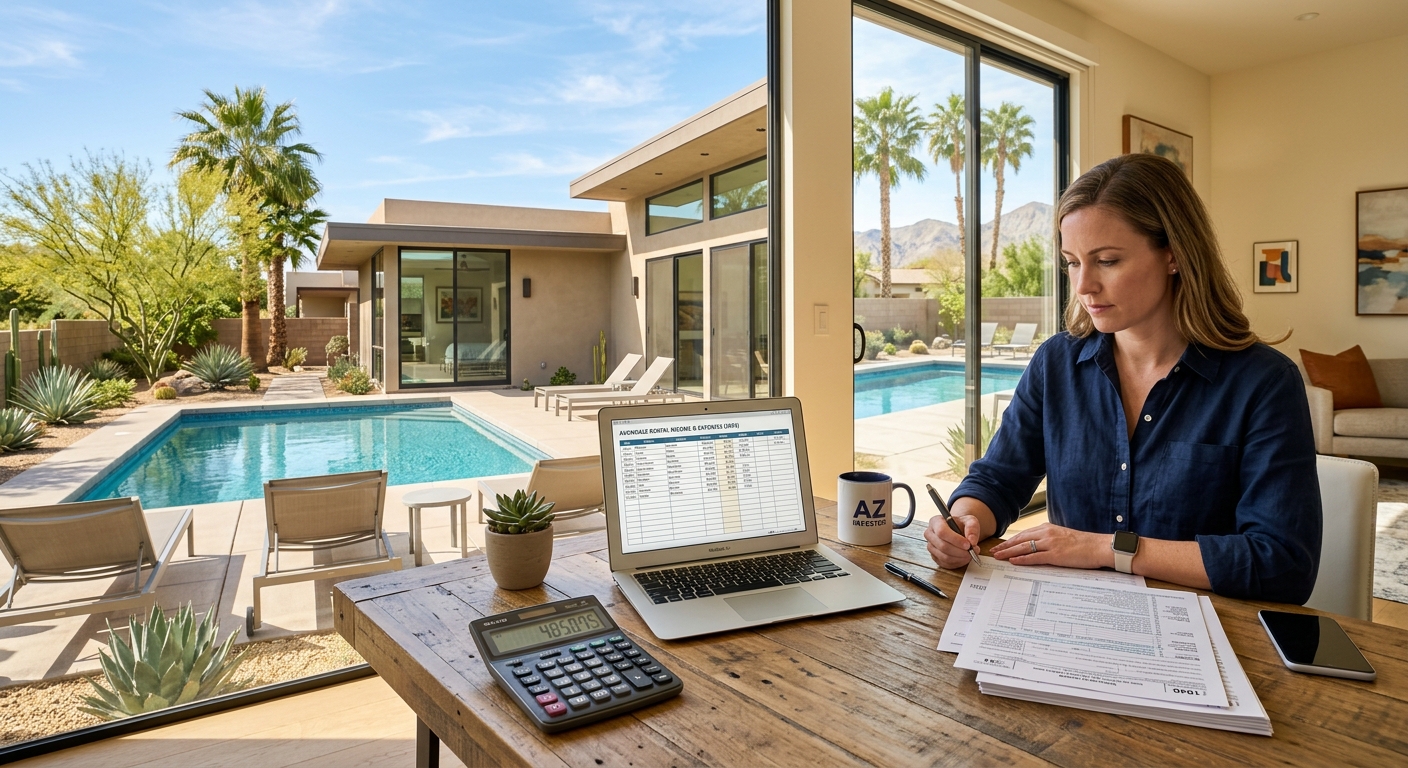
If you own a vacation property or Airbnb near the West Valley, understanding short term rental tax Avondale AZ rules is the difference between keeping thousands in your pocket and handing it to the IRS and the Arizona Department of Revenue. Avondale sits in the fast-growing Maricopa County corridor, and short term rentals here generate real cash flow. But that cash flow triggers a stack of tax obligations most owners never fully understand until they get a notice. This 2026 guide breaks down exactly how the rules work, where owners lose money, and how to structure your rental for maximum after-tax profit.
Whether you list one condo near Estrella or manage a portfolio across the West Valley, the tax treatment of your rental income depends on details most owners ignore. Miss them, and you overpay. Nail them, and you legally shrink your tax bill. Let’s get into it.
Quick Answer: How Is Short Term Rental Income Taxed in Avondale?
Short term rental income in Avondale is taxed at three levels. Federally, the IRS treats it as either rental income on Schedule E or business income on Schedule C, depending on the services you provide and how often the property turns over. At the state level, Arizona charges Transaction Privilege Tax (TPT) on transient lodging. Locally, the City of Avondale imposes its own transient lodging tax. Get all three right, and you stay compliant while claiming every deduction you’re owed.
This information is current as of 8/1/2026. Tax laws change frequently. Verify updates with the IRS or the Arizona Department of Revenue if reading this later.
The Federal Question: Schedule E or Schedule C?
This single decision drives most of your federal tax outcome, and it’s where the majority of Avondale owners make their first expensive mistake. The IRS looks at two things: how long guests typically stay, and what services you provide.
When Your Rental Goes on Schedule E
Most short term rentals land on Schedule E, which reports rental real estate income. If you provide what the IRS calls “no substantial services” beyond the space itself, the rental is passive real estate. That means:
- You report income and expenses on Schedule E
- Income is not subject to the 15.3% self-employment tax
- Losses may be limited by passive activity rules unless you qualify as a real estate professional or meet a material participation exception
In plain English: if you hand guests a key, clean between stays, and provide standard amenities like Wi-Fi and linens, you’re likely on Schedule E and you avoid self-employment tax.
When Your Rental Goes on Schedule C
If you provide “substantial services” like daily housekeeping, meals, concierge coordination, or guided experiences, the IRS reclassifies your rental as a business. That pushes income to Schedule C, and now the profit gets hit with self-employment tax on top of income tax.
Key Takeaway: A $40,000 profit taxed on Schedule C could owe roughly $5,650 in self-employment tax that the same profit on Schedule E would completely avoid. The services you offer directly control which bucket you land in.
The 7-Day Average Trap Most Owners Miss
Here’s a nuance competitors gloss over. Under IRS rules, if the average guest stay is 7 days or fewer, the property is not treated as a rental activity for passive loss purposes. This is the famous short term rental “loophole.” It means your rental losses may offset your active W-2 or business income if you materially participate, even without being a real estate professional. For a high earner in Avondale, that can be worth tens of thousands in the first year.
The Short Term Rental Tax Loophole: How Avondale Investors Slash W-2 Income
This is the strategy that separates informed owners from those who overpay. Normally, rental losses are passive and can only offset passive income. But when your average guest stay is 7 days or fewer AND you materially participate, the losses become non-passive. They can offset your salary, your spouse’s income, or your business profits.
Material participation typically means you meet one of the IRS tests, such as spending more than 100 hours on the activity and more than anyone else, or more than 500 hours total. For a hands-on Avondale owner who manages bookings, coordinates cleaning, handles maintenance, and communicates with guests, hitting these hours is realistic.
Combine this with cost segregation and bonus depreciation, and the numbers get dramatic. A $500,000 Avondale short term rental might generate $90,000 to $130,000 in first-year depreciation through cost segregation. If you materially participate and average 7-day stays, that paper loss can wipe out a huge chunk of your taxable W-2 income. Working with a qualified advisor on cost segregation studies is where this strategy pays for itself many times over.
Arizona TPT and Avondale Transient Lodging Tax
Federal tax is only part of the picture. Arizona treats short term rental income as taxable under the Transaction Privilege Tax system, specifically the transient lodging classification. This applies to any stay of fewer than 30 days.
What You Must Collect and Remit
- State TPT on transient lodging
- Maricopa County transient lodging tax
- City of Avondale transient lodging tax
Platforms like Airbnb and Vrbo may collect and remit some of these taxes on your behalf, but not always all of them, and not for every jurisdiction. The owner remains legally responsible for confirming full compliance. Many Avondale owners assume the platform handles everything, then discover a gap during an audit.
Registration Is Not Optional
You must obtain a TPT license through the Arizona Department of Revenue before renting short term. Arizona also requires short term rental owners to notify the county assessor and comply with local ordinances. Skipping registration invites penalties that dwarf the tax itself.
Key Takeaway: Even if Airbnb collects state and county tax, verify whether Avondale’s city lodging tax is being handled. Assume nothing.
Deductions Every Avondale Short Term Rental Owner Should Claim
This is where you win back money. Short term rentals qualify for a broad set of deductions that many owners underuse. Here’s the working list:
- Mortgage interest allocated to rental use
- Property taxes on the rental portion
- Depreciation of the building and improvements (huge with cost segregation)
- Cleaning and turnover costs between guests
- Platform fees from Airbnb, Vrbo, and booking channels
- Utilities including electricity, water, internet, and streaming
- Supplies and consumables like toiletries, coffee, and paper goods
- Repairs and maintenance to keep the property guest-ready
- Insurance including short term rental and liability coverage
- Furniture and appliances often deductible in the first year
- Property management fees if you use a local company
- Professional fees for tax prep, bookkeeping, and legal work
To keep this organized and audit-ready, most serious owners lean on structured bookkeeping systems that separate rental transactions from personal spending.
The Personal Use Rule That Reduces Your Deductions
If you use the property personally for more than 14 days or 10% of the days it’s rented, whichever is greater, the IRS limits your deductions. Cross that line and you cannot deduct losses that exceed your rental income. Track your personal nights carefully. A weekend getaway at your own Avondale rental could quietly shrink your write-offs.
KDA Case Study: Avondale Investor Turns a Rental Into a Tax Shield
A dual-income couple in the Phoenix metro purchased a $475,000 short term rental in Avondale, listing it on Airbnb with an average guest stay of five nights. Between them, they earned roughly $310,000 in combined W-2 income and were frustrated watching most of it disappear to federal and Arizona taxes. Their previous preparer simply reported the rental on Schedule E and moved on, leaving major strategy on the table.
When they came to KDA, we identified that their sub-7-day average stay qualified them for the short term rental exception, and one spouse could document material participation by managing bookings, guest communication, and maintenance coordination. We commissioned a cost segregation study that accelerated $118,000 of depreciation into year one. Because the losses were now non-passive, they offset a large portion of their W-2 income directly.
The result: approximately $34,000 in combined federal and state tax savings in the first year. They paid KDA about $6,500 for the study, planning, and filing, producing a first-year return of roughly 5.2x. Just as important, we set up compliant TPT registration and clean bookkeeping so the strategy holds up under scrutiny.
Ready to see how we can help you? Explore more success stories on our case studies page to discover proven strategies that have saved our clients thousands in taxes.
Common Short Term Rental Tax Mistakes in Avondale
These are the errors we see most often, and each one costs real money.
1. Assuming the Platform Handles All Taxes
Airbnb and Vrbo may remit some taxes, but the owner is still responsible for full compliance, especially city-level lodging tax and income reporting.
2. Missing the Material Participation Documentation
The short term rental loophole only works if you can prove material participation. No time log means no deduction if audited. Keep a contemporaneous record of hours.
3. Skipping Cost Segregation
Owners leave enormous depreciation on the table by depreciating the whole building over 27.5 years instead of front-loading components through a study.
4. Blending Personal and Rental Finances
Running rental income through a personal account creates a bookkeeping nightmare and weakens deductions during an audit.
5. Ignoring Arizona TPT Registration
Failing to register and remit TPT invites penalties and interest that can quickly exceed the original tax owed.
Should You Hold Your Avondale Rental in an LLC?
Yes, consider an LLC if:
- You want liability protection separating the rental from personal assets
- You own multiple properties and need clean separation
- You plan to bring in partners or family members
An LLC may be unnecessary if:
- You own a single property and carry strong liability insurance
- You want to avoid extra filing complexity and cost
An LLC by itself does not change your income tax outcome, since a single-member LLC is disregarded for federal tax purposes. But it can be a smart liability and organizational move. If you’re weighing structure options, our team can help through entity formation guidance tailored to real estate investors. To model your projected profit and tax, you can also run your numbers through a small business tax calculator before you meet with an advisor.
Estimated Taxes and Quarterly Payments
Short term rental profit is not subject to withholding, so if your rental generates net income, you likely owe quarterly estimated taxes to both the IRS and Arizona. Underpaying triggers penalties. A good rule of thumb is to set aside a portion of every booking into a dedicated tax reserve so you’re never scrambling in April. This is especially important in a profitable Avondale market where a strong season can push you into a higher bracket.
Ready to Reduce Your Tax Bill?
KDA Inc. specializes in strategic tax planning for business owners, S Corps, LLCs, and high-net-worth individuals. Book a personalized consultation and walk away with a clear plan.
Frequently Asked Questions About Short Term Rental Tax in Avondale
Do I owe self-employment tax on my Avondale short term rental?
Only if you provide substantial services and the income lands on Schedule C. If you report on Schedule E as a rental, you generally avoid the 15.3% self-employment tax.
Can my short term rental losses offset my regular job income?
Yes, potentially. If your average guest stay is 7 days or fewer and you materially participate, your rental losses become non-passive and can offset W-2 or business income.
Does Airbnb pay my Arizona and Avondale taxes for me?
Sometimes partially. Platforms may remit state and county lodging tax, but you must confirm coverage and often handle city-level tax and income reporting yourself.
How much can cost segregation save me?
On a mid-priced Avondale property, a study can accelerate roughly 20% to 30% of the purchase price into first-year depreciation, often producing tens of thousands in deductions.
What happens if I use the property myself?
Personal use of more than 14 days or 10% of rented days limits your deductions and can prevent you from claiming a loss beyond rental income.
Do I need a TPT license for one property?
Yes. Arizona requires a TPT license for transient lodging regardless of how many properties you rent short term.
What records should I keep?
Keep booking records, expense receipts, a material participation time log, personal use days, and TPT filings. Clean records protect every deduction you claim.
How KDA Helps Avondale Short Term Rental Owners
Short term rental taxation sits at the intersection of federal rules, Arizona TPT, and Avondale city ordinances. Getting all three right while maximizing deductions takes a coordinated strategy, not a rushed April filing. Our team helps West Valley owners structure ownership, run cost segregation, document material participation, register for TPT, and file clean returns that hold up under review. We also help you plan proactively through forward-looking tax planning so your rental keeps building wealth instead of leaking it to taxes.
Book Your Short Term Rental Tax Strategy Session
If you own or are buying a short term rental in Avondale and you’re not certain you’re capturing cost segregation, the 7-day exception, and full TPT compliance, you’re almost certainly leaving money on the table. Let’s fix that before your next filing. Book a personalized consultation with our real estate tax team and walk away with a clear, compliant plan to shrink your tax bill and protect your cash flow. Click here to book your consultation now.



