
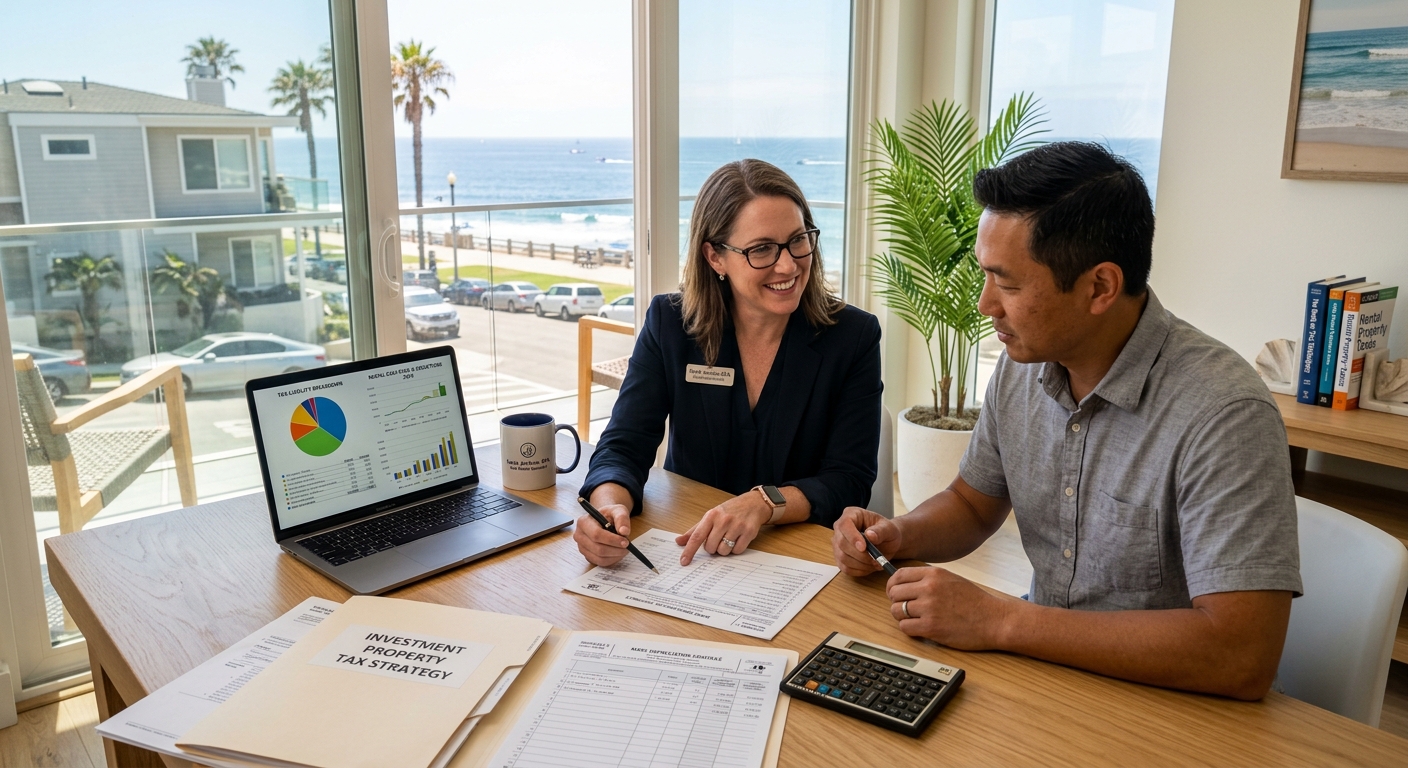
If you own rental property along the South Bay coast, you already know the numbers are big. High purchase prices, strong rents, meaningful appreciation, and a state tax code that treats every dollar of profit like it owes California a personal favor. That is exactly why working with a specialized real estate CPA in Redondo Beach, CA is not a luxury for serious investors. It is the difference between building wealth and quietly overpaying the IRS and the Franchise Tax Board every single year.
This guide breaks down the exact strategies a real estate focused tax professional uses to shrink your tax bill legally, from depreciation and cost segregation to 1031 exchanges and California specific compliance traps. Whether you own one duplex near the Esplanade or a portfolio of fourplexes across the South Bay, the playbook below is written for you.
Quick Answer
A real estate CPA in Redondo Beach helps investors keep more of their rental income through accelerated depreciation, cost segregation studies, 1031 exchanges, and careful California compliance. For a typical South Bay investor with $60,000 to $120,000 in rental profit, professional planning commonly saves $8,000 to $30,000 per year, far more than the $2,000 to $5,000 in annual fees. If you own multiple properties, an out of state rental, or you are planning a sale, the return on hiring a specialist is not close.
Why Redondo Beach Real Estate Investors Need a Specialized CPA
Redondo Beach is not an average rental market. Median property values sit well above the national norm, which means your depreciation deductions, your gains on sale, and your exposure to depreciation recapture are all magnified. A generalist preparer who mostly handles W-2 returns will treat your Schedule E as an afterthought. A real estate CPA treats it as the center of your financial life.
If you are looking for professional real estate tax preparation services in Redondo Beach, the goal is simple: pay every dollar you legally owe and not one cent more. The complexity here comes from three directions at once. First, federal rules on depreciation, passive activity losses, and 1031 exchanges. Second, California conformity issues where the state does not follow federal law. Third, the sheer size of the dollar amounts, which turns small percentage mistakes into five figure problems.
Consider a straightforward example. An investor buys a $1.2 million triplex. The building portion (excluding land) might be around $840,000. Standard straight line depreciation over 27.5 years produces roughly $30,545 in annual deductions. For an investor in a combined federal and California marginal bracket near 42 percent, that single deduction shelters about $12,800 in tax every year. Get the land allocation wrong, or miss the depreciation entirely, and you hand that money away.
Key Takeaway: In a high value market like Redondo Beach, the tax code rewards precision. A specialist who understands real estate can routinely find deductions worth more than ten times their fee.
The Core Tax Strategies a Real Estate CPA in Redondo Beach CA Uses
Let’s move past theory into the actual toolkit. These are the strategies that move the needle for South Bay investors, explained in plain English.
1. Depreciation Done Right
Depreciation is the single most powerful deduction in real estate. In plain English, the IRS lets you deduct a portion of the building’s value each year to account for wear and tear, even while the property is actually going up in value. Residential rental property depreciates over 27.5 years and commercial over 39 years.
The mistake most investors make is a lazy land versus building split. Land is not depreciable, so the more value you can reasonably allocate to the structure and improvements, the larger your annual write off. A real estate CPA uses county assessor ratios, appraisals, and defensible methodology to support that allocation, which protects you if the IRS ever asks.
2. Cost Segregation Studies
This is where the real acceleration happens. A cost segregation study breaks your property into components. Instead of depreciating everything over 27.5 years, an engineer identifies items like flooring, cabinetry, appliances, landscaping, and specialized electrical that qualify for 5, 7, or 15 year schedules.
Here is why 2026 matters. Under the One Big Beautiful Bill Act of 2025 and IRS Notice 2026-11, 100 percent bonus depreciation is now permanent. That means every dollar reclassified into a shorter life category can be fully deducted in the year the property is placed in service. If you want to model how a large first year deduction affects your overall bill, you can run scenarios through a federal tax calculator before you commit.
Real numbers help. On that same $1.2 million triplex, a cost segregation study might reclassify $210,000 of components into short life categories. With 100 percent bonus depreciation, that is a $210,000 first year deduction instead of spreading it across decades. At a 42 percent combined rate, that is roughly $88,000 in first year tax savings. Even after paying $8,000 for a quality engineering study, the return is dramatic.
3. The 1031 Exchange
When you sell a South Bay rental, the tax bill can be brutal. You owe capital gains tax on the appreciation plus depreciation recapture taxed up to 25 percent federally, plus California taxes the entire gain as ordinary income at rates up to 13.3 percent. A 1031 exchange lets you defer all of that by rolling the proceeds into a like kind replacement property within strict deadlines: 45 days to identify and 180 days to close.
California adds a wrinkle called clawback. If you 1031 out of a California property into an out of state property, the state tracks that deferred gain and expects its cut when you eventually sell. A real estate CPA files the required annual FTB Form 3840 so you stay compliant and avoid nasty surprises. To estimate what a sale would cost you without an exchange, plug your numbers into a capital gains tax calculator.
4. Passive Activity Loss Planning and Real Estate Professional Status
Rental losses are normally passive, which limits how much you can deduct against your other income. But two doors exist. The first is the $25,000 special allowance for active participants with modified adjusted gross income under $100,000, phasing out by $150,000. The second, and far more powerful, is Real Estate Professional Status. Qualify by spending more than 750 hours and more than half your working time in real estate, and your rental losses become non passive, deductible against W-2 or business income.
KDA Case Study: South Bay Investor Turns Depreciation Into Real Cash
One of our clients, a Redondo Beach investor we will call Marcus, owned three rental properties producing about $95,000 in annual net rental income. His previous preparer used basic straight line depreciation and never mentioned cost segregation. Marcus was writing checks for roughly $34,000 a year in combined federal and California tax on his real estate activity, and he assumed that was simply the cost of doing business.
When Marcus came to KDA, we ran the numbers on his most recently acquired fourplex, a $1.35 million property. We commissioned an engineering based cost segregation study that reclassified $265,000 of components into 5, 7, and 15 year categories. With 100 percent bonus depreciation now permanent, that produced a $265,000 first year deduction. We also corrected his land allocation on the other two properties and documented his spouse qualifying for Real Estate Professional Status, which unlocked the losses against their combined income.
The result in year one was a tax reduction of approximately $27,400. Marcus paid KDA $6,500 for the strategy work and study coordination, which is a first year return of roughly 4.2 times. Just as important, we set up his bookkeeping so future years stay clean and audit ready.
Ready to see how we can help you? Explore more success stories on our case studies page to discover proven strategies that have saved our clients thousands in taxes.
California Specific Considerations Every Redondo Beach Investor Must Know
Federal strategy is only half the game. California has its own rulebook, and it does not always play nice with the IRS. Working with a team that understands both is critical. Our approach to real estate tax preparation always accounts for these state level realities.
The $800 LLC Franchise Tax
If you hold rental property inside an LLC, California charges a minimum $800 annual franchise tax through Form 3522, regardless of whether you made a dime. Larger LLCs also owe a gross receipts fee on top. Many investors set up multiple single property LLCs for liability protection without realizing each one triggers its own $800 bill. A CPA helps you weigh asset protection against these recurring costs.
Non Conformity on Bonus Depreciation
Here is a trap that catches almost every DIY investor. California does not conform to federal bonus depreciation. That means the massive first year deduction you claim federally is not allowed on your California return. Your state depreciation follows the slower schedules. A real estate CPA maintains two separate depreciation schedules, federal and state, so your numbers are correct on both returns and you are never caught flat footed by an FTB notice.
Depreciation Recapture and the FTB
When you sell, California taxes your entire gain, including recaptured depreciation, as ordinary income. There is no preferential capital gains rate at the state level. For a high earning South Bay investor, that can mean an extra six figures owed to Sacramento on a large sale. Planning the timing of a sale, or structuring a 1031 exchange, is how you manage this.
Key Takeaway: California does not follow federal bonus depreciation rules and taxes all real estate gains as ordinary income. Ignoring these differences is the single fastest way to receive an FTB assessment letter.
Should You Hire a Real Estate CPA? A Simple Decision Framework
Not every investor needs a specialist. Here is a clear way to decide.
Yes, hire a real estate CPA if:
- You own 3 or more rental properties
- You hold property through partnerships, S corporations, or multiple LLCs
- You have out of state rentals in addition to California property
- You are planning a cost segregation study or a 1031 exchange
- You are selling a property within the next 24 months
- Your combined rental and W-2 income pushes you into a high bracket
You may be fine with software if:
- You own a single rental with simple, stable income
- You have no plans to buy, sell, or exchange soon
- Your total rental profit is modest and your other income is low
For most Redondo Beach investors, the property values alone push them firmly into the first category. The tax dollars at stake dwarf the fees.
Common Mistakes South Bay Investors Make
Even sophisticated investors leave money on the table. These are the errors we see most often.
- Skipping cost segregation. Many investors have never heard of it, and their old preparer never suggested it. A look back study can even recover missed depreciation from prior years through a Section 481(a) adjustment, with no amended returns required.
- Poor land allocation. Defaulting to a lazy split shrinks depreciation for the entire holding period.
- Missing quarterly estimates. A December property sale creates a huge liability due April 15. Underpaying triggers penalties. The safe harbor is 110 percent of prior year tax when your AGI exceeds $150,000.
- Ignoring the California clawback. Investors who 1031 out of state and skip Form 3840 get flagged years later.
- Mixing personal and rental expenses. Weak bookkeeping is the fastest path to disallowed deductions in an audit.
How the Filing and Planning Process Actually Works
Working with a real estate focused firm follows a predictable rhythm. Here is the step by step so you know what to expect.
- Portfolio review – We gather closing statements, prior returns, and current depreciation schedules to see exactly where you stand.
- Strategy session – We identify opportunities: cost segregation candidates, entity restructuring, exchange planning, and California specific fixes.
- Implementation – We coordinate engineering studies, correct depreciation schedules, and set up clean bookkeeping so the numbers flow correctly.
- Quarterly planning – We project your liability throughout the year so estimated payments are accurate and there are no April surprises.
- Filing and defense – We prepare federal and California returns with full documentation, ready to defend every position if questioned.
If you want a broader look at how planning and preparation fit together, our tax planning services are built to turn your real estate holdings into a long term wealth engine rather than a yearly tax headache.
Ready to Reduce Your Tax Bill?
KDA Inc. specializes in strategic tax planning for business owners, S Corps, LLCs, and high-net-worth individuals. Book a personalized consultation and walk away with a clear plan.
Frequently Asked Questions
How much does a real estate CPA in Redondo Beach cost?
Professional real estate tax preparation and planning typically runs $2,000 to $5,000 per year depending on portfolio complexity, with cost segregation studies priced separately. For investors with meaningful rental income, this fee is usually recovered many times over through the deductions and strategies identified.
Is a cost segregation study worth it for a smaller property?
It can be. As a rough rule, properties with a building basis above $500,000 tend to generate enough accelerated depreciation to justify the study cost. In a high value market like Redondo Beach, even a single fourplex often clears that threshold easily.
Can I do a 1031 exchange on my Redondo Beach rental?
Yes. As long as both the property you sell and the property you buy are held for investment or business use and you meet the 45 day and 180 day deadlines, you can defer the gain. Just remember California tracks the deferred gain and requires annual Form 3840 filings if you exchange into out of state property.
Does California really not allow bonus depreciation?
Correct. California does not conform to federal bonus depreciation, so your state depreciation follows the standard schedules. This is why maintaining separate federal and state depreciation records is essential and why a specialist is so valuable.
What is depreciation recapture and how much is it?
When you sell, the IRS recaptures the depreciation you claimed and taxes it at up to 25 percent federally. California taxes it as ordinary income at rates up to 13.3 percent. Proper planning, including 1031 exchanges, can defer or reduce this.
Do I qualify for Real Estate Professional Status?
You qualify if you spend more than 750 hours per year in real estate activities and more than half of your total working time in real estate. If you or your spouse can meet this, your rental losses become deductible against other income, which is a major advantage.
Ready to work with a tax professional who understands South Bay investors? Explore our Redondo Beach real estate tax services or book a consultation below to see how much you could be saving.
This information is current as of 7/31/2026. Tax laws change frequently. Verify updates with the IRS or FTB if reading this later.
Book Your Real Estate Tax Strategy Session
If you own rental property in Redondo Beach and you have never had a cost segregation study, a California conformity review, or a real 1031 plan, you are almost certainly overpaying. Let’s fix that before your next filing. Book a personalized consultation with our real estate strategy team and walk away with a clear, numbers backed plan to keep more of what your properties earn. Click here to book your consultation now.



