
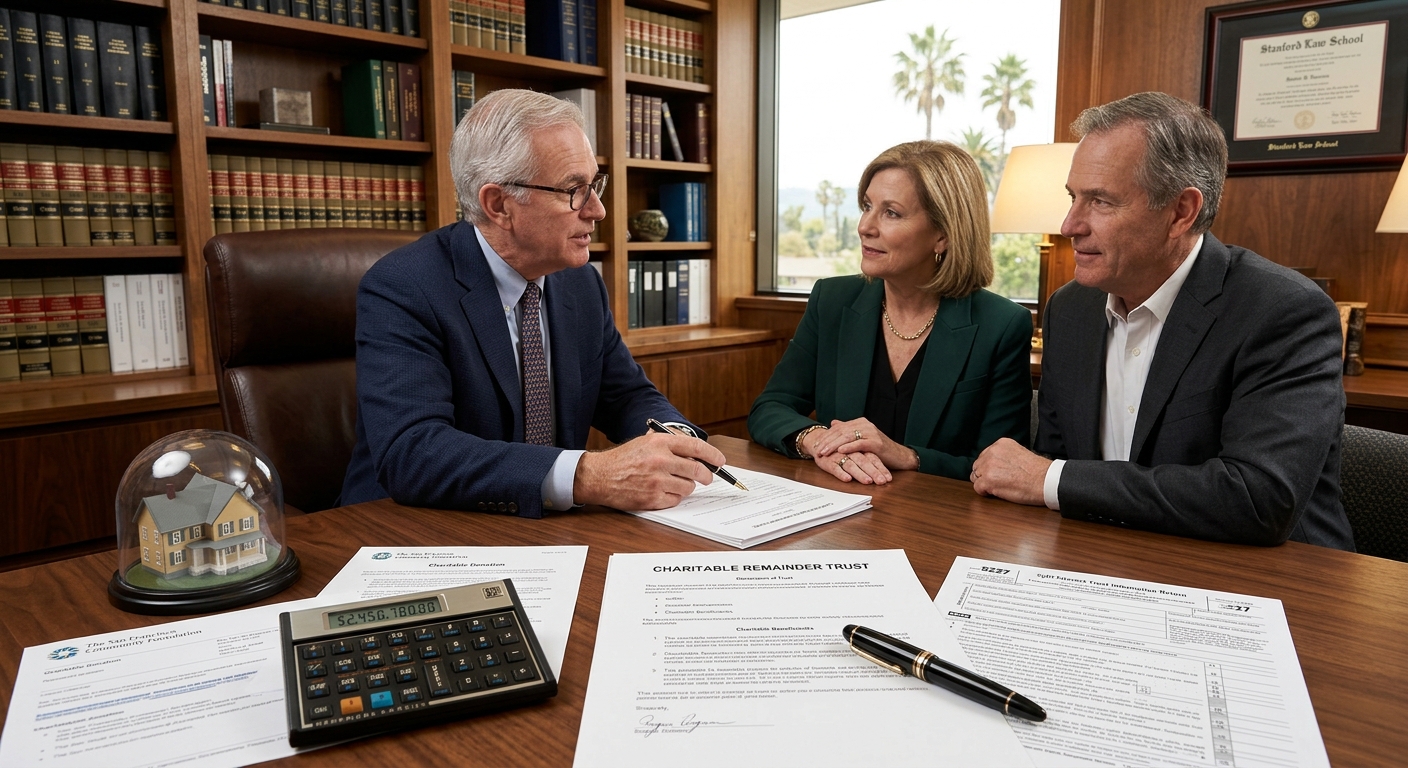
Most people who set up a charitable remainder trust believe the hard part ends the moment the trust is funded. The truth is the opposite. The IRS treats these trusts as living, breathing tax entities with their own annual filing obligations, and the paperwork behind charitable remainder trust tax returns is where good intentions quietly turn into penalties, missed deductions, and unwanted IRS attention. Getting the strategy right on the front end means very little if the annual reporting falls apart on the back end.
This guide breaks down exactly how these trusts are taxed, which forms you actually file, how the four-tier income system works, and the traps that turn a well-designed legacy plan into an audit magnet. Whether you funded your trust with appreciated stock, real estate, or a closely held business interest, the filing rules are the same, and they are unforgiving of guesswork.
Quick Answer: How Charitable Remainder Trust Tax Returns Actually Work
A charitable remainder trust (in plain English: a trust that pays you or your beneficiaries income for a set period, then hands the leftover assets to charity) files an annual information return with the IRS on Form 5227. The trust itself usually pays no income tax on its investment gains. Instead, the income you receive as a beneficiary gets taxed to you based on a strict ordering system called the four-tier structure. The trust reports your share of income to you, and you report it on your personal return.
That single sentence hides a lot of moving parts. Let’s break each one down so you know precisely what to file, when to file it, and what happens if you get it wrong.
What Is a Charitable Remainder Trust and Why the Filing Rules Are Strict
A charitable remainder trust is an irrevocable arrangement under Section 664 of the Internal Revenue Code. You transfer assets into it, the trust pays an income stream to one or more non-charitable beneficiaries (often you and your spouse), and whatever remains at the end goes to a qualified charity. In exchange for that eventual gift, you get an upfront income tax charitable deduction and, in most cases, a way to sell appreciated assets inside the trust without triggering immediate capital gains tax.
There are two main flavors. A charitable remainder annuity trust, or CRAT, pays a fixed dollar amount every year. A charitable remainder unitrust, or CRUT, pays a fixed percentage of the trust’s value, recalculated annually, so the payout rises and falls with the account.
The reason the IRS scrutinizes the annual returns so closely is that these trusts carry a powerful tax benefit. The government wants proof, year after year, that the trust is operating exactly as promised. Miss a filing, misclassify income, or overpay a beneficiary, and you risk penalties or even disqualification of the trust’s tax-exempt status. For families building multi-generational plans, this reporting sits at the center of any serious approach to business owners and high-net-worth estate structuring.
Key Takeaway
Key Takeaway: A charitable remainder trust is tax-exempt at the trust level, but that exemption is conditional on filing an accurate Form 5227 every single year the trust exists.
Which Charitable Remainder Trust Tax Returns You Actually File
People assume there is one form. There are usually several, and knowing which applies to your situation is half the battle when preparing charitable remainder trust tax returns.
Form 5227: The Core Annual Return
Form 5227, the Split-Interest Trust Information Return, is the main filing. Every charitable remainder trust files it annually regardless of income level. It reports the trust’s income, deductions, distributions to beneficiaries, and the running balances of the four income tiers. There is no minimum threshold that excuses you from filing. If the trust exists, Form 5227 is due.
Schedule K-1 for Each Beneficiary
The trust issues a Schedule K-1 to every income beneficiary. This document tells each recipient how much income they received and, critically, what character that income carries: ordinary income, capital gains, tax-exempt income, or return of principal. The beneficiary then transfers those numbers onto their personal Form 1040.
Form 1041-A When Income Is Accumulated
If the trust accumulates income rather than distributing all of it, Form 1041-A may come into play to report charitable amounts. Many standard CRTs avoid this, but it appears more often with complex trusts.
Form 4720 for Excise Taxes
If the trust runs afoul of the private foundation rules that apply to it (such as self-dealing or excess business holdings), Form 4720 reports the resulting excise taxes. You never want to file this one because it means something went wrong.
For the 2026 tax year, Form 5227 is generally due by April 15 following the close of the trust’s tax year, with a possible extension to October 15. According to IRS guidance on charitable remainder trusts, the trust must maintain calendar-year accounting, which keeps the deadlines aligned with individual returns.
The Four-Tier Income System That Determines Your Tax Bill
This is the single most misunderstood part of charitable remainder trust taxation, and it is where most beneficiaries either overpay or get a nasty surprise. The trust does not simply hand you cash and call it income. Instead, every dollar distributed carries a tax character assigned by a mandatory ordering system.
The four tiers work from the top down, and you are taxed on the worst-taxed income first. Here is how it flows:
Tier 1: Ordinary Income
Distributions are treated as ordinary income first, to the extent the trust has current and accumulated ordinary income (interest, non-qualified dividends, rents). This is taxed at your regular income tax rate, which can reach 37 percent for high earners.
Tier 2: Capital Gains
Once ordinary income is exhausted, distributions come from capital gains, taxed at long-term or short-term rates depending on the underlying asset holding period. Within this tier there is a further ordering: short-term gains before long-term, and higher-rate gains before lower-rate gains.
Tier 3: Tax-Exempt Income
Next comes tax-exempt income, such as interest from municipal bonds held inside the trust. This flows out to you tax-free, but only after the first two tiers are emptied.
Tier 4: Return of Principal
Finally, anything left is treated as a tax-free return of your original contribution. By the time distributions reach this tier, you owe nothing on them.
Here is a concrete example. Suppose your CRUT distributes $50,000 this year. The trust has $30,000 of ordinary income, $15,000 of long-term capital gains, and $5,000 of return of principal available. Your K-1 will report $30,000 as ordinary income taxed up to 37 percent, $15,000 as long-term gain taxed at 15 or 20 percent, and $5,000 as tax-free principal. You cannot cherry-pick. The tiers dictate the order.
This ordering explains why the character of income earned inside the trust matters so much. A trust stuffed with high-yield bonds throws off ordinary income that hits beneficiaries hardest. A trust that harvests long-term gains produces friendlier distributions. Smart trustees manage the portfolio with the four tiers in mind, which is a core piece of ongoing tax planning for anyone with a funded CRT.
KDA Case Study: Real Estate Investor Turns a Tax Bomb Into a $340,000 Advantage
Consider a client we’ll call Margaret, a 68-year-old real estate investor in Southern California. She owned a rental fourplex she had purchased decades earlier for $180,000. Its fair market value had climbed to $1.1 million, and her adjusted basis after depreciation sat near $90,000. Selling outright would have triggered roughly $340,000 in combined federal and California capital gains and depreciation recapture tax, a number that stopped her cold every time she considered selling.
Margaret came to us wanting income for retirement without handing the state and the IRS a third of her gain. We structured a charitable remainder unitrust, transferred the fourplex into it, and the trust sold the property with no immediate capital gains tax because of the trust’s exempt status. The full $1.1 million went to work generating income instead of the $760,000 she would have kept after taxes on an outright sale.
We then took over her annual Form 5227 preparation and managed the four-tier reporting so her K-1 distributions were characterized correctly. In the first year she received a payout of about $66,000, largely taxed at favorable capital gains rates rather than ordinary rates, plus she captured a five-figure upfront charitable deduction. Her all-in cost for the structuring and first-year filing work was roughly $9,500. The first-year tax deferral and deduction benefit exceeded $95,000, a return of nearly 10 times her fee, and the trust continues to pay her for life.
Ready to see how we can help you? Explore more success stories on our case studies page to discover proven strategies that have saved our clients thousands in taxes.
Why Most Trustees Get the Filing Wrong
The most common failure is not fraud. It is misclassification. A trustee who does not understand the four-tier system will often report distributions as return of principal because that is the friendliest outcome. The IRS sees this immediately when the trust clearly earned ordinary income or capital gains during the year. That mismatch is a fast track to an examination.
Red Flag Alert
Red Flag Alert: Reporting distributions as tax-free principal while the trust holds income-producing assets is one of the fastest ways to draw IRS scrutiny. The tiers are mandatory, not optional, and the agency cross-checks trust income against beneficiary K-1 characterization.
A second frequent mistake involves the annuity trust variety. For the 2026 tax year, the IRS finalized regulations identifying certain CRAT transactions as listed transactions, which are reportable arrangements requiring special disclosure. The targeted structure involves funding a CRAT with appreciated property, selling it, and using the proceeds to buy an annuity while treating the payout as largely tax-free. If your trust resembles that pattern, you and your advisors face mandatory disclosure and steep penalties for failure to report. This is a live 2026 issue, not a theoretical one, and it underscores why professional review of any CRAT is no longer optional.
A third error is simply missing the deadline. The penalty for late filing of Form 5227 accrues per day the return is late, and for larger trusts it can climb into the tens of thousands of dollars. Because the trust files every year with no income threshold to escape it, a trustee who forgets one year has a genuine problem.
What Happens If You Miss the Filing?
If Form 5227 is filed late, the IRS assesses a penalty for each day it is overdue, subject to a maximum tied to the trust’s gross income. Beyond the dollar penalty, a pattern of late or missing filings can put the trust’s tax-exempt character at risk. Once a charitable remainder trust loses its exempt status, the entire premise collapses: the capital gains you avoided on funding can come roaring back, and the beneficiaries lose their favorable treatment.
The fix is straightforward but requires diligence. File on time, extend when needed, and keep meticulous records of the four-tier balances carried from year to year. Those running balances are the backbone of accurate K-1s, and they must reconcile across every year of the trust’s life. This kind of continuity is exactly why families with funded trusts benefit from premium advisory services rather than treating each year’s return as a standalone project.
Federal Versus California Reporting for Charitable Remainder Trusts
California adds its own layer. A charitable remainder trust with a California resident beneficiary or California-source income generally must file California Form 541-B, the state’s split-interest trust information return, in addition to the federal Form 5227. California largely conforms to the federal four-tier system, but it does not always match on rates, and the state has its own scrutiny of trusts holding real estate located in California.
For the 2026 tax year, remember that California capital gains are taxed as ordinary income at rates reaching 13.3 percent for the highest earners. That state-level tax is precisely why deferring gain through a properly run CRT is so valuable for California residents holding appreciated property. But the state filing must accompany the federal one, and skipping it invites a Franchise Tax Board notice.
This information is current as of 7/31/2026. Tax laws change frequently. Verify updates with the IRS or the California Franchise Tax Board if you are reading this later.
Step-by-Step: Preparing Your Annual Return
Here is the practical workflow a well-run trust follows each year to keep its filings clean and defensible:
- Gather trust income records – Collect all 1099s, K-1s, brokerage statements, and rent rolls for assets held inside the trust for the tax year.
- Classify income by tier – Separate ordinary income, short-term gains, long-term gains, tax-exempt income, and principal into the four categories.
- Update the running tier balances – Add the current year’s amounts to any accumulated balances carried forward from prior years.
- Calculate the required distribution – For a unitrust, multiply the payout percentage by the trust’s year-end fair market value. For an annuity trust, confirm the fixed dollar amount.
- Characterize each beneficiary distribution – Apply the top-down tier ordering to assign the correct tax character to every dollar distributed.
- Prepare Form 5227 and the K-1s – Report the trust totals on Form 5227 and issue characterized K-1s to each beneficiary.
- File the California Form 541-B if applicable – Complete the state return for any California nexus.
- Distribute K-1s to beneficiaries before their filing deadline – Beneficiaries need these numbers to complete their personal 1040s accurately.
Miss any of these steps and the return either understates tax or exposes the trust to challenge. The tier balances in particular must reconcile perfectly with prior years, which is why continuity in preparation matters so much.
Do I Still File If the Trust Made No Distributions This Year?
Yes. This trips up new trustees constantly. Even in a year with zero distributions to beneficiaries, Form 5227 is still due because it is an information return, not a tax-due return. The IRS wants an annual snapshot of the trust’s income, activity, and tier balances regardless of whether money moved out. Skipping the filing because “nothing happened” is a classic and costly mistake.
What Records Should the Trustee Keep?
The trustee should maintain permanent records of the trust document, the original funding appraisals, every year’s Form 5227, the year-by-year four-tier balance carryforwards, all brokerage and income statements, and copies of every K-1 issued. These records are not just good hygiene. In an examination, the ability to demonstrate consistent tier accounting across the life of the trust is often what separates a quick review from a painful one.
Ready to Reduce Your Tax Bill?
KDA Inc. specializes in strategic tax planning for business owners, S Corps, LLCs, and high-net-worth individuals. Book a personalized consultation and walk away with a clear plan.
Frequently Asked Questions
Does the trust itself ever pay income tax?
Generally no. A qualified charitable remainder trust is exempt from income tax on its earnings under Section 664. The tax burden shifts to the beneficiaries through the four-tier distribution system. The exception is if the trust has unrelated business taxable income, which can trigger tax at the trust level.
Can I change the charity named in the trust?
It depends on how the trust was drafted. Some CRTs allow the donor to retain the power to substitute one qualified charity for another. If your document reserved that right, you can redirect the remainder, but you cannot simply take the assets back. The trust is irrevocable.
What is the difference between a CRAT and a CRUT for filing purposes?
Both file Form 5227 annually. The difference is in how the payout is calculated. A CRAT pays a fixed dollar amount set at funding, while a CRUT pays a percentage of the trust’s annually revalued assets. The CRUT therefore requires an annual valuation, which adds a step to the filing but allows the income to grow with the portfolio.
Are charitable remainder trust distributions subject to the net investment income tax?
Distributions can carry net investment income tax exposure at the beneficiary level, depending on the character of the income received and the beneficiary’s total income. This is another reason accurate K-1 characterization matters, because it determines how much of the distribution feeds into that additional 3.8 percent tax.
The Bottom Line on Charitable Remainder Trust Tax Returns
A charitable remainder trust is one of the most powerful tools for converting a highly appreciated asset into lifetime income while avoiding an immediate capital gains hit and supporting a cause you care about. But the entire benefit rests on flawless annual reporting. The four-tier system, the mandatory Form 5227, the California Form 541-B, and the new 2026 disclosure rules for certain annuity trusts all demand precision that off-the-shelf software and part-time preparers routinely miss.
The IRS is not hiding these rules. Most trustees were simply never taught how the tiers, the forms, and the deadlines fit together, and that gap is exactly where penalties and lost deductions live.
Protect Your Trust and Keep More of Your Legacy
If you funded a charitable remainder trust and you are not completely confident your Form 5227 and four-tier reporting are airtight, that uncertainty is costing you peace of mind and possibly real dollars. Let our strategy team review your trust, correct any misclassified distributions, and build a filing system that stands up to IRS and Franchise Tax Board scrutiny for the life of the trust. Click here to book your consultation now.



