
Most people believe that handing a child $50,000 for a house down payment triggers a tax bill. It does not. In almost every case, the person writing the check owes nothing, files one form, and moves on with life. The confusion around the max gifting amount 2026 costs families real money every year, because fear of a phantom tax keeps assets locked inside estates where they compound into a problem instead of solving one.
Here is the turn. The gifting rules are not a trap. They are one of the cleanest, most flexible planning tools in the entire tax code, and for 2026 the numbers are more generous than most business owners realize. The mistake is not gifting too much. The mistake is gifting too little, too late, and without documentation.
Quick Answer: What Is the Max Gifting Amount 2026?
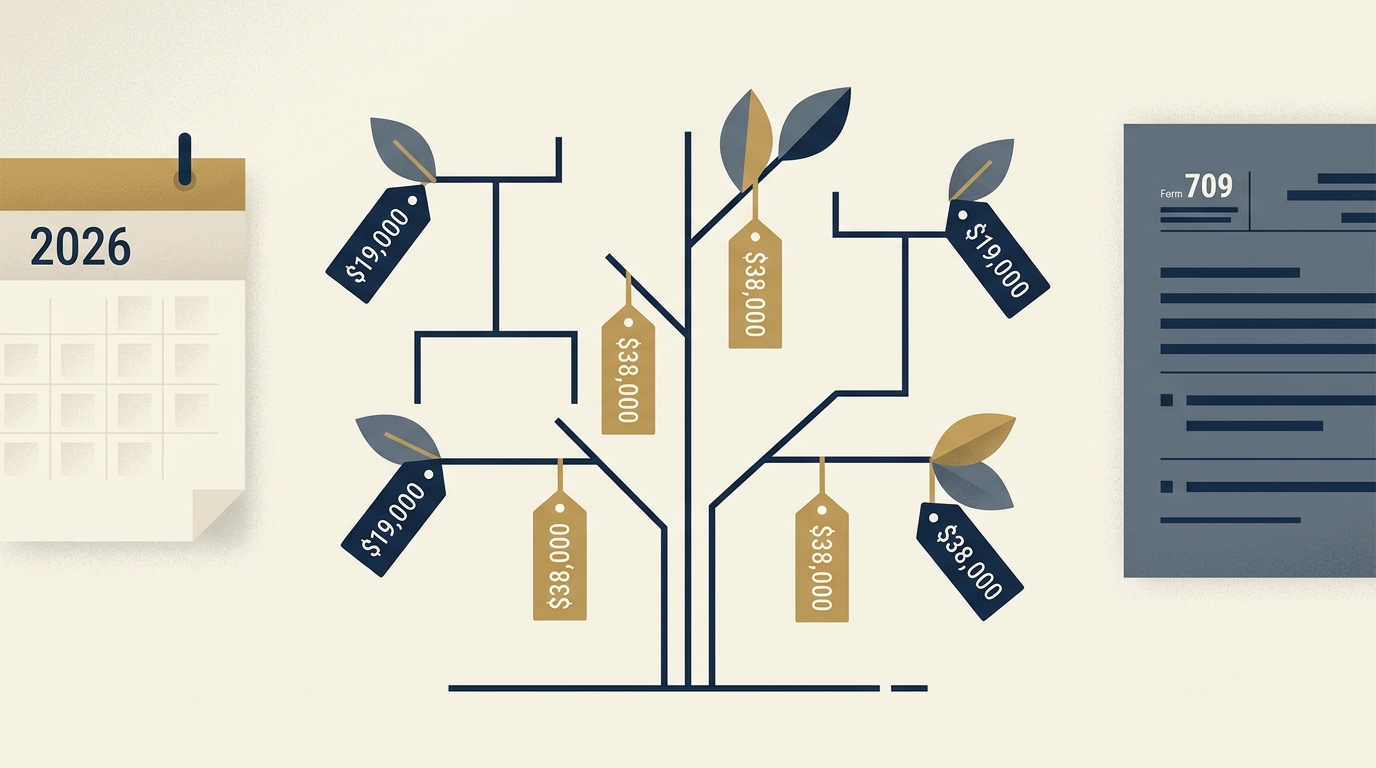
For 2026, the annual gift tax exclusion is $19,000 per recipient, per donor. A married couple can give $38,000 to each recipient. There is no limit on the number of recipients. Above that, gifts are reported on Form 709 and draw against a lifetime exemption of $15 million per individual, up from $13.99 million in 2025. Almost nobody actually pays gift tax.
Key Takeaway: The max gifting amount 2026 that requires zero paperwork is $19,000 per person you give to. Everything above that is a reporting event, not a taxable one, until you cross $15 million in lifetime gifts.
The Two Numbers That Control Everything
Gift tax rules confuse people because there are two separate limits doing two separate jobs. Mix them up and you either overpay a professional to solve a nonexistent problem or you accidentally blow a reporting deadline.
Number One: The Annual Exclusion ($19,000)
The annual exclusion is the amount you can give any single person in a calendar year with no reporting requirement whatsoever. For 2026 that number is $19,000, unchanged from 2025. It resets every January 1. It is per donor and per recipient, which is where the real leverage lives.
Say you own a construction company and you have three adult children, each married. You and your spouse are two donors. Your children and their spouses are six recipients. That is $19,000 times two donors times six recipients, or $228,000 moved out of your estate in a single year with zero gift tax returns filed and zero erosion of your lifetime exemption.
Do that for ten years and you have moved $2.28 million, plus all the future appreciation on those assets, entirely outside your taxable estate. That is not aggressive planning. That is reading the instructions.
Number Two: The Lifetime Exemption ($15 Million)
The lifetime exemption is the cumulative amount you can give away above the annual exclusion, either during life or at death, before any actual gift or estate tax is owed. For decedents dying in 2026, the basic exclusion amount is $15,000,000, per the IRS inflation adjustments. A married couple with proper portability elections has roughly $30 million of combined shelter.
When you exceed $19,000 to one person, you do not pay tax. You file Form 709, the United States Gift Tax Return, and the excess reduces your $15 million bucket. You can review the current filing rules in IRS Form 709 instructions and the broader framework in the IRS gift tax FAQ.
Comparison: Annual Exclusion vs Lifetime Exemption
| Factor | Annual Exclusion | Lifetime Exemption |
|---|---|---|
| 2026 Amount | $19,000 per recipient | $15,000,000 per person |
| Resets | Every calendar year | Never, cumulative |
| Form 709 Required | No | Yes |
| Tax Owed | None | None until exhausted |
| Married Couple Total | $38,000 per recipient | Roughly $30 million |
| Best Use | Steady annual transfers | Large one-time moves |
Five Gifting Strategies That Actually Move the Needle
Knowing the max gifting amount 2026 is the starting line, not the finish. The strategies below are where the dollars show up.
Strategy 1: Front-Load a 529 With Five-Year Averaging
Section 529 of the code lets you treat a lump-sum contribution to an education savings plan as if it were spread over five years. That means you can put $95,000 into a 529 in one shot ($19,000 times five) and still stay inside the annual exclusion, provided you make the election on Form 709.
A married couple can do $190,000 per beneficiary. For a business owner selling a company in a high-income year, this is one of the fastest legal ways to shift a six-figure sum out of the estate while giving the money 15 to 18 years of tax-free growth runway.
Documentation needed: Form 709 with the Section 529(c)(2)(B) election checked, the plan account statement, and a record of the contribution date. Miss the election and the IRS treats $95,000 as a single-year gift.
Strategy 2: Pay Tuition and Medical Bills Directly
This is the most underused rule in the entire gifting playbook. Under the qualified transfer exclusion, payments made directly to an educational institution for tuition or directly to a medical provider are not gifts at all. They do not count against your $19,000. They do not touch your $15 million.
There is no dollar cap. A grandparent can write a $68,000 check straight to a private university for a grandchild’s tuition and separately gift that same grandchild $19,000 in cash the same year. Combined, $87,000 moved with no gift tax return.
Red Flag Alert: The payment must go to the institution, not to the student. If you reimburse your grandchild after they pay the bill themselves, it becomes an ordinary gift subject to the $19,000 limit. Room, board, and books also do not qualify. Tuition only.
Strategy 3: Gift Appreciating Assets, Not Cash
Cash is the least efficient thing to gift. When you transfer an asset, you value the gift on the date of transfer, and all future appreciation happens on the recipient’s balance sheet, outside your estate.
Consider a real estate investor who gifts a $19,000 slice of a rental LLC to a child. If that interest grows to $45,000 over eight years, the entire $26,000 of appreciation escaped the estate for free. The same $19,000 in cash would have just sat there.
This is where entity structure matters enormously, and it is worth reviewing your position with a professional who handles strategic tax planning before you transfer any interest in an operating business. Valuation discounts, transfer restrictions, and basis consequences all interact here.
Pro Tip: Gifted assets carry over your original cost basis. If you bought stock at $2,000 that is now worth $19,000, your child inherits the $2,000 basis and owes capital gains on the full appreciation when they sell. Assets held until death get a stepped-up basis instead. Gift low-basis assets to charity, high-basis assets to family.
Strategy 4: Use Gift-Splitting Even If One Spouse Owns the Asset
If the money comes from one spouse’s separate account, you can still treat the gift as coming half from each spouse by making a gift-splitting election on Form 709. Both spouses must consent and both must sign.
This doubles your effective annual exclusion to $38,000 per recipient even when only one spouse has liquidity. The catch is that once you elect gift-splitting for the year, it applies to all gifts made by either spouse that year, and both spouses must then file returns.
Strategy 5: Stack Multiple Recipients Deliberately
The annual exclusion is per recipient with no cap on recipient count. Most families only think about children. Widen the frame. Grandchildren, adult children’s spouses, nieces, nephews, and trusts for minors all count as separate recipients.
A high-net-worth couple with four children, four in-laws, and nine grandchildren has 17 recipients. At $38,000 each, that is $646,000 per year moved out of the estate with no return filed. Over a decade, $6.46 million plus appreciation.
KDA Case Study: Small Business Owner With a Liquidity Event
A client we will call Marcus ran a specialty contracting business in Orange County generating roughly $1.4 million in annual revenue with about $420,000 in owner profit. In late 2025 he accepted an offer to sell a minority stake, which put an unexpected $780,000 of liquidity on his personal balance sheet. His net worth crossed $6.2 million.
Marcus assumed gifting was for billionaires. He had made zero lifetime gifts, filed zero Form 709s, and had never used a single dollar of annual exclusion. Every year he skipped was a year of exclusion permanently gone, because it does not carry forward.
What we built for him: a coordinated 2026 gifting plan across seven recipients including two adult children, their spouses, and three grandchildren. Using gift-splitting with his wife, that produced $266,000 of annual exclusion capacity. We layered in a $95,000 five-year-averaged 529 contribution for the oldest grandchild and routed $31,000 of private school tuition directly to the institution under the qualified transfer exclusion.
Total moved out of the estate in year one: $392,000, with only one Form 709 filed for the 529 election. Projected estate tax exposure reduction on the transferred assets, using a 40% federal rate applied to the amount that would have exceeded exemption thresholds under his prior trajectory, came to roughly $21,400 in year-one present-value savings, growing substantially as the strategy repeats annually and the gifted assets appreciate outside his estate.
Marcus paid $6,800 for the planning engagement and return preparation. First-year measurable benefit of $21,400 against $6,800 invested is a 3.1x return, before counting the compounding effect of ten more years of the same structure.
Ready to see how we can help you? Explore more success stories on our case studies page to discover proven strategies that have saved our clients thousands in taxes.
The Mistakes That Turn Simple Gifts Into Problems
Gifting is low risk when documented and genuinely messy when it is not. These are the failures we see most.
Mistake 1: Treating a Loan Like a Gift, or Vice Versa
Parents advance $80,000 to a child for a business, call it a loan, charge no interest, and never paper it. The IRS can recharacterize the entire amount as a gift, or impute interest income to the parent under the below-market loan rules. Either outcome is worse than just deciding upfront.
If it is a loan, write a promissory note, charge at least the applicable federal rate, and collect payments. If it is a gift, call it a gift and file the return.
Mistake 2: Assuming No Tax Owed Means No Filing Required
This is the single most common error. Exceeding $19,000 to one recipient requires Form 709 by April 15 of the following year even though you owe nothing. The penalty structure for unfiled gift returns is unpleasant, and worse, an unfiled return means the statute of limitations never starts running on the valuation of that gift.
That matters enormously for gifted business interests. If you gift LLC units and never file, the IRS can challenge your valuation decades later during an estate audit.
Mistake 3: Gifting the Wrong Asset to the Wrong Person
Gifting highly appreciated stock to a child in a high tax bracket converts a potential step-up in basis at death into a fully taxable capital gain. If you have a low-basis position you intend to leave to family, holding it until death is often the better answer.
Mistake 4: Ignoring the December 31 Deadline
The annual exclusion is use-it-or-lose-it. A check written December 30 but not deposited until January 4 may be treated as a next-year gift depending on the facts. For year-end gifting, use wire transfers or confirm the check clears before the 31st.
Mistake 5: Gifting Without Reviewing the Estate Plan
Gifting outside a trust structure can create Medicaid look-back problems, creditor exposure for the recipient, and unintended equalization issues among children. The gift itself is simple. The consequences downstream are not always.
California-Specific Considerations
California has no state gift tax and no state estate tax. That is genuinely good news and it means California residents planning around the max gifting amount 2026 only need to manage the federal rules.
But there are three California-specific wrinkles worth flagging.
Proposition 19 and Real Property Transfers
Gifting California real estate to children triggers a reassessment for property tax purposes under Proposition 19 unless the property becomes the child’s primary residence and specific value limits are met. A property with a low Prop 13 assessed basis can see its property tax bill multiply after a lifetime gift. Sometimes waiting until death preserves a more favorable result. This is a case where the gift tax answer and the property tax answer point in opposite directions.
Proposition 40 on the November 2026 Ballot
California voters will decide in November 2026 on a proposed one-time 5% wealth tax applying to resident individuals and trusts with net worth of $1 billion or more, measured as of a December 31, 2026 valuation date. If you are anywhere near that threshold, the interaction between gifting strategy and net worth measurement deserves immediate attention, including how trust interests and business valuations get counted.
Community Property and Basis
California community property gets a full step-up in basis on both halves at the first spouse’s death, which is more favorable than most states. Gifting community property assets during life forfeits that advantage. Coordinate any significant gifting program against your community property position rather than treating them as separate exercises.
Key Takeaway: California imposes no gift tax, but Proposition 19 reassessment risk means real property gifts require a separate property tax analysis before you transfer title.
Step-by-Step: How to Execute a 2026 Gifting Plan
- List every potential recipient including children, in-laws, grandchildren, and trusts. Takes 20 minutes and usually reveals more capacity than expected.
- Calculate your ceiling by multiplying $19,000 by the number of recipients, then doubling it if married and willing to gift-split.
- Decide cash versus assets by comparing cost basis against current value for each candidate asset. High basis gifts, low basis holds.
- Route tuition and medical payments directly to institutions before touching your annual exclusion. These are free capacity.
- Execute transfers by December 15 to give wires, title changes, and brokerage transfers time to settle before year end.
- File Form 709 by April 15, 2027 for any gift exceeding $19,000 to one recipient, any 529 five-year election, and any gift-splitting election.
- Document everything with a gift memorandum, transfer confirmations, and valuations for non-cash assets.
Decision Framework: Should You Gift in 2026?
Yes, gift aggressively in 2026, if:
- Your net worth exceeds $8 million individually or $16 million as a couple
- You hold assets expected to appreciate significantly over the next decade
- Your intended heirs are financially stable and would use funds productively
- You have grandchildren with education costs on the horizon
- You have never used annual exclusion capacity in prior years
No, slow down and plan first, if:
- Your net worth is under $5 million and estate tax is not realistically in play
- The asset in question is California real property with a low Prop 13 basis
- You may need the funds for long-term care within the next five years
- The recipient has active creditor issues or is in an unstable marriage
- The asset has very low cost basis and you expect to hold until death
Ready to Reduce Your Tax Bill?
KDA Inc. specializes in strategic tax planning for business owners, S Corps, LLCs, and high-net-worth individuals. Book a personalized consultation and walk away with a clear plan.
Frequently Asked Questions
Does the recipient pay tax on a gift?
No. Gifts are not taxable income to the recipient. They are not reported on the recipient’s Form 1040 at all. The reporting obligation, when one exists, sits entirely with the donor. The recipient does inherit the donor’s cost basis for capital gains purposes, so records matter.
What happens if I gift more than $19,000 and never file Form 709?
You have an unfiled return. No tax is likely owed given the $15 million exemption, but the statute of limitations on that gift’s valuation never begins, meaning the IRS can challenge the reported value indefinitely, typically during an estate examination years later. Penalties can also apply. Filing is cheap insurance.
Can I gift to a trust and still use the annual exclusion?
Yes, but only if the trust is drafted so the beneficiary has a present interest in the funds. Gifts to trusts where the beneficiary cannot access funds are treated as future interests and do not qualify for the annual exclusion. Crummey provisions are the standard drafting solution. This is not a place to improvise with a template.
Do gifts to my spouse count against the limit?
Gifts between US citizen spouses are unlimited and unrestricted under the marital deduction. There is no annual exclusion consumption and no Form 709 requirement. Gifts to a non-citizen spouse have a separate, much lower annual limit and do require attention.
Will the $15 million exemption go down?
The current exemption level is established law rather than a scheduled sunset provision at this point, but exemption amounts have historically moved with legislation. Planning as though today’s number is permanent is optimistic. Using annual exclusion capacity every year hedges against future changes at zero cost.
Three Takeaways Worth Remembering
First, the annual exclusion is the most valuable gifting tool available and it expires every December 31 whether you use it or not. Second, direct payments for tuition and medical care sit entirely outside the gift tax system with no dollar cap, and almost nobody uses them fully. Third, the choice of which asset to gift matters more than the amount, because basis rules quietly determine whether your generosity creates a tax benefit or a tax bill for the person you are trying to help.
Gifting is not about giving money away. It is about deciding whether your assets grow inside your estate or outside it.
This information is current as of 7/31/2026. Tax laws change frequently. Verify updates with the IRS or FTB if reading this later.
Book Your 2026 Gifting Strategy Session
Every year you leave annual exclusion capacity unused is capacity gone permanently. If you are a business owner with a growing balance sheet, appreciating assets, or family members who could use support now rather than in 30 years, there is a version of this plan built specifically for your numbers. We will map your recipient capacity, identify which assets to move and which to hold, and handle the Form 709 filings so nothing sits exposed. Click here to book your consultation now.



