
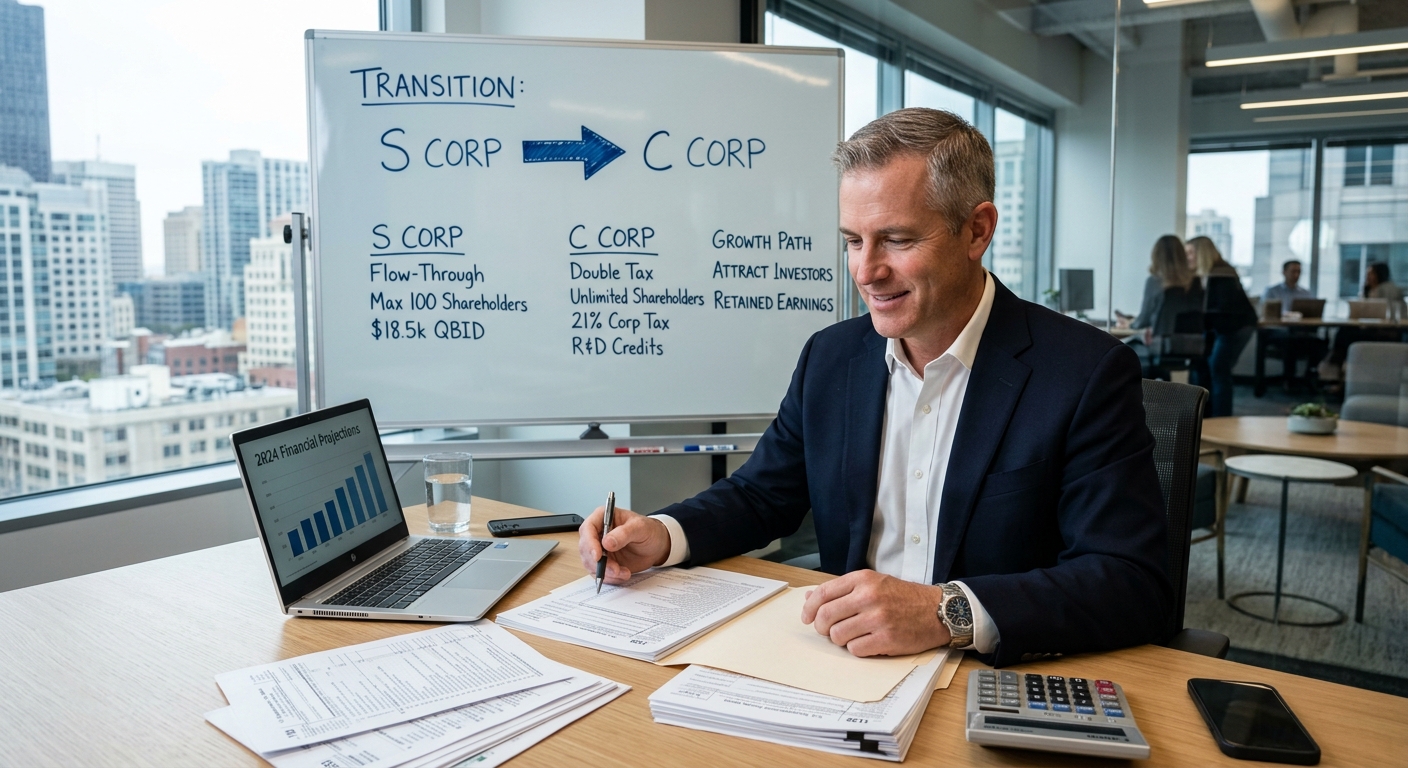
Why California Business Owners Suddenly Want Out of Their S Corp Election
Most business owners think an S Corp is the final destination once they’ve made the election. It is not. As profits climb past the seven-figure mark, as investors start circling, and as growth plans stretch beyond what a pass-through entity can support, the same election that saved you thousands in self-employment tax can become the thing holding your company back. Understanding how to change a s corp to a c corp is not just a paperwork exercise. It is a strategic decision that can reshape how your company raises money, retains earnings, and positions itself for acquisition.
The tension here is real. Founders spend years defending their S Corp status, then wake up one quarter and realize the structure that fit a solo consultant no longer fits a scaling company with a dozen employees and a venture capital term sheet on the table. If that sounds familiar, this guide walks you through the mechanics, the tax traps, and the timing so you can make the switch without triggering an avoidable tax bill.
Quick Answer: How to Change a S Corp to a C Corp
To change a S corp to a C corp, you revoke your S corporation election by filing a written statement of revocation with the IRS service center where you file your returns. The revocation must be signed by shareholders holding more than 50 percent of the outstanding stock. If you file it by the 15th day of the third month of your tax year (March 15 for calendar-year filers), the revocation is effective for the entire current year. File it later, and it kicks in the following year unless you specify a prospective date. Once revoked, your entity defaults back to C corporation taxation automatically. No separate C Corp election form is required.
What Actually Changes When You Convert From S Corp to C Corp
Before you file anything, you need to understand what you are trading. An S corporation is a pass-through entity. Profits and losses flow directly to your personal return, and the business itself pays no federal income tax. A C corporation is a separate taxpayer. It pays the flat 21 percent corporate rate on its profits, and then shareholders pay tax again when those profits are distributed as dividends. That is the classic double taxation problem everyone warns you about.
So why would anyone do it? Because the math changes at scale. When a company plans to retain most of its earnings to fund growth rather than distribute them, the 21 percent flat corporate rate can beat the top individual rates that S Corp owners face on pass-through income. Add in the ability to issue multiple classes of stock, bring in foreign or entity investors, and potentially qualify for Qualified Small Business Stock treatment, and the C Corp starts to look far more attractive to a growth-stage company.
Many business owners make this move right before a fundraising round because venture capital firms and institutional investors almost always require a C Corp structure. S corporations are limited to 100 shareholders, one class of stock, and only US individual shareholders. Those restrictions are dealbreakers for outside capital.
The Core Trade-Offs at a Glance
- Taxation: S Corp passes income to owners once. C Corp taxes at the entity level (21 percent), then again on dividends.
- Ownership: S Corp caps at 100 US individual shareholders and one stock class. C Corp allows unlimited shareholders, multiple classes, and foreign or entity owners.
- Retained earnings: C Corps can accumulate earnings inside the company more efficiently for reinvestment.
- Fringe benefits: C Corps can deduct a broader range of owner fringe benefits that S Corps cannot for more than 2 percent shareholders.
- QSBS potential: Only C Corp stock can qualify for the Section 1202 Qualified Small Business Stock gain exclusion.
How to Change a S Corp to a C Corp: The Step-by-Step Filing Process
The conversion itself is administratively simpler than most owners expect. You are not dissolving one company and forming another. You are revoking a tax election on an existing entity. Here is exactly how to do it.
Step 1: Confirm the Business Decision With Your Shareholders
The IRS requires that shareholders owning more than 50 percent of the outstanding shares (including non-voting shares) consent to the revocation. Before you draft anything, get a written shareholder consent signed. This protects you internally and satisfies the IRS documentation requirement. If you are the sole owner, this step is quick, but do not skip creating the paper trail.
Step 2: Draft the Statement of Revocation
Unlike electing S Corp status, there is no dedicated form to revoke it. You draft a written statement of revocation. According to the IRS instructions for Form 1120-S, the statement must include:
- A clear declaration that the corporation revokes its election under Section 1362(a)
- The corporation’s name, address, and Employer Identification Number (EIN)
- The number of shares of stock (including non-voting) outstanding at the time of revocation
- The effective date of the revocation, if you want a prospective date
- Signatures from shareholders holding more than 50 percent of shares, plus a consent statement
Step 3: Time Your Effective Date Correctly
This is where owners lose money. For a calendar-year corporation, if you file the revocation by March 15, it applies to the entire current tax year. File it after March 15 without specifying a date, and it takes effect the first day of the following tax year. You can also choose a prospective effective date by stating it in the revocation. Getting this timing wrong can strand you in a tax year you did not intend, so plan the date around your projected income.
Step 4: Mail the Revocation to the Correct IRS Service Center
Send the statement to the same IRS service center where the corporation files its Form 1120-S. There is no e-file option for the revocation statement, so mail it with tracking. Keep a stamped copy in your permanent corporate records.
Step 5: File Your Returns Under the New Structure
Once the revocation is effective, you stop filing Form 1120-S and start filing Form 1120, the C corporation return. If the revocation takes effect mid-year, you may need to file a short-year S Corp return and a short-year C Corp return covering the two portions of the year. This is where professional corporate tax services pay for themselves, because splitting a year between two tax regimes creates real complexity.
KDA Case Study: Software Founder Converts to C Corp Before a $4M Raise
Consider Marcus, a California software founder who ran his development studio as an S Corp for six years. The business threw off roughly $850,000 in annual profit, and Marcus paid himself a reasonable salary while taking the rest as distributions. The structure worked beautifully when it was just him and two contractors.
Then a venture firm offered a $4 million investment on the condition that the company convert to a Delaware C Corp with a preferred stock class. Marcus was thrilled but terrified. He assumed converting meant a massive tax bill and a mountain of new filings. When he came to KDA, we mapped out the entire transition. We timed the S Corp revocation to a clean prospective date, structured a short-year return split so his final S Corp year captured earnings taxed at his favorable individual rate, and positioned the new C Corp stock to potentially qualify for Section 1202 QSBS treatment down the road.
The result: Marcus avoided an estimated $61,000 in unnecessary tax that would have hit had he mistimed the conversion mid-year without planning the earnings split. He paid roughly $6,500 for the full engagement, which included the revocation drafting, the dual short-year returns, and the QSBS positioning memo. That is a first-year return of more than 9x, and it does not even count the future value of the QSBS exclusion, which could eliminate millions in tax on an eventual exit.
Ready to see how we can help you? Explore more success stories on our case studies page to discover proven strategies that have saved our clients thousands in taxes.
The Tax Traps Most Business Owners Miss When Converting
The filing is easy. The tax consequences are where people get hurt. Here are the traps that catch unprepared owners.
Trap 1: The LIFO Recapture Tax
If your S Corp uses the last-in, first-out (LIFO) inventory method, converting to a C Corp can trigger a LIFO recapture tax. The difference between your LIFO inventory value and its FIFO value gets recaptured as income. Businesses with significant inventory need to model this before filing, because it can produce a surprise tax bill in the transition year.
Trap 2: Losing Suspended Losses and Basis
S Corp shareholders who have suspended losses due to basis limitations can lose the ability to use those losses once the S election ends. There is a limited post-termination transition period to use them, but it does not last forever. If you are sitting on suspended losses, use them or lose them, and coordinate the timing of your revocation accordingly.
Trap 3: The Five-Year Re-Election Lockout
Here is the one that surprises everyone. Once you revoke your S Corp election, you generally cannot re-elect S Corp status for five tax years without IRS consent. This is not a decision you reverse on a whim. If there is any chance you will want to go back to pass-through treatment, think hard before you file. The IRS S corporation rules impose this waiting period specifically to prevent taxpayers from gaming the election year to year.
Trap 4: Accumulated Adjustments Account Distributions
Your S Corp likely has an accumulated adjustments account (AAA) representing previously taxed income. After conversion, you have a limited window (generally the post-termination transition period) to distribute that AAA tax-free to shareholders. Miss the window, and those distributions may become taxable dividends. Planning the distribution of your AAA before the window closes is one of the highest-value moves in the entire conversion.
Pro Tip: Distribute your accumulated adjustments account during the post-termination transition period to pull out previously taxed earnings tax-free before the C Corp double-taxation regime fully takes hold.
How Do I Know If Converting to a C Corp Is Right for My Business?
Not every S Corp should convert. This decision hinges on your growth plans, your distribution habits, and your capital needs. Use this framework.
Convert to a C Corp if:
- You are raising venture capital or institutional money that requires a C Corp
- You plan to retain most earnings inside the company to fund aggressive growth
- You want to issue multiple classes of stock or bring on foreign or entity investors
- You are positioning for an eventual sale where QSBS treatment could eliminate tax on the gain
- You need to exceed the 100-shareholder cap
Stay an S Corp if:
- You distribute most of your profits to yourself each year
- Your business is stable and you have no plans to raise outside capital
- Double taxation on dividends would outweigh any corporate rate benefit
- You value the self-employment tax savings the S Corp structure provides
For a complete breakdown of when the S Corp structure makes sense in the first place, review our complete guide to S Corp tax strategy in California before you decide to unwind an election you might still benefit from.
What Does Conversion Mean for California State Taxes?
Federal conversion is only half the picture in California. The Franchise Tax Board treats S corporations and C corporations differently, and the state does not automatically follow every federal election in the way you might assume.
In California, S corporations pay a 1.5 percent franchise tax on net income with an $800 annual minimum. C corporations pay the higher 8.84 percent corporate franchise tax rate. So while your federal picture might favor a C Corp for retained earnings, the California rate jump is significant and must be part of your model. For the 2026 tax year, run the combined federal and state numbers together rather than looking at the 21 percent federal rate in isolation.
You also need to notify the FTB and file the correct California return type. A mismatch between your federal and state filings is a common trigger for state notices. If your revocation splits the year, expect to file the corresponding California short-year returns as well.
This information is current as of July 27, 2026. Tax laws change frequently. Verify updates with the IRS or FTB if reading this later.
Common Mistake That Triggers Extra Tax: Converting Without an Earnings Plan
The single biggest mistake owners make is treating the conversion as a filing task instead of a planning event. They mail the revocation, switch forms, and never model what happens to their existing earnings.
Here is why that hurts. In your final S Corp year, income is taxed once at your individual rate. In your first C Corp year, the company pays 21 percent, and any distribution of those earnings gets taxed again as a dividend. If you had accumulated adjustments account balances you could have distributed tax-free, or suspended losses you could have used, and you let the conversion happen without capturing them, you leave money on the table permanently.
The fix is straightforward but requires foresight. Before you file the revocation, work with a strategist to sequence your final S Corp distributions, use up any basis-limited losses, and time the effective date so income lands in the year with the more favorable treatment. This is exactly the kind of proactive work our tax planning services are built for.
Can I Convert Back to an S Corp Later If I Change My Mind?
Technically yes, but not easily and not soon. As noted earlier, once you revoke an S election, you generally must wait five tax years before re-electing without IRS consent. You can request early consent, but it is not guaranteed and requires demonstrating that the change is not primarily tax-motivated.
This is why the decision demands genuine strategic thought. If you are converting purely to accommodate a single fundraising round and you expect to return to a distribution-heavy model afterward, the five-year lockout could trap you in C Corp double taxation longer than you want. Model the full time horizon, not just the immediate transaction.
What About Qualified Small Business Stock (QSBS)?
One of the most powerful and least understood reasons to convert is Section 1202 Qualified Small Business Stock. Only C corporation stock can qualify. If your stock meets the requirements and you hold it for at least five years, you may be able to exclude a substantial portion of the gain from federal tax when you sell.
For founders building toward an exit, this is enormous. A properly structured C Corp conversion can position new stock to qualify for QSBS, potentially eliminating federal tax on millions of dollars of future gain. The catch is that the five-year holding clock and the eligibility requirements are strict, so the conversion must be structured deliberately with QSBS in mind from day one. If a future sale is anywhere on your radar, do not convert without evaluating QSBS eligibility first.
Ready to Reduce Your Tax Bill?
KDA Inc. specializes in strategic tax planning for business owners, S Corps, LLCs, and high-net-worth individuals. Book a personalized consultation and walk away with a clear plan.
Frequently Asked Questions
Do I need to form a new company to convert from S Corp to C Corp?
No. In most cases you keep the same legal entity and simply revoke the S election, which reverts the company to C corporation taxation by default. You do not dissolve and reincorporate unless you are also changing your state of incorporation, such as moving to Delaware for a fundraise.
What is the deadline to make the conversion effective for the current year?
For a calendar-year corporation, file the revocation statement by March 15 to have it apply to the entire current tax year. Filed after that date without a specified effective date, it applies starting the next tax year.
Will converting trigger an immediate tax bill?
It can, depending on your situation. LIFO inventory recapture and mishandled accumulated adjustments account distributions are the most common sources of unexpected tax. Careful planning before filing usually prevents surprises.
How long does the conversion process take?
The filing itself is quick, often just days to draft and mail. The IRS does not issue a separate approval for a revocation. The strategic planning around timing, earnings, and state filings is what takes real work, typically a few weeks of coordination.
The Bottom Line on Switching Structures
Converting from an S Corp to a C Corp is not a downgrade or an upgrade. It is a strategic pivot that fits a specific stage of company growth. Get the timing wrong and you hand the IRS money you never had to pay. Get it right and you unlock outside capital, cleaner retained earnings, and a potential QSBS exclusion worth far more than any self-employment tax you were saving. The revocation form is easy. The strategy behind it is everything.
The IRS is not hiding the path from S Corp to C Corp. You just were not taught how to walk it without leaving cash on the table.
Book Your Entity Conversion Strategy Session
If you are weighing a switch from S Corp to C Corp because you are raising capital, scaling fast, or eyeing an exit, do not file that revocation blind. One mistimed effective date or a missed accumulated adjustments distribution can cost you tens of thousands. Book a personalized consultation with our strategy team and walk away with a clear conversion timeline, a tax-savings roadmap, and confidence that your new structure is built for where your company is going. Click here to book your consultation now.



