
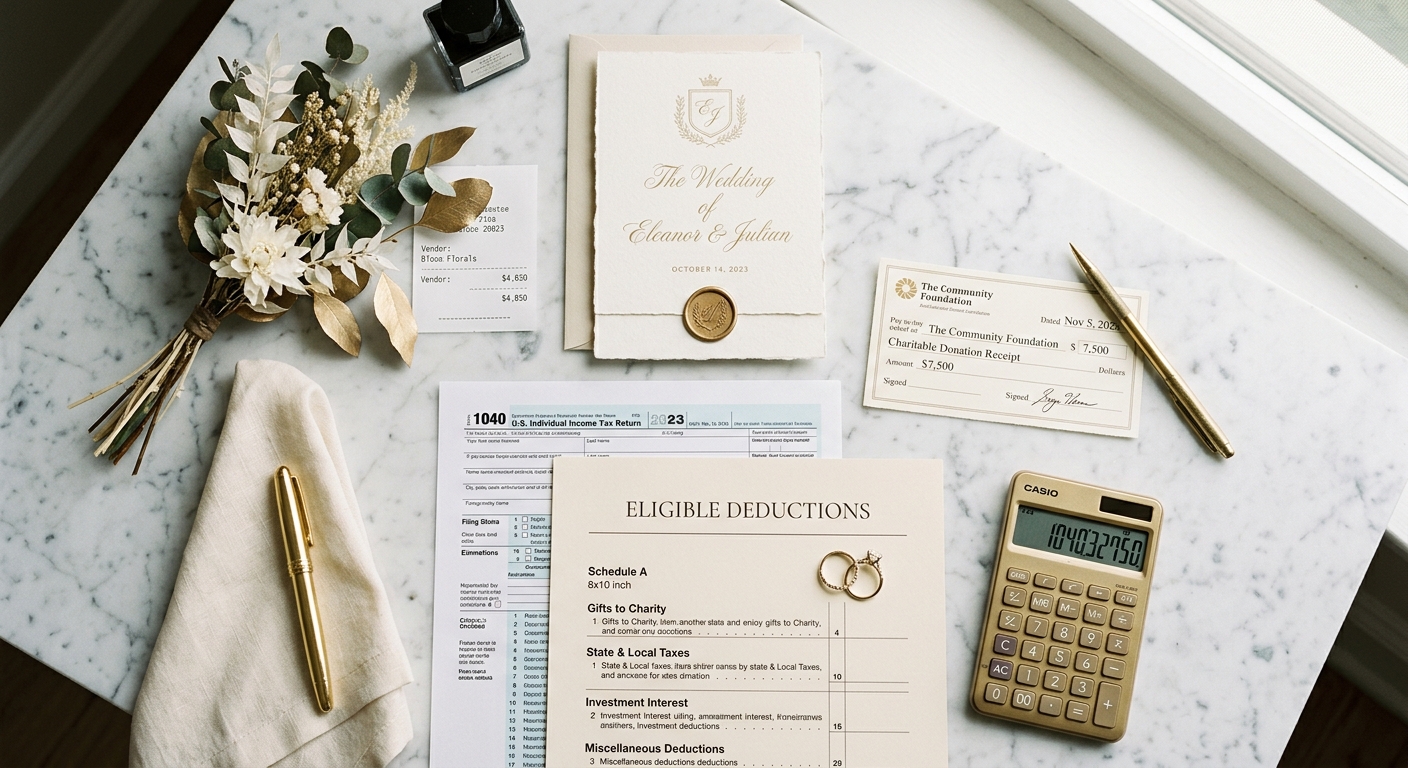
Here’s a claim that will surprise most engaged couples: the average American wedding now costs around $33,000, yet nearly every dollar of that spend is treated by the IRS as personal, nondeductible consumption. You can pour a year of savings into a venue, catering, flowers, and a photographer, and none of it moves the needle on your tax return. That feels unfair when you’re staring at the invoices. But here’s the turn that most planners never tell you: with the right structure, a meaningful slice of your big day can legitimately reduce your taxable income.
This guide breaks down the real, defensible wedding write offs that actually hold up under IRS scrutiny, along with the myths that get couples into trouble. We’re not talking about aggressive gimmicks. We’re talking about charitable giving, business use, and timing strategies that turn a nondeductible celebration into a partial tax-planning event. If you approach it correctly, a $33,000 wedding might carry $2,000 to $8,000 in legitimate deductions hiding inside it.
Quick Answer: Are Wedding Expenses Tax Deductible?
No, the wedding itself is not tax deductible. The IRS treats your ceremony, reception, dress, and honeymoon as personal expenses. However, specific components of a wedding can generate real deductions: charitable donations of food, flowers, and decor to qualified nonprofits, fees paid to a church or nonprofit venue, and business-use portions when the event doubles as a legitimate business activity. Wedding write offs live in the details, not the total.
Key Takeaway: The party is personal, but the pieces can be planned. Charitable giving and documented business use are where the deductible dollars hide.
The 5 Legitimate Wedding Write Offs That Survive an Audit
Let’s get specific. Most articles wave their hands and say “donate your flowers.” That’s not enough to protect a deduction if the IRS asks questions. Below are five categories that actually work when documented correctly, each with a real dollar example so you can see the math.
1. Donating Leftover Food to a Qualified Charity
After the reception, you often have trays of untouched catered food. If you donate that food to a registered 501(c)(3) organization such as a food bank or shelter, you may claim a charitable deduction for the fair market value. A 501(c)(3) is simply a nonprofit the IRS has approved as tax-exempt, which means gifts to it can be deductible.
Example: Sarah and Marcus had roughly $1,400 in untouched plated dinners after their 150-person reception. They arranged in advance for a local shelter to pick up the food, obtained a written acknowledgment, and deducted the $1,400 fair market value. In the 24% federal bracket, that produced about $336 in federal tax savings, plus California state savings on top.
2. Donating Flowers, Decor, and Centerpieces
Fresh floral arrangements have a short life, and many couples spend $3,000 to $6,000 on them. Rather than tossing everything, you can donate arrangements to a hospital, nursing home, church, or other qualified nonprofit the next day. The deduction equals the fair market value of what you give, which for same-day floral is often a portion of what you paid.
Red Flag Alert: You cannot deduct the full retail price you paid the florist just because you spent it. The deduction is fair market value at the time of the gift, and wilting flowers are worth less than fresh ones. Document with photos and a receipt from the receiving organization.
3. Venue Fees Paid to a Church or Nonprofit
If you marry at a church, historic nonprofit site, museum, or public garden operated by a 501(c)(3), part of your payment may qualify as a charitable contribution rather than a pure fee. The deductible portion is the amount that exceeds the fair market value of what you received. If the venue provides a suggested donation figure and states no goods or services were received beyond the space, that spread becomes deductible.
Example: A couple paid a historic nonprofit chapel a $2,500 “use donation.” The chapel documented that the fair rental value of comparable space was $1,000, and issued a letter confirming the $1,500 excess was a contribution. That $1,500 became a deductible gift.
4. Charitable Favors Instead of Trinkets
Many couples now skip party favors and instead make a donation in guests’ names. That donation, when made directly by you to a qualified charity, is fully deductible as a charitable contribution. A $500 gift to a food bank in lieu of favors is both meaningful and deductible, unlike the $500 in personalized koozies that vanish into junk drawers.
5. Business-Use Portions of the Event
This is the advanced play and where working with a professional matters. If you own a business and your wedding legitimately serves a business purpose for a defined portion of attendees or activities, a reasonable slice may be deductible as a business expense. This is narrow, fact-specific, and frequently abused, so it demands airtight documentation. We help clients evaluate whether this applies through our tax planning services, because the line between a personal party and a business event is exactly where audits happen.
KDA Case Study: The Self-Employed Couple
Priya, a 1099 wedding photographer, and her partner Devin, who runs a small event-rental LLC, came to us three months before their wedding. They assumed nothing about the day could be written off. On paper their combined event budget sat at about $38,000, all treated as personal.
We restructured three elements. First, they donated $2,100 of leftover catered food and $3,200 of florals (at documented fair market value of roughly $1,600) to two qualified nonprofits, generating a combined $3,700 charitable deduction. Second, Devin’s LLC used the reception as a genuine showcase event for prospective rental clients, and we documented a defensible 15% business-use allocation on the $4,000 in rental equipment displayed, producing a $600 business deduction. Third, they replaced $600 in favors with a direct charitable gift.
Total legitimate deductions came to roughly $4,900. In their combined federal and California marginal bracket, that translated to about $1,760 in real tax savings. They paid KDA $1,200 for the planning engagement, delivering a first-year return of roughly 1.5x, plus a documentation framework they now reuse for every business event going forward.
Ready to see how we can help you? Explore more success stories on our case studies page to discover proven strategies that have saved our clients thousands in taxes.
The Biggest Wedding Write Off Mistakes That Trigger IRS Attention
Deductions fail not because the strategy is wrong, but because the documentation is sloppy or the claim is inflated. Here are the errors that turn a smart plan into an audit headache.
Mistake 1: Deducting the Full Amount You Paid
The single most common error is claiming the retail cost of donated items rather than fair market value. If you paid $5,000 for flowers and donate them the next morning, you cannot deduct $5,000. You deduct what those specific arrangements were worth at the moment of donation. Overstating value is the fastest way to lose the entire deduction and invite penalties.
Mistake 2: No Written Acknowledgment
For any single charitable gift of $250 or more, the IRS requires a contemporaneous written acknowledgment from the organization. No letter, no deduction. This is not optional. According to IRS guidance on charitable contribution deductions, the acknowledgment must state the amount and whether you received anything in return.
Mistake 3: Assuming Marriage Itself Cuts Your Taxes
Many couples believe getting married automatically saves money. It often does through the wider joint brackets, but high-earning dual-income couples can hit a marriage penalty where combined income pushes them into higher rates. This is a planning issue, not a wedding-day issue, and it deserves attention before you file your first joint return.
Mistake 4: Trying to Write Off a Personal Honeymoon
Red Flag Alert: A honeymoon is personal travel, full stop. Attaching a one-hour “business meeting” to a two-week beach trip does not convert it to a deductible business expense. The IRS looks at the primary purpose of travel, and a honeymoon’s primary purpose is not going to survive scrutiny.
How to Document Wedding Write Offs Correctly
Documentation is the entire game with wedding write offs. The strategy is worthless if you cannot prove it. Here is the step-by-step process we use with clients.
Step-by-Step: Building an Audit-Proof File
- Confirm the charity is qualified before the event using the IRS Tax Exempt Organization Search tool. This takes two minutes and prevents a worthless donation.
- Arrange pickup or drop-off in advance with the receiving organization so food and flowers transfer while still valuable.
- Photograph everything donated with a timestamp, showing quantity and condition at the moment of the gift.
- Obtain a written acknowledgment for every gift of $250 or more, stating the description and that no goods or services were exchanged.
- Estimate fair market value conservatively and keep the original invoices to support your reasoning, not to claim as the deduction amount.
- File the right forms, including Form 8283 for noncash charitable contributions exceeding $500. Form 8283 is the IRS form that reports property donations and requires detail about how you valued the items.
Pro Tip: Assign one trusted person, often a wedding coordinator or family member, to handle donation logistics on the day itself. You will be busy, and the deductions only exist if someone captures the receipts and photos in real time.
Which Deductions Require Itemizing?
Here is a distinction that trips people up. Charitable wedding deductions only help if you itemize on Schedule A rather than taking the standard deduction. Business-use deductions, by contrast, reduce business income directly and help whether or not you itemize. This is why the mix of charitable versus business strategies matters so much for your specific situation.
| Write Off Type | Where It’s Claimed | Requires Itemizing? |
|---|---|---|
| Food donation | Schedule A | Yes |
| Flower donation | Schedule A | Yes |
| Nonprofit venue gift | Schedule A | Yes |
| Business-use portion | Schedule C or business return | No |
| Charitable favors | Schedule A | Yes |
California-Specific Considerations for Wedding Write Offs
California generally conforms to federal rules on charitable contributions, which means gifts that qualify federally also reduce your California taxable income when you itemize on your state return. That matters because California’s top marginal rate reaches 13.3%, so a charitable deduction can be worth more in California than in many other states.
For a California couple in a combined federal and state marginal bracket near 35%, a documented $5,000 in legitimate charitable wedding deductions can produce roughly $1,750 in total tax savings. That is real money recovered from an expense you were going to incur anyway. Couples who own businesses in the state should also coordinate any business-use claims with their broader entity strategy, which ties into our California business owner tax strategy resources.
Decision framework for California couples:
Pursue charitable wedding write offs, if:
- You already plan to itemize deductions this year
- You are comfortable arranging donations in advance
- Your event includes significant food, flowers, or a nonprofit venue
Skip the effort, if:
- You will take the standard deduction and have no business tie-in
- Your event is small with minimal donatable value
- You cannot commit to gathering documentation on the day
Special Situations and Edge Cases
Most guides stop at the basics. Here are the scenarios that actually come up and that competitors rarely address.
Destination Weddings and Charitable Giving
If your wedding is out of state or abroad, U.S. charitable deduction rules only apply to gifts made to organizations qualified under U.S. law. A donation to a foreign charity generally does not qualify. If you want the deduction, donate to a U.S.-based 501(c)(3), even one operating internationally.
When One Spouse Owns a Business
If only one partner owns a business, the business-use portion must be genuinely tied to that business, and the expense should flow through the correct entity. Business owners evaluating this should review how event spending fits their overall structure through resources for business owners, because misallocating personal celebration costs to a business is a classic audit trigger.
Vendor Gift Cards and Referral Fees
If you receive vendor referral fees, influencer payments, or free services in exchange for promotion during your wedding, that income may be taxable even though it never hit your bank account as cash. Content creators who monetize their weddings need to report the fair market value of comped goods and services as income.
Ready to Reduce Your Tax Bill?
KDA Inc. specializes in strategic tax planning for business owners, S Corps, LLCs, and high-net-worth individuals. Book a personalized consultation and walk away with a clear plan.
Frequently Asked Questions
Can I write off my wedding dress if I donate it later?
Yes, donating a wedding dress to a qualified charity such as a nonprofit that repurposes gowns can generate a charitable deduction for the dress’s fair market value at the time of donation, not the price you originally paid. Keep the acknowledgment letter and photos, and remember this only helps if you itemize.
Are engagement ring costs ever deductible?
No, an engagement ring is a personal purchase with no deductible component. The only exception is the unlikely scenario where a ring is later donated to a qualified charity, in which case its appraised fair market value could support a deduction under standard noncash contribution rules.
What if my venue says the whole fee is a donation?
Be cautious. A payment is only deductible to the extent it exceeds the fair market value of what you received. If a nonprofit venue claims the entire fee is a gift while providing you exclusive use of valuable space, the IRS will look at the fair rental value and disallow the portion representing that benefit. Insist on a proper acknowledgment that separates the two.
Book Your Wedding Tax Strategy Session
Your wedding is a once-in-a-lifetime expense, and most of it is personal. But leaving thousands of legitimate deduction dollars on the table because nobody planned ahead is a mistake you can avoid. Whether you are a W-2 couple with a nonprofit venue, a self-employed pair with a business tie-in, or high earners navigating a marriage penalty, the right structure captures real savings without crossing any lines. Let our strategy team map exactly which wedding write offs apply to your situation and build the documentation to defend them. Click here to book your consultation now.
This information is current as of 7/24/2026. Tax laws change frequently. Verify updates with the IRS or FTB if reading this later.



