
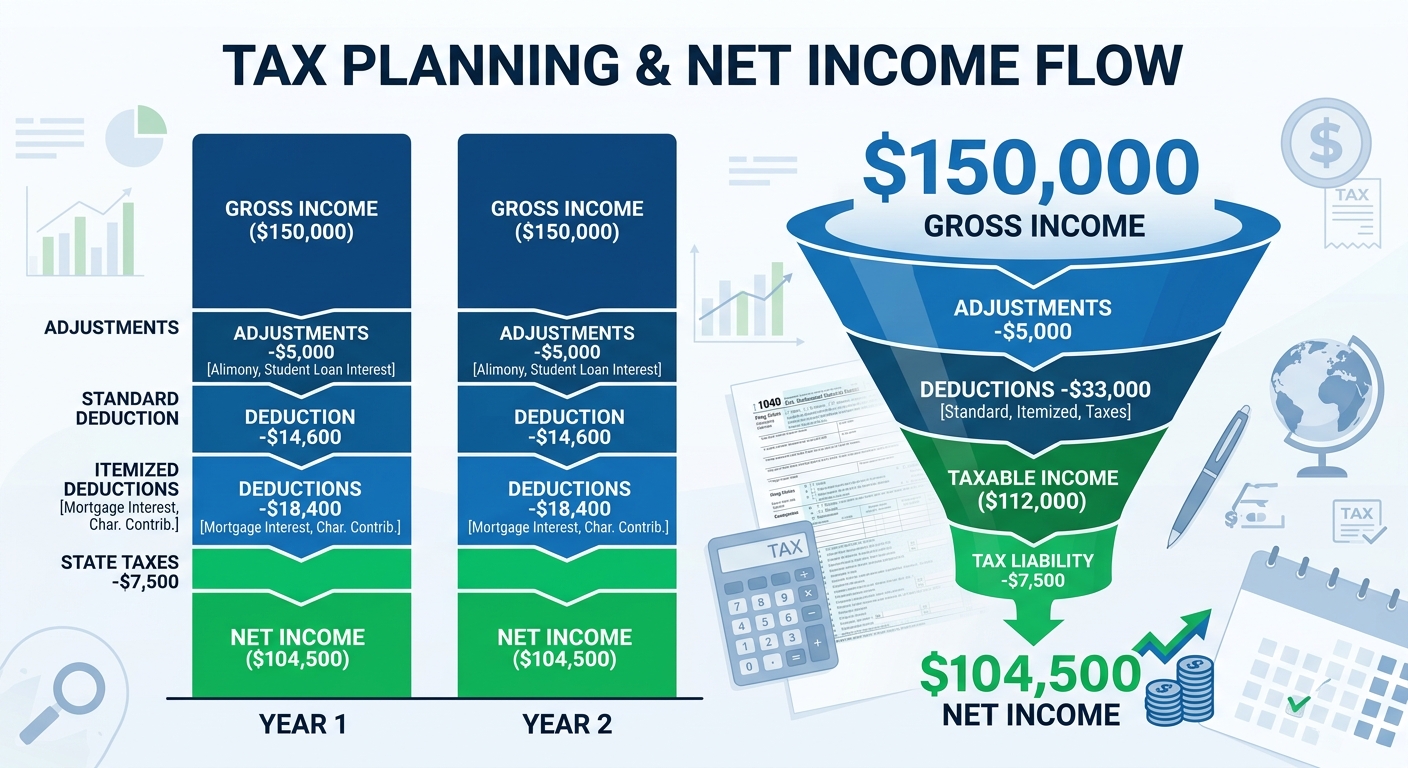
Here is a number that trips up smart taxpayers every single year: the income on your paystub is almost never the income the IRS actually taxes. People assume that if they earned $120,000, they owe tax on $120,000. That misunderstanding costs households thousands of dollars in missed planning opportunities because they never learn where the real levers sit.
Understanding AGI vs taxable income is the single most useful piece of tax literacy you can pick up, and it is the foundation for nearly every legitimate strategy that lowers your bill. These two numbers are not interchangeable, they are calculated at different points on your return, and they control completely different tax outcomes. Get them straight and you will finally understand why one contribution or deduction saves you money while another does almost nothing.
Quick Answer: The Difference Between AGI and Taxable Income
Adjusted Gross Income (AGI) is your total income minus specific “above the line” adjustments like retirement contributions and student loan interest. Taxable income is your AGI minus either the standard deduction or your itemized deductions, plus the qualified business income deduction if you qualify. In plain terms: AGI comes first, taxable income comes second, and the tax you owe is calculated on taxable income, not AGI and not your gross pay.
This information is current as of 7/23/2026. Tax laws change frequently. Verify updates with the IRS or FTB if reading this later.
What Is Adjusted Gross Income (AGI)?
Your Adjusted Gross Income is the running total the IRS builds after adding up every source of income and then subtracting a short, specific list of adjustments. Income here means wages, self-employment profit, interest, dividends, capital gains, rental income, retirement distributions, and more. Once you total all of that, you arrive at your gross income.
From gross income, you subtract “adjustments to income,” which the IRS lists on Schedule 1 of Form 1040. These are commonly called “above the line” deductions because they sit above the line where AGI is calculated. You can find the current list in the IRS Schedule 1 instructions. The most common adjustments include:
- Traditional IRA contributions (subject to income limits)
- Health Savings Account (HSA) contributions
- Self-employed retirement plan contributions like a SEP-IRA or Solo 401(k)
- The deductible portion of self-employment tax (half of it)
- Student loan interest (up to $2,500)
- Self-employed health insurance premiums
The reason AGI matters so much is that it is not just an intermediate figure. Dozens of tax benefits phase in or out based on your AGI, or a close cousin called Modified AGI. Your eligibility for Roth IRA contributions, the amount of your child tax credit, education credits, and even certain healthcare subsidies all hinge on this number.
Why AGI Is the Gatekeeper Number
Think of AGI as the doorman for tax breaks. Many credits and deductions check your AGI before they let you in. If your AGI is $5,000 too high, you might lose a $2,000 credit entirely. That is why reducing AGI is often more valuable than the deduction itself, because it unlocks a chain of downstream benefits.
Key Takeaway: Lowering your AGI by even a few thousand dollars can restore eligibility for credits worth far more than the deduction that lowered it.
What Is Taxable Income?
Taxable income is the final figure your tax rate actually gets applied to. You calculate it by taking your AGI and subtracting your deduction, either the standard deduction or your total itemized deductions, whichever is larger. If you own a pass-through business, you may also subtract the qualified business income deduction here.
The standard deduction is a flat dollar amount the IRS lets you subtract with no receipts and no documentation. Itemized deductions are specific expenses you tally on Schedule A, such as mortgage interest, state and local taxes (capped at $10,000), charitable gifts, and large medical expenses. You pick whichever one is bigger. The official figures live in the IRS Publication 17.
Once you land on taxable income, the IRS applies the progressive tax brackets to it. This is the number that determines whether the top slice of your income is taxed at 12%, 22%, 24%, or higher. Two people with identical gross pay can owe wildly different amounts of tax simply because their taxable income differs after deductions.
How the Two Numbers Flow Together
The order matters enormously. Here is the actual sequence your return follows:
- Total income: Add up all sources of income for the year
- Subtract adjustments: Remove above-the-line items to get your AGI
- Subtract your deduction: Take the standard or itemized deduction
- Subtract QBI deduction: If eligible, remove up to 20% of qualified business income
- Arrive at taxable income: This is what your tax brackets apply to
Understanding this waterfall is exactly why proactive planning works. Every dollar you can legitimately move out of the stream, and at which stage you move it, changes your outcome. If you want the bigger picture on how these strategies fit into an annual plan, our tax planning services map out the exact levers for your situation. Business owners in particular should review our California business owner tax strategy hub for entity-level coordination.
AGI vs Taxable Income: The Comparison That Clears It Up
| Factor | AGI | Taxable Income |
|---|---|---|
| Position on return | Calculated first | Calculated second |
| What reduces it | Above-the-line adjustments | Standard or itemized deduction plus QBI |
| Controls tax owed | No, indirectly | Yes, brackets apply here |
| Controls credit eligibility | Yes, most credits check AGI | Rarely |
| Appears on tax transcript | Yes, prominently | Yes |
The table makes the core insight obvious. AGI is the number that unlocks or blocks credits. Taxable income is the number your tax rate multiplies against. You need to manage both, but you manage them with different tools at different points in the year.
KDA Case Study: The Dual-Income W-2 Household
Marcus and Diane, a married couple in Sacramento, came to KDA convinced they earned “too much” to qualify for any meaningful tax breaks. Marcus worked as a project engineer earning $138,000, and Diane earned $46,000 in a part-time administrative role. Their combined gross income sat at $184,000. They were taking the standard deduction, doing nothing else, and watching a large chunk disappear to federal and California tax.
When we reviewed their return, the problem was clear. Their AGI was high enough to reduce their eligibility for certain benefits and push their top dollars into the 24% federal bracket. We built a plan focused on reducing AGI first. Marcus increased his 401(k) contributions to the maximum, Diane opened a Solo-adjacent traditional IRA that she qualified for, and together they funded a family HSA through Marcus’s high-deductible plan.
Those above-the-line moves reduced their AGI by roughly $34,000. That drop pulled income out of the 24% bracket, restored a partial credit they had been losing, and lowered their combined federal and state tax by approximately $9,200 in the first year. They paid KDA $3,100 for the planning engagement and implementation support, delivering a first-year return of nearly 3x, with the retirement contributions continuing to compound for decades.
Ready to see how we can help you? Explore more success stories on our case studies page to discover proven strategies that have saved our clients thousands in taxes.
Five Strategies That Use the AGI vs Taxable Income Distinction
Once you understand the two numbers, you can attack them deliberately. Here are five strategies that target one or both.
1. Max Out Above-the-Line Retirement Accounts
Traditional 401(k) and IRA contributions reduce AGI directly. A W-2 employee earning $95,000 who contributes $15,000 to a 401(k) drops their AGI to $80,000. At a 22% marginal rate, that is roughly $3,300 in federal tax savings, plus additional California savings. The money still belongs to you, it just grows tax-deferred.
2. Fund a Health Savings Account
An HSA is the rare triple-tax-advantaged account. Contributions lower AGI, growth is tax-free, and qualified withdrawals are tax-free. A self-employed 1099 consultant contributing $4,300 to an HSA at a 24% bracket saves over $1,000 in federal tax while building a medical war chest. Details are in IRS Publication 969.
3. Deduct Self-Employment Costs Correctly
For freelancers and business owners, the deductible half of self-employment tax and self-employed health insurance premiums both reduce AGI. A 1099 graphic designer with $80,000 of net profit can deduct roughly $5,650 for the employer-equivalent portion of self-employment tax, shaving real dollars off AGI before deductions even begin. Run your numbers through this self-employment tax calculator to see the impact.
4. Choose Itemizing When It Beats the Standard Deduction
Taxpayers with a large mortgage, high state taxes, and significant charitable giving may itemize their way to a lower taxable income than the standard deduction offers. A homeowner paying $18,000 in mortgage interest and $10,000 in capped state and local taxes plus $6,000 in charity has $34,000 of itemized deductions, comfortably above the standard amount.
5. Claim the Qualified Business Income Deduction
The QBI deduction lets eligible pass-through owners deduct up to 20% of qualified business income at the taxable income stage. A small business owner with $100,000 of qualified income could deduct up to $20,000, reducing taxable income to $80,000. This deduction is governed by AGI thresholds, another reminder that the two numbers work together.
Red Flag Alert: The Mistakes That Cost the Most
Red Flag Alert: The most expensive mistake is confusing which number a benefit is tied to. People try to lower AGI with itemized deductions, but itemized deductions only reduce taxable income, not AGI. If you are trying to qualify for an AGI-based credit, charitable giving on Schedule A will not help you cross that threshold. Only above-the-line adjustments move AGI.
Another common error is ignoring Modified AGI, which is your AGI with certain deductions added back for specific tests. Roth IRA eligibility, for example, uses MAGI, not straight AGI. Assuming they are the same can lead to an excess contribution and a 6% penalty. The IRS explains MAGI in its Roth contribution guidance.
Pro Tip: Before December 31, project your AGI and taxable income for the year. A quick estimate can reveal whether one more retirement contribution keeps you under a critical threshold or in a lower bracket.
California-Specific Considerations
California starts with your federal AGI and then applies its own adjustments to arrive at California taxable income. This matters because California does not always conform to federal rules. For instance, HSA contributions reduce federal AGI but California does not recognize the HSA deduction, so you add it back for state purposes.
Similarly, California has its own treatment of certain retirement contributions and depreciation rules. This creates a scenario where a strategy that lowers your federal taxable income might have a smaller effect on your California bill. High earners in California, where the top marginal rate stacks on top of federal rates, feel every planning decision more sharply, which is why coordinated federal and state planning is essential rather than optional.
Special Situations and Edge Cases
Part-year residents and people with income in multiple states must apportion income carefully, since the AGI feeding each state return can differ. Married couples deciding between filing jointly and filing separately should model both, because the choice changes AGI-based phaseouts for each spouse. And retirees taking Social Security should watch AGI closely, because the taxable portion of their benefits climbs as other income rises.
Ready to Reduce Your Tax Bill?
KDA Inc. specializes in strategic tax planning for business owners, S Corps, LLCs, and high-net-worth individuals. Book a personalized consultation and walk away with a clear plan.
Frequently Asked Questions
Is AGI the same as gross income?
No. Gross income is everything you earned before any subtractions. AGI is your gross income after above-the-line adjustments like retirement and HSA contributions. AGI is always equal to or lower than gross income.
Which number determines my tax bracket?
Taxable income determines which brackets apply. Your AGI influences credits and phaseouts, but the tax rate math is applied to taxable income after your deductions.
Where do I find my AGI on my tax return?
Your AGI appears on the front page of Form 1040 on the AGI line, and you will also need it from last year’s return to verify your identity when e-filing this year.
Can lowering my AGI save me more than lowering taxable income?
Often, yes. Reducing AGI can restore eligibility for credits and deductions worth far more than the marginal tax on that income, making AGI reduction a high-leverage move.
Book Your Tax Strategy Session
If you have been guessing at which number to attack and losing money because of it, it is time to build a plan that treats your AGI and taxable income as the separate levers they are. Our strategy team will project both numbers, identify every above-the-line adjustment you qualify for, and stack deductions in the right order for your household. Click here to book your consultation now.



