
Quick Answer
Most business owners spend hours reading articles like c corp vs s corp investopedia and walk away more confused than when they started. The short version is simple. A C corporation pays its own tax and can trap profits in the company but risks double taxation. An S corporation passes profit straight to owners, can slash self employment tax when done correctly, but comes with strict eligibility rules and a reasonable salary requirement. The right choice can easily swing your annual tax bill by five figures.
Why The C Corp vs S Corp Choice Matters More Than The Article You Read
The internet treats entity choice like a personality quiz. In real life, it decides how every dollar of profit from your business is taxed at both the federal and California level. A high income contractor with $300,000 of net profit has a very different decision to make than a W 2 engineer moonlighting with $30,000 of side income or a real estate investor using a corporation for property management fees. Get this wrong and you can donate $15,000 to $40,000 a year to the IRS and Franchise Tax Board for no benefit.
Before we talk labels, define your reality.
- How much recurring profit do you expect in the next two to three years not just this month.
- Do you plan to keep cash in the company or distribute almost everything.
- Are you in California, and if so, are you ready for both the franchise tax and the S corp fee structure.
- Do you want to raise outside capital or keep the cap table tight.
If you ignore those questions and simply follow a generic chart you risk being technically correct and financially broke.
c corp vs s corp investopedia Style Overviews Ignore These Core Tax Mechanics
Most comparison articles hit the surface points. C corp equals double tax. S corp equals pass through tax. Limited liability for both. You have seen the bullet points. What they rarely unpack is how the math plays out over several years for different personas.
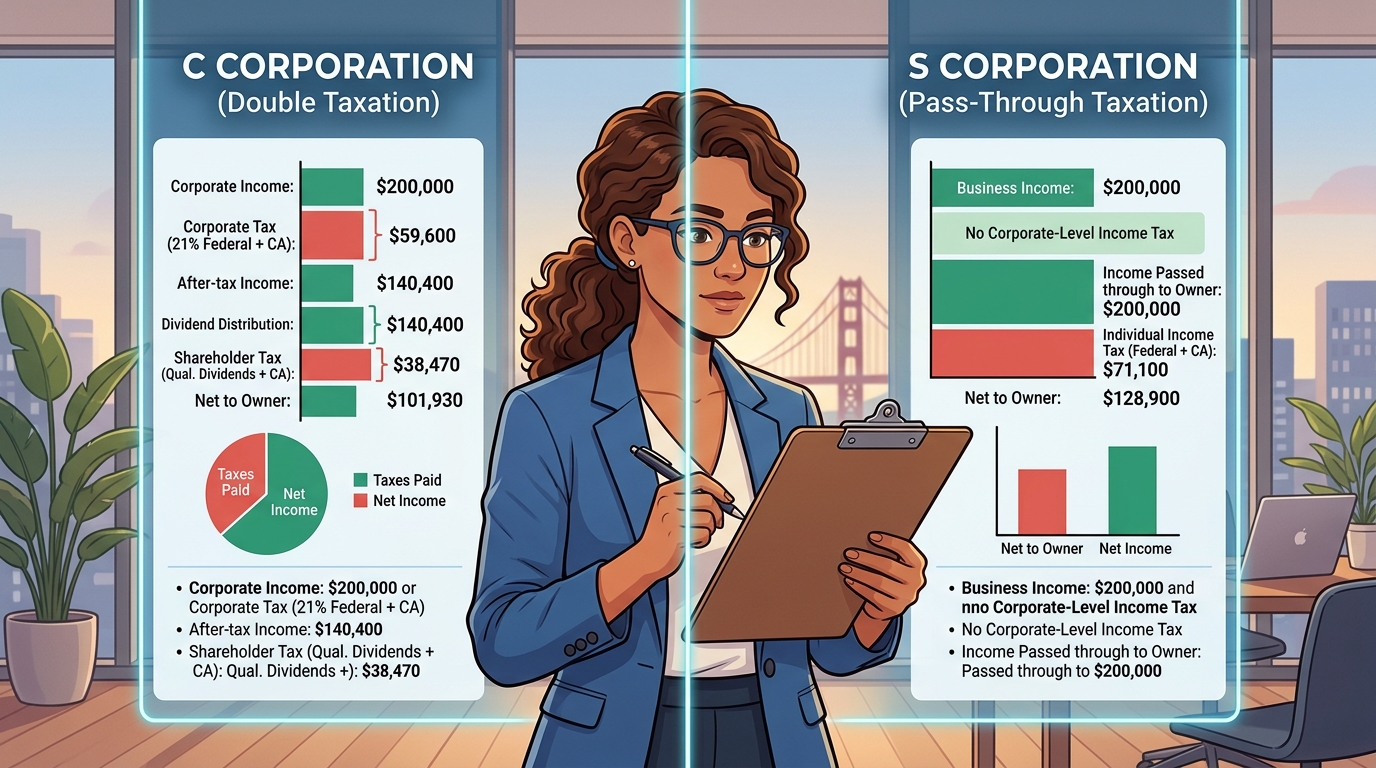
Start with the C corporation. Under current law the federal corporate tax rate is a flat 21 percent. California adds its own corporate rate for C corporations plus the at least eight hundred dollar franchise tax. When the C corp pays a dividend to shareholders that dividend is taxed again on the individual return. That is the classic double taxation. However, C corps can retain profits after paying the 21 percent federal tax. For a high growth business, that can be a feature if you reinvest aggressively and do not need to distribute much cash.
S corporations take the opposite path. They are pass through entities. The company itself generally does not pay federal income tax. Instead, profit after paying a reasonable salary to owner employees flows to the shareholders via Schedule K 1 and lands on their individual returns, where it is taxed at their marginal rates. In exchange, the owner avoids self employment tax on the profit portion and instead only pays Social Security and Medicare on the W 2 salary. Done correctly this is where the big savings show up for 1099 professionals and small LLC owners who elect S status.
California overlays its own rules. S corps pay a 1.5 percent tax on net income to the state, plus the same minimum franchise tax corporations face. In many cases the federal savings from cutting self employment tax vastly outweigh the California S corp tax cost, but that ratio flips if your profit is low or your salary is mis calibrated.
How The Numbers Actually Work For Real Taxpayers
Scenario 1: Solo 1099 Consultant In California
Assume Maria, a marketing consultant, nets $200,000 after business expenses. As a sole proprietor she pays income tax plus roughly 15.3 percent self employment tax on most of that amount, subject to Social Security wage caps. Her self employment tax alone can easily hit the $20,000 plus range.
If Maria instead operates through an S corporation, pays herself a reasonable W 2 salary of $100,000, and takes the remaining $100,000 as S corp distribution, only the salary is subject to payroll taxes. The other $100,000 bypasses self employment tax. That shift can save around $15,000 in federal payroll taxes for the year even after accounting for employer side payroll costs. The 1.5 percent California S corp tax on $200,000 costs $3,000, leaving a clear net win.
Now re run that example as a C corporation. The company earns $200,000 before any dividends. The C corp pays 21 percent federal corporate tax or $42,000, plus California corporate tax. If Maria takes the rest as dividend, she then pays federal and state tax again on that dividend income. Even with qualified dividend rates, the combined burden usually exceeds what she would have paid under the S structure unless she is leaving substantial profits trapped in the company.
Scenario 2: W 2 Engineer With $40,000 Side Project
Daniel is a W 2 software engineer earning $220,000 in salary and stock compensation. On weekends he builds a small SaaS tool that nets $40,000 in profit. For someone in his bracket, defaulting to an LLC taxed as a sole proprietorship means that $40,000 faces both ordinary federal income tax at the top marginal rate and self employment tax.
If he moves that side business into an S corporation, pays himself a $25,000 W 2 salary, and takes $15,000 as distribution, he shaves self employment taxes on the distribution portion. The savings may be a few thousand dollars but still meaningful. In his situation a C corporation rarely makes sense because he is not looking for outside investors, the profit is relatively modest, and the C corp double taxation would erode his after tax return.
Scenario 3: Real Estate Investor Using A Corporation For Management
Consider Jasmine, who owns several rental properties through LLCs and earns $300,000 a year in net rental income. She sets up a corporation to charge asset management fees to those LLCs. If that corporation is an S corp, she can pay herself a salary tied to her actual management work and treat remaining profit as distribution, again reducing payroll taxes. If it is a C corp, she may use it to retain profits for future acquisitions, but she must monitor accumulated earnings tax rules and the risk of double taxation when pulling cash out.
For more advanced S corporation planning specific to California, you can dig deeper with a complete S corp tax strategy breakdown at this California S corporation guide covering payroll, fees, and multi entity structures.
KDA Case Study: High Profit Consultant Restructures From LLC To S Corp
A few years ago a California based marketing consultant came to KDA after three frustrating tax seasons. She was operating as a single member LLC, filing Schedule C with about $260,000 in net profit on top of her spouse salary income. Between income tax and self employment tax their combined federal and state liability regularly crossed $95,000 per year. Despite strong revenue they felt trapped by the size of their April payments.
We analyzed three structures. Staying as a disregarded LLC, converting to an S corporation, and using a C corporation with profit retention. Based on her actual work duties, industry benchmarks, and guidance from IRS reasonable compensation cases, we pegged an appropriate S corp salary at $120,000. The remaining projected $140,000 would flow as S corp profit distribution not subject to self employment tax.
In the first full S corp year the shift cut federal payroll taxes by roughly $18,000, even after factoring in employer side FICA and Medicare. California S corp tax on the $260,000 profit ran about $3,900. Net, the family saved more than $14,000 in year one. Our annual advisory and compliance fees for the restructure, payroll implementation, and ongoing monitoring totaled about $4,500, giving them a better than three times cash on cash return in the first year alone. Over a five year window the projected cumulative savings broke six figures assuming stable profit levels.
Ready to see how we can help you? Explore more success stories on our case studies page to discover proven strategies that have saved our clients thousands in taxes.
Red Flag Alert: Reasonable Compensation Is Not Optional
The single biggest mistake S corp owners make is treating the structure like a magic box that turns all profit into tax free distributions. The IRS does not see it that way. When you work in the business, the agency expects the corporation to pay you a reasonable salary via payroll before profit flows as distribution. That means actual W 2 wages, payroll tax deposits, and year end Forms W 2 and 941.
Reasonable compensation is not defined by a single dollar amount, but by what an independent person would be paid for the same role in the same market. Factors include duties, hours, training, and prior experience. The IRS discusses corporate officer pay in guidance like IRS Publication 15 and has litigated many cases where owners tried to minimize salary and maximize distributions. When they lose, the reclassification of distributions as wages often comes with back payroll tax, penalties, and interest.
For example, if an S corp nets $300,000 and pays the owner a $20,000 salary while they are clearly working full time, that is a red flag. An audit could easily result in the IRS reclassifying $150,000 to $200,000 of distributions as wages, triggering tens of thousands of dollars in back payroll taxes plus penalties. The net effect wipes out the intended self employment tax savings and then some.
How C Corps Create Flexibility For Scaling Businesses
Despite the focus on S corp payroll savings, C corporations still have a place especially for startups planning to raise outside capital or retain significant profits. Venture capital and many institutional investors prefer C corp stock. Equity compensation plans, stock options, and certain ownership structures are easier inside a C corporation.
From a tax standpoint, the flat 21 percent federal corporate rate can be attractive if owners do not need to distribute most of the profit personally. A C corp earning $500,000 and retaining $300,000 after paying a modest dividend could see lower current year tax at the shareholder level compared with an S corp pushing all $500,000 through to individual returns taxed at high marginal rates. However, the retained profits remain inside the corporation. When eventually paid out as dividends or realized through a sale, there will be another layer of tax. That timing question is where strategy lives.
California layers on additional questions. The state corporate tax for C corps combined with the federal rate means you must run long term models, not just one year snapshots. For some high net worth owners planning to sell the company outright, a C corp combined with qualified small business stock strategies can dramatically reduce or even eliminate capital gains at exit, but that requires careful planning and strict compliance with rules found in sections like IRC 1202 and confirmed in IRS guidance.
For owners comparing paths, it is worth having an advisor model multiple year outcomes under each structure instead of relying on a single year savings estimate. That financial modeling step is typically missing in simplified online comparisons.
What The IRS Will Not Tell You About Double Taxation Risk
Double taxation is often the headline negative for C corporations, but many discussions water it down. In practice, double tax risk shows up in three main ways.
- Routine dividends paid from after tax corporate profit to shareholders.
- Constructive dividends, where the IRS argues that personal expenses paid by the company or below market compensation are really disguised distributions.
- Liquidation events or redemptions where the difference between fair market value and basis becomes taxable.
In each case the corporation may pay tax on its income first, then the shareholder pays again when cash or value leaves the entity. Sophisticated planning can mitigate this, including paying reasonable salaries, using deductible fringe benefits appropriately under rules from sources like IRS Publication 15 B, and planning for redemptions. But if you go into a C corp structure assuming you will never feel double taxation you may be surprised when you try to pull serious cash out.
Can You Switch Later If You Choose Wrong
Many owners ask whether they can start as one type of corporation and later switch. The answer is yes but with strings attached. Converting from C to S status is done by filing Form 2553, and you must meet eligibility rules including the number and type of shareholders and having only one class of stock. If you have built up appreciated assets inside the C corporation, the change can trigger built in gains tax if assets are sold within a recognition period after conversion.
Moving from S to C status is easier technically but may reset certain built in gain timelines and closes the door on pass through loss usage for shareholders going forward. Each switch comes with clock based restrictions on when you can re elect, and California follows many but not all federal rules. This is why we rarely recommend using entity election as a short term toggle. It is a long term commitment that must match your growth plan.
Where Each Structure Tends To Win
When S Corps Usually Make Sense
- 1099 professionals and consultants with at least $80,000 to $100,000 in profit after expenses.
- Small business owners who actively work in the business and want to reduce self employment tax using a defensible salary plus distribution split.
- Real estate investors using a management company structure where fee income is meaningful.
In these scenarios the payroll savings from the S corp often outweigh the extra compliance cost and the California S corp tax. W 2 heavy households where the main goal is turning side business profit into less payroll tax often benefit most.
When C Corps Earn Their Keep
- High growth startups seeking venture capital with plans to reinvest most profits.
- Businesses targeting qualified small business stock treatment for a future stock sale.
- Groups where ownership includes foreign investors or entities that cannot hold S corp stock.
Here the governance structure, investor expectations, and long term capital gains strategy matter more than the near term payroll tax difference. The C corporation is the native language of institutional capital, even if it trades some ongoing tax efficiency for flexibility and scale.
Will This Trigger An Audit
Any time you claim a large tax benefit, you should assume the IRS could take a closer look. That does not mean you avoid the benefit. It means your file needs to be audit ready. For S corporations, that starts with reasonable salary analysis and clean payroll records. For C corporations, it includes documentation around dividends, loans to shareholders, and any related party transactions. According to IRS data summarized in compliance studies, pass through entities including S corps and partnerships are a growing audit focus.
One of the cleanest ways to lower risk is to match your structure and behavior to what the IRS already expects. That includes using the right forms, such as Form 1120 for C corporations and Form 1120 S for S corps, and aligning your bookkeeping with the line items on those forms. Professional bookkeeping and payroll support dramatically reduces the chance of miscoding items that trigger automated notices.
Strategic year end moves can also reduce surprises. Our tax planning services are built to identify those moves early and coordinate with your payroll and bookkeeping so the story on your return is internally consistent. That planning matters far more than any single line item deduction you read about online.
How To Decide Without Getting Lost In Charts
If you are still on the fence between a C corporation and an S corporation, focus on three decisions instead of twenty.
- How much profit do you reasonably expect in the next two to three years.
- How much cash do you need to pull out personally versus reinvest.
- Do you intend to bring in investors who expect a classic C corp structure.
If you are an active business owner planning to take most of the profits home, the S corporation often wins, especially for service businesses. If your goal is to raise capital, issue stock options, and potentially pursue a major exit event, the C corp structure is usually non negotiable. For many California business owners, a tailored combination of entities offers the best of both worlds, but only if the plan is built intentionally from the beginning.
To get a rough sense of how your total federal tax changes as your business profit grows, it can help to run numbers through a simple tax bracket calculator so you understand how additional pass through income or dividends stack on top of your other earnings.
We also find that owners making this decision benefit from seeing how corporate tax strategy aligns with their personal financial goals. That is why we often pair entity work with broader planning from our premium advisory services so the tax structure supports, rather than fights, your overall plan.
Ready to Reduce Your Tax Bill?
KDA Inc. specializes in strategic tax planning for business owners, S Corps, LLCs, and high-net-worth individuals. Book a personalized consultation and walk away with a clear plan.
Book Your Tax Strategy Session
If you have been relying on simplistic charts or generic c corp vs s corp comparisons, there is a good chance the IRS and California are quietly collecting more tax than necessary from your business. The right structure, salary, and distribution plan can redirect thousands of dollars a year back into your accounts instead of theirs. Click here to book your consultation now.
The IRS is not hiding these rules. You just were not taught how to use them. That is what a focused strategy session is for.
This information is current as of 7/12/2026. Tax laws change frequently. Verify updates with the IRS or FTB if you are reading this at a later date.



