
Most California business owners do not pick the wrong corporation on purpose. They are usually rushed through an online filing, click C corporation because it is the default, and do not learn the cost until they are staring at a tax bill that is thousands of dollars higher than it needed to be.
The right choice between s corp vs c corp pros cons will not just keep you compliant. It can shift where and how your profit is taxed, change your exposure to double taxation, and open or close powerful planning moves around payroll, dividends, and long term exits. For a California owner with 150,000 dollars of profit, the gap between a badly structured C corporation and a dialed in S corporation can easily land in the 8,000 to 20,000 dollar per year range.
Quick Answer
For most closely held California businesses earning between 80,000 and 750,000 dollars in profit, an S corporation is usually the better long term move. You avoid federal double taxation, you can reduce self employment tax by paying yourself a reasonable salary and taking the rest as distributions, and you keep your company eligible for many small business relief rules. A C corporation can still win when you plan to reinvest most profits in the company, you are chasing venture capital, or you are aiming for a qualified small business stock exclusion after a major exit. The decision lives in your goals, profit level, and time horizon, not in what your filing service defaults to.
What Really Changes When You Choose S Corporation Versus C Corporation
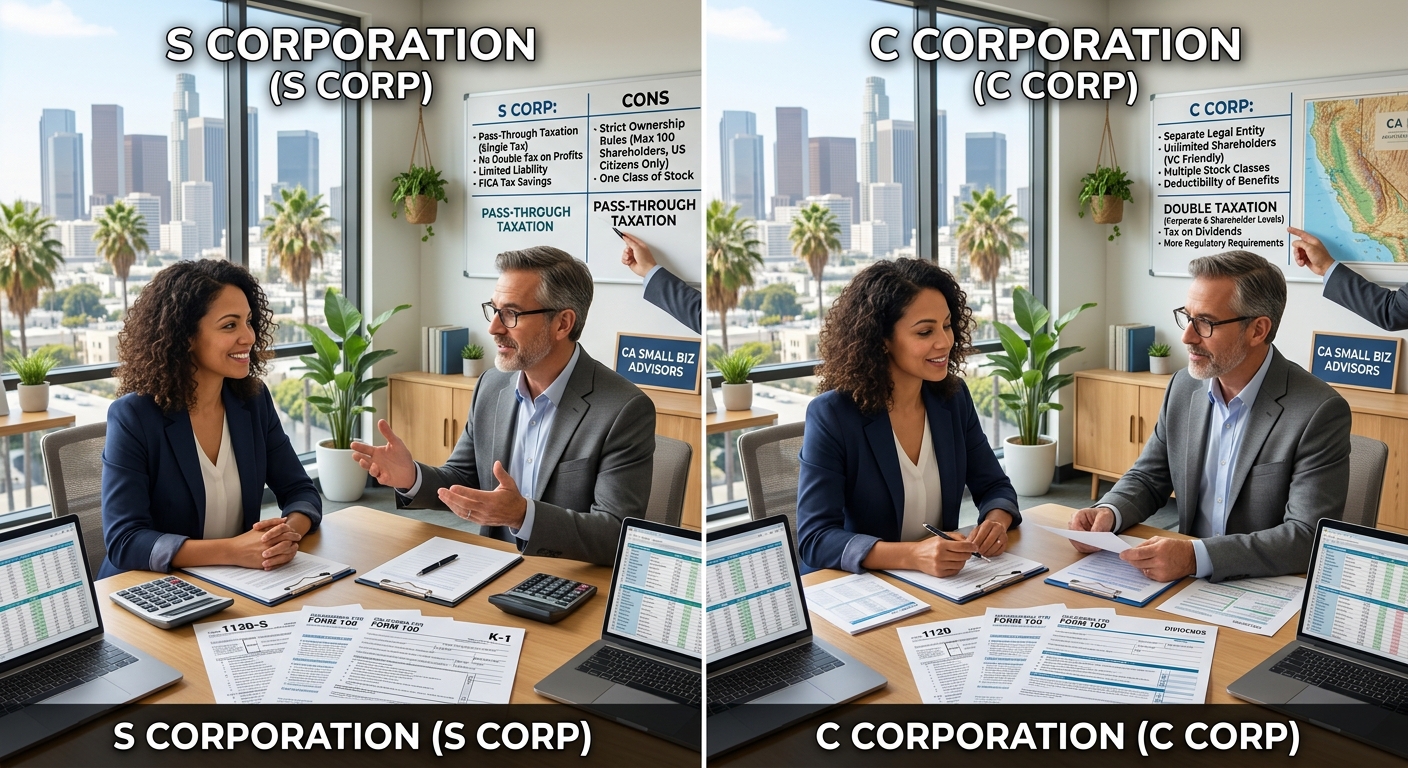
At the federal level, an S corporation is a pass through entity. The corporation files an informational return on Form 1120 S, but the actual income flows to you on Schedule K 1 and lands on your individual Form 1040. You avoid corporate level income tax. By contrast, a C corporation files Form 1120 and pays corporate tax on its earnings under rules explained in IRS Publication 542. When that after tax profit is distributed as dividends, you pay individual tax again. That is the classic double taxation issue.
For a California owner with 200,000 dollars of annual profit, here is a simplified comparison:
- C corporation pays 21 percent federal corporate tax, 42,000 dollars, leaving 158,000 dollars. If you distribute that as dividends and you are in the 15 percent qualified dividend bracket, that is another 23,700 dollars. Combined federal layer is about 65,700 dollars, not counting state tax.
- S corporation passes the 200,000 dollars to you. If you pay yourself 100,000 dollars in W 2 wages and take 100,000 dollars as distributions, only the wage portion is hit with Social Security and Medicare, under rules you see in IRS Publication 15. Your income tax picture can still be heavy, but you are not layering corporate tax on top of it.
This is why the headline comparison of s corp vs c corp pros cons usually starts with double taxation and self employment tax. But the real story for a California owner requires you to layer in the state level costs, the 800 dollar minimum franchise tax, and the long term exit path you actually expect to use.
How California Treats S Corporations and C Corporations Differently
California does not copy the federal rules line by line. Both S corporations and C corporations pay the 800 dollar minimum franchise tax. C corporations then pay a state income tax on net income, while S corporations pay a reduced rate on net income plus the shareholders pay tax again when they pick up their share on their personal California return.
That means S corporation status does not fully eliminate double taxation at the state level. You are trading a higher corporate rate and simpler structure in a C corporation for a lower S corporation tax at the entity level plus pass through income. The math depends heavily on your profit, salary choices, and whether you plan to leave earnings in the business.
If you are a California owner trying to decide between structures, you are exactly the type of client who benefits from specialized guidance for business owners that understands this state’s quirks and the federal interaction.
On the planning side, the decision between these entity types is one of the core themes in our broader S corporation content. If you want an even deeper dive into how S corporation mechanics work in California specifically, you can explore our primary S corporation resource at this in depth California S corporation strategy guide for more scenarios and compliance detail.
Headline s corp vs c corp pros cons for Different Profit Levels
There is no single right answer across all profit ranges. You have to map how each structure behaves as your profit and payout pattern changes. Here is a simplified framework for an owner operator in California with no outside investors.
Under 60,000 dollars of Annual Profit
At this level, it often makes sense to stay as a single member LLC taxed as a sole proprietorship or a partnership if there are multiple owners. Once you become an S corporation, you are expected to run payroll and pay yourself a reasonable salary. Even a 40,000 dollar salary with payroll software, filings, and potential bookkeeping support can eat most of the savings from the S election. A C corporation usually does not make sense here unless there is a very specific long run qualified small business stock plan.
60,000 to 200,000 dollars of Annual Profit
This is the sweet spot where an S corporation often shines. Imagine a consultant with 180,000 dollars of profit before any owner payroll. As a sole proprietor, all 180,000 dollars is subject to self employment tax in addition to income tax. With an S corporation, you might justify a 90,000 dollar salary and leave 90,000 dollars as distributions. Only the salary portion is hit with Social Security and Medicare. That alone can reduce federal payroll related taxes by 10,000 dollars or more compared with a Schedule C. C corporation status in this band often creates more tax without a strong strategic benefit.
Over 200,000 dollars of Annual Profit With Reinvestment Plans
At higher profit levels, particularly if you plan to leave money in the business to fund growth, a C corporation re enters the conversation. Corporate tax at 21 percent on retained earnings can look attractive compared to high individual marginal rates. If your long run strategy involves building a company for sale and you can qualify for the qualified small business stock exclusion, the C corporation path can deliver extraordinary benefits on exit. The tradeoff is higher annual tax friction if you distribute large dividends.
Strategic year end projections and scenario modeling are critical here. That is where a dedicated tax planning services relationship pays for itself, especially when you are toggling between salaries, bonuses, and dividends across years.
KDA Case Study: California Consultant Rethinks Corporation Choice
Consider Maya, a Los Angeles based marketing consultant who formed a C corporation through an online service in 2022. By 2025 her corporation was earning around 220,000 dollars before her own pay. Her prior advisor had her take a 120,000 dollar W 2 salary and then clean out the rest as dividends. Between the 21 percent federal corporate tax, California corporate tax, and dividend tax, she was watching about 80,000 dollars vanish each year to combined corporate and individual layers, without really knowing why.
When Maya engaged KDA in 2026, we rebuilt the projections under an S corporation election effective for the new year. We kept the same 120,000 dollar salary but now the remaining 100,000 dollars passed through directly to her return as S corporation income. Instead of paying 21 percent corporate tax plus dividend tax, she simply paid individual income tax and California S corporation level tax. The federal and state savings in the first full S corporation year approached 19,000 dollars after fees, largely driven by eliminating the corporate layer and cleaning up some missed deductions that applied under both structures. On an advisory fee of about 4,000 dollars, that was close to a five to one first year return.
Ready to see how we can help you? Explore more success stories on our case studies page to discover proven strategies that have saved our clients thousands in taxes.
Red Flag Alert: Reasonable Compensation and IRS Scrutiny
For S corporations, the IRS expects owner employees to pay themselves a reasonable salary for the work they perform before taking large distributions. This is explained in several IRS resources and tied back to general employment tax principles discussed in IRS Publication 15. If you have 300,000 dollars of S corporation profit and you only pay yourself a 20,000 dollar salary, you are inviting an audit level adjustment where the IRS reclassifies a large portion of your distributions as wages and adds payroll tax, penalties, and interest.
On the C corporation side, the trap flips. If you overpay yourself with wages and bonuses to avoid corporate tax, the IRS can treat part of that compensation as disguised dividends. That strips away the corporate deduction and re characterizes some of the payout, giving you the worst of both worlds.
In both cases, contemporaneous documentation matters. Industry compensation surveys, job descriptions, and board minutes backing your salary decisions are powerful. Working with a firm used to defending these decisions is the difference between an efficient structure and a future payroll tax problem.
Will S Corporation or C Corporation Status Trigger More Compliance Work
Neither structure is simple if you care about doing things correctly. C corporations can feel straightforward because you do not need to worry about reasonable compensation rules in the same way and you keep a clean separation between the company and the shareholders. But when you combine the federal corporate return, California filings, and the bookkeeping standards needed to support everything, the workload is still substantial.
S corporations layer on their own complexity. You need timely S elections, sometimes late election relief, accurate shareholder basis tracking, and careful handling of distributions and loans. When basis is not tracked correctly, shareholders can wind up paying tax on distributions they thought were tax free. Much of this is addressed in IRS guidance around S corporations and in the general business expense rules summarized in IRS Publication 535.
For many California owners, a blended support model that covers bookkeeping, payroll, and tax is the most efficient. That way, the same team that designs your entity structure keeps the books and prepares the returns, reducing gaps and finger pointing. If you are currently bouncing between a bookkeeper, a payroll provider, and a separate tax preparer, you are living the opposite of this integration.
How Long Should You Commit Before Changing Entity Types
It is possible to convert from one structure to another, but each move has costs and friction. Converting a C corporation to an S corporation can trigger built in gains tax issues if the corporation holds appreciated assets. Flipping repeatedly between structures confuses lenders, investors, and sometimes regulators. Instead of thinking in terms of short term swaps, you should be thinking in at least three to five year blocks.
For example, a startup planning to seek institutional capital might launch as an S corporation while the founding team proves the model and keeps things lean. As they approach a serious funding round, they might convert to a C corporation to match investor expectations and access the full qualified small business stock opportunity. The key is that each shift is mapped to a strategic inflection point, not a reaction to one surprising tax bill.
When we evaluate s corp vs c corp pros cons with clients, we always run a five year pro forma. That model shows taxes paid in each structure, cash available to owners, payroll and compliance costs, and likely exit paths. Only then do we lock in a recommended structure and build a compliance calendar to match.
What If You Already Chose the Wrong Corporation Type
If you launched as a C corporation and now see that an S election might have been smarter, all is not lost. In some cases, you can file Form 2553 for a late election and request relief under the reasonable cause provisions. The IRS has specific procedures for this, and while not guaranteed, many businesses have successfully obtained retroactive S status. The details live in a mix of revenue procedures and instructions to Form 2553, so you want a professional who has navigated them before.
If you are an S corporation that should really be a C corporation, especially because of investor requirements or the desire to reinvest earnings at the corporate rate, the fix usually involves a revocation of the S election. That sounds simple, but you have to plan the timing carefully, especially if you have accumulated adjustments accounts or built in gain issues.
In both directions, the IRS is primarily concerned with clear elections, honest explanations, and consistent reporting. Hidden backdated changes, sloppy returns, and partial year confusion are what draw scrutiny.
Bottom Line
The loudest social media takes on s corp vs c corp pros cons ignore the reality that you are not choosing a tax label in the abstract. You are choosing how you will pay yourself, what kind of investors you can attract, how much cash you can reinvest, and what your exit looks like. For a W 2 employee dabbling in a side business, an S corporation can be a powerful upgrade at the right profit level, but it is not magic. For a high growth startup or capital intensive company, the C corporation’s access to reinvested earnings and potential qualified small business stock treatment might dwarf the annual tax drag.
This information is current as of 7/9/2026. Tax laws change frequently. Verify updates with the IRS or California Franchise Tax Board if you are reading this in a later year.
Ready to Reduce Your Tax Bill?
KDA Inc. specializes in strategic tax planning for business owners, S Corps, LLCs, and high-net-worth individuals. Book a personalized consultation and walk away with a clear plan.
Book Your Tax Strategy Session
If you are deciding between S corporation and C corporation status and want numbers specific to your income, profit, and California footprint, you should not guess. Book a personalized consultation with our strategy team and we will run a five year side by side projection, dial in reasonable compensation, and give you a clear, defensible plan. Click here to book your consultation now.
The IRS is not hiding these choices. You just were not given the framework to see how much they matter.



