
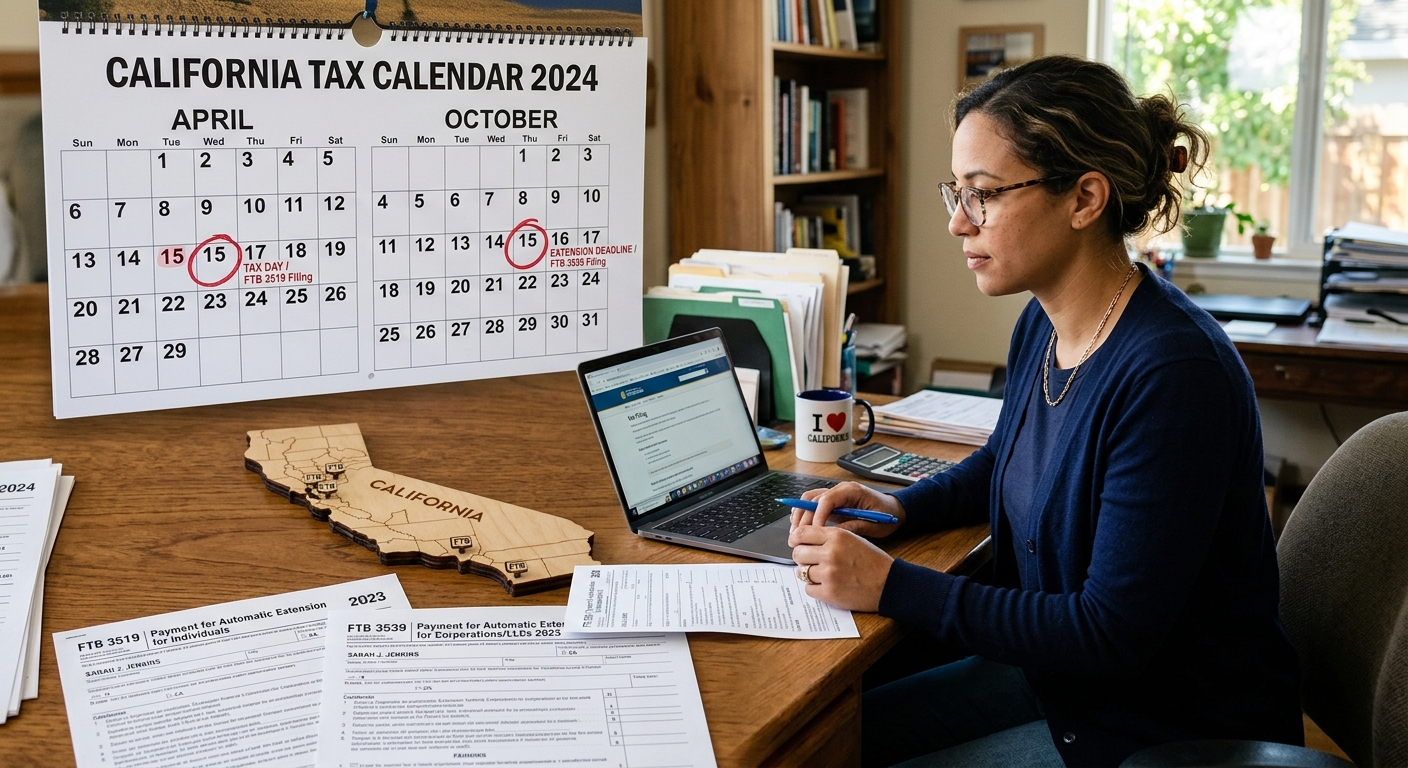
Most California taxpayers assume that if they cannot file by April 15, they need to scramble for an extension form or risk penalties. That belief quietly costs people thousands of dollars in late fees and interest every year, especially business owners and high earners who juggle multiple income streams. The reality is that California already gives many filers extra time automatically, but you still need a clear plan so that extension time buys you savings, not just delay.
how to file an extension for California taxes is really a question about three things: what the Franchise Tax Board (FTB) does for you automatically, when you must send payment with a specific form, and how to use the extra months to shore up your records and tax strategy instead of kicking the can down the road.
Quick Answer: How California Tax Extensions Really Work
California handles extensions differently from the IRS. For most individuals, you do not need to file a separate extension form to get more time to file your state return. If you meet basic conditions, you automatically get until October 15 to file. What you do not automatically get is more time to pay. Any unpaid balance after the original April deadline starts accruing penalties and interest, regardless of the extension.
For individuals who expect to owe, the main tool is Payment for Automatic Extension for Individuals, FTB Form 3519. Corporations and exempt organizations use different forms and rules. The core play is simple: estimate what you will owe, pay that amount by the original due date using the right form or electronic payment method, then use the extra months to finalize your return with better records and planning.
Understanding how to file an extension for California taxes by Taxpayer Type
The way you approach an extension depends heavily on how you earn your money. A W 2 employee who just has wages and maybe some interest income has a very different risk profile than a 1099 consultant or a multi property real estate investor.
W 2 Employees with Simple Returns
If you only have wages reported on a W 2, maybe some bank interest and a small brokerage account, California usually gives you an automatic extension to file your return until October 15 as long as:
- You file by the extended due date, and
- You pay at least 90 percent of your total state tax liability by the original due date.
In practice, most W 2 filers who are due a refund do not need to worry about a state extension at all. If California owes you money, penalties for late filing generally do not apply, though interest may limit how long you should wait. The real risk sits with higher income employees, such as engineers or medical professionals with significant RSUs or bonuses, who occasionally owe a surprise balance.
Self Employed and 1099 Contractors
For self employed taxpayers and 1099 contractors filing Schedule C with their federal return, an extension is less about convenience and more about risk management. If your income swings from year to year, you might easily underpay California estimated taxes. When that happens, using Form 3519 to send an additional payment by the April deadline can significantly reduce late payment penalties.
This group often benefits from working with a firm that understands the realities of irregular cash flow. KDA works closely with self employed clients who have multiple 1099s, online income, or project based work. The goal is to avoid both overpaying and penalty exposure by calibrating estimates before you ever need an extension.
Business Owners, LLCs, and S Corporations
California entity returns follow different calendars and extension mechanics. Many owners assume that once they file a federal extension they are automatically covered at the state level, but the interaction is more nuanced. Corporations and LLCs taxed as corporations often need to think about Form 3539, Payment for Automatic Extension for Corporations and Exempt Organizations, and separate rules for limited liability companies filing Form 568.
If you own an LLC or S corporation, your extension strategy should be tied to broader tax planning. That includes reasonable salary decisions, distribution planning, and entity structure work that an advisory focused firm like KDA supports through its tax planning services.
How California Automatic Extensions Actually Work
California law gives most individual taxpayers an automatic extension of time to file their state income tax return. For calendar year filers, that generally moves the due date from mid April to mid October. You do not submit a separate form just to request that filing extension in many cases.
However, the automatic extension is conditional. If you end up owing tax and fail to pay at least 90 percent of your total liability by the original due date, the FTB can assess a late payment penalty. As of this writing, the late payment penalty is usually 5 percent of the unpaid tax plus 0.5 percent per month or part of a month it remains unpaid, similar in concept to federal rules. Details sit in state law and the FTB website rather than a single IRS style publication.
When You Must Use FTB Form 3519
Form 3519 is essentially a payment voucher tied to your individual state extension. You use it if you expect to owe tax and you are not paying electronically. The form asks for your identifying information, your estimated total tax liability, amounts paid through withholding and estimated payments, and your extension payment.
For example, if you believe your total California tax will be $14,000 and you have already paid $10,500 through withholding and estimates, you would send an additional $3,500 with Form 3519 by the April deadline to stay safely under the 10 percent underpayment threshold. If you actually owe $15,000 when you file, you will have a small balance due, but you have dramatically reduced penalty exposure.
Corporations and FTB Form 3539
Corporations and exempt organizations use Form 3539 to pay for their automatic extension of time to file. As with individuals, this form is a payment mechanism, not a request letter. California generally provides a seven month extension for corporate filers, but penalties and interest still apply on any unpaid tax after the original due date.
For LLCs classified as partnerships, the situation depends on how the entity is taxed. An LLC treated as a partnership may rely on automatic extension rules attached to its California Form 565 filing, but entity level fees and the $800 annual tax still must be paid timely to avoid separate penalties.
Why Most People Get California Extensions Wrong
Most taxpayers focus only on the filing deadline and assume the extension buys time across the board. They do not realize that California splits the problem into two separate questions: did you file on time and did you pay on time. You can be on extension and still face both underpayment penalties and interest if your April numbers were weak.
Red Flag Alert: Believing that an extension wipes away penalties is one of the fastest ways to stumble into a notice from the Franchise Tax Board. California will happily accept your October return and still charge months of late payment penalties if the April numbers were off.
Underestimating the Payment Needed with Form 3519 or 3539
A common trap is sending a round number with your extension payment without actually estimating income. For example, a self employed consultant who had a strong first quarter might just mail $2,000 with Form 3519 because it feels like enough. If their final state bill later shows $5,000 due, they have effectively left $3,000 exposed to months of penalties and interest.
The better move is a rough but defensible projection. That might involve pulling year to date bookkeeping reports, estimating full year revenue based on pipeline, and then backing out expected expenses. Business owners who maintain clean books, often with professional bookkeeping and payroll support, can usually get this done in under an hour.
Ignoring California When You File a Federal Extension
Another mistake is treating the federal and state governments as a single unit. Filing IRS Form 4868 for an automatic federal extension does not automatically protect you at the California level. The federal extension handles your federal filing deadline. California has its own automatic rules and payment vouchers, and the FTB does not read your 4868.
California guidance evolves, so it is smart to cross reference current instructions on the FTB website and, when needed, the relevant IRS materials such as Form 4868 instructions to see how your federal extension interacts with state timing and cash flow.
Step by Step: How to File and Pay for a California Extension
Once you understand that the key is paying enough by April while claiming your automatic filing extension, the process becomes manageable. Here is a practical walk through that works for most individuals and many small business owners.
Step 1: Estimate Your California Tax Liability
Start with your federal adjusted gross income projection. If last year you had $180,000 of AGI and expect a modest raise plus similar bonus, you might project $195,000. Adjust for known changes such as more 1099 income, rental properties, or large stock sales. Apply California adjustments that differ from federal law, such as differences in bonus depreciation or certain retirement contributions.
Then run the income through the current California tax tables. This does not need to be perfect. A reasonable estimate that lands you within 5 to 10 percent of the final number usually protects you from the harshest penalties. If you want more precision, especially with large capital gains, you can use the FTB's online calculators or work with a professional preparer.
Step 2: Subtract Withholding and Estimated Payments
Gather your latest pay stubs and any prior state estimated tax vouchers. Add up all California income tax withheld and any 540 ES payments you have made. Subtract that from your estimated total tax. The difference is your target payment with Form 3519 or your online extension payment.
For example, if your estimated tax is $16,000 and you have already paid $13,800, you want to send at least $2,200 by the April deadline. If cash is tight, you might decide to send $2,500 to give yourself a cushion, knowing that interest on small underpayments is cheaper than stacking more penalties.
Step 3: Make the Extension Payment
You can pay your California extension amount by mailing Form 3519 with a check, using FTB Web Pay, or scheduling an electronic funds transfer. For corporations, Form 3539 plays the same role. Whenever possible, use an electronic method so there is a timestamped trail and no risk of mail delays.
According to the FTB, payments are generally due by the original return due date. For most individuals that is in April, while many calendar year corporations face a different spring deadline. Missing that date is the main trigger for late payment penalties, even if you eventually file your return well before October.
Step 4: Use the Extra Time Strategically
The worst use of an extension is doing nothing until October and then rushing again. The best use is to treat April to October as a clean up and planning window. That can include:
- Reconciling business income and expenses in your accounting system
- Correcting 1099 mismatches
- Gathering documentation for large deductions such as mileage, home office, or major purchases
- Evaluating entity structure or retirement contributions before the year is too far gone
If you are a business owner or real estate investor, this is also when it makes sense to speak with an advisor about more proactive options, not just plugging numbers into last year's template. The KDA team often uses this window to help business owners rethink their mix of salary, distributions, and estimated payments.
KDA Case Study: 1099 Consultant Fixes Years of Extension Penalties
Lena is a 1099 marketing consultant in Los Angeles who regularly earns between $220,000 and $260,000 per year. She always filed extensions for both federal and California returns because her clients paid on unpredictable schedules and she never felt ready by April. Each year she would send a few thousand dollars with a federal extension and skip any targeted payment for California, assuming the state would follow whatever the IRS did.
By the time she came to KDA, she had three straight years of underpayment penalties and interest from the FTB totaling roughly $9,400. She thought this was just the price of being self employed. Our team reviewed her income patterns and spotted that her California balances were consistently underpaid by 20 to 30 percent by April, mainly due to missing state estimated payments in strong quarters.
We restructured her approach by installing quarterly projections and aligning those with state estimates. For the current year, we used a realistic income projection to calculate a California liability of about $21,000 and confirmed she had already paid $15,500. Instead of guessing, we had her send a $5,500 payment with Form 3519 by the April deadline and adjusted her remaining estimates.
On her next return, Lena owed just $700 at filing and the FTB assessed no late payment penalty. Between better estimates and extension payments, she avoided roughly $3,800 in new penalties and interest in that one year, easily covering the cost of advisory work. Over a three year horizon, tightening up her extension strategy is projected to save her more than $10,000.
Ready to see how we can help you? Explore more success stories on our case studies page to discover proven strategies that have saved our clients thousands in taxes.
Will Filing an Extension Increase Your Audit Risk
Many taxpayers quietly worry that asking for more time will flag their return for closer review. At the federal level, the IRS has long stated that filing a timely extension does not increase audit risk on its own. California's FTB focuses more on obvious noncompliance, such as failing to file at all or underreporting income that has been reported to the state by employers or financial institutions.
In other words, an extension is usually neutral for audit risk as long as you ultimately file a complete and accurate return. What does draw attention is wildly inconsistent reporting, such as large mismatches between 1099 income reported to the state and what appears on your return, or sudden steep drops in reported income with no clear explanation.
For complex cases or when notices do appear, having a professional in your corner matters. Firms that provide audit representation services can often resolve issues more efficiently and protect you from making statements that complicate the situation.
Using Tools to Estimate Your Extension Payment
One challenge in planning extension payments is understanding your overall tax exposure when income jumps or you trigger large capital gains. If you are selling a rental property or a big block of stock, it can help to model both federal and state consequences in one place before you set your California extension payment.
A practical approach is to first forecast your total federal bill and then use the relationship between federal and California liability from prior years as a sanity check. If your California tax has historically run around 40 percent of your federal tax, and a projected federal bill jumps from $20,000 to $32,000, you now expect California to land near $12,800 instead of $8,000. Running numbers through a federal tool like a reliable federal tax calculator can give you a starting point before you layer in California's brackets.
Pro Tip: When in doubt, slightly overpay your extension. If you end up with a refund, you have essentially made an interest free loan to the state, which is far cheaper than stacking late payment penalties at effective rates many times higher than typical savings account yields.
Common Questions About California Tax Extensions
What If I File After October 15
If you miss the extended filing deadline, California treats your return as late even if you previously relied on the automatic extension. That can trigger a separate late filing penalty on top of late payment penalties and interest. The FTB generally calculates late filing penalties as a percentage of the unpaid tax per month, up to a cap. Details change over time, so you should always check current guidance on the Franchise Tax Board website.
If you are more than a few months late and owe a meaningful amount, it is usually worth speaking with a strategist to explore options. In some cases, you may qualify for penalty relief if you have a strong compliance history or can demonstrate reasonable cause, similar in spirit to the federal concepts found in IRS Publication 17 and related guidance.
Do I Need a Separate Extension for Each California Entity
Yes. If you are involved in multiple entities, each business or trust has its own filing and payment obligations. An S corporation extension via Form 3539 does not cover your personal Form 540, and vice versa. This is especially important for real estate investors who hold properties in separate LLCs as well as directly in their personal names.
Real estate investors should map out every return they are responsible for well before April, including personal, entity, and sometimes trust filings. Coordinating this with a firm experienced in working with real estate investors can prevent missing a filing that sits quietly in the background until a penalty notice arrives.
Can I Still Contribute to Retirement Accounts after Filing an Extension
In many cases, yes. A federal extension can preserve your ability to make deductible contributions to certain retirement plans tied to your business income, such as SEP IRAs or solo 401 k plans, up to the extended due date of the return. California usually follows the federal treatment of the deduction itself, but your timing still needs to line up with IRS rules, often detailed in resources such as IRS retirement plan guidance.
The extension window is a prime time to reevaluate how much you can and should contribute to retirement, both for long term savings and near term tax savings. High income W 2 employees with side consulting income, for example, may be able to tuck an additional $10,000 to $30,000 into a plan once the year's numbers are finalized.
Bottom Line: Turn Your California Extension into a Strategy
Filing an extension for California taxes should never be about procrastination. Done correctly, it is a pressure release valve that lets you gather better data, make smarter decisions, and avoid the most painful penalties. The key is understanding that California grants extra time to file, not extra time to pay, and then using forms like 3519 and 3539, plus electronic payments, to close any gaps by the original deadline.
If you are a W 2 employee with a straightforward return, your action list might be as simple as checking whether a surprise bonus shifts you from a refund to a balance due and sending in a targeted extension payment if needed. If you are a 1099 contractor, business owner, or real estate investor, your extension strategy should be integrated into a broader annual tax plan that covers estimates, entity structures, and retirement moves.
This information is current as of 7/8/2026. Tax laws and FTB procedures change regularly, so you should always confirm details with the Franchise Tax Board or current IRS resources before acting.
Ready to Reduce Your Tax Bill?
KDA Inc. specializes in strategic tax planning for business owners, S Corps, LLCs, and high-net-worth individuals. Book a personalized consultation and walk away with a clear plan.
Book Your Tax Strategy Session
If you are unsure whether your California extension approach is quietly adding hundreds or thousands in penalties to your annual tax bill, it is time to fix that. Book a personalized consultation with the KDA strategy team and turn your extension months into a real planning advantage instead of a scramble. Click here to book your consultation now.



