
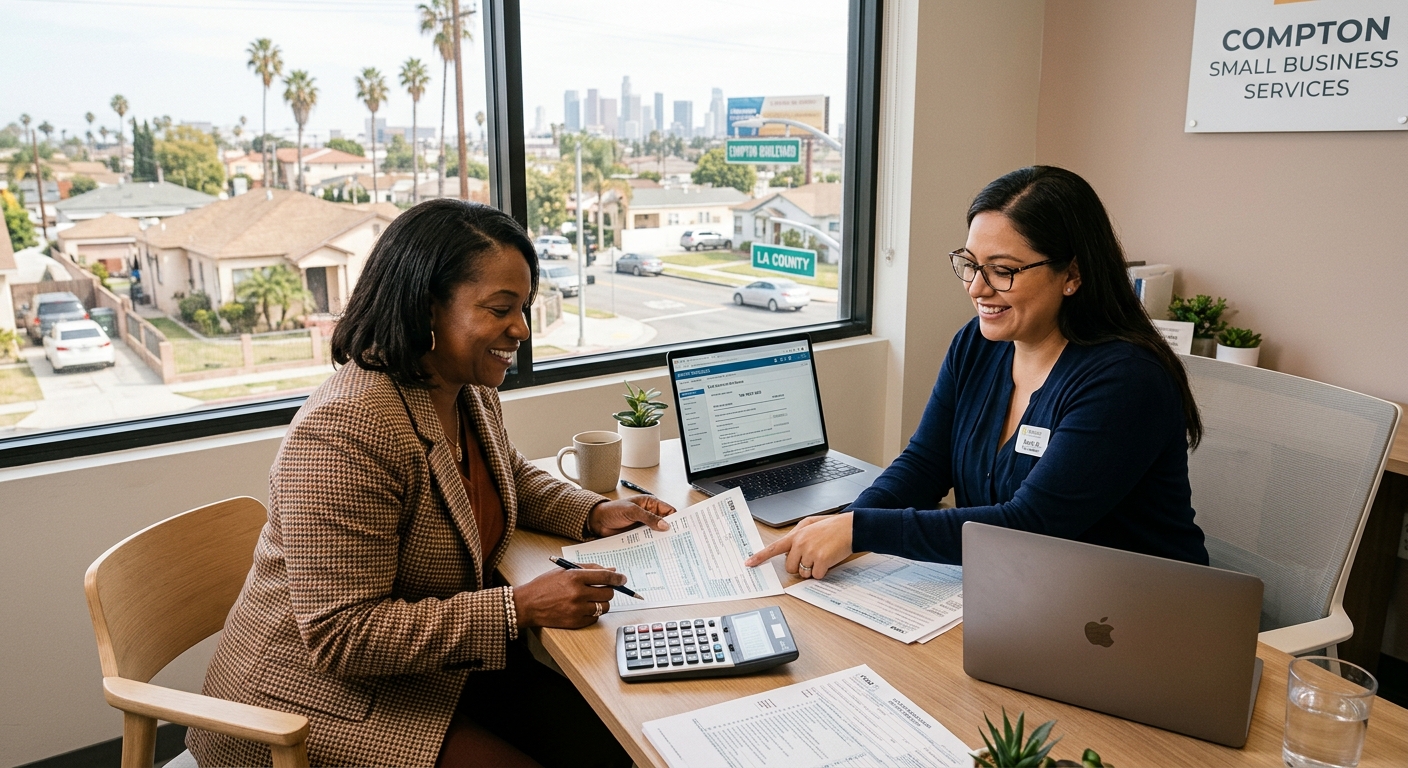
Tax preparation in Compton, CA does not have to feel like a guessing game. Whether you run a family business off Long Beach Boulevard, drive rideshare across the 710, or work a W-2 job while picking up 1099 side income, the way you file in 2026 directly affects how much money stays in your pocket. If you are searching for professional tax preparation services in Compton, you are in the right place. This guide breaks down exactly what Compton taxpayers need to know this year, in plain English, with real numbers.
This information is current as of 7/7/2026. Tax laws change frequently. Verify updates with the IRS or FTB if reading this later.
Quick Answer: What Compton Taxpayers Need to Know in 2026
If you live or work in Compton, three things matter most this year. First, the IRS now runs 126 active AI systems that flag returns for review, so sloppy or undocumented deductions get caught faster than ever. Second, California taxes you at both the state and federal level, and the Franchise Tax Board (FTB) has its own filing rules that differ from the IRS. Third, most Compton residents leave money on the table by missing deductions they legally qualify for. Good tax preparation fixes all three.
Why Tax Preparation in Compton, CA Requires Local Knowledge
California is one of the most aggressive tax states in the country. Between the FTB, city business taxes, and federal rules, a Compton taxpayer navigates layers most people in other states never think about. A generic online filing tool does not understand that a Compton barbershop owner files a Schedule C, may owe the $800 California LLC franchise tax, and could qualify for the qualified business income deduction all at the same time.
Compton sits inside Los Angeles County, which means residents face LA County property considerations, local sales tax rates, and business license requirements on top of state and federal filing. The stakes are real. A single misclassified worker, a missed quarterly estimate, or an unreported 1099 can trigger penalties that cost thousands.
According to the IRS Publication 334, Tax Guide for Small Business, self-employed individuals must report all income, even cash. In a working city like Compton with many cash-based businesses, this is where a lot of people get into trouble without meaning to.
Who This Guide Is For
- W-2 employees who want a bigger refund and fewer mistakes
- 1099 contractors and gig workers juggling rideshare, delivery, and freelance income
- Small business owners running shops, salons, trucking, and trades
- Real estate investors holding rental property in and around Compton
- Families trying to claim every credit they qualify for
The 2026 Tax Changes Every Compton Resident Should Understand
The 2025 federal tax law is still being implemented through 2026, and several changes directly affect Compton taxpayers. Bonus depreciation has been enhanced, which helps business owners who buy equipment or vehicles. The cap on deducting business interest costs has been eased. And research and development deduction rules changed for businesses that build products or software.
On the enforcement side, the IRS has quietly raised the bar. As reported in 2026, the agency now uses AI to select audits, detect fraud, and score compliance. What this means for you in plain English: the documentation standard went up without anyone announcing it. If you claim a deduction, you had better be able to prove it. This is exactly why professional tax preparation matters more in 2026 than it did five years ago.
Federal vs California: Know the Difference
This is the part that trips up most Compton filers. California does not automatically adopt every federal tax change. The state decides, provision by provision, whether to conform. That means a deduction that works on your federal return may not reduce your California tax at all. For example, California has historically not conformed to federal bonus depreciation in the same way. A quality preparer runs your numbers twice, once for the IRS and once for the FTB, so nothing slips through.
7 Deductions Compton Taxpayers Miss Most Often
Here are the deductions we see left unclaimed year after year. Each one is legal, documented, and available to the right taxpayer.
- Home office deduction. If you use part of your Compton home regularly and exclusively for business, you can deduct a portion of rent, utilities, and internet. A 200 square foot office in a 1,000 square foot home means 20 percent of qualifying costs. See the IRS home office deduction guidance.
- Vehicle mileage. For 2026, the standard mileage rate covers gas, wear, and insurance. A rideshare driver logging 18,000 business miles can deduct several thousand dollars, but only with a mileage log.
- Self-employment health insurance. If you are self-employed and pay your own health premiums, that cost is often deductible above the line.
- Retirement contributions. A SEP IRA or solo 401(k) lets a self-employed Compton business owner shelter income and lower taxable dollars at the same time.
- Startup and equipment costs. New business owners can deduct qualifying startup expenses and depreciate equipment.
- Cell phone and internet. The business-use percentage of your phone and home internet is deductible when tied to your work.
- The California Earned Income Tax Credit. Many working Compton families qualify for CalEITC and never claim it. This is refundable money.
Our Compton tax preparation team specializes in helping working families and small business owners capture every deduction they legally qualify for while staying fully compliant with both the IRS and the FTB.
If you are self-employed and want to see roughly what you will owe before you file, run your numbers through a self-employment tax calculator so there are no surprises at filing time.
KDA Case Study: Compton Trucking Owner Cuts Tax Bill by $11,400
Marcus, a 42-year-old owner-operator based in Compton, ran his trucking business as a sole proprietor for six years. He earned roughly $138,000 in net profit in 2025 and was paying self-employment tax on every dollar. He filed with a discount storefront preparer each year and never questioned the result, even though his tax bill kept climbing.
When Marcus came to KDA, we found three problems. He was not deducting his per diem for days on the road, he had never set up a retirement plan, and his sole proprietor structure was costing him thousands in unnecessary self-employment tax. We elected S corporation status, set a reasonable salary of $72,000, and moved the remaining profit to distributions that avoid the 15.3 percent self-employment tax. We added a solo 401(k) and captured his per diem and vehicle deductions properly.
The result was $11,400 in first-year tax savings between the entity restructure, retirement contributions, and recovered deductions. Marcus paid $3,900 for the planning and preparation work, which delivered nearly a 2.9x first-year return. More importantly, his documentation is now audit-ready in an environment where the IRS is watching pass-through entities closely.
Ready to see how we can help you? Explore more success stories on our case studies page to discover proven strategies that have saved our clients thousands in taxes.
Common Tax Mistakes Compton Residents Make
Even honest, hardworking filers make errors that cost real money. Here are the ones we correct most often.
Mistake 1: Ignoring Quarterly Estimated Taxes
If you are self-employed or run a business, the IRS and FTB expect you to pay tax throughout the year, not just in April. Skip your quarterly payments and you face underpayment penalties. A Compton contractor earning $90,000 net who never pays estimates can rack up hundreds in penalties before filing season even starts.
Mistake 2: Mixing Personal and Business Money
Running everything through one bank account is a red flag and a bookkeeping nightmare. Separate accounts make your deductions defensible and your life simpler. This is where clean bookkeeping and payroll support pays for itself.
Mistake 3: Forgetting the $800 California Franchise Tax
If you form an LLC in California, you owe the $800 annual franchise tax to the FTB, filed with Form 3522, even if the business made no money. Many new Compton entrepreneurs are blindsided by this bill in year one. See the California Franchise Tax Board for current requirements.
Mistake 4: Misclassifying Workers Under AB5
California’s AB5 rules make it harder to treat workers as 1099 contractors instead of W-2 employees. Get this wrong and you face back payroll taxes, penalties, and interest. If you have people helping in your Compton business, get the classification reviewed.
Mistake 5: Claiming Deductions Without Documentation
In the AI-driven IRS era, an undocumented deduction is a liability, not an asset. Keep receipts, logs, and records. If you cannot prove it, do not claim it, and if you can prove it, do not leave it on the table.
Should You File Yourself or Hire a Professional in Compton?
Here is a clear decision framework.
You can likely self-file if:
- You have a single W-2 and no side income
- You take the standard deduction
- You have no dependents with complex credit situations
- You own no business or rental property
You should hire a professional if:
- You have 1099 or self-employment income
- You own a business, LLC, or S corporation
- You own rental or investment property
- You had a major life change such as marriage, a new child, or a home purchase
- You received an IRS or FTB notice
For most Compton small business owners and gig workers, the fee for professional preparation is a fraction of what a good preparer saves. The math almost always favors getting help.
What to Bring to Your Tax Appointment
- All W-2 and 1099 forms
- Prior year tax return
- Business income and expense records
- Mileage logs and vehicle records
- Receipts for deductible purchases
- Records of estimated tax payments made
- Social Security numbers for you and any dependents
How KDA Helps Compton Business Owners Plan, Not Just File
Filing is looking backward. Planning is looking forward. The biggest savings happen when we work with you before December 31, not after. Through smart tax planning strategies, we help Compton business owners choose the right entity, time their income and expenses, fund retirement accounts, and stay ahead of quarterly obligations.
Business owners often benefit most from proactive support. We help business owners structure payroll, set reasonable salaries, and build audit-ready books so a CP2000 notice never turns into a crisis. In an environment where the IRS has more automated cross-matching than ever, being organized is a competitive advantage.
Ready to Reduce Your Tax Bill?
KDA Inc. specializes in strategic tax planning for business owners, S Corps, LLCs, and high-net-worth individuals. Book a personalized consultation and walk away with a clear plan.
Frequently Asked Questions About Tax Preparation in Compton, CA
How much does tax preparation cost in Compton?
Cost depends on complexity. A simple W-2 return costs less than a business return with a Schedule C, rental property, and multiple states. The value is in what a preparer saves you, not just the fee. Many Compton business owners save several times the cost of preparation.
Do I have to file a California return if I only worked part of the year?
Usually yes. California requires filing if your income exceeds the state threshold, even for part-year residents. A preparer can confirm your exact obligation and make sure you do not overpay.
What happens if I miss the tax deadline?
Filing late without an extension triggers a failure-to-file penalty, and paying late triggers a separate penalty plus interest. Even if you cannot pay in full, filing on time reduces the damage significantly.
Can I deduct my car if I drive for rideshare in Compton?
Yes, but only the business-use portion, and you need a mileage log. You can use the standard mileage rate or actual expenses. A preparer will run both to see which saves you more.
What is the $800 California LLC fee and do I owe it?
If you have a California LLC, you owe the $800 annual franchise tax to the FTB regardless of profit. It is filed using Form 3522. New business owners are frequently surprised by this.
Will hiring a preparer reduce my audit risk?
A skilled preparer reduces errors and ensures your deductions are documented and defensible, which lowers the chance of a flag and prepares you if one comes. It does not guarantee no audit, but it puts you in a far stronger position.
Does KDA serve clients in Compton specifically?
Yes. We work with taxpayers throughout Compton and Los Angeles County, from W-2 families to trucking companies and real estate investors, with strategies tailored to California’s rules.
Special Situations and Edge Cases
Some Compton taxpayers face unusual scenarios that generic filing tools handle poorly. If you earned income in more than one state, worked as an independent contractor for a company outside California, or received a large one-time payment, your return needs careful attention. Multi-state filing, part-year residency, and married-filing-separately decisions can swing your tax bill by thousands of dollars. These are exactly the situations where sitting down with a professional pays off.
Ready to work with a tax professional who understands Compton taxpayers? Explore our Compton, CA tax preparation services or book a consultation below.
Book Your 2026 Compton Tax Strategy Session
Stop overpaying and start keeping more of what you earn. If you are a Compton business owner, gig worker, or family wondering whether you are leaving money on the table, let’s find out together. Our team will review your situation, uncover missed deductions, and build a filing and planning strategy that keeps you compliant with both the IRS and the FTB. Click here to book your consultation now.



