
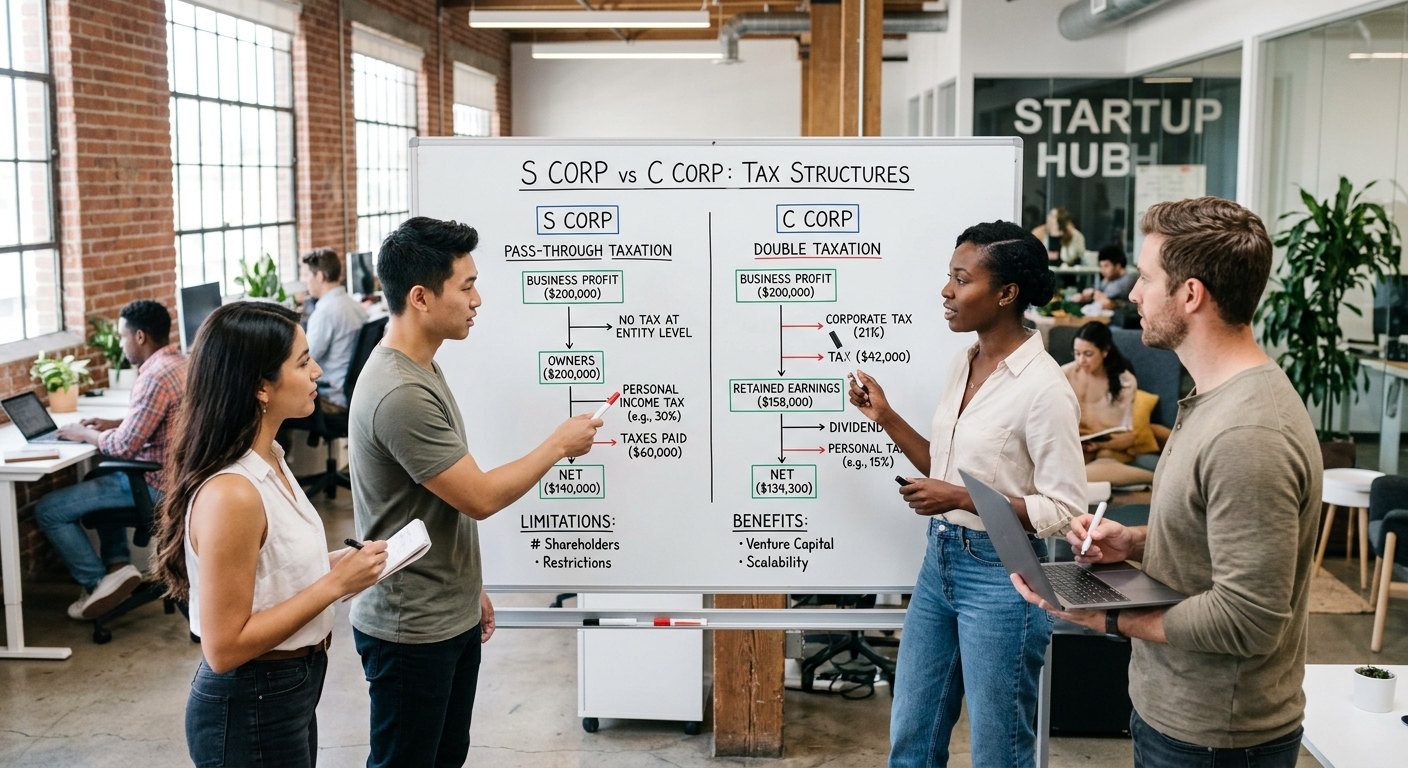
Most founders assume there is only one serious path for a high growth company: incorporate quickly, raise money, worry about taxes later. That shortcut is expensive. The choice you make on day one about whether your startup is taxed as an S corporation or a C corporation can swing your lifetime tax bill by six or even seven figures.
If you are comparing a startup company s corp or c corp structure, you are not choosing between two pieces of paperwork. You are choosing how the IRS will treat every dollar of profit, salary, stock option and exit check that touches your cap table.
Quick Answer
For a bootstrapped or lightly funded startup where one to four US based founders expect to take profit out of the business within a few years, an S corporation often creates lower total taxes because profit passes through once and can reduce self employment tax if salaries are structured correctly. For a company that plans to raise institutional venture capital, issue preferred stock, or aim for a large stock sale or IPO, a C corporation is usually mandatory because S corporations cannot have preferred stock, have restrictions on shareholders and still face a 1.5 percent California franchise tax on net income.
The right answer is not about what your lawyer prefers. It is about matching your tax structure to your funding plan, growth speed and exit strategy.
How the IRS Taxes S Corps and C Corps for Startups
Before you can choose, you need to see how these entities actually show up on tax returns.
C corporation basics
A C corporation is the default federal tax status for a corporation. The company files its own corporate tax return on Form 1120 and pays a flat 21 percent federal corporate tax rate on taxable income, plus any state corporate tax. Shareholders do not report corporate profit on their personal returns unless the company distributes dividends or they sell stock.
This creates what founders call double taxation. First, the corporation pays income tax. Then, when it pays a dividend, shareholders pay individual income tax on the dividend. If those shareholders are in California and in a high federal bracket, that second layer can easily reach 30 percent or more of the dividend amount.
The detailed rules for corporate taxation are laid out in IRS Publication 542, which is worth skimming if you plan to operate as a C corporation for more than a year or two.
S corporation basics
An S corporation is not a type of entity at the state level. It is a tax status you elect by filing Form 2553 with the IRS. An eligible corporation or LLC that makes this election becomes a pass through entity for federal tax purposes. The company generally does not pay federal income tax. Instead, it files Form 1120 S, and its profit or loss passes through to shareholders, who report it on their individual returns using Schedule E.
S corporation shareholders who work in the business must take a reasonable salary that is subject to payroll taxes, but any additional profit distributions are not subject to self employment tax. This is where significant savings can appear for profitable startups with active founder owners.
California still imposes a 1.5 percent franchise tax on S corporation net income, with a minimum annual tax, so the pass through treatment does not eliminate state tax. It just changes who pays it and how.
Startup specific twist
The key difference for startups is timing. A C corporation might pay little or no tax for years if it reinvests all revenue and generates losses. An S corporation might pass losses through to founders during those early years, giving them deductions they can use against other income. But once the business becomes profitable, the way those profits are taxed diverges dramatically.
Choosing a Startup Company S Corp or C Corp Structure
Successful founders do not start with forms. They start with the end in mind and work backward. Deciding between an S corporation and C corporation is really answering three questions.
Question 1: What is your funding path for the next five years
If your realistic path involves angel investors only, no institutional venture capital and no need for preferred stock, an S corporation can work very well. The S corporation rules limit shareholders to 100, require them to be US persons in most cases, and prohibit multiple classes of stock. That alone blocks a standard venture capital preferred stock structure.
If you plan to raise a priced round from venture capital funds, especially Delaware based funds, you will almost certainly need a C corporation with the ability to issue preferred shares, standard option plans and convertible instruments. In practice, funds rarely invest directly into an S corporation.
Many serious business owners building professional services, e commerce or specialized tech consultancies choose S status precisely because they do not want or need institutional equity. For them, lower ongoing taxes on profit matter more than venture capital preferences.
Question 2: How quickly will you generate real profit
Consider a two founder California startup that expects to become profitable in year two and stay lean. With C corporation status, the company might pay that 21 percent federal rate plus California corporate tax and retain profits for growth. The founders receive W 2 salaries that are subject to payroll tax and might receive some dividends later that trigger another layer of tax.
With S corporation status, that same profit passes through. The founders still take reasonable salaries, but distributions above salary avoid self employment tax. If the company earns 300,000 in net profit and pays each founder a 120,000 salary, there might be 60,000 left for each founder as a distribution that escapes the 15.3 percent combined Social Security and Medicare tax up to the wage base. That is roughly 9,000 each in additional savings per year once wages exceed the Social Security cap.
The details of this pass through treatment and reasonable compensation are discussed further in our complete S corporation tax strategy guide for California, which is required reading for any founder considering an S election.
Question 3: Do you want near term tax savings or maximum long term flexibility
S corporations tend to create more near term tax savings for actively involved founders who are pulling money out of the business. C corporations provide more flexibility for complex cap tables, international investors and equity compensation structures. They also give access to potential Section 1202 Qualified Small Business Stock treatment, which can exclude up to 10 million of gain on qualifying stock at exit if strict rules are met.
Balancing these tradeoffs is where professional guidance matters. Our entity formation services are built around that choice, not just filing articles. In many scenarios we model both paths out over five to ten years for founders so they see real numbers before they sign anything.
If you want to sanity check your own projections, plug your expected revenue and profit into this small business tax calculator to see how quickly your tax bill can grow once the business moves out of the early loss phase.
Real Numbers: How Much Tax Can S Corp Status Save a Startup Founder
Abstract rules do not move founders. Cash flow does. So let us put some concrete numbers on the table for a California based software startup with one founder.
Scenario A: Single member LLC taxed as sole proprietor
Assume the business nets 220,000 after expenses in year three. As a sole proprietor, the entire 220,000 is subject to self employment tax plus income tax. Roughly, self employment tax could be around 21,000 after the wage base limit, and combined federal and California income tax for a high earning founder could easily land above 50,000. Total burden might be in the 70,000 plus range, depending on deductions and credits.
Scenario B: S corporation with reasonable salary
Now assume that same business has elected S corporation status. The founder takes a 120,000 W 2 salary. Payroll taxes apply to that salary. The remaining 100,000 flows through as S corporation profit on Schedule K 1. That 100,000 is still subject to income tax but not self employment tax.
At current Social Security and Medicare rates, this simple move can cut self employment or payroll taxes by roughly 7,500 to 10,000 per year for one founder, and much more for multi founder teams, while keeping the IRS satisfied that salary is reasonable for the role and industry.
According to IRS Publication 535, the underlying business deductions do not change between these structures. What changes is the way the IRS layers payroll taxes on top of that profit.
Scenario C: C corporation paying only salary
If the business is a C corporation and pays out the full 220,000 as founder salary, corporate taxable income is near zero and there may be little corporate tax. The entire 220,000 appears on the founder s personal return as W 2 income subject to full payroll and income tax. There are no pass through distributions to optimize self employment tax.
On pure cash tax cost, the S corporation usually wins over both a default LLC and a C corporation for this moderate profit, actively managed startup, especially in California where high marginal income tax rates amplify the benefit of shifting income away from payroll taxes and into pass through profit.
Red Flag Alert: Common Mistakes When Electing S Corp Status
Founders frequently hear that S corporations are a tax hack and rush into the election without understanding the traps. That is how you end up on the wrong side of an IRS notice or a California Franchise Tax Board letter.
Missing or late Form 2553
You do not become an S corporation just by saying so. You must file Form 2553 and have the IRS accept it. Late elections can sometimes be fixed under IRS relief procedures, but not always. Operating for a year assuming you are an S corporation when the IRS has you coded as a C corporation is an expensive mistake.
Unreasonable salaries
Some founders try to push their salary down to token levels and pull almost all cash out as distributions. That is an invitation for the IRS to reclassify distributions as wages and assess back payroll taxes, penalties and interest. The reasonable compensation standard looks at what you would pay someone else to do your job, your role mix, and market data for your industry.
Ineligible shareholders and multiple classes of stock
S corporations cannot have non resident alien shareholders, most types of entities as shareholders, or more than one class of stock. If you accidentally admit an ineligible shareholder or create an economic arrangement that counts as a second class of stock, you can blow your S election retroactively, pushing you back into C corporation taxation and creating a mess of amended returns.
The eligibility rules are detailed and technical. They are summarized in IRS instructions for Form 2553. Founders should not experiment here. Getting it wrong can cost far more than any legal or tax advisory fee.
What If You Plan To Raise Venture Capital or Offer Stock Options
Many founders start as an LLC or S corporation and assume they will convert to a C corporation later if investors demand it. That can work, but you should understand the tradeoffs before you hang a shingle.
Why VCs insist on C corporations
Venture capital funds typically have tax exempt and foreign investors of their own. They do not want pass through profit allocations from S corporations. They also need preferred stock, liquidation preferences, anti dilution provisions and other features that S corporations cannot offer. A Delaware C corporation is the accepted standard for this ecosystem.
Stock options, QSBS and long term planning
C corporations offer much more flexibility for stock option plans, restricted stock and other equity incentives. They also open the door to Section 1202 Qualified Small Business Stock treatment. If your company qualifies and you hold the stock for at least five years, you may exclude up to 10 million of gain per shareholder on sale, subject to detailed rules.
For a venture scale startup with a realistic shot at a big exit, that potential exclusion can dwarf the annual payroll tax savings an S corporation would have delivered in the early years.
Converting later is possible but not free
You can often convert an LLC or S corporation to a C corporation later, but the timing is delicate, especially once the company owns valuable intellectual property or has significant built in gain. It is far cheaper to set the right structure early than to unwind a misaligned structure five years in.
KDA Case Study: SaaS Founder Uses S Corp Strategy Before a Later C Corp Flip
Consider a California based SaaS founder who came to KDA after two years of operating as a single member LLC. The business generated 180,000 of net profit in year two, and the founder was shocked at the size of the self employment tax bill.
We reviewed the growth plan. The founder anticipated staying self funded for at least three more years and did not plan to raise institutional venture capital. We recommended forming a corporation, making an S election, and running a structured reasonable compensation analysis for the founder s role across engineering, sales and management.
In year three as an S corporation, the business produced 260,000 of profit before owner compensation. We set a 130,000 W 2 salary and treated the remaining 130,000 as S corporation profit. Compared to the prior sole proprietor structure, the founder saved just over 9,500 in federal self employment and payroll taxes that year, while California tax stayed roughly flat due to the S corporation franchise tax.
Two years later, the company began serious conversations with a small venture fund. At that point, KDA coordinated with corporate counsel to convert the S corporation to a C corporation before term sheets were signed, preserving clean financials for due diligence while locking in four years of earlier tax savings. Over the five year period, the founder paid KDA roughly 14,000 in combined advisory and compliance fees and realized more than 32,000 in tax savings, a little over a 2.2 times first five year return on investment.
Ready to see how we can help you? Explore more success stories on our case studies page to discover proven strategies that have saved our clients thousands in taxes.
Will This Choice Trigger an Audit
Choosing S corporation status instead of C corporation status does not automatically increase your audit risk. What attracts attention are inconsistent returns, extreme salary to distribution ratios and sloppy documentation.
The IRS has been explicit in guidance and enforcement actions that it focuses on S corporation reasonable compensation and on failure to file required payroll returns. If your books are clean, salaries are defensible and you file all required employment and information returns on time, an S corporation is not a red flag by itself.
C corporations carry their own risks. Accumulated earnings that sit on the balance sheet year after year without a clear business purpose can invite questions. So can informal loans to shareholders, undocumented fringe benefits and personal expenses disguised as corporate deductions.
Can You Change From S Corp to C Corp or Vice Versa
Most startup founders want the right to change their minds. The tax code allows that, but on a schedule and with consequences.
Changing from S corporation to C corporation
You can revoke an S election and return to C corporation status. The corporation then becomes subject to corporate income tax. Certain built in gain rules can cause old appreciation from the S years to be taxed at the corporate level if assets are sold within a recognition period. This is another reason to coordinate with a strategist before changing status.
Changing from C corporation to S corporation
A C corporation can elect S status if it meets all the eligibility rules. However, there are restrictions on how soon you can reelect S status after terminating it, and there can be taxes on built in gains recognized after the election. Once real value exists in the business, entity conversions stop being simple checkbox exercises.
California Specific Considerations for Startup Entities
California layers its own rules on top of federal law. Whether you choose S corporation or C corporation status, you will deal with the state s franchise tax system, minimum taxes and various filing fees.
S corporations owe a 1.5 percent tax on net income in California, with a minimum annual tax that applies even in low profit years. C corporations pay the general corporation tax rate on income apportioned to California. Both structures must file state returns every year.
For founders with W 2 jobs on top of startup income, understanding how these entity level California taxes interact with your personal bracket is critical. That is one reason many California founders work with specialized advisors rather than generic national software. Our team at KDA frequently coordinates with tax planning services for self employed and corporate clients to keep federal and state strategies aligned.
Fast Tax Fact: How To Decide in Under an Hour
If you are overwhelmed, here is a simple decision framework you can walk through before your next meeting with an advisor.
Choose C corporation now if:
- You are raising or seriously planning to raise institutional venture capital within 12 to 18 months.
- You need preferred stock, complex option plans or cross border investors from day one.
- Your expected exit value realistically exceeds the range where Section 1202 QSBS could make a dramatic difference.
Lean toward S corporation if:
- You and one or two cofounders are US individuals with no foreign or entity investors on the horizon.
- Your business will generate real profit in the next two to three years and you expect to pull cash out to fund your life.
- You want to contain self employment and payroll taxes as profit grows.
Stay as a default LLC or C corporation for now if:
- You are still validating the idea and expect losses for several years.
- Your ownership structure or investor mix clearly disqualifies you from S status.
- You do not yet have enough data to run a meaningful multi year comparison.
Ready to Reduce Your Tax Bill?
KDA Inc. specializes in strategic tax planning for business owners, S Corps, LLCs, and high-net-worth individuals. Book a personalized consultation and walk away with a clear plan.
Frequently Asked Questions About S Corps and C Corps for Startups
What if my startup loses money for the first few years
If you expect sustained losses and you have other income to offset, an S corporation can make those losses available on your personal return, subject to basis and at risk rules. If you have no other income and will not use the losses, the value of that pass through deduction is smaller, and a C corporation might be acceptable early on.
Can non US founders use S corporation status
Non resident aliens cannot be shareholders in an S corporation. If any cofounder is a non resident or if you expect foreign investors, an S corporation is usually off the table. In those cases, you typically look at C corporation structures and sometimes layered entity designs involving partnerships for tax efficiency.
Does an S corporation change how I run payroll
Yes. As an S corporation shareholder employee, you must run real payroll, file Forms 941 and 940, issue W 2s and comply with employment law. This is not optional. Ignoring payroll is a fast way to attract IRS attention. Many founders outsource bookkeeping and payroll to ensure compliance while they focus on product and sales.
Where can I verify the latest IRS guidance
Rules change. This article is current as of July 5, 2026. For technical details, always cross check with official IRS sources, including Publication 542 for corporations, Publication 535 for business expenses, and the latest instructions for Form 2553.
This information is current as of 7/5/2026. Tax laws change frequently. Verify updates with the IRS or California Franchise Tax Board if you are reading this later.
Book Your Tax Strategy Session
If you are still unsure which path your startup should take, do not guess. A wrong decision on S corporation versus C corporation status can cost far more than any legal or tax fee, and fixing it years later is always harder than doing it right up front. Book a personalized strategy session with our team and walk away with a clear, written recommendation based on your revenue model, funding plan and exit goals. Click here to book your consultation now.
Key Takeaway: The IRS is not hiding these rules. Most founders simply have never seen the side by side math. Once you do, the right structure for your startup becomes obvious.



