
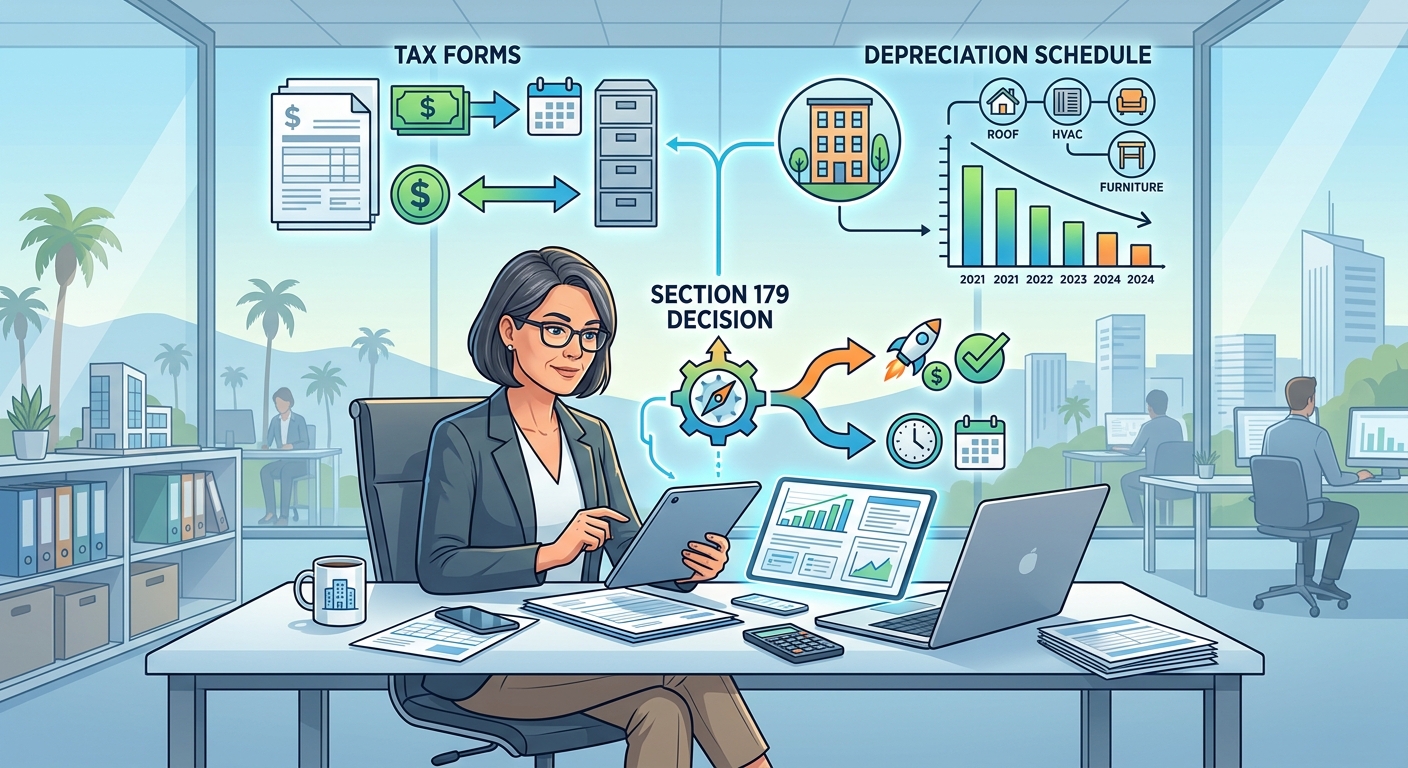
Most California rental property owners have heard of Section 179, but many were told it never applies to rentals. That blanket advice is wrong enough that it can cost a serious investor five figures in unnecessary tax every year. Used correctly, Section 179 can accelerate deductions on certain assets tied to your rentals while keeping you well inside IRS rules.
This article walks California investors through the real 2024 landscape for Section 179 and rentals, clarifies how federal rules interact with California treatment, and shows where the opportunity ends so you do not stumble into an audit problem.
Quick Answer
For the 2024 tax year, most long term residential rentals in California still cannot expense the building itself under Section 179, but you may be able to use Section 179 on certain business assets tied to your rental activity, such as computers, office equipment, vehicles, and in some cases equipment used in a short term rental business. The building and major structural components stay on regular depreciation under IRS Publication 527, while equipment and other tangible personal property follow the rules in IRS Publication 946.
How section 179 rental property rules 2024 california actually work
Section 179 is a federal tax rule that lets a business deduct the full cost of qualifying tangible personal property in the year it is placed in service, instead of depreciating it over several years. For 2024, the federal Section 179 limit is in the million dollar range, and it begins to phase out once your business places several million dollars of qualifying property in service. The exact numbers are updated regularly in IRS guidance, so your CPA will confirm the current limits when you file.
For rental property owners, the key distinction is whether the IRS treats your activity as a business with active participation or as a passive investment. Traditional long term rentals where tenants sign a one year lease and you provide minimal services are usually considered passive. In that setting, Section 179 on the building itself is off the table, and even equipment has to clear some hurdles.
Short term rentals and more intensive operations look different. If you run a portfolio of nightly or weekly rentals, provide hotel level services, and materially participate, the IRS often views that as an active business rather than passive rental income. In that case, more of your assets fall into the bucket where Section 179 and bonus depreciation might be available, subject to all the usual income limitations and at risk rules.
On top of the federal rules, California sometimes decouples from federal expensing limits. The state has historically been more conservative about depreciation and Section 179, so a California investor can easily wind up with one set of numbers on the federal return and another for the state return. That split treatment is normal, but it increases the bookkeeping burden.
What Section 179 can never do on rentals
There are bright lines you cannot cross. Section 179 does not let you expense the purchase price of a residential rental building. It also does not apply to land. Those amounts must be depreciated over 27.5 years for residential property or 39 years for commercial property. Cost segregation studies can move portions of the purchase price into shorter lived property classes, but the core building structure never becomes eligible for Section 179 on a typical rental.
Section 179 also cannot turn a fundamentally passive activity into an active business just to unlock deductions. If your facts do not support material participation, trying to force a business label can put you in the audit crosshairs.
When California landlords can and cannot use Section 179
To understand when Section 179 fits, start with how the IRS classifies your rental activity, then overlay California rules. Many serious landlords operate like small business owners. They advertise, keep books, manage repairs, and sometimes even have employees. The tax code still divides them into passive and non passive buckets.
If you own two long term rentals in Los Angeles with one year leases and you outsource property management, you almost certainly fall into the passive category. In that case, Section 179 for rental improvements is highly limited. You still deduct appliances, carpeting, and similar items, but you do it with standard depreciation methods outlined in Publication 527, not with an immediate Section 179 write off.
If instead you operate a cluster of short term rentals in San Diego, personally manage bookings, cleaning, and guest services, and average stays under seven days, the IRS is more likely to view your activity as a trade or business. In that scenario, certain furnishings, equipment, and even vehicles used in the business may be eligible for Section 179 and bonus depreciation, as long as they meet the active use tests in Publication 946.
Investors who are growing a sizable portfolio often benefit from working with advisors who focus on real estate investors. The gray areas around participation, grouping elections, and classification can dramatically change which assets qualify for immediate expensing and which stay on long timelines.
Because Section 179 interacts with entity choice, passive loss rules, and qualified business income deductions, it is rarely a one line decision. For a deeper overview of how all the moving pieces fit together for California landlords, you can review our broader California real estate tax strategies guide and use this article to zoom in specifically on Section 179 issues.
Federal versus California treatment
Even when an asset is eligible for Section 179 at the federal level, California may cap or disallow that deduction on the state return. The gap shows up most clearly for high income investors placing large amounts of equipment in service. You still capture the federal benefit, but you track a different basis and depreciation schedule for California. That dual tracking belongs on a well structured depreciation schedule, not in a spreadsheet you update once a year during tax season.
Step by step: Using Section 179 on rental related assets
The mechanics of claiming Section 179 on rental related assets are straightforward once you have done the strategic thinking. The implementation shows up on Form 4562, Depreciation and Amortization, which flows through to Schedule E or your business return.
Step 1: Identify assets that are truly business property
Start by listing everything you purchased during the year that supports your rental activity. Common candidates include laptops used solely for managing the properties, office furniture in a dedicated rental management space, software subscriptions, and in some structures, vehicles used to travel between properties and job sites.
For each item, document how it is used. An SUV that is 90 percent personal and 10 percent rental related is rarely a good Section 179 candidate. A dedicated work truck that never hauls kids to school is a different story. The IRS expects you to back up business use percentages with mileage logs and calendars if you are ever examined.
Step 2: Confirm that your rental activity qualifies as a business
If your rental activity is reported on Schedule E as passive with no grouping election to a trade or business, your Section 179 options are narrower. You may still claim Section 179 on some non rental business activities, but you will not use rental losses to drive taxable income below zero using Section 179 alone. On the other hand, if your short term rental operation meets the tests to be treated as a business with non passive income, Section 179 deductions can directly offset that income.
At this stage, many landlords realize they are closer to operating a real business than they thought. That realization often leads to conversations about entity structure and more proactive real estate tax preparation services. The right structure can make the difference between a deduction that sticks and a deduction the IRS reclassifies years later.
Step 3: Choose between Section 179, bonus depreciation, and regular depreciation
Section 179 is not the only way to accelerate write offs. Bonus depreciation allows an immediate deduction for a percentage of the cost of qualifying property, subject to the phase down schedule that began after 2022. For 2024, bonus percentages are lower than they were at peak levels, but they still matter for high dollar purchases.
In practice, you decide asset by asset whether to elect Section 179, rely on bonus depreciation if available, or simply depreciate over the normal life. Because Section 179 is limited by your business income, excess Section 179 can carry forward, but the sequencing between Section 179 and bonus depreciation affects your overall result.
Step 4: Model your tax result before you buy
Before you spend $40,000 on new equipment, run the numbers. A landlord in the 35 percent federal bracket and 9.3 percent California bracket who takes a $40,000 Section 179 deduction on eligible business property can save roughly $17,000 in combined tax. That kind of savings can justify better equipment or free up cash to fund the next down payment.
If you expect to sell a property in the near term, you also model recapture tax. When you sell, the IRS expects you to pay tax on prior depreciation deductions, often at higher ordinary income rates. Tools such as a simple capital gains tax calculator can give you a rough sense of the exit tax hit, but a full projection should include depreciation recapture.
Step 5: Document everything
Once you decide to use Section 179 on a particular asset, keep:
- The purchase invoice
- Proof of payment
- Documentation of when the asset was placed in service
- Business use calculations, such as mileage logs
- The completed Form 4562 and depreciation schedule
According to IRS recordkeeping guidance, you should generally keep these records for at least three years after the return is filed, but longer is wise for real estate because property transactions often trigger questions about older years.
Pro Tip: Keep a running depreciation schedule that tracks federal and California basis separately. That single spreadsheet or software report can save hours every time you refinance, sell, or respond to a notice.
KDA Case Study: California investor uses Section 179 the smart way
Consider Maria, a high earning technology professional in San Jose who owns three long term rentals and one short term coastal property that she operates as a business. In 2024, she decided to systematize her rental operations. She leased a small office, purchased a dedicated computer, office furniture, and a work truck used exclusively for property visits, hauling materials, and meeting contractors.
Before calling our team, Maria assumed none of these costs were immediately deductible because they were tied to rentals. Her prior preparer had taken straight line depreciation on every asset, which meant small write offs spread over five or seven years. That approach left her paying more tax up front than necessary.
Our team reviewed her facts and confirmed that her short term rental activity qualified as a trade or business with material participation. We also confirmed that the truck was exclusively used for rental operations. For 2024, Maria spent $65,000 on the truck and $8,000 on office equipment tied to the rental business. We elected Section 179 on these assets to the extent of her business income, generating roughly $25,000 in combined federal and California tax savings in the first year.
Maria paid about $4,000 for comprehensive tax planning and preparation. Her first year return on that investment was more than six times her fee, and she will continue to benefit from stronger entity choices and tracking going forward. Just as important, the Section 179 decisions were fully documented and aligned with IRS rules, so she can grow without worrying that an exam will undo her strategy.
Ready to see how we can help you? Explore more success stories on our case studies page to discover proven strategies that have saved our clients thousands in taxes.
Common mistakes with Section 179 on rentals
With this much nuance, it is easy for landlords to get tripped up. Some mistakes just delay deductions, while others can trigger penalties and interest.
Trying to Section 179 the building
The most obvious error is attempting to use Section 179 on the cost of the rental building itself. That deduction will not survive an audit. The IRS has clear guidance in Publication 527 about depreciating residential rental property over 27.5 years, and there is simply no election that turns the structure into a one year write off.
Ignoring California decoupling
Another common mistake is claiming the full federal Section 179 deduction on the California return without checking state limits. If the Franchise Tax Board later adjusts your return, you could face additional tax plus late payment penalties. Aligning your federal and state depreciation schedules correctly on day one keeps these surprises away.
Overstating business use on mixed use assets
Overly aggressive business use percentages on vehicles, cell phones, or other mixed use assets attract attention. The IRS sees a huge difference between a 60 percent business use truck supported by detailed logs and a 100 percent business use SUV that obviously doubles as a family car. Reasonable assumptions plus solid documentation are your best defense.
Red Flag Alert: If you are claiming Section 179 on a vehicle or equipment and you do not have mileage logs, purchase records, and a clear explanation of business use, you are betting that the IRS will never ask. That is not a solid long term strategy for someone building a portfolio worth millions.
Will Section 179 increase my audit risk?
Section 179 by itself is not a red flag. What draws attention is a pattern of deductions that does not match your facts. For example, a full Section 179 deduction on a luxury SUV in a year where you report only one small rental might look suspicious. So would large Section 179 claims in a year when you report minimal business income.
Used correctly, Section 179 simply accelerates deductions you are entitled to take anyway. That acceleration must be consistent with your income, entity structure, and participation level. Working with a firm that handles both tax planning and compliance for landlords keeps your strategy grounded in what the IRS actually accepts.
How this fits into your larger California real estate tax plan
Section 179 is one lever in a much bigger control panel. California investors also need to think about cost segregation, 1031 exchanges, passive loss rules, qualified business income deductions, and local transfer taxes. A decision about Section 179 on one asset can affect your ability to use losses, qualify for certain credits, or show the right income on a mortgage application.
If you own rentals through an LLC or S corporation, Section 179 works at the entity level, but the deduction flows through to your personal return. That makes coordination between your entity returns and your Form 1040 essential. If you are still filing everything on a basic Schedule E without planning, there is usually money left on the table.
This information is current as of 7/3/2026. Tax laws change frequently. Always confirm current Section 179 limits and California conformity before you finalize major purchases or elections.
Ready to Reduce Your Tax Bill?
KDA Inc. specializes in strategic tax planning for business owners, S Corps, LLCs, and high-net-worth individuals. Book a personalized consultation and walk away with a clear plan.
Frequently asked questions for California landlords
Can I use Section 179 on appliances in my rental?
For most long term residential rentals, appliances are depreciated over their class life using MACRS rules rather than Section 179. In an active short term rental business, some appliances may qualify for Section 179 if they meet business use tests. Publication 946 outlines how different asset classes are treated, and Form 4562 is where you or your preparer report the final decision.
What if I already claimed Section 179 incorrectly?
If a prior return took Section 179 deductions that do not match the rules, you can usually correct the mistake by filing an amended return. Fixing errors proactively is almost always cheaper and less stressful than waiting for the IRS or the Franchise Tax Board to send a notice. A qualified advisor can help you weigh whether an amendment or an accounting method change is the better path.
Is Section 179 better than bonus depreciation?
Neither tool is automatically better. Section 179 is limited by business income but can be directed to specific assets. Bonus depreciation is not tied to income limits in the same way, but the percentage available is phasing down, and not all assets qualify. In practice, most serious investors use a mix of regular depreciation, bonus depreciation, and Section 179 to shape their taxable income over several years rather than chasing the biggest deduction in a single year.
Do I need an LLC or S corporation to use Section 179?
No. Section 179 is available to sole proprietors, partnerships, S corporations, and C corporations. The entity choice affects how income and deductions flow, liability protection, and other planning issues, but it does not by itself turn Section 179 on or off. That said, landlords with meaningful portfolios often benefit from a more formal structure for reasons that go beyond this one deduction.
Book your tax strategy session
If you own California rentals and you are not sure whether you are using Section 179 and other depreciation tools safely and effectively, it is time to get specific. A targeted planning session can reveal whether you are leaving five figures on the table or taking risks that will not hold up under scrutiny. Click here to book your consultation now.



