
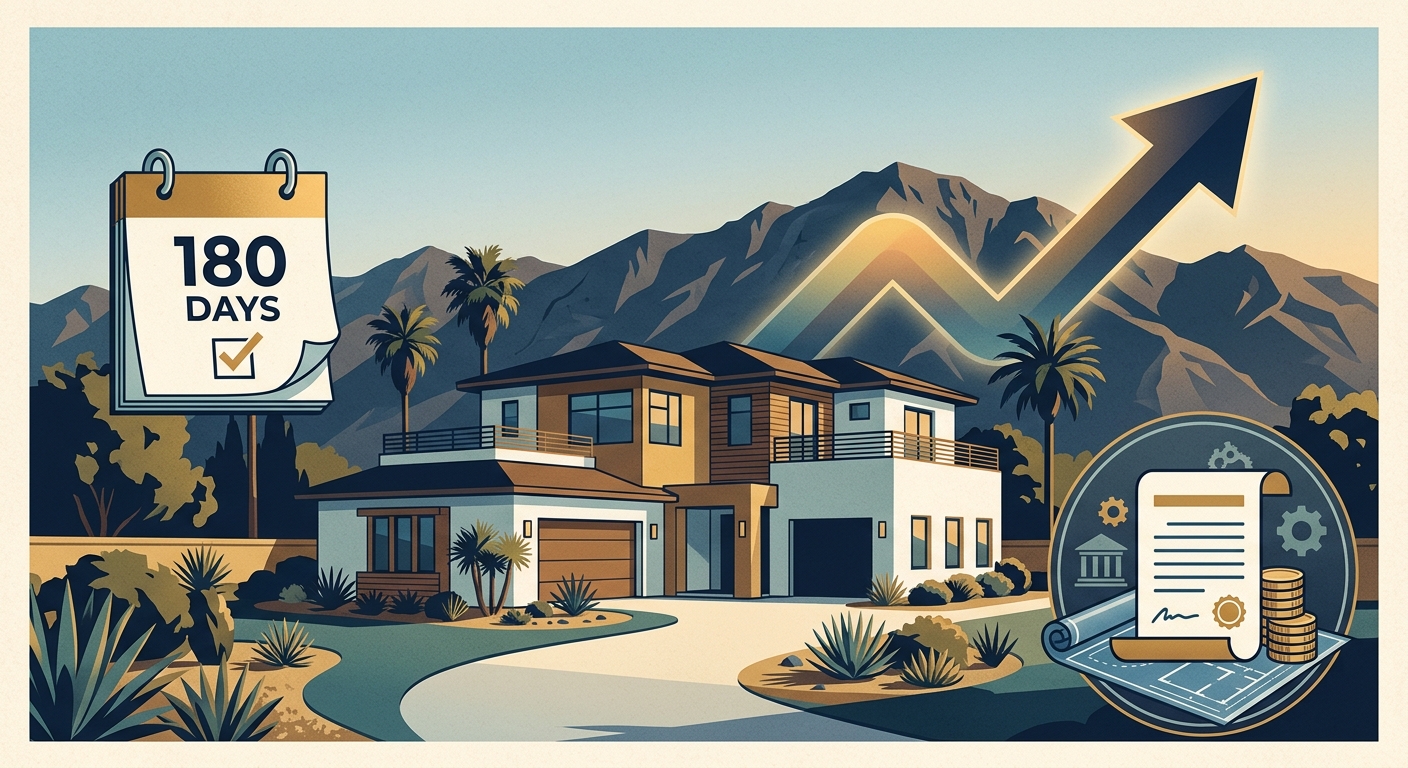
If you own investment property in the Inland Empire, a 1031 exchange Rancho Cucamonga CA investors rely on may be the single most powerful tool you have for building generational wealth without handing a huge chunk of your gain to the IRS and the Franchise Tax Board. Sell a rental, reinvest the proceeds into another qualifying property, and defer the tax. That is the headline. The reality has more moving parts, tighter deadlines, and more traps than most investors realize until it is too late.
This information is current as of 7/3/2026. Tax laws change frequently. Verify updates with the IRS or FTB if reading this later.
Quick Answer
A 1031 exchange lets you sell an investment or business-use property and defer both federal capital gains tax and California state tax by reinvesting the full proceeds into a “like-kind” replacement property. In Rancho Cucamonga, where a duplex or small commercial building bought a decade ago may carry $300,000 or more in embedded gain, the deferral can be worth well over $100,000. The catch: you have 45 days to identify a replacement and 180 days to close, and the money must never touch your hands.
What Is a 1031 Exchange, in Plain English?
Named after Section 1031 of the Internal Revenue Code, a 1031 exchange (in plain English: a “swap and defer” transaction) allows a real estate investor to sell one property and buy another of equal or greater value while postponing the tax bill on the gain. You are not erasing the tax. You are kicking it down the road, sometimes indefinitely, and reinvesting money that would otherwise have gone to the government.
Here is why that matters so much for an Inland Empire investor. Say you bought a Rancho Cucamonga rental in 2014 for $340,000. Today it is worth $640,000. If you sell outright, you face capital gains tax on roughly $300,000 of appreciation, plus depreciation recapture on the deductions you already claimed, plus California income tax that can reach 13.3% at the top. Stack those together and a straight sale can cost you $120,000 to $150,000 in combined tax. A properly structured exchange defers nearly all of it.
Section 1031 now applies only to real property held for business or investment use. Personal residences do not qualify. Property held primarily to flip does not qualify. The relinquished property and the replacement property both need to be genuine investment or business assets. You can review the fundamentals directly through IRS like-kind exchange guidance before you commit to a strategy.
Key Takeaway: A 1031 exchange defers, not eliminates, tax. Done right, it keeps six figures of capital working for you instead of sitting in a tax payment.
The Two Deadlines That Make or Break Your 1031 Exchange in Rancho Cucamonga
Nothing sinks an exchange faster than a missed deadline, and the IRS shows zero mercy here. There are two clocks, and they start ticking the day your relinquished property closes escrow.
The 45-Day Identification Period
From the day you close on your sale, you have exactly 45 calendar days to identify your replacement property or properties in writing. Weekends and holidays count. There are no extensions for a busy schedule or a slow market. You must deliver your identification to your qualified intermediary or another party involved in the exchange, and it has to be specific: street address or legal description, not “a duplex somewhere in Fontana.”
Most investors use one of two identification rules. The Three-Property Rule lets you name up to three potential replacements regardless of value. The 200% Rule lets you name more than three, as long as their combined fair market value does not exceed 200% of what you sold.
The 180-Day Exchange Period
You must close on your replacement property within 180 days of selling the relinquished one, or by the due date of your tax return for that year, whichever comes first. This is why an investor who sells in late December needs to think carefully, because filing your return early without an extension can accidentally shorten your window.
For an investor who closed a Rancho Cucamonga sale on, say, June 1, 2026, the identification deadline lands around mid-July and the closing deadline falls in late November. Miss either one, and the entire deferral collapses. The gain becomes taxable in full.
Key Takeaway: 45 days to identify, 180 days to close. Both clocks start at your sale’s close of escrow, and neither one pauses for anything.
KDA Case Study: Rancho Cucamonga Rental Investor Defers $118,000
A married couple came to us owning a small four-unit rental building near Foothill Boulevard in Rancho Cucamonga. They bought it in 2013 for $410,000, and by 2026 it appraised at $780,000. They were tired of managing tenants and wanted to move into a lower-maintenance retail strip property closer to their home, but they were terrified of the tax hit. Their prior preparer had told them to “just sell and pay it,” which would have triggered roughly $118,000 in combined federal capital gains, depreciation recapture, and California state tax.
We structured a delayed 1031 exchange. First, we engaged a qualified intermediary before escrow closed so the couple never took constructive receipt of the funds. We mapped the 45-day identification window against their target properties and had them formally identify three candidate retail buildings within 30 days. They closed on a $795,000 net-leased commercial property on day 141, comfortably inside the 180-day limit. Because the replacement value and debt both exceeded the relinquished property, they deferred 100% of the gain and paid zero tax that year.
Their total investment in our planning, coordination, and filing was about $6,500. The deferred tax was $118,000, a first-year return of more than 18 times their fee, and they exchanged a management-heavy rental for a passive income stream.
Ready to see how we can help you? Explore more success stories on our case studies page to discover proven strategies that have saved our clients thousands in taxes.
Step-by-Step: How to Complete a 1031 Exchange
- Confirm eligibility – Verify the property is held for investment or business use, not personal use or flipping. This takes one conversation with your tax advisor.
- Hire a qualified intermediary before you close – The QI holds the sale proceeds so you never touch them. If you receive the cash even for a day, the exchange is dead. Set this up before escrow closes on your sale.
- Sell the relinquished property – Escrow instructions must reference the exchange, and proceeds flow to the QI, not to you.
- Identify replacement property within 45 days – Submit a signed, written identification listing specific addresses to your QI.
- Close on the replacement within 180 days – The QI transfers funds directly to the closing to complete the purchase.
- Report the exchange on Form 8824 – File this with your federal return for the year of the exchange, and coordinate the corresponding California reporting.
If you want to gauge the tax you would owe on a straight sale before committing, run the numbers through a capital gains tax calculator so you can see exactly what the deferral is worth in dollars.
California-Specific Considerations Inland Empire Investors Cannot Ignore
California generally conforms to federal 1031 rules, so the state honors the deferral. But there are two California wrinkles that trip up out-of-area investors.
The Clawback Rule (FTB Form 3840)
If you sell a California property and exchange into an out-of-state replacement, California still wants its cut eventually. The FTB requires you to file Form 3840 annually to track the deferred California-source gain. When you finally sell the out-of-state property in a taxable transaction, California reclaims the tax on the original in-state appreciation. Skip the annual filing and the FTB can accelerate the tax and pile on penalties.
Withholding on the Sale
California real estate sales are subject to state withholding, generally 3.33% of the sale price. In a properly documented exchange, you can claim an exemption from this withholding, but only if the paperwork is completed correctly at closing. Many investors overpay simply because the escrow officer was not told the deal was an exchange.
Rancho Cucamonga sits in a fast-appreciating Inland Empire corridor, and many local investors are exchanging into industrial, retail, or multifamily assets both inside and outside California. Getting the state layer right is just as important as the federal side. Our team helps real estate investors coordinate both.
Key Takeaway: California conforms to federal deferral but adds Form 3840 tracking and withholding rules. Ignore them and the state tax you thought you deferred can come back with penalties.
Common 1031 Exchange Mistakes That Cost Rancho Cucamonga Investors Thousands
After coordinating dozens of exchanges, we see the same avoidable errors again and again.
- Touching the money. The moment sale proceeds hit your personal account, even briefly, the IRS treats it as a completed sale. Use a qualified intermediary from the start.
- Buying down in value. If your replacement property costs less than what you sold, or carries less debt, the difference is “boot” and it is taxable. To defer 100%, trade equal or up in both value and debt.
- Vague identification. Writing “a commercial building near the 210” does not satisfy the rule. You need specific addresses.
- Missing the 45-day window. Investors underestimate how fast 45 days pass in a competitive market. Line up candidates before you sell.
- Forgetting California Form 3840. Exchanging out of state without tracking the deferred California gain sets up a nasty surprise later.
- Using the wrong entity. If a partnership owns the property but only some partners want to exchange, you need advanced planning well before the sale.
Should You Do a 1031 Exchange? A Decision Framework
Yes, if:
- Your property has appreciated significantly and a sale would trigger a large tax bill
- You intend to stay invested in real estate rather than cash out
- You can commit to the 45-day and 180-day deadlines
- You want to trade into a property that better fits your goals, such as passive net-leased income
No, or reconsider, if:
- You want to exit real estate entirely and use the cash elsewhere
- Your gain is modest and the exchange costs outweigh the deferred tax
- You cannot realistically find and close a replacement in time
- You are inheriting property soon and could benefit from a step-up in basis instead
Ready to Reduce Your Tax Bill?
KDA Inc. specializes in strategic tax planning for business owners, S Corps, LLCs, and high-net-worth individuals. Book a personalized consultation and walk away with a clear plan.
Frequently Asked Questions
Can I do a 1031 exchange on a property in Rancho Cucamonga and buy in another state?
Yes. Like-kind real property can be located anywhere in the United States. Just remember California’s clawback rule requires you to file Form 3840 annually to track the deferred California-source gain.
What does “like-kind” actually mean?
For real estate, like-kind is broad. You can exchange a rental home for a commercial building, raw land for an apartment complex, or a duplex for a warehouse. Any real property held for investment or business use generally qualifies to exchange for any other such property.
How much does a 1031 exchange cost?
Qualified intermediary fees typically run $800 to $1,500 per exchange, plus your advisor’s planning and coordination fees. Against a deferral that can exceed $100,000, the cost is minor.
Can I use a 1031 exchange for a property I flip?
No. Property held primarily for resale, like a flip, is treated as inventory and does not qualify. The property must be held for investment or productive use in a trade or business.
What happens to the deferred tax when I die?
This is the powerful part. If you hold exchanged property until death, your heirs generally receive a step-up in basis to fair market value, potentially wiping out the deferred gain entirely. This is why some investors “swap till they drop.”
Can I take some cash out during the exchange?
You can, but any cash you receive is treated as boot and taxed. To defer the full gain, reinvest all proceeds and match or exceed your prior debt level.
Do I have to identify replacement property before I sell?
No, but it is smart to line up candidates in advance. You have 45 days after closing your sale to formally identify, and that window disappears quickly in a hot market.
For investors juggling multiple properties or entities, our real estate tax preparation services handle the coordination between your sale, your intermediary, and your return so nothing slips.
Book Your Rancho Cucamonga 1031 Exchange Strategy Session
If you are sitting on a Rancho Cucamonga rental with six figures of embedded gain, selling without a 1031 plan could hand the IRS and the FTB more than $100,000 you never needed to pay. The deadlines are unforgiving and the California rules are easy to miss, but with the right structure your capital keeps working for you. Book a personalized consultation with our strategy team and we will map your exchange, deadlines, and California filings before you list. Click here to book your consultation now.



