
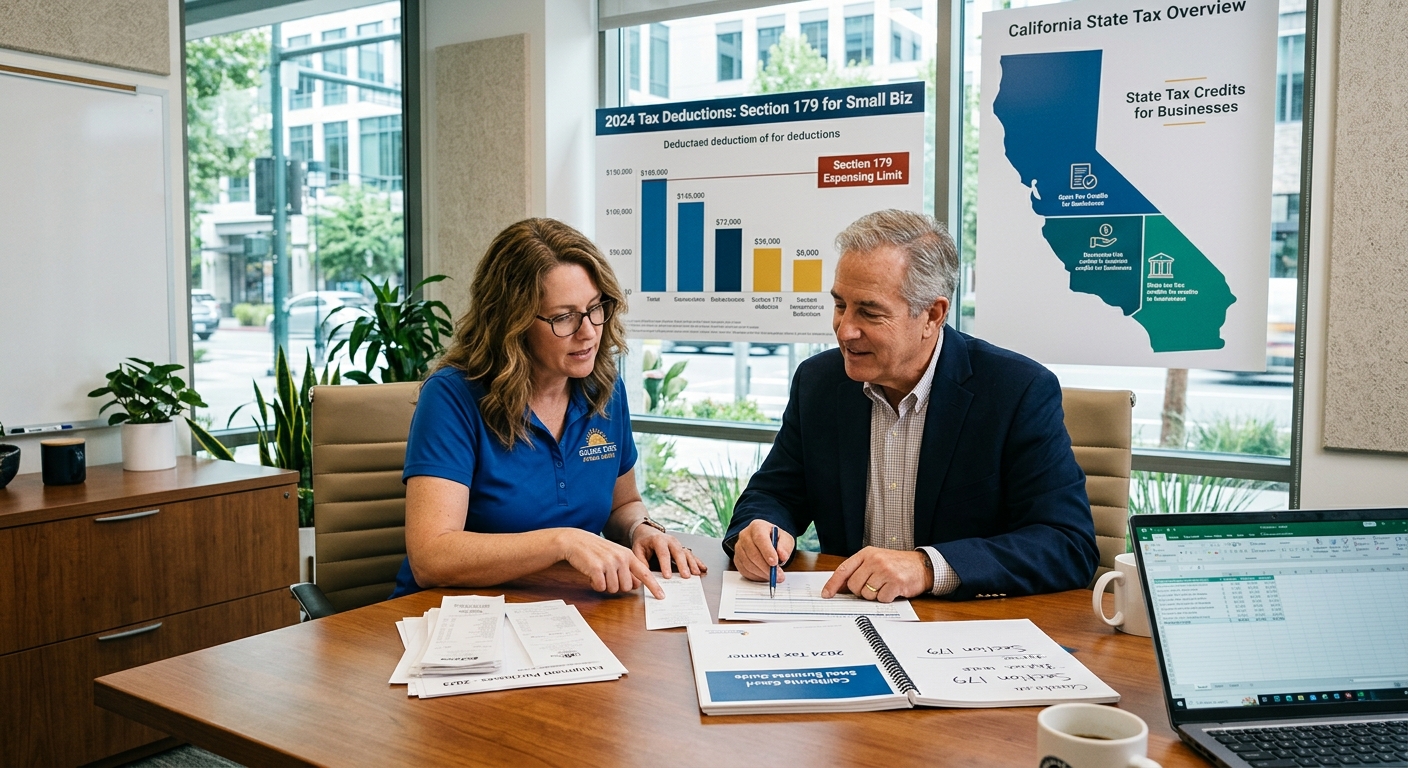
Most California business owners have heard of Section 179, but very few actually understand how the state treats it differently from federal law. That gap costs real money. If you buy a $120,000 truck or $80,000 of machinery in 2024 and your accountant applies the wrong limits, you can easily overpay California tax by thousands of dollars and not notice. This article breaks down how the federal rules work, how California decouples from them, and how to plan your purchases so you do not get burned on April 15.
Quick Answer
For 2024, the federal Section 179 limit is high enough that many small businesses can expense most or all of their qualifying equipment. California, however, caps the deduction at much lower levels and phases it out much sooner. If you operate in California, you often end up with two different depreciation schedules: one for the IRS and one for the Franchise Tax Board. Smart planning means modeling both sets of limits before you sign a purchase order.
How Section 179 Works at the Federal Level in 2024
Section 179 is the rule that lets you treat certain equipment and software purchases as an immediate expense instead of depreciating them over several years. For federal purposes in 2024, the dollar limits are generous. You can generally elect to expense over one million dollars of qualifying property, with the ability to combine Section 179 and bonus depreciation in many cases. That is why you constantly hear about business owners “writing off” a truck or a machine in the year they buy it.
The federal concept is simple. When you buy qualifying tangible personal property like machinery, computers, office furniture, or certain vehicles and place it in service during the tax year, you can choose to expense up to the annual limit instead of depreciating over its usual class life. If your total purchases exceed a separate phase out threshold, the amount you can expense begins to shrink dollar for dollar.
For example, say a contractor buys $300,000 of equipment in 2024. Federal law may allow a full Section 179 deduction on that amount as long as the contractor stays under the phase out threshold. If the contractor’s marginal federal tax rate is 24 percent, that immediate write off can reduce federal tax by $72,000. Cash flow improves right away because less money goes to the IRS.
The federal rules also allow Section 179 on certain improvements to nonresidential real property, such as roofs or HVAC systems, subject to specific definitions. That is why professional advice matters. Misclassifying property can cause the IRS to disallow your deduction later.
California’s Different Approach to Section 179
California uses its own limits and thresholds. While federal law for 2024 supports very large immediate write offs, California keeps the Section 179 limits relatively low and does not follow federal bonus depreciation. That means the same purchase that is fully expensed on your federal return may only be partially expensed on your California return, with the rest spread out over several years.
Consider a small manufacturing LLC in Los Angeles that buys $200,000 of new machines in 2024. Federally, they might expense the full $200,000 using a combination of Section 179 and bonus depreciation. On the California side, they may only be able to expense a fraction in year one, maybe tens of thousands rather than the full amount. The remaining basis has to be depreciated over the asset’s normal life for California purposes.
The result is a permanent timing difference. Over the long run, you will likely deduct the full cost for both federal and state. But your California tax bill is higher in the early years because the state forces slower depreciation. If the LLC’s combined California tax rate is around 9 percent, the difference between a $200,000 deduction and a $40,000 deduction in year one is roughly $14,400 of extra California tax. That is real cash flow pressure for a growing business.
This is where working with advisors who focus on business owners in California matters. A generic federal-only projection can make an equipment purchase look painless, but once you layer in the separate California 179 limits and the lack of bonus depreciation, the picture changes.
Planning Equipment Purchases Around California Limits
Because California keeps its version of Section 179 tighter than the federal rules, timing is everything. If you are considering several large purchases, it can make sense to stage them across multiple years for California purposes, even if federal law would let you expense them all at once. The key is modeling your combined federal and California liability before year end.
Imagine a professional services firm structured as an S corporation that needs to upgrade its entire office: new workstations, servers, and specialized software totaling $350,000. A purely federal analysis might say “go ahead” and expense most of it. But when you factor in the state’s lower 179 cap and the phase out kicking in at a much lower threshold, it may be smarter to split the purchases into two tax years. You still get aggressive federal write offs, and you avoid a sudden spike in California taxable income.
Strategic year end moves can be hard to manage when you are already running payroll, billing, and everything else. That is why many owners lean on dedicated tax planning services instead of trying to juggle it alone. A good planning session in the fall can reveal whether moving a purchase up or back across December 31 will save or cost you state tax.
Section 179 planning is not just about how much you can deduct, but about how much you should deduct for your broader strategy. If you are qualifying for certain credits or trying to show higher net income to a lender, booking the largest possible deduction might not align with your other goals.
KDA Case Study: California Contractor Balances Federal and State 179
A California general contractor operating as an S corporation came to KDA in late 2023. The owner expected about $600,000 of net profit and was planning to purchase two new work trucks and a skid steer loader for roughly $260,000 total. His prior advisor had told him to buy everything before year end and simply “write it off” using federal Section 179 and bonus depreciation, without really explaining the California impact.
We rebuilt the projection, modeling both the federal and California returns separately. Federally, the trucks and equipment could be fully expensed in 2024, knocking down federal tax by over $60,000. For California, though, the state’s lower Section 179 cap meant only a slice could be immediately deducted. The rest would be depreciated over five years. If he followed the old plan, his 2024 California tax bill would jump by nearly $18,000 compared to his expectations.
We recommended that he purchase one truck in late 2023 and push the other truck and the skid steer into the first quarter of 2024. That way he maximized the use of California’s 179 limit in both years while still capturing strong federal deductions. He also adjusted his estimated tax payments so the cash flow hit did not blindside him. The result was roughly $14,000 of state tax savings over the first two years compared with the original plan, on top of the federal benefit he was already expecting.
Ready to see how we can help you? Explore more success stories on our case studies page to discover proven strategies that have saved our clients thousands in taxes.
How to Keep Your Federal and California Depreciation Straight
Once you start taking different depreciation and Section 179 deductions for federal and California, your books and records have to keep pace. Many owners assume their accounting software handles this automatically, but that is not always true. You often need separate schedules or tagging to track the state basis and federal basis for each asset.
When you buy a qualifying asset, you should document the purchase date, cost, vendor, and how you are using the property. Then, for each piece of equipment, record the federal Section 179 or bonus depreciation taken and the California Section 179 elected. Over time, you maintain two sets of depreciation for the same asset one for the IRS and one for the Franchise Tax Board. The differences will reverse as you continue to depreciate on the California side.
According to IRS Publication 946, businesses must keep records that substantiate both the amount and use of property claimed under Section 179. California expects similar documentation if they audit your return. That means invoices, financing agreements, and usage logs when necessary. For vehicles, you should keep mileage logs that prove business use percentages.
If you are self employed and filing a Schedule C, or you run a corporation or partnership, the form that reflects your Section 179 deduction will differ. Sole proprietors use Schedule C alongside a separate form to compute and report the deduction. S corporations and partnerships pass Section 179 information through to shareholders or partners, who then apply their own limits. That adds another layer of complexity when shareholders live in different states but the business operates in California.
Common Mistakes That Trigger Problems With Section 179
One widespread mistake is assuming California follows federal bonus depreciation. For years, business owners saw marketing about “100 percent write offs” and believed that applied equally to their state return. It does not. When California decouples from a federal provision like bonus depreciation, you are left with mismatched schedules, even when your software tries to simplify it.
Another problem comes from failing to track personal versus business use. Section 179 generally requires more than 50 percent business use for the property. If your use falls below that threshold later, you may have to recapture some of the deduction as income. This can surprise a real estate agent or consultant who buys a large SUV, assumes it is fully deductible, and then gradually uses it more for personal driving than for client work.
Improper documentation is another red flag. If you are ever selected for examination, the IRS and the Franchise Tax Board will look for clear invoices, proof of payment, and evidence the asset was placed in service in the year claimed. Back dating a purchase or claiming an asset that is still sitting in a warehouse and not yet used can cause the deduction to be denied. That can mean back taxes, penalties, and interest.
Red Flag Alert: Treating every large purchase as automatically deductible without checking the California Section 179 limits and business use percentage is asking for trouble. A quick review with a knowledgeable advisor could be the difference between a clean deduction and an expensive audit adjustment.
Will Aggressive Section 179 Use Trigger an Audit?
Legitimate Section 179 deductions by themselves usually do not trigger audits, but they can contribute to a risk profile. The IRS looks at patterns. If your return suddenly shows very high equipment write offs relative to revenue, or if your vehicle deductions spike, that can invite questions.
California also monitors returns that claim unusual or disproportionate deductions. Remember, the state already starts from a different Section 179 limit. If your California return tries to mirror the large federal deduction without adjusting for state rules, you significantly increase the chance of a notice.
To lower your risk, match your deductions to your business story. A construction company with $3 million of revenue buying $500,000 of gear fits a believable pattern. A consulting firm with $500,000 of revenue claiming $400,000 of new equipment may raise eyebrows unless there is a compelling explanation. Document the business need and keep board minutes or internal memos for major capital decisions.
According to IRS audit guidance, having consistent books, clear documentation, and reasonable positions on deductions are the strongest shields you have. Section 179 and depreciation are not inherently suspicious if used within the rules.
How Self Employed Californians Should Think About Section 179
If you are a 1099 contractor or freelancer based in California, Section 179 can be one of your most valuable tools. A videographer who buys $40,000 of cameras and editing equipment, or a consultant who invests $25,000 in computers and networking gear, can turn those purchases into immediate deductions. But the California limits may mean you need to prioritize which assets to expense first for state purposes.
A practical approach is to run your expected net income for the year with and without the deduction. If your self employment earnings put you in a higher California bracket, claiming Section 179 for the biggest ticket items can save state tax now. If your income is modest and you expect higher earnings in future years, you might prefer to slow the deduction so you can match it to higher rate years.
Because self employed taxpayers also owe self employment tax at the federal level, combining Section 179 with other strategies like retirement plan contributions can create significant combined savings. A planner who understands both can help you decide whether that next equipment purchase should be this year or next year. To get a quick approximation of how your total tax picture shifts as your income changes, tools like a simple federal tax calculator can help frame the discussion before you look at detailed state projections.
Bottom Line: Coordinating Federal and California Section 179 Is Nonnegotiable
Section 179 is one of the cleanest ways to accelerate deductions for business equipment, vehicles, and software. In 2024, federal law remains extremely favorable, allowing many small and midsize businesses to expense large portions of their capital spending. California, however, maintains lower limits and does not fully conform to all federal expensing provisions. The result is two different answers to the same question: How much do you really get to deduct this year
If you are buying equipment, vehicles, or technology and operating in California, you need a plan that respects both systems. That means understanding how the state caps Section 179, when those caps phase out, and how your federal and California depreciation schedules will differ over the next few years. A one size fits all “write it all off” mindset can quietly raise your state bill even as your federal taxes fall.
This information is current as of 6/21/2026. Tax laws change frequently. Verify updates with the IRS or Franchise Tax Board if you are reading this in a later year.
Ready to Reduce Your Tax Bill?
KDA Inc. specializes in strategic tax planning for business owners, S Corps, LLCs, and high-net-worth individuals. Book a personalized consultation and walk away with a clear plan.
Book Your Tax Strategy Session
If you are a California business owner or self employed professional planning major equipment or vehicle purchases, do not guess about your Section 179 strategy. Sit down with a strategist who can model your federal and California positions side by side and show you exactly how timing and limits affect your bill. Book a personalized consultation with our team and leave with a clear, compliant plan for your next round of investments. Click here to book your consultation now.
The IRS is not hiding these write offs you just were not taught how to coordinate them with California’s rules.



