
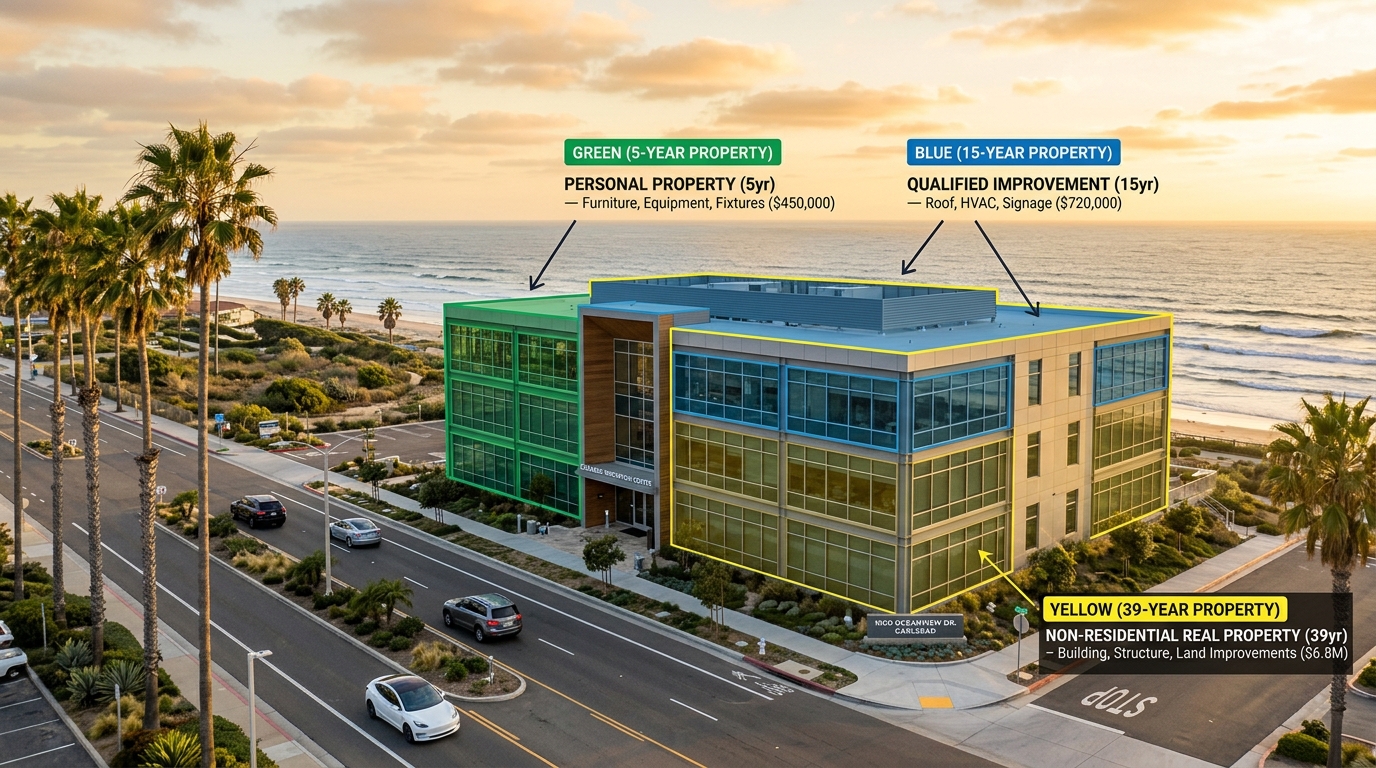
Why Carlsbad Property Owners Are Leaving Thousands on the Table
If you own commercial or residential rental property in Carlsbad, California, there is a good chance you are overpaying on your federal tax bill right now. Not because you filed incorrectly. Not because your CPA made an error. But because you never had a cost segregation in Carlsbad, CA study performed on your property. And that one missing step could be costing you $50,000, $100,000, or more in accelerated depreciation deductions you are legally entitled to claim.
If you are searching for professional tax and accounting services in Carlsbad, you are in the right place. KDA works with Carlsbad property owners every day to unlock deductions that most general CPAs simply overlook. This guide breaks down exactly how cost segregation works, who it benefits most, and the specific dollar amounts at stake for property owners in the Carlsbad market during the 2026 tax year.
Quick Answer
A cost segregation study reclassifies components of your property into shorter depreciation categories (5, 7, or 15 years instead of 27.5 or 39 years), allowing you to front-load your depreciation deductions and reduce your tax bill dramatically in the early years of ownership. For a typical $1.2 million Carlsbad commercial property, a well-executed study can generate $150,000 to $250,000 in accelerated first-year deductions.
What Is Cost Segregation and Why Does It Matter for Carlsbad, CA Property Owners?
Cost segregation is an IRS-approved tax strategy that involves a detailed engineering-based analysis of a property’s individual components. The goal is to identify building elements that qualify for shorter depreciation recovery periods under the Modified Accelerated Cost Recovery System (MACRS). Instead of depreciating your entire building over 27.5 years (residential) or 39 years (commercial), a cost segregation study separates components like flooring, lighting, parking lots, landscaping, and specialized electrical systems into 5-year, 7-year, or 15-year asset categories.
Here is why this matters in practical terms. Under standard straight-line depreciation, a $1 million commercial property gives you roughly $25,641 in annual depreciation ($1,000,000 divided by 39 years). But after a cost segregation study identifies $300,000 worth of components eligible for accelerated schedules, you could claim $60,000 or more in depreciation during year one alone. That is more than double the standard deduction in the first year, and it compounds from there.
For Carlsbad property owners specifically, the math gets even more interesting. Property values in the Carlsbad market have climbed steadily, with median commercial property prices in north San Diego County often exceeding $1.5 million. Higher property values mean larger depreciation pools, which translates directly into bigger tax savings when cost segregation is applied properly.
The IRS has consistently upheld cost segregation as a legitimate tax planning tool. See the IRS Cost Segregation Audit Techniques Guide for the agency’s own framework on how these studies should be conducted and reviewed.
How a Cost Segregation Study Works: Step-by-Step
Understanding the process removes the mystery. Here is exactly what happens when you commission a cost segregation study on your Carlsbad property.
Step 1: Preliminary Feasibility Analysis
Before committing to a full study, your tax team reviews the property’s purchase price, age, construction type, and current depreciation schedule. Properties with a cost basis of $500,000 or more typically justify the investment. For most Carlsbad properties, this threshold is easily met.
Step 2: Engineering Site Visit
A qualified engineer or construction professional visits the property to inspect and document every building component. They photograph, measure, and catalog items like HVAC systems, specialized electrical wiring, decorative finishes, paving, site work, and more. This is not a paperwork exercise. It is a boots-on-the-ground inspection.
Step 3: Component Classification
Each identified component is classified into the appropriate MACRS recovery period:
- 5-year property: Carpeting, decorative lighting, certain electrical outlets, appliances, and signage
- 7-year property: Office furniture, specialized fixtures, and certain mechanical equipment
- 15-year property: Landscaping, parking lots, sidewalks, fencing, and site improvements
- 27.5-year property: Residential rental building structure (walls, roof, foundation)
- 39-year property: Commercial building structure (walls, roof, foundation)
Step 4: Report Preparation and Filing
The engineering firm produces a detailed report that your CPA uses to adjust your depreciation schedule. The reclassified assets are reflected on your tax return, typically on IRS Form 4562 (Depreciation and Amortization). If the study is performed on a property you already own, the catch-up depreciation is claimed using a change of accounting method on Form 3115.
Step 5: Tax Savings Realized
The accelerated deductions reduce your taxable income in the current year. For a Carlsbad investor in the 37% federal bracket plus California’s 13.3% top state rate, a $200,000 acceleration in depreciation could save over $75,000 in combined taxes in a single year.
KDA Case Study: Carlsbad Medical Office Building Owner
A Carlsbad-based physician purchased a 4,200-square-foot medical office building for $1.85 million in 2024. His previous CPA had been depreciating the entire building (minus land value) on a straight-line 39-year schedule. That gave him roughly $35,000 per year in depreciation deductions. Decent, but nowhere near what the property should have been generating.
When he came to KDA, we recommended a cost segregation study immediately. Our engineering partners identified $485,000 in components eligible for 5-year and 15-year recovery periods. That included specialized medical exam room buildouts, upgraded electrical systems for diagnostic equipment, parking lot improvements, and decorative interior finishes.
Using bonus depreciation provisions still available for properties placed in service before January 1, 2027, we accelerated $485,000 in deductions into his 2024 return through a Form 3115 catch-up adjustment. At his combined federal and California marginal rate of approximately 48%, that translated into $232,800 in tax savings. The cost of the study was $8,500. His first-year ROI was over 27x.
He reinvested a portion of those savings into a second Carlsbad property and is now planning a cost segregation study on that building as well.
Ready to see how we can help you? Explore more success stories on our case studies page to discover proven strategies that have saved our clients thousands in taxes.
Who Benefits Most from Cost Segregation in the Carlsbad Market?
Cost segregation is not limited to large commercial developers. In Carlsbad, several property owner profiles benefit enormously from this strategy. Our Carlsbad tax preparation team regularly works with each of the following personas.
Residential Rental Property Investors
If you own single-family rentals, duplexes, or small multi-family buildings in Carlsbad, cost segregation works for you. A $900,000 rental home might yield $80,000 to $120,000 in reclassified components. On a 27.5-year residential schedule, that means pulling forward several years of depreciation into year one.
Commercial Property Owners
Office buildings, retail spaces, and industrial properties on the 39-year commercial schedule benefit the most. The longer the original recovery period, the bigger the acceleration. A $2 million Carlsbad office building could generate $300,000 or more in reclassified assets.
Short-Term Rental Operators
Carlsbad’s proximity to LEGOLAND, the beach, and the Flower Fields makes it a strong short-term rental market. If you operate a vacation rental and you materially participate in the management, cost segregation deductions can offset your active income, not just passive income. That is a game-changer for high-earning W-2 professionals who also own Airbnb-style properties.
Medical and Dental Practice Owners
Carlsbad has a robust healthcare community. If you own the building where your practice operates, the specialized medical buildout components (exam rooms, sterilization systems, lab infrastructure) often qualify for accelerated depreciation at even higher percentages than typical commercial properties.
Real Estate Developers and Flippers
Developers who build and hold Carlsbad properties should commission cost segregation studies during or immediately after construction. The data is freshest, the classification is cleanest, and the tax benefits start from day one. Even investors who plan a Section 1031 exchange later should consider a study, because the deductions you take in the interim years still reduce your annual tax bill.
Cost Segregation in Carlsbad, CA: The Numbers That Matter in 2026
Let’s get specific. Here is a comparison table showing the impact of cost segregation on three common Carlsbad property types during the 2026 tax year.
| Property Type | Purchase Price | Standard Year 1 Depreciation | Post-Study Year 1 Depreciation | Estimated Tax Savings (Year 1) |
|---|---|---|---|---|
| Single-Family Rental | $850,000 | $24,727 | $95,000 | $33,600 |
| Medical Office Building | $1,800,000 | $36,923 | $285,000 | $119,700 |
| Retail Strip Center | $3,200,000 | $65,641 | $480,000 | $201,600 |
Assumptions: Land value excluded at 20% of purchase price. Tax savings calculated at a combined 42% effective rate (federal + California). Bonus depreciation applied at current 2026 rates. Actual results vary based on property condition, age, and component breakdown.
These are not hypothetical numbers. They reflect the types of outcomes KDA consistently delivers for property owners across the Carlsbad and greater San Diego County market. If you want to estimate your own potential savings, run your property numbers through our small business tax calculator to get a ballpark figure before scheduling a formal study.
Bonus Depreciation in 2026: What Carlsbad Investors Need to Know
The bonus depreciation landscape is shifting. Under the Tax Cuts and Jobs Act of 2017, 100% bonus depreciation was available for qualifying assets placed in service between September 27, 2017, and December 31, 2022. Since then, bonus depreciation has been phasing down:
- 2023: 80% bonus depreciation
- 2024: 60% bonus depreciation
- 2025: 40% bonus depreciation
- 2026: 20% bonus depreciation
- 2027: 0% bonus depreciation (unless Congress acts)
This phase-down makes 2026 one of the last years to capture any bonus depreciation at all. For Carlsbad property owners, the window is closing. A cost segregation study done this year still captures that 20% bonus on top of the accelerated MACRS schedules for 5-year, 7-year, and 15-year property. By 2027, those bonus percentages drop to zero, and you lose that additional first-year benefit permanently.
That said, cost segregation remains powerful even without bonus depreciation. The core benefit is the accelerated MACRS schedule itself. A 5-year recovery period is still dramatically faster than 39 years, and the time value of money means earlier deductions are always worth more than later ones.
If Congress extends or restores higher bonus depreciation rates (there is ongoing legislative discussion around this), properties that already have a completed cost segregation study will be positioned to capture those benefits immediately. Think of a completed study as a loaded weapon you can fire whenever the tax code gives you a target.
Common Mistakes Carlsbad Property Owners Make with Depreciation
After working with hundreds of property owners across Southern California, KDA has identified the most frequent errors that cost Carlsbad investors real money.
Mistake 1: Depreciating Land Value
Land is not depreciable. Period. But many property owners (and some CPAs) fail to properly allocate the purchase price between land and improvements. In Carlsbad, where land values can represent 30% to 50% of a property’s purchase price, getting this allocation wrong inflates or deflates your depreciable basis by hundreds of thousands of dollars. A cost segregation study includes a proper land-to-improvement allocation.
Mistake 2: Using Cookie-Cutter Percentages
Some tax preparers estimate cost segregation results using generic percentages (“about 20-30% of the building qualifies for shorter lives”). That approach leaves money on the table. A proper engineering-based study examines your specific property and often identifies 25% to 40% of qualifying components, sometimes more for medical, restaurant, or specialty properties.
Mistake 3: Waiting Too Long
Many owners assume cost segregation is only for newly purchased or newly constructed properties. Wrong. You can perform a cost segregation study on a property you have owned for years and file a Form 3115 to claim all the missed depreciation in a single year through a “catch-up” adjustment. There is no amended return required. The IRS allows this as an automatic change of accounting method under Revenue Procedure 2015-13.
Mistake 4: Ignoring California Conformity Issues
California does not conform to federal bonus depreciation. That is critical. If you claim federal bonus depreciation on cost segregation components, you must add back that bonus amount on your California return (Form 540 or 100S) and then depreciate those assets under California’s own schedule. This creates a federal-state timing difference that must be tracked carefully. Failing to handle this correctly can trigger FTB audits and penalties.
Mistake 5: Skipping the Study on “Smaller” Properties
Properties valued at $500,000 or more almost always justify a cost segregation study. In Carlsbad, where even a modest condo rental might have a cost basis of $600,000 or more, the minimum threshold is easily met. The typical study cost for a single-family rental is $3,000 to $5,000, and it usually pays for itself multiple times over in year one.
Should You Order a Cost Segregation Study? A Decision Framework
Yes, if:
- Your property’s depreciable basis exceeds $500,000
- You purchased, built, or renovated the property within the last 15 years
- You have not previously performed a cost segregation study on the property
- You have other income (W-2, 1099, business) that could benefit from larger deductions
- You plan to hold the property for at least 3 to 5 more years
Maybe not right now, if:
- Your property cost basis is under $300,000 (the study cost may not be justified)
- You are planning to sell the property within the next 12 months (depreciation recapture could offset benefits)
- You are already generating net operating losses and do not need additional deductions this year
Key Takeaway: For the vast majority of Carlsbad property owners with buildings valued above $500,000, a cost segregation study is one of the highest-ROI tax moves available in 2026.
Ready to Reduce Your Tax Bill?
KDA Inc. specializes in strategic tax planning for business owners, S Corps, LLCs, and high-net-worth individuals. Book a personalized consultation and walk away with a clear plan.
Frequently Asked Questions About Cost Segregation in Carlsbad
How much does a cost segregation study cost?
For a single residential rental property, expect $3,000 to $5,000. For a commercial property, costs typically range from $5,000 to $15,000 depending on size and complexity. The study almost always pays for itself in the first year of tax savings.
Can I do a cost segregation study on a property I have owned for years?
Absolutely. You file a Form 3115 (Change of Accounting Method) and claim all the missed accelerated depreciation in a single “catch-up” year. No amended returns needed.
Will a cost segregation study trigger an IRS audit?
A properly conducted, engineering-based study actually reduces audit risk because it provides detailed documentation supporting your depreciation claims. The IRS has published its own audit techniques guide specifically for cost segregation, which means they expect taxpayers to use this strategy.
Does California allow cost segregation?
California allows the accelerated MACRS depreciation schedules (5-year, 7-year, 15-year classifications). However, California does not conform to federal bonus depreciation. Your tax professional must track the federal-state differences carefully.
What types of properties qualify?
Virtually any type of real property qualifies: single-family rentals, multi-family apartments, office buildings, retail centers, medical offices, industrial warehouses, restaurants, hotels, and even self-storage facilities. The property must be used for business or investment purposes (personal residences do not qualify).
Can I combine cost segregation with a 1031 exchange?
Yes. You can take cost segregation deductions during the years you hold a property and then execute a 1031 exchange when you sell. The depreciation recapture is deferred along with the capital gain. This is one of the most powerful combination strategies in real estate tax planning.
How long does the study take?
Most studies are completed within 4 to 8 weeks from the initial engagement. Rush studies are available if you need results before a filing deadline.
Is there a deadline to order a study for the 2026 tax year?
Technically, you can order a cost segregation study and file the results on your 2026 return (due April 15, 2027, or October 15, 2027, with extension). However, ordering before year-end allows your tax team to integrate the results into your overall 2026 tax planning strategy. Earlier is better.
California-Specific Considerations for Carlsbad Property Owners
Carlsbad sits in San Diego County, and property owners here face unique considerations that affect cost segregation outcomes.
First, California’s Proposition 13 caps property tax increases at 2% per year, which means your county-assessed value may differ significantly from your federal cost basis. Cost segregation is based on your actual purchase price (or construction cost), not your assessed value. Do not let a low county assessment fool you into thinking your depreciation potential is small.
Second, California’s 13.3% top income tax rate means that depreciation deductions are exceptionally valuable at the state level, even without bonus depreciation. A $100,000 deduction at the 13.3% rate saves you $13,300 in state taxes alone, on top of your federal savings.
Third, the Franchise Tax Board (FTB) has been increasing scrutiny on real estate tax strategies. Having a formal, engineering-based cost segregation report on file provides substantial audit protection. If the FTB questions your depreciation, you hand them a 50-page engineering report. That ends most inquiries before they start.
This information is current as of 6/17/2026. Tax laws change frequently. Verify updates with the IRS or FTB if reading this later.
How KDA Handles Cost Segregation for Carlsbad Clients
At KDA, we do not just order a cost segregation study and hand you a report. We integrate the results into your entire tax picture. That means coordinating your tax planning strategy to ensure the accelerated depreciation works in harmony with your other deductions, estimated payments, entity structure, and long-term investment goals.
For real estate investors with multiple properties, we stack cost segregation across your entire portfolio to optimize the timing of deductions year over year. For business owners who also own their operating real estate, we coordinate between your business return and your personal return to maximize the combined benefit.
Our cost segregation services page outlines the full scope of what we deliver, from initial feasibility analysis through final implementation and ongoing depreciation tracking.
What Happens If You Miss This Opportunity?
Skipping a cost segregation study does not trigger penalties. It is not a compliance issue. But it is a missed opportunity that compounds every year you wait. Here is why.
Every year you depreciate your property on a straight-line schedule when you could be using accelerated schedules, you are lending the government money interest-free. A $100,000 deduction this year is worth more than a $100,000 deduction five years from now, because of the time value of money. If you invest your tax savings at even a modest 6% return, a $75,000 savings today grows to over $100,000 in five years.
With bonus depreciation dropping to 20% in 2026 and disappearing entirely in 2027 (barring legislative action), every month you delay reduces the total available benefit. Carlsbad property owners who act before December 31, 2026, capture the last window of bonus depreciation. Those who wait until 2027 lose it permanently.
Ready to work with a tax professional who understands Carlsbad property owners? Explore our Carlsbad tax services or book a consultation below.
Book Your Cost Segregation Consultation
If you own property in Carlsbad and you have never had a cost segregation study done, you are almost certainly leaving five and six figures in tax savings unclaimed. Stop overpaying. Stop waiting. Let KDA’s team analyze your property, run the numbers, and show you exactly what you stand to save in 2026. Click here to book your personalized cost segregation consultation now.



