
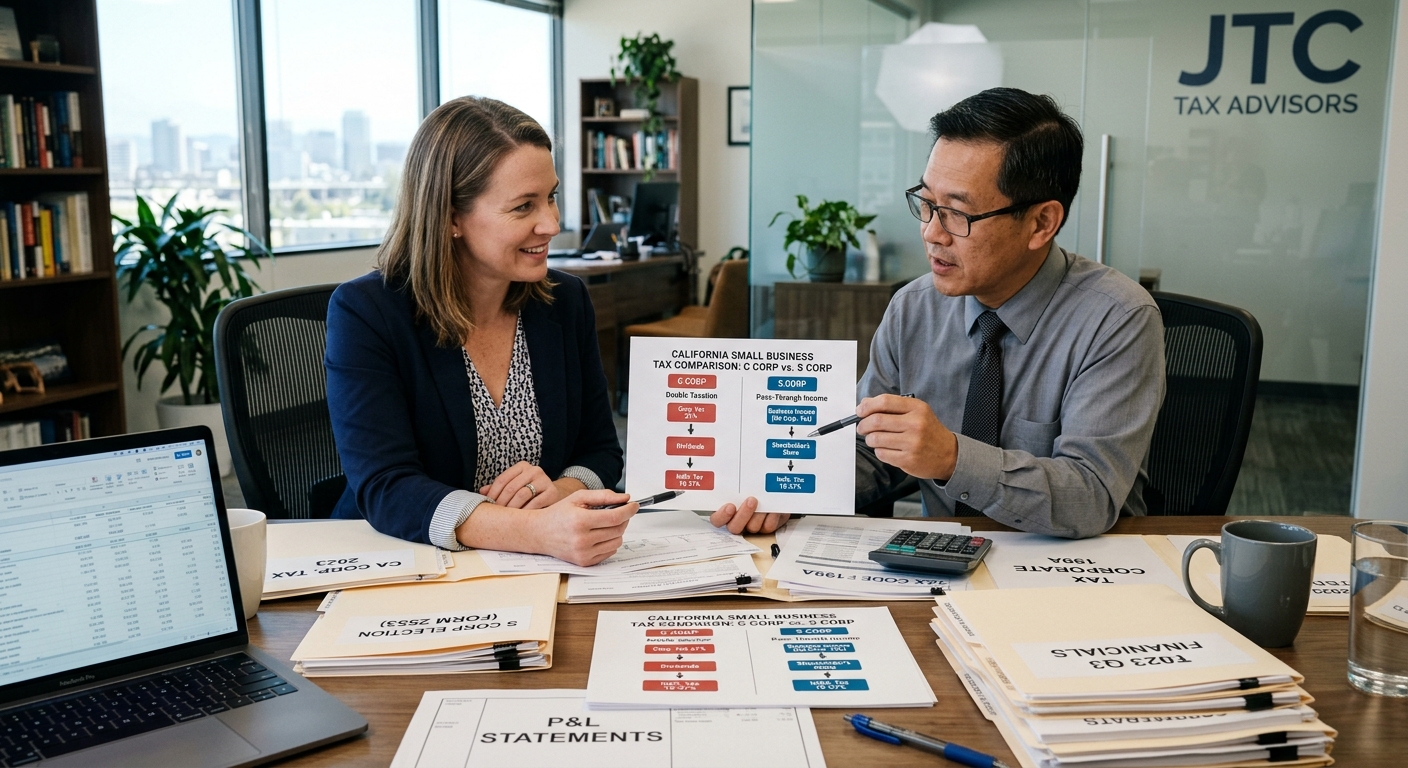
Many owners of profitable C corporations are in a rush to cut their tax bill by flipping a switch to S corporation status. On paper it looks simple: file a form, avoid double taxation, keep more cash. In practice, the conversion can trigger some of the nastiest corporate tax traps in the Internal Revenue Code, especially for California businesses.
This post walks through the main pitfalls of converting from c corp to s corp so you can decide whether the move fits your situation, and how to structure it without stepping on a tax landmine.
Quick Answer
Switching from a C corporation to an S corporation can cut ongoing federal and self employment taxes, but it can also trigger a built in gains tax on appreciated assets, LIFO recapture, issues with accumulated earnings and profits, and stricter rules on who can be a shareholder. These issues are especially painful for profitable companies with valuable assets or complex ownership. You need a detailed plan that models the numbers before filing Form 2553.
What Changes When You Convert From C Corporation To S Corporation
Before looking at specific traps, you need to be clear on what actually changes when a C corporation elects S status.
C Corporation Basics In Plain English
A C corporation is a separate taxpayer. It files Form 1120, pays its own income tax, and then pays dividends to shareholders from after tax profits. Those dividends are usually taxable again at the shareholder level. That is the classic double taxation issue.
Example. A California C corporation earns 300,000 of taxable income. At a 21 percent federal corporate rate, it pays 63,000 of federal tax. If it distributes the remaining 237,000 as dividends to a single owner in the 15 percent dividend bracket, the owner pays about 35,550 in additional federal tax. Combined federal hit is 98,550 before any state tax. That is a meaningful drag on growth.
S Corporation Basics
An S corporation is generally a pass through entity for federal income tax. The company itself usually pays no federal income tax. Instead, profits and losses are allocated to shareholders and reported on their personal returns via Schedule K 1 and Form 1040.
That pass through treatment can be attractive. For example, a consulting company earning 300,000 that qualifies for the qualified business income deduction under section 199A might effectively pay tax on only 240,000 of that profit after the 20 percent deduction. However, the S corporation still has payroll tax and reasonable compensation requirements, and California treats S corporations differently than the federal government, including a 1.5 percent franchise tax on net income.
Why So Many Owners Consider Converting
Business owners, especially those with LLCs already taxed as corporations or long standing C entities, look at S status to:
- Reduce double taxation on dividends
- Use pass through losses in lean years
- Access the qualified business income deduction
- Lower self employment taxes by splitting salary and distributions
Those benefits can be real, but only if you navigate the traps that come with changing status.
Hidden Tax Bombs When You Elect S Status After Operating As A C Corporation
The most serious pitfalls of converting from c corp to s corp show up around built in gains, inventory methods, and old C corporation earnings.
Built In Gains Tax On Appreciated Assets
When a C corporation holds assets that have gone up in value such as real estate, equipment, or goodwill and then elects S status, the IRS does not forget about that appreciation. For a limited recognition period after conversion, a special corporate level tax called the built in gains tax applies if the S corporation sells those appreciated assets.
The built in gains tax rate is tied to the corporate tax rate under section 1374. If your corporation owns a building with a tax basis of 500,000 and fair market value of 1,000,000 on the day you convert, there is 500,000 of built in gain. If you sell that property during the recognition period, the S corporation may owe up to 21 percent federal tax, or 105,000, at the corporate level on that gain before it passes through to you.
That is on top of any individual level tax. Many owners convert and then immediately sell property or even the business itself, only to discover this second layer of tax. Proper planning may mean delaying the sale, adjusting the election date, or restructuring the deal.
LIFO Recapture For Inventory Heavy Businesses
If your C corporation uses the last in, first out method for inventory and then elects S status, section 1363(d) requires LIFO recapture. That means you pick up into income the excess of inventory valued under LIFO over inventory valued under FIFO right before the conversion.
Say your LIFO reserve is 200,000. When you convert, that 200,000 becomes additional income at the corporate level, taxed under C corporation rules, even though you did not sell anything. The tax can be spread over four years, but the cash outlay is still real. This can wipe out much of the near term benefit of S status for wholesalers or manufacturers.
Accumulated Earnings And Profits Complications
Any undistributed C corporation earnings and profits carry into the S corporation period as accumulated earnings and profits. That history matters. If an S corporation with accumulated earnings and profits has excessive passive investment income over certain thresholds for three consecutive years, the IRS can terminate the S election under section 1362.
For California companies that have built up investment portfolios inside the C corporation, this is a serious risk. Before converting, many owners either distribute excess cash, spin assets into a separate entity, or change the investment mix so passive income stays below the danger zone.
Reasonable Compensation And Payroll Tax Exposure
Once you are an S corporation, the IRS expects owner employees to take a reasonable salary for the work they perform. The formula is not spelled out in the Code, but IRS guidance and court cases lay out factors like duties, experience, industry norms, and hours worked.
A common mistake is to slash salary to a token amount and take the rest of the profit as distributions to avoid Social Security and Medicare tax. That may work for a year or two, but it is increasingly a red flag. According to IRS enforcement data in its recent Data Book, automation is pushing more returns with suspect wage patterns into review. For many business owners, this is where a structured payroll and bookkeeping system becomes essential, not optional.
If you want professional support designing reasonable compensation and running clean books after a conversion, it is worth looking at dedicated bookkeeping and payroll services that understand S corporation rules.
KDA Case Study: California C Corporation Owner Facing Conversion Traps
Consider Ben, who owned a California C corporation marketing agency with 1,200,000 in annual revenue and consistent net profit of around 350,000. The corporation owned custom software developed in house plus a small office condo purchased years earlier. Ben heard from peers that switching to an S corporation was a no brainer to avoid double tax and lower self employment costs.
Before filing anything, he engaged KDA to run the numbers. We found that the office condo had a tax basis of 400,000 and a current value near 900,000, creating 500,000 of built in gain. Ben intended to sell the condo within three years and move the agency to remote operations. If he had converted, then sold the building during the built in gains window, the corporation would likely have owed over 100,000 in corporate level tax on that sale alone, plus Ben would have paid individual capital gains tax.
We also discovered that the company had a LIFO reserve of about 80,000 related to branded merchandise inventory. Electing S status would have triggered LIFO recapture and about 16,800 of extra federal tax over four years, on top of California liabilities.
Instead of an immediate conversion, we helped Ben restructure. First, the corporation sold the office condo to a newly formed LLC with outside financing, intentionally timing the transaction before any S election. We then modeled an S election starting in a later tax year, when expected appreciation had already been taxed at the C level on terms Ben could manage. Through adjusted compensation planning and expense strategy, his projected net personal tax over five years dropped by roughly 140,000 compared to a rushed, unplanned conversion.
Ready to see how we can help you? Explore more success stories on our case studies page to discover proven strategies that have saved our clients thousands in taxes.
Shareholder And Stock Structure Pitfalls
The S corporation regime is picky about who can own shares and what those shares look like. Violating these rules can invalidate your election, dumping you back into C corporation status like it or not.
Eligible Shareholders Only
Only certain types of shareholders are allowed for S corporations. Permitted owners include U.S. citizens and resident individuals, certain estates, and specific trusts like grantor trusts and electing small business trusts. Partnerships, corporations, and most nonresident aliens cannot own S stock.
If your C corporation already has ineligible owners, you either need to buy them out, restructure ownership into permitted trusts, or skip the S election. A single share ending up in the wrong hands, even by inheritance, can terminate S status.
Single Class Of Stock Requirement
An S corporation can only have one class of stock in terms of economic rights. Differences in voting rights are generally allowed, but you cannot have one series of shares that is entitled to a higher dividend rate or liquidation preference than another.
C corporations with existing preferred stock, convertible instruments, or complex option plans need careful review before converting. Sometimes you can clean this up first by redeeming or restructuring instruments so that only a single economic class remains. Other times, it may be better to stay a C corporation, especially for high growth ventures expecting institutional investment.
Consequences Of A Blown S Election
If the IRS determines that your S election was invalid from day one because of shareholder or stock class issues, it can treat the corporation as a C corporation the entire time. That means recalculating prior year returns under C rules, imposing corporate tax, and potentially hitting shareholders with unexpected dividend reclassifications and penalties. Fixing a defective election after the fact is complicated and often expensive.
Distribution Ordering Rules And Old C Corporation Earnings
Once you have made the switch, the way distributions are taxed is more complicated than many owners expect. The existence of accumulated earnings and profits from C years can change the character of what looks like a simple S distribution.
Understanding The S Corporation Buckets
Distributions by an S corporation with no C history generally reduce stock basis and then become capital gain once basis hits zero. When there are accumulated earnings and profits from C years, the ordering rules under section 1368 get more intricate.
- First, distributions come from the accumulated adjustments account, which tracks S period income that has already been taxed to shareholders.
- Next, distributions are treated as dividends to the extent of accumulated earnings and profits from C years and taxed as ordinary or qualified dividends.
- Only after those buckets are exhausted do distributions reduce stock basis and then create capital gain.
Owners who assume every S corporation distribution is magically tax free or only reduces basis can be surprised when their preparer classifies part of a payment as a taxable dividend because of old C corporation earnings sitting on the books.
Passive Investment Income Trap
If an S corporation with accumulated earnings and profits generates too much passive investment income interest, rents, royalties, and some portfolio dividends for three straight years, it can be hit with a punitive tax on that income and even lose S status. The thresholds and definitions in section 1375 are technical, but the practical point is simple. If your post conversion plan involves turning the old corporation into a holding company for investments, you need to monitor passive income ratios carefully or consider another structure.
Timing, Elections, And Administrative Missteps
Even if the economics of conversion are favorable, paperwork failures can undo everything. The IRS provides specific rules for when and how to make the S election and related elections.
Missing The Form 2553 Deadline
To be effective for a full tax year, Form 2553 generally must be filed no more than two months and 15 days after the beginning of that year, or at any time during the preceding tax year. Many owners miss this window and assume they are stuck. In reality, there are late election relief procedures, but they require demonstrating reasonable cause and consistent treatment of the corporation as an S entity.
Getting the date wrong can mean your intended S year is still a C year. That creates cascading issues with payroll, estimated tax payments, and shareholder reporting.
Not Coordinating State Level Treatment
California recognizes S corporations but has its own rules and forms. For 2025 and 2026, an S corporation doing business in California is subject to a 1.5 percent franchise tax on net income with a minimum tax, and shareholders pay personal state tax on their share of income.
Other states where you do business may treat S corporations differently or not recognize them at all. For multistate operations, you need a clear map of how each state will tax the entity after conversion. This is especially important for real estate investors and operating companies with employees in several jurisdictions.
Sloppy Basis Tracking And Loan Planning
In a C corporation world, shareholder stock basis is important mainly for when you sell your shares. In S land, basis limits the amount of losses shareholders can deduct and affects whether distributions are taxable. Basis is increased by contributions and income, and reduced by losses and distributions, as explained in IRS guidance such as Publication 542.
Ignoring basis can cause owners to claim losses they are not entitled to or treat taxable distributions as tax free. For owners who also loan money to their corporation, properly documenting and tracking shareholder debt basis is equally important to avoid surprise disallowance of losses.
Common Mistake That Triggers An Audit
One of the more dangerous pitfalls of converting from c corp to s corp is a pattern of low officer wages combined with high shareholder distributions right after the election. The IRS uses data analytics to spot S corporations with unusually low payroll relative to industry norms and revenue.
Red Flag Alert: A professional services firm that reports 500,000 of S corporation income with only 60,000 of wages to its sole shareholder employee is asking for attention. Adjusting that salary to a more defensible 160,000 may increase payroll tax by roughly 15,300, but it can easily save tens of thousands in penalties and back taxes if the return is examined.
Pro Tip: Do not wait for an audit notice to fix compensation. Build a written reasonable compensation analysis into your annual planning and keep documentation in your files. The IRS has discussed factors in sources like Fact Sheet FS 2008 25 and case law, and aligning with those standards can make a big difference if your numbers are challenged.
Will Converting Actually Lower Your Total Tax Bill
The only way to know whether an S election helps is to run a multi year projection comparing life as a C corporation with life as an S corporation. That projection should include federal and state income tax, payroll tax, built in gains exposure, and exit scenarios.
Simple Comparison Example
A California C corporation with 300,000 of pre tax profit and no plans to sell in the near term might pay roughly 21 percent federal corporate tax and 8.84 percent California tax at the entity level, then dividends taxes on top of that. Over five years, the cumulative tax drag can exceed 250,000 depending on the owner bracket and payout pattern.
The same business converted to an S corporation, with the owner paying a 140,000 salary and taking the rest as distributions, might see combined federal and California liabilities 20 to 60,000 lower per year depending on qualified business income deduction eligibility and other factors. But if the corporation also holds highly appreciated real estate, a planned sale inside the built in gains window could wipe out those savings in one transaction.
For a full breakdown of how S corporation strategy works more broadly including salary, distributions, and California nuances it is worth reading our complete S corporation guide at this detailed S corporation tax strategy article.
What If You Plan To Sell Or Raise Capital
If you expect to sell your business or bring in institutional investors within a few years, rushing into an S election can complicate the transaction. Many private equity buyers and venture funds prefer C corporations, both for structural reasons and because certain tax benefits, such as section 1202 qualified small business stock, can be more favorable in the C environment if requirements are met.
In some situations, staying a C corporation until close to the sale and focusing on other tax planning moves, like compensation design and fringe benefit optimization, produces a better net result than flipping to S status.
Ready to Reduce Your Tax Bill?
KDA Inc. specializes in strategic tax planning for business owners, S Corps, LLCs, and high-net-worth individuals. Book a personalized consultation and walk away with a clear plan.
Frequently Asked Questions About Converting From C Corporation To S Corporation
How Do I Actually Make The Election
You use IRS Form 2553, Election by a Small Business Corporation. All shareholders must consent, and the form must be filed within the permitted window. The instructions to Form 2553 on the IRS website explain where to file and what information you need. For corporations that already filed as C corporations in a prior year, attach a copy of the most recent return to help the IRS process the change.
Can I Undo An S Election If I Change My Mind
You can voluntarily revoke an S election by filing a statement with the IRS signed by shareholders holding more than 50 percent of the stock. However, once you revoke, there is generally a waiting period before you can elect again, often five tax years. You also have to deal with the tax consequences of the time you were an S corporation, including basis changes and distribution ordering rules.
Does This Affect My Personal Tax Return Complexity
Yes. As a C corporation owner, your individual return mainly reflects dividends and W 2 wages. With an S corporation, you will receive a Schedule K 1 each year reporting your share of income, deductions, and credits. That flows into your Form 1040 and can affect phaseouts and other tax items. Many owners choose to work with firms that provide integrated business and personal tax planning. KDA, for example, offers coordinated tax planning services for closely held businesses so that entity level decisions and personal goals stay aligned.
Will This Trigger Extra IRS Scrutiny Automatically
An S election by itself does not cause an automatic audit. However, if your first year as an S corporation shows dramatic shifts in reported wages, distributions, or deductions compared to your C years, that may stand out in IRS data. Following documentation best practices and aligning with IRS guidance and publications, such as Publication 542 for corporations and Publication 535 for business expenses, reduces the risk that reasonable positions are misinterpreted as abusive.
Bottom Line
The headline benefits of S corporation status are real for many profitable, owner operated businesses, but the pitfalls of converting from c corp to s corp can easily erase those gains if you ignore built in gains tax, LIFO recapture, accumulated earnings and profits complications, shareholder eligibility rules, and reasonable compensation standards.
This information is current as of 6/13/2026. Tax laws change frequently. Verify updates with the IRS or state authorities if you are reading this later, and review primary sources such as IRS Publication 542 and the instructions to Form 2553 for technical requirements.
Book Your Tax Strategy Session
If you are considering an S election for your existing C corporation and want to know exactly how the numbers play out in your situation, do not guess. Book a personalized strategy session with our team so we can model multi year scenarios, flag every major risk, and design a conversion path that fits your exit plans. Click here to book your consultation now.



