
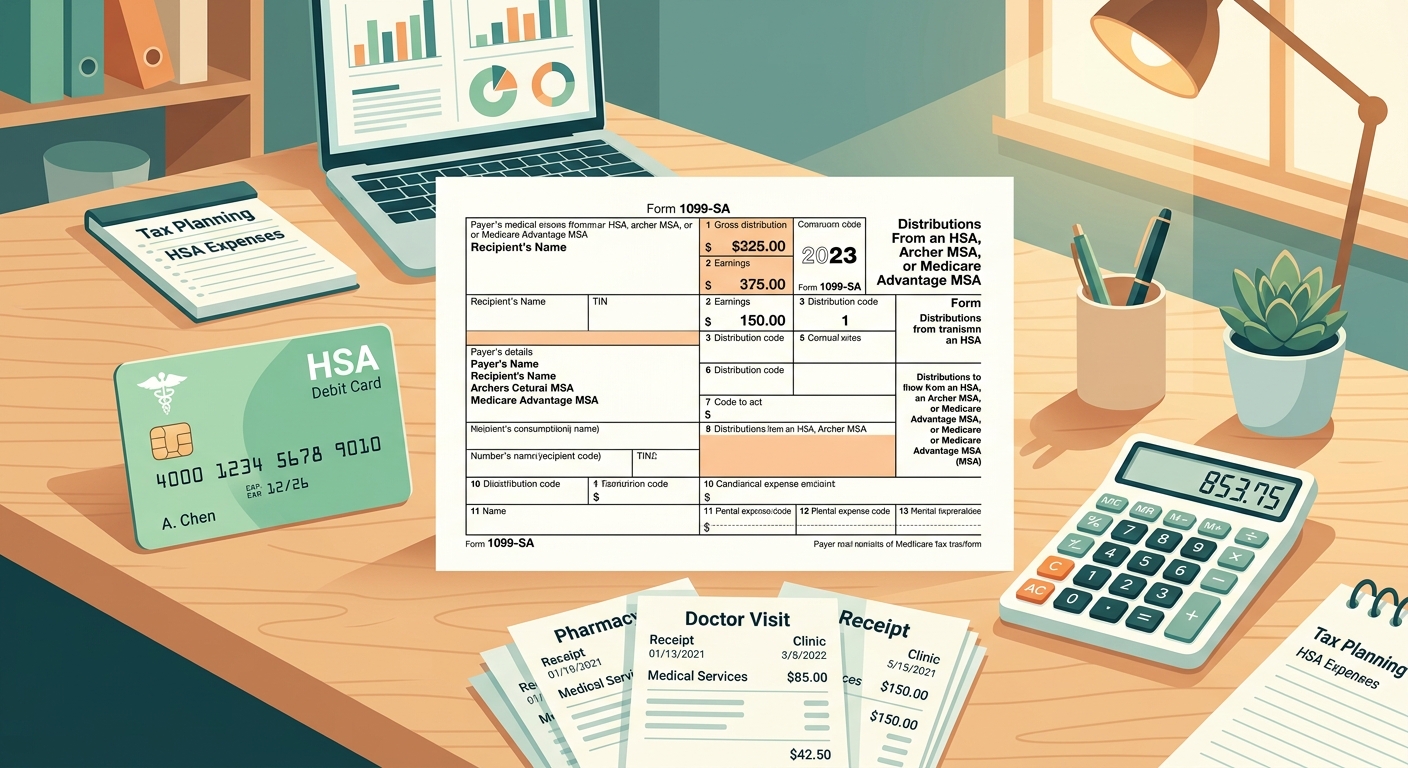
What Is the 1099-SA Form?
Form 1099-SA is an IRS tax document that reports distributions you took from a Health Savings Account (HSA), Archer Medical Savings Account (Archer MSA), or Medicare Advantage MSA during the tax year. If you withdrew money from one of these accounts, the financial institution managing your account sends you this form by January 31 and files a copy with the IRS. The form shows how much you withdrew, and you’ll use that information when filing your tax return to prove the money was spent on qualified medical expenses or to report taxable income if it wasn’t.
Think of the 1099-SA form like a receipt from your HSA custodian. It doesn’t tell the IRS whether your withdrawal was legitimate or not. It just says, “This person took out $X.” You’re responsible for keeping records that prove you used that money correctly. If you can’t prove it, the IRS treats your distribution as taxable income plus a 20% penalty if you’re under 65.
This matters because HSA withdrawals are one of the few triple-tax-advantaged accounts in the tax code. Contributions are tax-deductible, growth is tax-free, and withdrawals for medical expenses are tax-free. But the second you use HSA money for a non-medical expense before age 65, you lose that advantage and trigger a tax bill.
Quick Answer
The 1099-SA is a tax form that reports how much you withdrew from your HSA, Archer MSA, or Medicare Advantage MSA. You’ll receive it by January 31 if you took any distribution in the prior tax year. The IRS uses it to verify that your HSA withdrawals match what you report on your tax return.
Who Receives a 1099-SA Form?
You’ll receive a 1099-SA form if you took any distribution from a tax-advantaged medical savings account during the year. This includes:
- Health Savings Account (HSA) withdrawals for any reason, including qualified medical expenses, non-qualified expenses, or reimbursements for past expenses
- Archer MSA distributions (a predecessor to HSAs, still held by some taxpayers)
- Medicare Advantage MSA distributions used by those enrolled in high-deductible Medicare Advantage plans
Even if you only withdrew $10, you’ll get a 1099-SA. The IRS wants a paper trail for every dollar that leaves these accounts because of their tax-free status. Your HSA custodian (the bank, brokerage, or benefits administrator managing your account) is required to issue the form and report the distribution to the IRS.
Here’s where self-employed taxpayers and 1099 contractors often get tripped up: If you contribute to an HSA through your business and then take a distribution, you’re juggling both a tax deduction (on Schedule 1 of your 1040) and a distribution report (on Form 8889). Miss either piece, and the IRS may flag your return.
What If You Didn’t Receive a 1099-SA?
If you took a distribution but never received your 1099-SA by mid-February, contact your HSA provider immediately. You’re still required to report the withdrawal even if the form never arrives. The IRS already has a copy on file, so failing to report it will trigger a mismatch notice.
How to Read Your 1099-SA Form
The 1099-SA is one of the simpler IRS forms, but every box matters. Here’s what each section tells you:
Box 1: Gross Distribution
This is the total amount you withdrew from your HSA or MSA during the year. It includes everything: debit card purchases, checks you wrote, reimbursements you requested, and electronic transfers. If you withdrew $4,500 for medical bills, Box 1 shows $4,500.
Pro Tip: Compare Box 1 to your own records. HSA custodians occasionally make mistakes, especially if you used your HSA debit card at merchants that don’t exclusively sell medical items. If the number seems wrong, request a corrected 1099-SA before you file your return.
Box 2: Earnings on Excess Contributions
This box only has a value if you over-contributed to your HSA and then withdrew the excess plus any earnings it generated. The IRS taxes those earnings as ordinary income. Most people will see this box blank.
Box 3: Distribution Code
This single-digit code tells the IRS what type of account the distribution came from:
- Code 1: HSA (Health Savings Account)
- Code 2: Archer MSA
- Code 3: Medicare Advantage MSA
- Code 4: Not used
- Code 5: Not used
- Code 6: Not used
Almost everyone with a 1099-SA will see Code 1. If your form shows Code 2 or 3, the same rules apply, but you’ll report it slightly differently on Form 8889.
Box 4: Fair Market Value (FMV) on Date of Death
This box is only filled in if the account owner died and the HSA was distributed to a beneficiary. For living account holders, this will be blank.
Boxes 5-11: Identifying Information
These boxes show your name, address, and account number. Double-check that your Social Security number is correct. A mismatch between your 1099-SA and your tax return will delay your refund or trigger an IRS letter.
What You Must Do With Your 1099-SA
Receiving a 1099-SA doesn’t automatically mean you owe taxes. It just means you have to report the distribution and explain what you did with the money. Here’s the step-by-step breakdown:
Step 1: Gather Your Medical Expense Records
Before you file your tax return, organize every receipt, invoice, and explanation of benefits (EOB) for medical expenses you paid during the year. The IRS defines qualified medical expenses in IRS Publication 502, and the list is extensive: doctor visits, prescriptions, dental work, vision care, mental health counseling, lab tests, medical equipment, and more.
You’ll need this documentation if the IRS ever questions your HSA withdrawals. Even though you don’t submit receipts with your tax return, you must keep them for at least three years in case of an audit.
Step 2: Complete IRS Form 8889
Every taxpayer who contributes to or withdraws from an HSA must file Form 8889 with their tax return. This form reconciles your HSA activity for the year.
On Form 8889, you’ll report:
- Total HSA contributions (from you, your employer, or your business)
- Total distributions (from Box 1 of your 1099-SA)
- How much of those distributions were used for qualified medical expenses
- Any taxable distributions and penalties owed
If your total distributions equal your qualified medical expenses, you owe nothing. If you withdrew more than you spent on medical costs, the excess is taxable income, and if you’re under 65, you’ll owe an additional 20% penalty.
Step 3: Report on Your 1040
The bottom line from Form 8889 flows to your Form 1040. If you owe taxes or penalties on your HSA distribution, they’ll show up on Schedule 2 as additional tax. If everything was used correctly, Form 8889 simply documents that fact, and you move on.
Step 4: Keep Records for Three Years
Store your 1099-SA, Form 8889, and all supporting receipts together in a tax folder (physical or digital). The IRS has three years from your filing date to audit your return, and HSA distributions are a common audit trigger because so many taxpayers fail to keep adequate records.
Common Mistakes That Trigger IRS Problems
Red Flag Alert: Using HSA Funds for Non-Medical Expenses
The most expensive mistake self-employed taxpayers make with HSAs is treating them like a slush fund. You can legally withdraw HSA money for any reason at any time, but if it’s not for a qualified medical expense, you’ll owe income tax on the withdrawal plus a 20% penalty if you’re under 65.
Example: You’re a 1099 contractor who contributed $4,000 to your HSA in 2025. In December, you withdrew $2,500 to cover a business expense because cash was tight. That $2,500 is now taxable income. If you’re in the 22% federal tax bracket, you’ll owe $550 in income tax plus $500 in penalties (20% of $2,500), for a total tax hit of $1,050.
That’s a 42% effective tax rate on money you thought was yours. The tax savings you got from the HSA contribution ($550 if you deducted it) doesn’t come close to covering the penalty you’ll pay for the non-qualified withdrawal.
Red Flag Alert: Forgetting to File Form 8889
The IRS receives a copy of your 1099-SA directly from your HSA custodian. If you don’t file Form 8889 with your tax return, the IRS has no way to know whether your distribution was legitimate or not. The default assumption is that it wasn’t, and you’ll receive a CP2000 notice proposing additional tax and penalties.
Even if 100% of your distribution was for qualified expenses, skipping Form 8889 creates an audit risk that’s completely avoidable.
Red Flag Alert: Not Matching Your 1099-SA to Your Records
Your HSA custodian reports the gross distribution amount to the IRS. If you report a different number on Form 8889, the IRS computer will flag the mismatch. Always use the exact amount from Box 1 of your 1099-SA, even if you think the custodian made an error. If there’s a mistake, get a corrected 1099-SA before you file.
KDA Case Study: Self-Employed Consultant
Meet Jenna, a 38-year-old marketing consultant in San Diego operating as a single-member LLC. She earned $92,000 in 1099 income in 2025 and contributed $4,300 to her HSA (the 2025 max for self-only coverage). Throughout the year, she used her HSA debit card to pay for prescriptions, dental work, and a pair of prescription glasses, totaling $2,100 in qualified expenses.
In January 2026, Jenna received a 1099-SA showing a $2,100 distribution. She wasn’t sure if she needed to do anything with it since the money went to legitimate medical costs.
KDA walked her through the process:
- We verified her receipts matched the $2,100 distribution
- We completed Form 8889 showing $4,300 in contributions and $2,100 in qualified distributions
- We confirmed zero taxable income from the HSA and zero penalties
- We structured her bookkeeping to track HSA expenses separately going forward
Tax Savings Result: Jenna saved $1,290 in federal taxes from her HSA contribution (at her 30% effective rate) and paid zero penalties because everything was documented correctly. She paid KDA $850 for tax prep and advisory, netting $440 in first-year savings, with compounding benefits in future years as her HSA grows tax-free.
Ready to see how we can help you? Explore more success stories on our case studies page to discover proven strategies that have saved our clients thousands in taxes.
How the 1099-SA Affects Your Tax Return
The 1099-SA itself doesn’t change your tax bill. What matters is how you used the money. Here’s how different scenarios play out:
Scenario 1: All Withdrawals Were for Qualified Medical Expenses
You withdrew $3,000 from your HSA and spent all $3,000 on doctor visits, prescriptions, and dental work. On Form 8889, you’ll report the $3,000 distribution and show that 100% was used for qualified expenses. Result: Zero taxable income, zero penalties, and your tax return moves forward with no HSA-related tax liability.
Scenario 2: You Withdrew More Than You Spent on Medical Expenses
You withdrew $3,000 but only spent $2,200 on medical expenses. The remaining $800 is taxable income. If you’re under 65, you’ll also owe a $160 penalty (20% of $800). On your 1040, that $800 gets added to your gross income, and the $160 penalty shows up on Schedule 2.
Scenario 3: You’re Over 65
Once you turn 65, the 20% penalty goes away. You can withdraw HSA funds for any reason and pay only ordinary income tax (no penalty). This makes your HSA function like a traditional IRA once you hit Medicare age. You’ll still receive a 1099-SA, and you’ll still report it on Form 8889, but the penalty line stays at zero.
Scenario 4: You Reimbursed Yourself for Old Medical Expenses
You had $1,800 in medical bills in 2023 that you paid out of pocket. In 2025, you withdrew $1,800 from your HSA to reimburse yourself. This is 100% legal as long as the original expenses occurred after you opened your HSA, and you never reimbursed them before.
The 1099-SA reports the $1,800 distribution. On Form 8889, you’ll show it as a qualified distribution, and you’ll keep your receipts from 2023 to prove the expenses were legitimate. There’s no time limit on reimbursing yourself, which makes this a powerful tax planning strategy.
California-Specific Considerations
California doesn’t follow federal HSA rules. While the IRS allows you to deduct HSA contributions and withdraw funds tax-free for medical expenses, California treats HSAs like regular taxable accounts. This creates a compliance nightmare for California taxpayers.
Here’s how it works:
- Contributions: Not deductible on your California state return (you must add them back)
- Investment Growth: Fully taxable to California each year, even though it’s tax-free federally
- Distributions: Not taxable to California, because California never gave you a deduction in the first place
When you receive your 1099-SA, you’ll report the distribution on your federal Form 8889 but handle it differently on your California return. Most California taxpayers use an adjustment worksheet to back out the HSA activity and avoid double taxation.
Bottom Line: If you’re self-employed in California, the HSA is still worth it for federal tax savings, but you won’t get the same state-level benefit. Your effective tax rate on HSA contributions is roughly 8% higher than taxpayers in other states.
For comprehensive guidance on navigating California’s complex tax rules, explore our tax planning services to ensure you’re maximizing deductions while staying compliant.
What Qualifies as a Medical Expense for HSA Withdrawals?
The IRS defines qualified medical expenses in Publication 502, and the list is longer than most people expect. Here are the categories that count:
- Doctor and hospital visits: Co-pays, deductibles, and out-of-pocket costs for medical care
- Prescription medications: Any drug prescribed by a licensed healthcare provider
- Dental and vision care: Cleanings, fillings, crowns, glasses, contact lenses, LASIK surgery
- Mental health services: Therapy, counseling, and psychiatric treatment
- Medical equipment: Wheelchairs, crutches, blood pressure monitors, diabetic supplies
- Preventive care: Annual physicals, immunizations, and screenings
- Long-term care: Nursing home costs, in-home care for chronically ill individuals
What doesn’t qualify? Cosmetic procedures (unless medically necessary), over-the-counter medications without a prescription (though this changed temporarily during COVID), gym memberships, vitamins and supplements (unless prescribed), and health insurance premiums (with limited exceptions for COBRA, Medicare, and long-term care insurance).
Should You Use Your HSA for Every Medical Expense?
Here’s a contrarian strategy: Don’t touch your HSA if you can afford to pay medical expenses out of pocket. Let the account grow tax-free for decades, and reimburse yourself later when you’re in a higher tax bracket or when you need the money in retirement.
Because there’s no time limit on reimbursing yourself for old medical expenses, you can treat your HSA like a stealth retirement account. Pay for medical costs with after-tax dollars today, keep the receipts, and withdraw the money tax-free 20 years from now when your account has grown to six figures.
This strategy works best for high-income earners who can absorb current medical costs without tapping their HSA. For self-employed taxpayers with variable income, it’s often smarter to use the HSA as intended and withdraw funds as expenses arise.
When Do You Receive Your 1099-SA?
Your HSA custodian must send your 1099-SA by January 31 of the year following your distribution. If you took an HSA withdrawal anytime in 2025, you’ll receive your 1099-SA by January 31, 2026.
Most custodians mail paper copies and also post digital versions in your online account. If you’re enrolled in paperless delivery, check your HSA portal in late January.
The IRS receives their copy at the same time you do, which means any discrepancy between what you report and what the custodian reports will trigger a computer-generated notice within 12 to 18 months.
What If You Need a Corrected 1099-SA?
If your 1099-SA contains an error (wrong distribution amount, wrong Social Security number, or wrong account type), contact your HSA custodian immediately and request a corrected form. They’ll issue a 1099-SA with “CORRECTED” marked at the top.
Don’t file your tax return until you receive the corrected version. If you already filed, you may need to amend your return using Form 1040-X.
Ready to Reduce Your Tax Bill?
KDA Inc. specializes in strategic tax planning for business owners, S Corps, LLCs, and high-net-worth individuals. Book a personalized consultation and walk away with a clear plan.
Frequently Asked Questions About the 1099-SA
Do I Need to Attach My 1099-SA to My Tax Return?
No. Form 8889 is the only HSA-related form you file with your 1040. Keep your 1099-SA in your tax records, but don’t mail it to the IRS or attach it to your e-filed return.
What If I Lost My 1099-SA?
Log into your HSA account online and download a duplicate copy. Most custodians allow you to access prior-year tax forms indefinitely. If you can’t find it online, call your HSA provider and request a replacement.
Can I Take an HSA Distribution Before I Pay the Medical Bill?
Yes, as long as the expense has already been incurred. You don’t have to wait until the bill is paid. If you had surgery in December but didn’t pay the hospital until January, you can withdraw HSA funds in December to cover the bill as long as the service was provided in December.
Book Your Tax Strategy Session
If you’re self-employed and unsure whether your HSA distributions are setting you up for an IRS problem, let’s fix that now. Too many 1099 contractors and business owners assume their HSA custodian handles the tax reporting, only to get hit with penalties later because they didn’t file Form 8889 correctly. Book a personalized consultation with our strategy team and get clear, compliant, and confident about your HSA tax treatment. Click here to book your consultation now.
This information is current as of June 10, 2026. Tax laws change frequently. Verify updates with the IRS if reading this later.



