
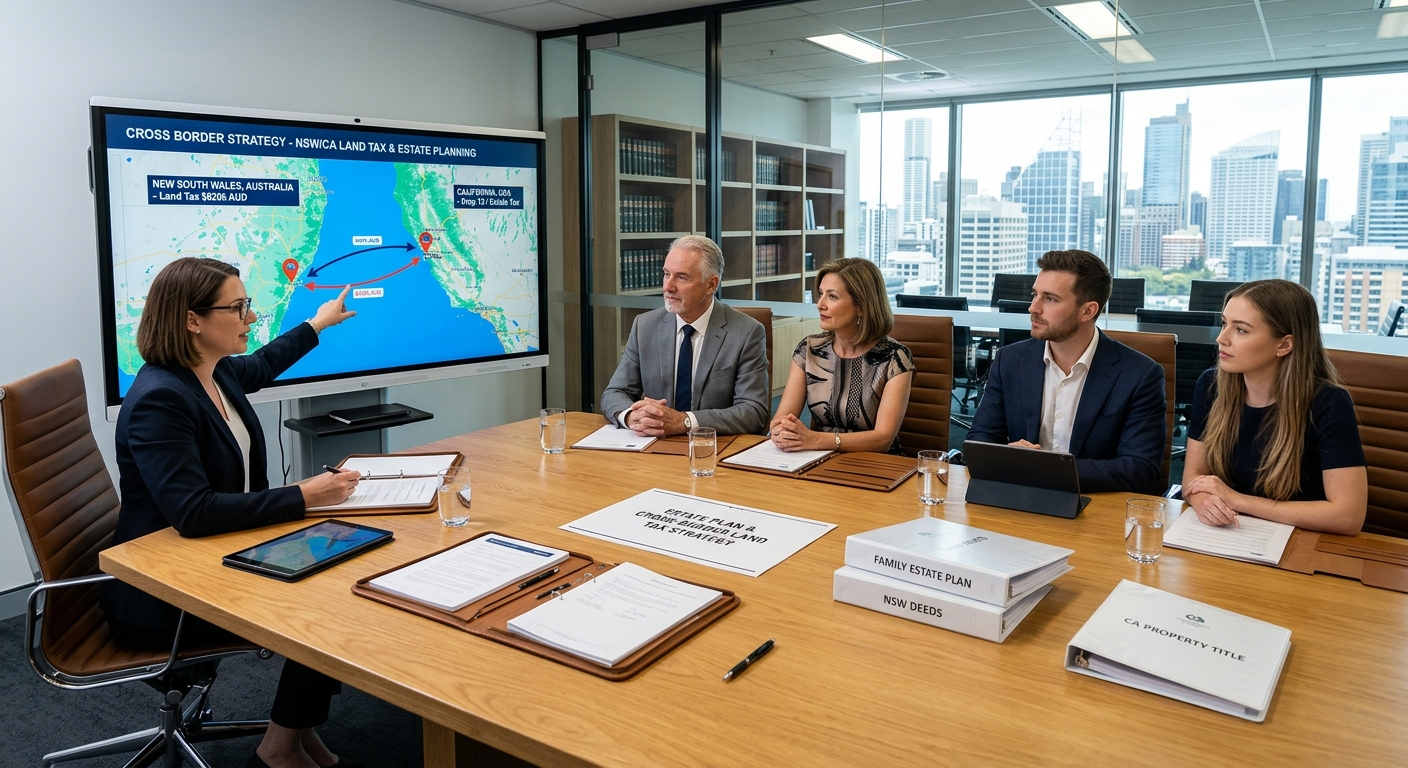
Many property owners fixate on income tax and ignore the quiet leak in their wealth: land tax on property held in or outside a trust. That oversight becomes more expensive once you layer in cross border issues and family dynamics across generations.
The right structure for **land tax family trust nsw** decisions does not live in a vacuum. If you or your heirs live or invest in the United States, especially California, the way an Australian family trust holds land can collide with US estate, gift and income tax rules. Done well, you create a coordinated plan that reduces annual land tax, limits US tax exposure and keeps control of assets inside the bloodline. Done poorly, you stack avoidable Australian surcharges on top of US estate tax and probate problems.
Quick Answer
If your family holds New South Wales land through a discretionary or family trust and any current or future beneficiary is in the US, you need an integrated plan that covers NSW land tax classification, trust deed wording, foreign person surcharges and US estate and income tax treatment. In practice that means reviewing the trust deed, mapping each beneficiary’s tax residency, testing NSW foreign person rules, and aligning that structure with US estate and gift planning so your heirs do not inherit a tax mess along with the property.
How NSW Family Trust Land Tax Rules Interact with Cross Border Families
Start with the basics. Land tax in New South Wales is an annual charge on the unimproved value of land above a threshold. Trusts that own land for a family group often face different land tax treatment compared with individuals, companies or superannuation funds. Add a foreign person surcharge if the trust has any potential beneficiaries who are foreign persons under NSW law and the annual bill can jump sharply.
This matters if your family is split between Australia and the US. A parent may have set up a family trust in Sydney twenty years ago with a wide class of potential beneficiaries including future spouses and remote relatives. Since then, one adult child has become a US tax resident working in California, another lives in New York, and grandchildren were born as US citizens. On paper those relatives may cause the trust to be treated as a foreign person for NSW land tax, which can trigger surcharge land tax and even surcharge purchaser duty when buying new property.
At the same time, the US sees many foreign trusts as either grantor trusts, where the person who funded the trust is still treated as the owner for US tax purposes, or as complex non grantor trusts with their own US reporting and withholding rules. When a US beneficiary receives income or capital from the trust, they may owe US federal income tax and in some cases state tax where they live. That is on top of the Australian tax at trust level or beneficiary level.
Coordinating these regimes is not about gaming either system. It is about making sure the trust deed and ownership pattern line up so you do not accidentally suffer double or triple layers of tax or have a structure that looks suspicious to revenue authorities in both countries.
Why Families Use Trusts Instead of Individual Land Ownership
For many families the choice was simple at the time of purchase. Holding NSW land directly in personal names exposed the property to creditor claims, divorce settlements and forced sales if an owner lost capacity. A family trust offered several benefits.
Asset protection and control
A properly drafted discretionary trust can help quarantine investment property from personal liabilities. If one child runs a business or works in a high risk profession, creditors chasing that child cannot automatically access land held in the family trust. The appointor or controller can replace the trustee or adjust distributions if a beneficiary gets into personal or financial trouble.
Flexible income distribution
Income from the land, such as rent on a commercial property or rural land leases, can be streamed to different family members over time. When children are at university with low income, some rent can be distributed to them. When they become high earning professionals, more income can stay with parents or be retained in the trust subject to Australian trust tax rules. This flexibility is one of the main reasons families use trusts even when land tax outcomes are similar to personal ownership.
Estate and legacy planning
Instead of each generation owning a direct slice of the title, which can lead to messy co ownership and partition disputes, the trust holds the land continuously. Control passes by changing the appointor or trustee, not by shifting legal title on every death. That has two big advantages. The first is avoiding repeated transfer duty in Australia. The second is creating a cleaner path to integrate US estate tax and US probate planning if one or more family members live in the United States.
For a comprehensive discussion of how legal entities, trusts and cross border families can plan their estates, including California specific angles, see our California estate and legacy tax planning guide.
How Land Tax Classification Choices Shape Long Term Costs
With a family trust structure the key question is not just whether land tax applies, but how the land and the trust are classified. In NSW, revenue authorities look at the trust deed terms and beneficiary classes to decide whether a trust is a fixed trust, a concessional trust such as a special disability trust, or a generic discretionary trust potentially caught by foreign person rules.
Consider two scenarios. In the first, the trust deed lists a wide class of beneficiaries including non resident relatives and a class of potential spouses. No variation has ever been lodged to restrict foreign persons from benefiting. The trust then acquires a Sydney residential investment property with an unimproved value of AUD 2 million. Surcharge land tax at a few extra percentage points each year over two decades can easily consume hundreds of thousands of dollars that could have stayed in the family.
In the second scenario, the trust deed is amended within NSW guidelines to exclude foreign persons from benefiting and the variation is lodged correctly. Land tax may still apply at general trust rates above the threshold, but without the surcharge. Over a thirty year holding period on a significant property, that difference alone can be enough to fully fund the professional fees for a solid cross border structure including US planning and California counsel if needed.
The longer your holding period and the higher the expected land value growth, the more important it becomes to run the numbers in detail instead of assuming that the structure chosen years ago is still optimal. That same exercise should include your US exposure if you are a citizen, green card holder or tax resident, or if your heirs live in the US.
Where US estate and income tax quietly creep in
US citizens and long term residents are taxed on worldwide income and are subject to US estate and gift tax on worldwide assets. Even if your NSW family trust is not considered a US taxpayer itself, a US beneficiary can trigger complex reporting on Forms 3520 and 3520 A when they receive distributions. If the trust ever holds US situs assets, such as US real estate or certain US securities, US estate tax rules can reach into the structure on death.
A common mistake is ignoring these reporting and estate issues because the land itself is in Australia and the trust deed is governed by NSW law. From a US perspective, what matters is the status of the grantor, the trustee and the beneficiaries and where they reside and pay tax. If a US person is treated as the owner of the trust for US tax purposes, they may need to report the full activity of the trust each year, even if the trustee files Australian trust returns and pays Australian land tax and income tax.
KDA Case Study: Cross Border Family Trust with NSW Land and US Heirs
Consider a family originally from Sydney who built wealth through a privately held distribution business. Fifteen years ago they settled a family trust which now owns two NSW properties with a combined land value of AUD 4.5 million. One child moved to California, became a US citizen and built a high income career in the technology sector. The parents intended that child and their siblings would eventually benefit equally from the trust assets.
By the time they came to us, the trust had been paying surcharge land tax for several years because the beneficiary class included non residents and no foreign person exclusion clause had been lodged. At the same time, the California based child had begun receiving distributions from the trust that were not being reported correctly on US returns, creating a risk of penalties for missed foreign trust reporting and underpaid US tax.
We worked with Australian counsel to vary the trust deed within NSW guidelines so that foreign persons could not benefit directly from the trust, eliminating future surcharge land tax on existing properties. Together with their Australian tax adviser the family reviewed how income would be distributed so that Australian tax was correctly paid and documented. On the US side we helped clean up prior year reporting and built a plan that shifted the US child’s benefit away from direct distributions of foreign trust income toward a coordinated estate plan involving US entities and life insurance.
The result was significant. Over a ten year horizon, projected surcharge land tax savings were more than AUD 350,000 compared with doing nothing. US penalty exposure was reduced by voluntary corrections and careful filings, and the family gained clarity about how the NSW properties would transition to the next generation without dumping unexpected tax bills on the California based heir. Professional fees across both countries were a fraction of the projected savings.
Ready to see how we can help you? Explore more success stories on our case studies page to discover proven strategies that have saved our clients thousands in taxes.
What the IRS and Australian Revenue Authorities Focus On
Both Australian and US authorities use information matching and disclosure rules to police trusts. In Australia, land registries, revenue offices and trust tax returns provide a clear picture of who owns significant property. In the US, the Internal Revenue Service relies on a mixture of self reporting, cross border information exchange treaties and bank reporting to identify foreign trust relationships involving US persons.
On the US side the filings are complex but clear. US beneficiaries of foreign trusts often must file Form 3520 to report distributions and Form 3520 A to report the trust’s annual income and activities. Failure to file can trigger penalties that are calculated as a percentage of the distribution or of the trust’s assets, and those penalties add up quickly. Details are described in the instructions to Form 3520 A.
US taxpayers may also need to report foreign financial accounts associated with the trust on FinCEN Form 114 and may have additional disclosure under the Foreign Account Tax Compliance Act. While land itself is not a financial account, rental income and proceeds often flow through foreign bank accounts that are reportable. In parallel, NSW Revenue can review land tax registrations to ensure that trusts pay the correct rate and surcharge based on their classification.
In short, both sides have visibility. Hoping that a complex trust structure will simply fly under the radar is not a strategy. Aligning the structure with the rules on both sides is.
Red Flag Alert: Common Cross Border Family Trust Mistakes
Certain patterns show up repeatedly in cross border trust reviews and they all increase tax risk.
Ignoring foreign person definitions in the trust deed
NSW foreign person rules do not just look at who currently receives income. They often consider who could benefit under the trust deed. If the class includes non resident relatives, foreign companies or future spouses who might be foreign persons, the trust may be treated as a foreign person for land tax and duty purposes unless the deed is varied correctly.
Families who created broad discretionary trusts decades ago frequently discover that they are paying surcharge land tax long after any practical risk justified such a broad class. Tightening the deed to focus on the real family group, subject to Australian legal advice, can produce immediate savings.
US beneficiaries receiving unplanned trust distributions
From a US perspective, distributions from a foreign trust can carry out different types of income, including ordinary income, capital gains and so called accumulated income that is subject to special US anti deferral rules. If those distributions are made without understanding the US rules, the US beneficiary can face higher tax and interest charges, as explained in IRS Publication 519.
The fix is straightforward conceptually but requires discipline. Map out which beneficiaries are US persons, understand the character of trust income under US rules, and design a distribution policy that avoids pushing problematic income into the US system unless the tax cost has been modelled and accepted.
Assuming probate tools replace proper trust planning
Some families try to avoid deeper planning by relying on simple probate avoidance tools such as transfer on death deeds in US states that allow them. Those tools can be helpful where a single family home in the US is the main asset, but they do not solve cross border trust and land tax issues and they do not coordinate well with a long standing NSW family trust owning Australian land.
For families with multi jurisdictional assets and mixed residency heirs, a coordinated plan involving trusts, sometimes entities and carefully drafted wills tends to deliver more predictable outcomes than piecemeal instruments stitched together over time.
How to Align NSW Land Tax and US Estate Planning for Your Family
The practical work of aligning NSW land tax and US planning is methodical rather than glamorous. The goal is to give your family a written roadmap so future trustees and executors are not guessing how you wanted things to work.
Step 1: Map your assets and entities
List every parcel of land in NSW, who holds legal and beneficial ownership and through which entity. Include family trusts, unit trusts, companies and personal names. Note current land tax assessments and any surcharge components. On the US side, note any US real estate, US partnerships or companies and key bank or brokerage accounts.
Step 2: Map your family’s tax residency and citizenship
Create a simple family tree and mark who is a US citizen, US tax resident or green card holder, who is Australian resident for tax and who lives elsewhere. This drives both NSW foreign person analysis and US foreign trust and estate tax exposure.
Step 3: Review and, if needed, vary trust deeds
With Australian counsel, review each trust deed that owns NSW land. Identify whether the deed is drafted broadly with foreign person classes or whether it has already been varied. Confirm that any intended variations have been lodged with NSW revenue agencies where required. At the same time, US advisers can assess whether each trust is a grantor or non grantor trust under US rules and what US reporting is triggered.
Step 4: Build a documented distribution and succession policy
Document how and when the trustee will distribute income and capital to beneficiaries in different countries, taking into account both Australian and US tax outcomes. Decide who will control the trust on the death or incapacity of key family members and how that control interacts with US estate plans, including revocable living trusts or US wills. Once the policy is drafted, update trust minutes and US estate planning documents to match.
For families where business or rental income flows through the trust or related entities, this is also the stage to bring in bookkeeping and payroll support so records are clean and ready for cross border analysis. If you need ongoing support tracking trust income and expenses across multiple entities, our bookkeeping and payroll services can help create the level of documentation that both IRS and Australian revenue offices expect.
Will This Trigger an Audit or Extra Scrutiny?
Many families hesitate to adjust long standing structures because they worry that any change will invite attention from revenue authorities. In practice, what tends to draw scrutiny is inconsistent reporting, unexplained patterns or obvious errors, not careful alignment work done with professional advice.
On the Australian side, updating a trust deed and lodging required forms can often reduce risk rather than increase it, because it brings the deed into line with current law and clarifies how land tax and surcharge rules apply. On the US side, filing corrected foreign trust forms with clear explanations and professional support can be the difference between manageable outcomes and damaging penalties.
If you do receive correspondence from the IRS or from Australian revenue authorities about trust structures, it is important not to ignore it. Our team regularly supports clients with audit defence and response strategies, and our audit representation services are designed to help cross border families navigate those reviews calmly and professionally.
Who Needs to Act Now
Not every family with a NSW trust and US connections needs to overhaul their structure immediately. But certain profiles should move this review from the “someday” list to the “this year” list.
- Families with NSW land in a trust that has already been classified as a foreign person for land tax and surcharge purposes
- US citizens or residents who are trustees, appointors or beneficiaries of Australian family trusts
- California residents with parents or siblings who hold Australian property through trusts or companies
- Families expecting a major transfer of wealth over the next decade involving both Australian and US assets
- Anyone who has received a land tax or foreign trust reporting notice they do not fully understand
If you fall into one of these categories, a coordinated review today can protect you against more painful surprises later. Many of our investor and capital partner clients arrive with structures that grew organically over time. The first step is always to survey the existing landscape and quantify the cost of keeping things as they are compared with making targeted adjustments.
Bottom Line
NSW land tax rules, foreign person surcharges and US trust taxation are each complicated on their own. Combine them in a single family and the complexity multiplies. The answer is not to abandon trust structures altogether, nor is it to cling to outdated arrangements solely because they were set up years ago.
Instead, treat your family trust as part of a larger cross border estate and tax strategy. Review the trust deed against NSW land tax and foreign person definitions, map your family’s residency and citizenship, and bring US estate and income tax advisers into the conversation early. That combination allows you to keep more of what your family has built, while staying squarely within the rules on both sides of the Pacific.
Key Takeaway: the rules that govern land tax and trusts will continue to evolve in both Australia and the US. The families who come out ahead are those who treat their structures as living plans and revisit them periodically as laws and family circumstances change.
Ready to Reduce Your Tax Bill?
KDA Inc. specializes in strategic tax planning for business owners, S Corps, LLCs, and high-net-worth individuals. Book a personalized consultation and walk away with a clear plan.
Book Your Cross Border Estate and Trust Strategy Session
If your family straddles NSW and the US and you are not sure whether your current trust and land ownership structure is helping or hurting you, it is time for a focused review. Our advisory team regularly works with Australian counsel to align land tax, trust and US estate planning for business owners, investors and high net worth families. Click here to book your consultation now.
This information is current as of 6/7/2026. Tax laws change frequently. Verify updates with the IRS, NSW Revenue or other relevant authorities if you are reading this at a later date.



