
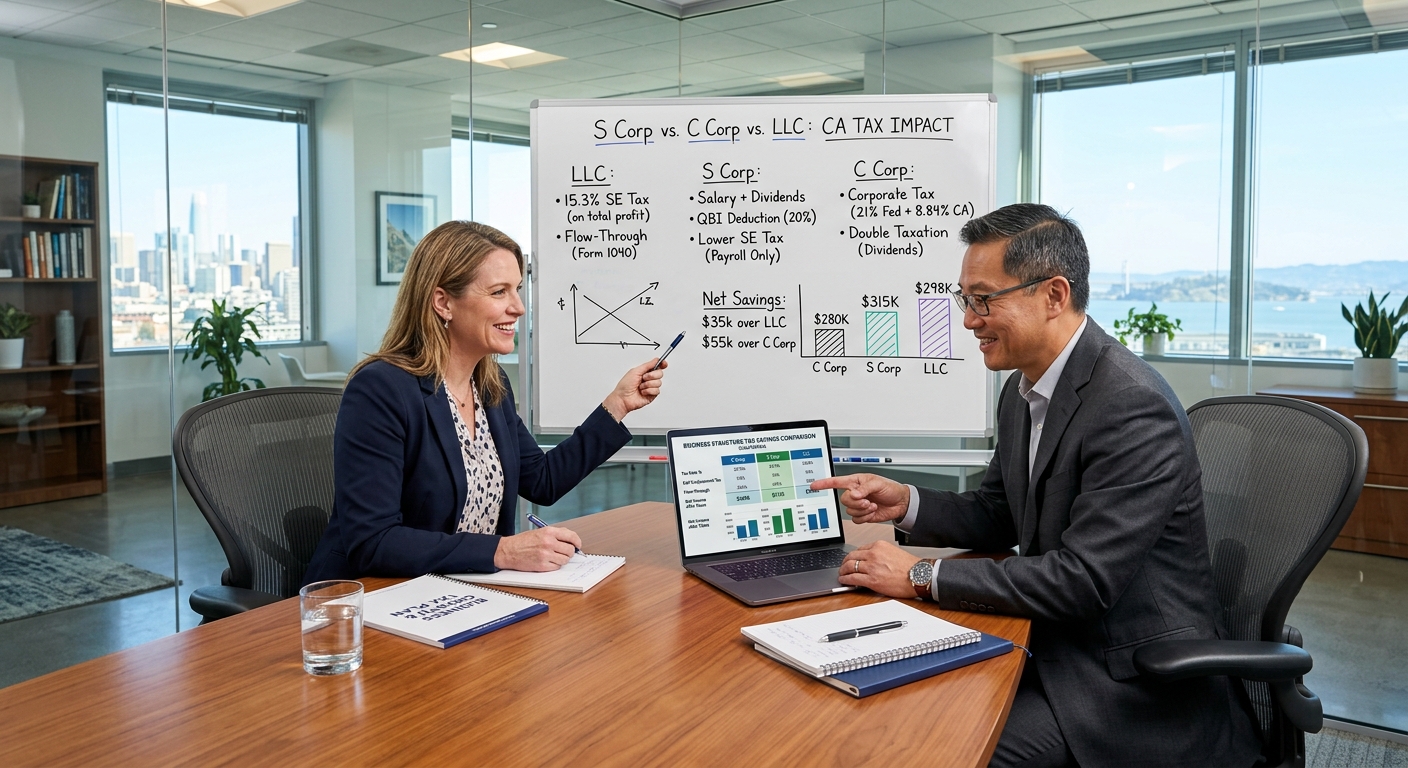
Most business owners obsess over revenue and ignore the one decision that can quietly drain five or six figures over a decade: how the business itself is structured for tax purposes. The wrong choice between an S corporation, a C corporation, or an LLC can lock you into extra payroll taxes, double taxation, or a nightmare sale later when you want to cash out.
On the surface, comparing s corp vs c corp llc looks like alphabet soup. In practice, it is the difference between paying self employment tax on every dollar of profit versus only on the salary you choose to pay yourself, or paying corporate tax and then personal tax again on the same money. If you are a W 2 earner with side gigs, a 1099 consultant, an LLC owner, or a real estate investor with multiple properties, getting this decision wrong is expensive.
Quick Answer: How These Entities Really Differ On Taxes
If you strip out the legal jargon, here is how the three structures usually break down for tax purposes for the 2025 tax year.
- LLC taxed as a sole proprietor or partnership: All net profit flows to you and is subject to income tax and normally self employment tax. Simple, flexible, but often expensive once profits climb.
- S corporation: Still pass through, but you split earnings into W 2 salary (subject to payroll taxes) and distributions (generally not subject to self employment tax). Done correctly, this often cuts thousands of dollars of tax per year.
- C corporation: Separate taxpayer that pays corporate income tax. If you pull out after tax profits as dividends, you get hit again at the personal level. Double taxation can be worth it in very specific situations but is usually a trap for small owners.
The right answer depends on your profit level, how you take money out, whether you plan to sell, and whether you operate in a high tax state like California. That is why cookie cutter advice from the internet is dangerous.
How LLC Taxation Actually Works Once Real Money Shows Up
Most people start their business with a simple LLC because the filing is easy and the liability protection is better than operating as a sole proprietor. For tax purposes, a single member LLC is disregarded by default. That means the IRS treats you as a sole proprietor and your business activity lands on Schedule C of your individual return. If there are multiple members, the LLC typically files Form 1065 as a partnership and issues Schedule K 1s to the owners.
From a tax perspective, this default treatment has one big downside once your profits grow. Every dollar of net profit is normally subject to self employment tax, which is the combination of Social Security and Medicare taxes. For 2025, that is 15.3 percent on roughly the first 160,000 of combined wages and self employment income, then 2.9 percent Medicare beyond that, plus the 0.9 percent additional Medicare surtax at higher incomes. Those numbers change slightly year by year, but the concept is the same. A profitable consultant or online seller clearing 150,000 may easily be writing a 20,000 plus check just for this layer of tax.
The upside of the LLC default is simplicity. You avoid corporate formalities and separate tax returns. Losses flow through to your individual return, which can be powerful in the early years if you are investing heavily in equipment or marketing. Publications like IRS Publication 334 and IRS Publication 535 outline how small business income and deductions work for these pass through structures.
If you are a solo operator or side hustler, you might also fit the profile on KDA s dedicated page for self employed taxpayers, where we routinely see missed deductions and messy bookkeeping amplify the inherent self employment tax cost of the default LLC approach.
When A Default LLC Still Makes Sense
Keeping your LLC taxed in the default way can be smart when:
- Your net profit is still under roughly 40,000 to 60,000 per year.
- You have significant losses from startup costs or heavy equipment purchases.
- You are not ready to run payroll or deal with another tax return.
In this zone, the extra cost of self employment tax might be less than the added admin cost of an S corporation. But once your profit climbs past that band, the math starts to flip.
How S Corporation Status Changes The Tax Math
An S corporation is not a separate type of legal entity. It is a tax election you make by filing Form 2553 with the IRS for an eligible corporation or LLC. Once in place, the S corporation generally does not pay federal income tax itself. Instead, profit or loss flows through to shareholder K 1s. The twist is in how the IRS treats compensation to owners who work in the business.
If you own and actively work in an S corporation, the IRS expects you to pay yourself a reasonable W 2 salary for the services you perform. That salary is subject to the normal payroll taxes: Social Security, Medicare, and any state employment taxes. But once you have paid yourself that reasonable salary, additional profit can typically be distributed as S corporation dividends that are not subject to self employment tax.
Compare that to staying in an LLC taxed as a sole proprietor. In that case, every dollar of profit is hit with self employment tax. That difference is where the savings show up.
For a deeper dive into how S corporations work in practice, including California quirks and reasonable compensation expectations, KDA has a pillar level resource at this complete S corporation strategy guide.
Using S Corp Versus C Corp Versus LLC To Cut Self Employment Tax
Consider a consultant based in California netting 180,000 after expenses in a single member LLC. At default, nearly all of that 180,000 is subject to self employment tax. Roughly 160,000 would incur the 15.3 percent Social Security and Medicare layer, and the rest would still face Medicare tax. You are easily in the 24,000 self employment tax neighborhood, on top of federal and California income taxes.
Now assume that same business instead elects S corporation status. Reasonable salary is facts and circumstances, but say we justify a 90,000 W 2 wage based on market pay for similar roles. That 90,000 is subject to payroll taxes, around 13,770 combined employer and employee Social Security and Medicare for 2025 ballpark numbers. The remaining 90,000 of profit passes through as S corporation distribution not subject to self employment tax. Even netting out some extra costs for payroll service and tax prep, this owner likely keeps 7,000 to 10,000 more in their pocket annually.
Clients who operate as business owners with consistent mid six figure revenue often see that number go higher, especially when combining S corporation status with systematic retirement contributions and health insurance written through the entity.
To model your own numbers across different profit levels and salary mixes, it can be helpful to plug projections into a dedicated tool like a small business tax calculator. Seeing the difference in black and white between paying self employment tax on all profits versus just your salary tends to focus the conversation.
Red Flag Alert: Reasonable Compensation Is Not Optional
Some owners abuse S corporation status by paying themselves almost nothing in wages and taking nearly everything as distributions. That is a direct invitation for IRS scrutiny. The agency has repeatedly challenged cases where owner employees took unreasonably low salaries, and courts have supported payroll tax assessments in those cases. See discussions in IRS Publication 15 on employment tax responsibilities.
A sustainable S corporation strategy will always include a defensible salary number backed by market data, role expectations, and time spent in the business. Skipping this step can turn a tax savings play into a future audit headache.
Where C Corporations Fit Into The Picture
C corporations are the default structure for many venture backed startups and larger companies, in part because they offer flexible stock classes and easier capital raising. From a tax standpoint, however, they are usually a poor choice for closely held service businesses or real estate investors.
A C corporation files Form 1120 and pays corporate income tax on its profits. When the company then pays those after tax profits out as dividends, the shareholder reports that dividend income again on their individual return. That double layer of tax can easily exceed the combined income and self employment tax burden of a well structured S corporation.
There are narrow situations where a C corporation can make sense, such as when you plan to leave profits inside the company for a long time, pursue qualified small business stock benefits under Internal Revenue Code Section 1202, or operate in an industry where investors demand a C corporation. For most solo or small professional firms, though, defaulting to a C corporation simply because it sounds more official is an expensive branding exercise.
KDA Case Study: Turning An Expensive LLC Into A Lean S Corporation
A few years ago, a California based marketing consultant we will call Alicia came to KDA after three years in business. She had formed an LLC on the advice of a friend and was reporting everything on Schedule C. Her revenue had grown to about 260,000, with net profit of roughly 170,000 after expenses. Her prior preparer dutifully filed her returns but never raised the question of entity taxation.
When we reviewed her returns, we calculated that she was paying in the neighborhood of 22,000 to 24,000 annually in self employment tax alone, on top of federal and state income tax. Over three years, that layer alone had consumed close to 70,000 of her hard earned profit.
Our team walked Alicia through the tradeoffs of s corp vs c corp llc using her real numbers. Given her consistent earnings, intent to keep the business long term, and willingness to run payroll, we recommended electing S corporation status for her LLC as of the start of the next tax year. We set a 100,000 W 2 salary based on her role, industry data, and workload, with the remaining 70,000 expected to flow as S corporation distributions.
In the first year after the switch, Alicia saved roughly 8,500 in combined Social Security and Medicare taxes net of additional payroll and tax prep costs. We also used the structure to support a Solo 401 k contribution strategy that moved another 30,000 per year into tax deferred retirement savings. Her initial advisory fee to KDA for entity analysis and ongoing support was about 3,000, giving her nearly a three times return in just year one, with higher long term benefit as profits grew.
Ready to see how we can help you? Explore more success stories on our case studies page to discover proven strategies that have saved our clients thousands in taxes.
Common Mistakes When Choosing Between Entity Types
Business owners, especially first timers, tend to repeat the same errors when deciding on an entity structure and tax treatment. Understanding these traps can save you from costly amendments and restructures later.
Choosing A C Corporation Just For The Name
Many high earning professionals think C corporation means more legitimate, especially if they see it on the letterhead of large firms. The problem is that bigger firms usually have complex ownership and profit retention strategies that offset C corporation downsides. A solo engineer pulling 300,000 from consulting work has a very different reality. That engineer may fit better within the profile discussed on KDA s dedicated page for engineers and technical professionals.
Filing as a C corporation purely for prestige can lock you into double taxation and limit flexibility on how and when you exit the business. Unwinding that choice often requires legal work, tax elections, and sometimes tax on built in gains.
Waiting Too Long To Elect S Corporation Status
The S corporation election on Form 2553 has strict timing rules. Generally, you must file by the 15th day of the third month of the tax year for which the election is to take effect. There are late election relief procedures in certain cases, but relying on forgiveness is not a strategy.
Owners often realize they should have been S corporations after several strong years of profit. At that point, we can sometimes obtain late election relief, but you may have already overpaid self employment taxes for prior years that are now closed. Getting this right early is far cheaper than trying to fix it later.
Ignoring State Level Taxes And Fees
States layer their own rules on top of federal tax concepts. California, for example, charges an annual 800 minimum franchise tax on most entities and imposes a 1.5 percent tax on S corporation net income. LLCs face an annual fee that scales with total income. A structure that looks perfect on a federal spreadsheet can perform differently once you overlay state and local costs.
Any serious entity decision should factor in your state s rules, especially if you live in or move between high tax jurisdictions. For federal concepts, you can review IRS Publication 542 for corporate taxation and IRS Publication 541 for partnerships, then work with an advisor who understands your specific state.
How To Decide Which Structure Fits Your Situation
While every case is different, you can use a simple framework to narrow in on the right fit.
Step 1: Clarify Your Profit Range
Estimate your realistic annual net profit over the next two to three years, not just this month s performance. If you expect to hover under 40,000, staying as an LLC with default taxation may be fine. Between 60,000 and 200,000, the S corporation begins to shine, especially for service businesses. Above that, more advanced planning like multi entity structures and qualified small business stock may enter the conversation.
Step 2: Decide How You Take Money Out
If you pull every dollar of profit out of the business each year to fund living expenses, you will feel every bit of extra tax. That makes avoiding unnecessary self employment tax even more important. If you plan to retain profits inside the company for growth or long term investment, the C corporation may have a narrow role, particularly if you can use lower corporate rates and 1202 benefits.
Step 3: Consider Your Exit Strategy
If you hope to sell your company within five to ten years, structure and tax classification can dramatically change your after tax proceeds. Asset sales versus stock sales, built in gains, and basis all tie back to whether you ran as an LLC, S corporation, or C corporation. Planning this from day one is ideal, but it is never too late to reevaluate.
Owners in this more complex category often benefit from coordinated tax and advisory support, like KDA s higher touch offerings described on our premium advisory services page.
Will Choosing The Wrong Entity Trigger An Audit?
Picking an entity type by itself does not cause an audit. What draws attention is inconsistent reporting, extreme positions, or ignoring basic rules like reasonable S corporation salaries. The IRS knows that many small owners are confused by s corp vs c corp llc tradeoffs. Their concern is not your choice; it is whether you apply the law correctly once you have chosen.
For example, if your S corporation shows 500,000 of profit and you only pay yourself 20,000 in wages, that imbalance can stand out. Similarly, using an LLC to run what is effectively a personal hobby and claiming large losses year after year without a real profit motive can raise questions under the hobby loss rules summarized in IRS Publication 535.
Good records, consistent classification, and proactive planning dramatically reduce your risk. When the IRS does ask questions, having an advisor who already understands your structure and has documented the reasoning behind it is valuable.
What If You Need To Change Structures Later?
It is common for businesses to evolve from one structure to another. Many start as sole proprietors or simple LLCs, then elect S corporation status once profits justify the move. In more advanced setups, owners layer holding companies, operating entities, and special purpose vehicles for real estate or intellectual property.
Changing your tax classification is possible but should never be done impulsively. Some changes, like electing S corporation status for an existing LLC, are relatively straightforward when done on time and with good records. Others, like moving appreciated assets out of a C corporation, can trigger immediate tax.
This is one of the reasons KDA rarely gives blanket advice online. Two owners with identical income numbers can have very different ideal structures based on their debt, family situation, state residency, and exit plans. A 1099 software engineer in Texas and a real estate investor in California with multiple LLCs will not end up in the same design, even if they start from the same question about s corp vs c corp llc.
Bottom Line
The choice between an LLC, an S corporation, and a C corporation is not about what sounds impressive on a business card. It is about controlling where and how your income is taxed now and at exit, how much of it is exposed to self employment or payroll taxes, and how easily you can move money in and out of the business without surprises.
If your net profit is above roughly 75,000 and you are still in a default LLC or sole proprietor setup, you owe it to yourself to run the numbers. In many cases, a properly structured S corporation will save thousands per year in taxes while still giving you flexibility and liability protection. There are also cases where staying simple makes sense or where a C corporation is justified, but those are the exceptions, not the rule.
This information is current as of 6/5/2026. Tax laws, income thresholds, and IRS enforcement priorities change regularly, so if you are reading this much later, confirm current limits directly with the IRS or a qualified advisor before acting.
Ready to Reduce Your Tax Bill?
KDA Inc. specializes in strategic tax planning for business owners, S Corps, LLCs, and high-net-worth individuals. Book a personalized consultation and walk away with a clear plan.
Book Your Tax Strategy Session
If you are not sure whether your current structure is costing you unnecessary tax, it is time to get a clear, personalized answer. Our team reviews your actual numbers, state situation, and goals, then builds a plan around your specific reality instead of generic rules. Many clients discover five figure savings opportunities simply by rethinking their entity and compensation mix.
If you want to know whether an LLC, S corporation, or C corporation will put more after tax cash in your pocket over the next three to five years, schedule a focused strategy session with KDA. Click here to book your consultation now.



