
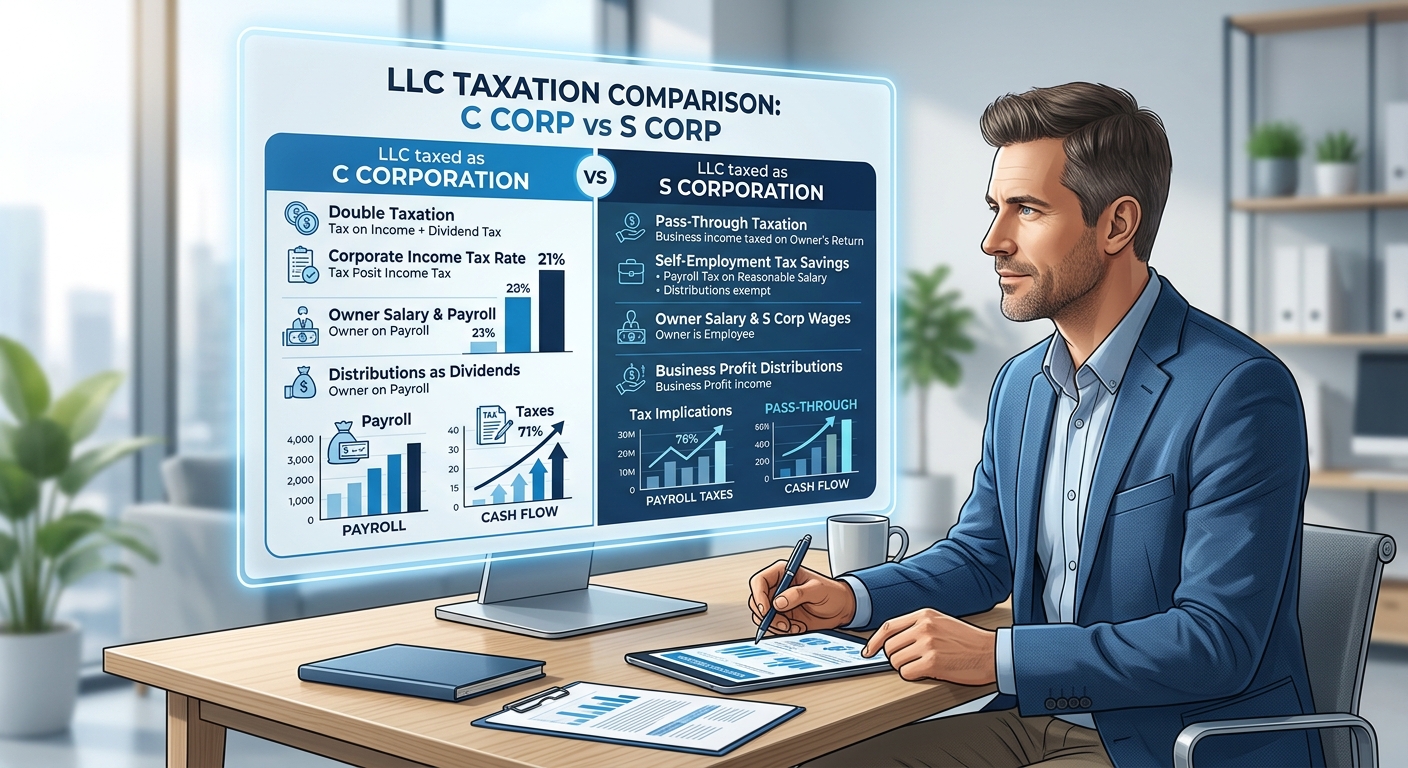
Most LLC owners have no idea that the difference between LLC C Corp and LLC S Corp can swing their annual tax bill by tens of thousands of dollars. They file whatever their friend or incorporation website suggested, then wonder why they are still writing big checks to the IRS every April.
Quick Answer: Which LLC Tax Setup Usually Saves More
In simple terms, an LLC is a legal shell. For federal tax, you choose whether that shell is taxed like a sole proprietorship or partnership by default, or you elect to have it taxed like a C corporation or S corporation.
For profitable small businesses with owners who actively work in the company, S corporation taxation often produces the lowest overall tax bill because part of the profit can avoid self employment tax. C corporation status can work for businesses that reinvest most of their profit and take minimal distributions, but it can expose you to double taxation if you pull out cash the wrong way.
How the Difference Between LLC C Corp and LLC S Corp Shows Up on Your Tax Return
Before you worry about forms, understand where the money lands on your return. That is where the real difference between LLC C Corp and LLC S Corp shows up.
- An LLC taxed as a C corporation files Form 1120. The corporation pays its own income tax on profits, then you pay personal tax on any salary or dividends you receive.
- An LLC taxed as an S corporation files Form 1120 S. The business itself normally pays no federal income tax. Instead, profit passes through to your personal return on Schedule E.
- If you do not elect C or S treatment, a single member LLC is disregarded and files on Schedule C, and a multi member LLC is treated as a partnership filing Form 1065. In both cases, owners usually pay self employment tax on their full share of active profit.
According to IRS Publication 334, these default rules apply unless you affirmatively elect to be treated as a corporation using Form 8832 or elect S corporation status using Form 2553.
LLC Basics: How You Are Taxed Before Any Election
The IRS does not see the letters LLC and automatically know how to tax you. It applies what is often called the check the box regime.
- One owner LLC: default is a disregarded entity. You report income and expenses directly on Schedule C of your Form 1040, just like a sole proprietor.
- Two or more owners: default is a partnership, reported on Form 1065. Each partner receives a Schedule K 1 showing their share of income and deductions, which then flows to their individual return.
In these default modes, if you materially participate in the business, your net earnings from self employment are subject to self employment tax, which covers both the employee and employer side of Social Security and Medicare. For 2026, that is still broadly 15.3 percent on the first Social Security wage base and 2.9 percent Medicare on top, plus an extra 0.9 percent Medicare surtax at higher incomes.
Imagine a consultant with a single member LLC netting 160,000 dollars. Under default taxation, roughly 160,000 dollars is exposed to self employment tax. Just the 15.3 percent portion on the first layer could be over 20,000 dollars before you even look at income tax brackets.
That is why many active business owners eventually look for a better structure once profit crosses a certain level.
LLC Taxed as C Corporation: When Keeping Profit Inside Can Work
Electing to have your LLC taxed as a C corporation means you file Form 8832 and start filing Form 1120. Under current law, C corporations pay a flat 21 percent federal tax on taxable income, plus any state corporate tax. Owners then pay personal tax on salaries and on dividends or other distributions.
On paper, that 21 percent rate looks attractive compared to a high earning owner in the 32 percent or 35 percent individual bracket. The problem is that when you want to spend the money personally you face a second layer of tax.
Real World Example: High Growth Company That Reinvests Profit
Say a software startup organized as an LLC expects 400,000 dollars of profit, but the founders plan to leave almost all of it in the business to fund developers and marketing. If the LLC stays taxed as a partnership, most of that 400,000 dollars will hit the owners personal returns, potentially driving them into higher brackets and creating big quarterly estimated tax payments.
If they elect C corporation treatment instead, the 400,000 dollars is taxed at 21 percent inside the entity. That is 84,000 dollars of federal corporate tax. The remaining 316,000 dollars stays in the business. If the owners take modest salaries of 80,000 dollars each and no dividends, their personal tax bill on that income may be relatively modest compared to world where they report the full profit.
This is the classic use case where a C corporation structure, including an LLC taxed as a C corp, can make sense. You intentionally trade flexibility later for a lower headline rate now because you know you will not drain cash out of the entity.
Key Features of LLC Taxed as C Corporation
- Double taxation risk if you distribute profits as dividends or liquidate the company.
- Full access to traditional fringe benefits like certain health and retirement plans with more favorable treatment for owner employees.
- Losses generally trapped at the corporate level instead of passing through to owners.
- More attractive for outside investors that prefer familiar corporate rules.
IRS Publication 542 provides the core rules that apply to corporations, including many that will govern an LLC taxed in this way.
However, for many closely held service businesses, using a C corporation election inside an LLC creates unnecessary friction. The owner usually wants to take money home each year, which is where the double taxation problem shows up.
LLC Taxed as S Corporation: Cutting Self Employment Tax With a Paycheck
Now consider the S corporation election. An S corporation is still a corporation under state law, but for federal tax purposes it is a pass through entity. Profit flows to the owner, but subject to a crucial twist.
If your LLC elects to be taxed as an S corporation, you must pay yourself a reasonable salary for the work you perform. That salary is subject to normal payroll taxes. Profit on top of that salary, however, usually passes through free of self employment tax. You still pay income tax, but you avoid the 15.3 percent self employment layer on that portion.
Numerical Example: Solo Owner With 180,000 Dollars of Profit
Take a marketing consultant in California with an LLC generating 180,000 dollars of net profit. Under default Schedule C taxation, nearly all of that is subject to self employment tax. Rough math: you could see around 20,000 to 22,000 dollars of self employment tax on top of income tax.
If that same LLC elects S corporation status and pays the owner a reasonable W 2 salary of 100,000 dollars, then the remaining 80,000 dollars is S corporation profit. The payroll tax applies only to the 100,000 dollars. The 80,000 dollars passes through and avoids the 15.3 percent layer, which could save roughly 12,000 dollars per year, even after factoring in some extra payroll costs and state fees.
According to IRS Publication 334 and the Form 2553 instructions, you make this election by filing Form 2553 generally no later than two months and 15 days after the beginning of the tax year you want S status to start. There are late election relief rules, but you should not rely on them casually.
For a deeper discussion of S corporation planning in California, review our complete S Corp tax strategy guide after you finish this overview.
Who Usually Benefits From S Corporation Status
- 1099 professionals with stable profit above roughly 80,000 to 100,000 dollars per owner.
- LLC owners in high tax states where every dollar of self employment tax hurts.
- Businesses where the owners actively work in the company and can justify a clear W 2 salary.
Pro Tip: Before you assume S corporation status is right, plug your projected profit into a small business tax calculator and compare scenarios with and without self employment tax savings. Then sit down with a strategist to refine the numbers.
Simple Framework to Choose Between Default, C Corp, and S Corp
To keep the decision grounded, look at three questions in order.
Question 1: How Much Profit Do You Really Have After Reasonable Salary
If your LLC is just starting and netting 30,000 to 50,000 dollars, the complexity of S corporation payroll may not be worth it yet. Once true business profit per owner consistently crosses 80,000 dollars, the self employment tax savings begin to justify the extra work.
Question 2: Will You Leave Profits Inside the Company or Distribute Them
If you plan to reinvest most profit for years and keep distributions low, an LLC taxed as a C corporation may be viable. If you need to pull significant cash out for personal use each year, S corporation or default taxation is usually safer.
Question 3: Do You Want Simplicity or Maximum Tax Optimization
Default LLC taxation is simplest but often the most expensive in tax once you are truly profitable. An S corporation requires payroll, corporate minutes, and more discipline at year end, but that extra structure is exactly what generates the tax savings.
Side by Side Comparison Table
| Feature | LLC Default (Schedule C or Partnership) | LLC Taxed as S Corporation | LLC Taxed as C Corporation |
|---|---|---|---|
| Self employment tax | On most or all active profit | On W 2 salary only | On W 2 salary only |
| Federal income tax level | Owner only | Owner only | Entity and owner |
| Use of losses | Generally pass through to owner, subject to limits | Pass through to owner, subject to limits | Trapped at corporate level |
| Best fit | Side hustles, low profit, simple operations | Profitable owner operated businesses needing tax efficiency | High growth businesses reinvesting profit or seeking investors |
KDA Case Study: LLC Owner Saves Big With S Corporation Restructure
Consider Maria, a Southern California physical therapist who left a hospital job to open her own practice. She set up an LLC on the advice of a friend and filed taxes as a sole proprietor for three years. By year three, her LLC was netting around 220,000 dollars after expenses, but her accountant simply kept reporting it on Schedule C.
Maria thought she was doing well until she noticed she was paying more than 30,000 dollars per year in combined self employment tax and income tax. She came to KDA asking a simple question: Is there a better way than just being an LLC
Our team rebuilt her numbers under an S corporation model. We set a reasonable salary of 120,000 dollars based on market pay for a lead physical therapist and her actual duties. The remaining 100,000 dollars was treated as S corporation profit, not subject to self employment tax.
Once we ran the projections, her self employment and payroll tax dropped by roughly 15,000 dollars in the first full S corporation year, even after payroll costs and California S corporation fees. Her federal and state income tax stayed roughly the same, so the net savings were driven almost entirely by cutting the self employment layer on part of her earnings.
KDA set up her payroll, handled the late S election relief, and implemented monthly bookkeeping so there would be no surprises at year end. Maria paid around 3,500 dollars for the full restructuring and ongoing support in year one, and her net first year tax savings were approximately 15,000 dollars, for a more than four to one return on fees.
Ready to see how we can help you? Explore more success stories on our case studies page to discover proven strategies that have saved our clients thousands in taxes.
Red Flag Alert: Mistakes That Trigger IRS Scrutiny
Every structure choice comes with traps. Here are the ones we see most often when people try to change their LLC tax status without guidance.
Problem 1: Electing S Status but Ignoring Payroll
The IRS expects S corporation owners who work in the business to pay themselves reasonable compensation. If your LLC is taxed as an S corporation and you distribute everything as owner draws with no W 2 wages, you are waving a red flag. IRS guidance and case law give the Service room to reclassify distributions as wages, assess back payroll tax, and add penalties.
According to the Form 2553 instructions and various IRS rulings, salary decisions must consider your role, hours, and what similar businesses pay for that work. Documenting that analysis annually is critical.
Problem 2: Missing Election Deadlines
If you file Form 2553 or Form 8832 late without qualifying for relief, the IRS may simply deny the election for that year. That leaves you stuck in your old tax classification for another entire tax cycle, often costing thousands in avoidable tax.
Form 8832 instructions outline when and how you can request late election relief, but the rules are technical. It is far safer to plan your transition months before year end.
Problem 3: Using a C Corporation When You Constantly Drain Cash
We often meet owners who were told that a C corporation gives them a low 21 percent rate, then discover that every year they are pulling most profits out in the form of dividends or loans that do not meet IRS standards. That is when double taxation shows up.
Red Flag Alert: If you see your LLC taxed as a C corporation paying tax at 21 percent and then you report large qualified dividends on your personal return every year, you are probably not using that structure in an optimal way.
What If You Need to Change Your LLC Tax Classification
The structure you started with does not have to be permanent. You can generally move from default taxation to C or S status, and in some cases from C status to S status later. The rules become more complex if you try to go back from corporate status to partnership or disregarded entity treatment.
Changing From Default LLC to C or S Corporation
- To become an LLC taxed as a C corporation, you usually file Form 8832.
- To become an LLC taxed as an S corporation, you file Form 2553. In some cases the Form 2553 doubles as your Form 8832 filing for C status followed immediately by S status.
- You need an employer identification number, a clear ownership structure, and clean books before you file these elections.
IRS Publication 541 and IRS Publication 542 discuss the consequences of changing entity classification, including how assets and liabilities are treated in the conversion.
State Level Consequences, Especially in California
On top of federal rules, states layer their own quirks. In California, for example, LLCs pay an annual 800 dollar franchise tax plus a gross receipts based LLC fee once revenue crosses certain thresholds. Corporations pay their own minimum tax and often a separate S corporation fee.
That means when you adjust your LLCs tax classification, you are not just deciding how federal tax works. You are also adjusting your state level costs. Getting this wrong can add thousands per year in fees that a better design could have avoided.
Because of that, many owners coordinate their federal structure choice with professional entity formation services that factor in both IRS rules and California Franchise Tax Board rules at the same time rather than treating them as separate decisions.
Ready to Reduce Your Tax Bill?
KDA Inc. specializes in strategic tax planning for business owners, S Corps, LLCs, and high-net-worth individuals. Book a personalized consultation and walk away with a clear plan.
Frequently Asked Questions About LLC C Corp and LLC S Corp Choices
Will Choosing the Wrong Structure Trigger an Audit
Simply electing C or S status for your LLC does not automatically trigger an audit. What gets attention is inconsistent reporting, extreme owner compensation numbers, or sloppy handling of payroll and distributions. If you follow the guidance in IRS Publication 334 and keep clean records, you greatly reduce that risk.
What If I Missed the Deadline to Elect S Corporation Status
The IRS allows certain late elections if you can show reasonable cause and that you have consistently treated the entity as an S corporation in practice. This usually means you filed returns and payroll as if the election had been in place. The late election relief process is technical, so it is wise to involve a professional if you think it applies to you.
Can Real Estate Investors Use S Corporation Status
In most cases, long term buy and hold rental real estate is a poor fit for S corporation ownership. The combination of depreciation, losses, and capital gain treatment does not align well with S corporation rules. Many real estate investors instead use disregarded LLCs or partnerships with careful debt and basis planning.
How Do W 2 Employees Fit Into This Decision
If your only income is W 2 wages from an employer and you do not have a side business, C or S corporation status for an LLC is irrelevant because you do not have business income to reclassify. The structures discussed here apply to business owners with 1099 or active trade or business income.
Will an S Corporation Save Me Money If My Profit Is Under 60,000 Dollars
At lower profit levels, the extra payroll costs, tax preparation fees, and state level fees can eat up much of the self employment tax savings. There are exceptions, but many owners wait until profit is clearly above 80,000 dollars per year before moving to S corporation status.
Bottom Line and Next Steps
The bottom line is this. The difference between LLC C Corp and LLC S Corp is not academic. It determines whether you are paying self employment tax on every dollar of profit, whether your company is exposed to double taxation, and how much flexibility you have to use losses or reinvest profit.
This information is current as of 5/31/2026. Tax law changes, and both the IRS and states like California regularly update their rules and forms. You can always confirm the latest details by reviewing current IRS publications or the Franchise Tax Board website, but the strategic principles in this guide remain durable across years.
Book Your Tax Strategy Session
If you are unsure whether your current LLC tax setup is costing you five figures in unnecessary tax, do not guess for another year. Sit down with a strategist who can model default, C, and S corporation scenarios on your actual numbers and give you a clear, actionable recommendation.
If you are ready to choose the structure that supports your growth instead of fighting it, our team will help you design, implement, and maintain the right entity and payroll setup for your situation. Click here to book your consultation now.



