
Quick Answer
Thinking about **how to change a c corp into a s corp** because you are tired of double tax on your profits? For the 2025 tax year, the move can shift thousands of dollars per year back into your pocket if you do it correctly and on time. The catch is that the IRS gives you exactly one path, a tight deadline, and some painful penalties if you ignore the fine print.
This guide walks through the real world version of the conversion process, not the watered down bullet list you get from a generic help article. We are going to cover deadlines, forms, salary rules, built in gains tax, California complications, and how to decide whether this move even makes sense for your business in the first place.
What Really Changes When You Convert From C To S
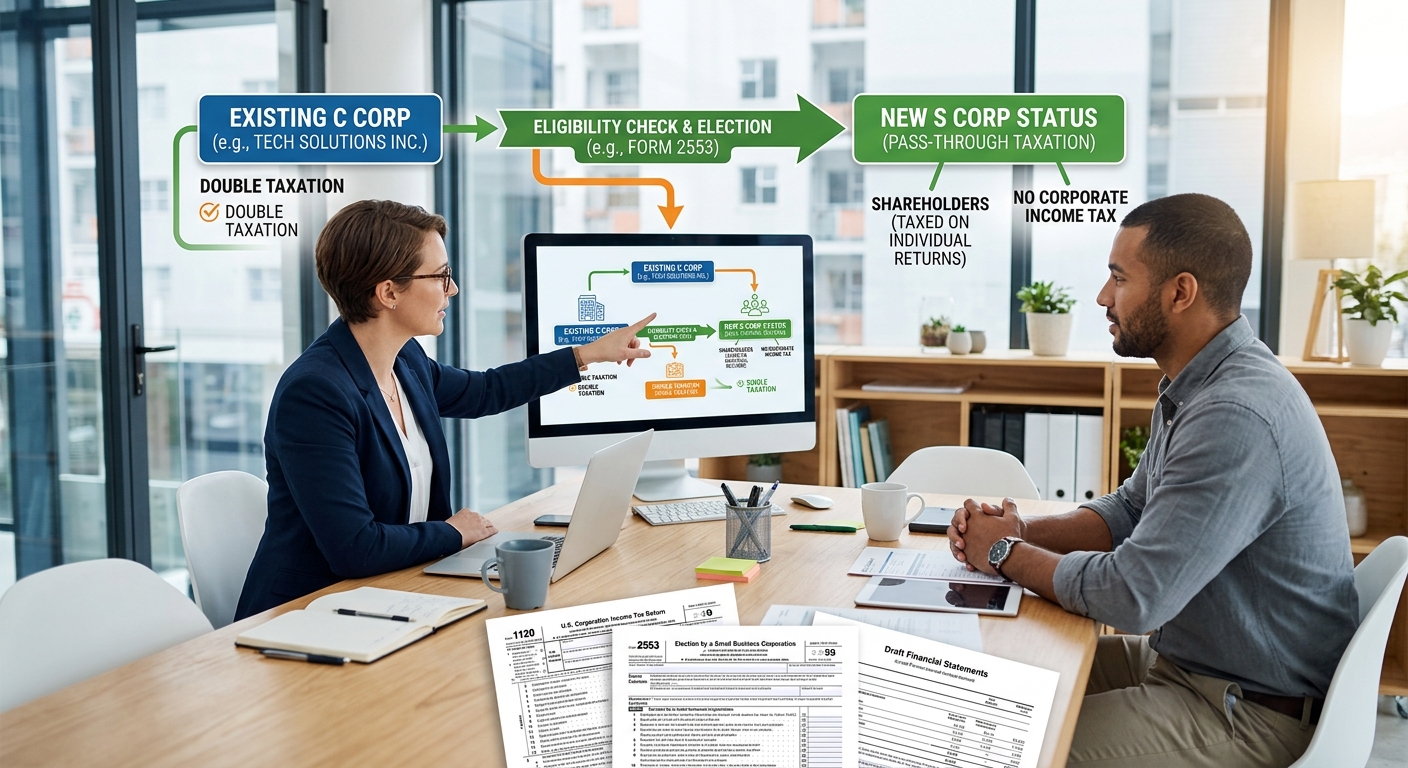
On paper, a C corporation (C Corp) pays its own income tax. Then shareholders pay tax again on dividends. That is the classic double tax problem. An S corporation (S Corp) is a pass through. It generally does not pay federal income tax itself. Income, deductions, and credits pass to owners, who report them on their personal returns. See IRS instructions for Form 1120 S for how that return works.
Here is what that shift looks like with numbers. Imagine your C Corp earns $300,000 of taxable income for 2025 and you leave the cash in the company. At the flat 21 percent corporate rate, the company owes $63,000 of federal tax. Later, you distribute $150,000 as a dividend. If you are in the 15 percent long term capital gain and qualified dividend bracket, that is another $22,500 in personal tax. Total combined tax on that same $300,000 is $85,500.
If that exact same business is taxed as an S Corp with the same $300,000 profit and two equal owners, the result is very different. The company files Form 1120 S, shows $300,000 of profit, and passes $150,000 of K 1 income to each owner. No corporate level federal tax. Each owner adds $150,000 to their personal return and pays at their marginal rate. For a married couple with other income, you might see a combined federal hit of $55,000 to $60,000 instead of $85,500. That is a real savings in the range of $25,000 or more every year.
For California owners, you still pay a 1.5 percent franchise tax on S Corp net income on Form 100 S, so you do not fully escape entity level tax. But the federal savings often dominate. That is why so many business owners look at the conversion once profits cross roughly $80,000 to $100,000 per year.
Bottom line, the conversion does not change your legal entity under state law. The corporation stays a corporation. You are only changing how the IRS and state agencies tax it.
Step by Step: How to Change a C Corp Into an S Corp
The mechanics are not complicated, but you cannot wing it. The IRS tells you exactly what to file in Form 2553 instructions. Miss a step and you are still a C Corp despite what your accountant or payroll provider thinks.
Step 1: Confirm You Actually Qualify
Not every corporation can make the election. To qualify as an S Corp, you must meet these federal rules, summarized from IRS Publication 542 and the Form 2553 instructions:
- Only allowable shareholders. Generally individuals who are U.S. citizens or residents, certain trusts, and estates. No partnerships or corporations as owners.
- Under or at 100 shareholders.
- Only one class of stock. Voting and non voting is fine, but no preferred with separate rights to distributions or liquidation proceeds.
- The corporation is domestic and not a bank, insurance company, or certain other ineligible types.
Red Flag Alert: Many closely held companies think they have one class of stock, but they have side agreements promising special dividends or different liquidation payouts. The IRS will treat that as a second class of stock and can disqualify the S election. Clean up those agreements before you file.
Step 2: Fix Ownership and Shares If Needed
If your C Corp has corporate or foreign shareholders, you either need to buy them out, move them to a different entity, or accept that you cannot elect S status. This is where real planning kicks in for investors and high net worth families. It is common to spin off operating activities into a new corporation eligible for S status while leaving ineligible owners and legacy assets in the old C Corp.
For example, suppose a consulting corporation is owned 80 percent by a U.S. founder and 20 percent by a foreign investor. The founder earns $400,000 of annual profit and hates the double tax. One solution is to form a new corporation that the founder owns 100 percent, transfer the active consulting contracts to that entity through a proper asset transfer and agreement, and leave the old C Corp holding only the investment assets. The new entity then elects S status. Moves like this need careful structuring to avoid gain on the transfer and state tax surprises, which is why many owners bring in formal entity formation support rather than tackling it alone.
Step 3: File Form 2553 by the Deadline
Form 2553 is the actual election. For a corporation that already exists and wants S status for the 2025 calendar year, the form generally must be filed no later than March 15, 2025, which is two months and 15 days after the start of the tax year. Mail or fax it to the address in the instructions or use any authorized electronic method. Late elections can sometimes be fixed under the late election relief rules if you can show reasonable cause and consistent treatment, but you do not want to rely on a mercy ruling.
Fast Tax Fact: If you are forming a brand new corporation and want S status from day one, you can file Form 2553 within 75 days of the date of incorporation or within 75 days of the start of the tax year you want it to apply to.
Step 4: Align Payroll, Accounting, and Distributions
Once the IRS accepts the election, you now must treat working owners as employees who receive W 2 wages plus distributions. That means real payroll, not just draws. See IRS Publication 15 for employment tax rules. You also must keep clean books and issue Schedule K 1 to each shareholder after year end.
This is the part many owners underestimate. Running an S Corp without solid bookkeeping and payroll processes usually leads to messy returns, missed deadlines, and increased audit risk. If you do not have that infrastructure in place, consider outsourcing to a firm that handles bookkeeping and payroll for closely held corporations.
KDA Case Study: LLC Owner Saves Big With S Corp Restructure
Consider Maya, a software consultant in California who originally formed an LLC taxed as a C Corp on her attorney’s advice in 2018. Her company was generating about $500,000 in net income each year by 2024. She was paying the 21 percent corporate tax on profits and then taking out roughly $250,000 in dividends for personal living expenses. Combined federal and California taxes were running close to $170,000 per year when you count corporate tax, dividend tax, and state levies.
KDA reviewed her structure and walked through the economics of an S election. Because all owners were U.S. individuals and there was only one class of stock, she qualified. We helped her clean up an old investor side agreement that created a second class of stock problem, coordinated the filing of Form 2553 in early January for the coming tax year, and set up a reasonable salary of $180,000 with the balance of profit flowing as S Corp distributions.
After the first full S Corp year, the combined federal and state tax burden dropped by just over $32,000, even after accounting for higher California S Corp franchise tax and added payroll costs. Our advisory and implementation fee was $8,500, so her first year return on investment was nearly 3.8 times what she paid, with similar savings expected going forward. She also gained clearer books and more predictable quarterly estimates.
Ready to see how we can help you? Explore more success stories on our case studies page to discover proven strategies that have saved our clients thousands in taxes.
Built In Gains Tax: The Trap Most C Corp Conversions Miss
When a C Corp becomes an S Corp, the IRS does not forget about appreciated assets the corporation already holds. Under rules explained in Form 1120 S instructions, if the S Corp sells assets that had built in gain from C Corp years within a specific recognition period, a corporate level tax known as built in gains (BIG) tax can apply at the 21 percent C Corp rate.
Say your C Corp owns a building that cost $1 million and is now worth $1.6 million at the time you elect S status. The $600,000 of gain sitting inside the building is built in gain. If the S Corp sells that building within the recognition period, part or all of that $600,000 can be hit with BIG tax at the entity level before the remainder flows to shareholders.
Red Flag Alert: Many owners convert to S status, then immediately sell their business assets or real estate in the next year thinking they have dodged C Corp double tax. In reality, they walk straight into the BIG tax and end up almost where they started. Strategic timing and careful valuation are critical. You may want a valuation snapshot as of the conversion date to document what portion of future gain is subject to BIG tax versus post election appreciation.
Reasonable Salary and Payroll After the Election
For working shareholders, the biggest post election issue is how much to pay as W 2 wages versus distributions. The IRS expects a reasonable salary for services performed. If you pay yourself nothing and take everything as distributions, you are inviting payroll tax adjustments and penalties. See the discussion of reasonable compensation in recent IRS guidance.
As a simple frame, imagine your S Corp earns $240,000 after expenses before owner pay. If the going market salary for someone in your role is $140,000, paying yourself $140,000 as W 2 wages and taking the remaining $100,000 as distributions is often defensible. The wage portion is subject to Social Security and Medicare tax plus unemployment and other employment taxes. The distribution portion generally is not subject to self employment tax, though it still counts as taxable income on your personal return.
Pro Tip: If you are transitioning from a C Corp that already ran payroll, you may not need to change much beyond rethinking the mix of dividends and wages. Use your historical compensation data as a starting point to justify your reasonable salary under the new structure.
Common Mistakes That Trigger IRS or State Problems
Converting from C to S status is simple on paper, but we routinely see owners make avoidable mistakes that cost them time and money.
Missing the Election Deadline
Filing Form 2553 after the deadline but treating yourself as an S Corp anyway is a classic trap. You might run payroll differently, distribute cash as if it were S Corp income, and even file Form 1120 S, but the IRS computers still view you as a C Corp until they formally accept the election.
If you discover the problem late, you may be able to request late election relief under the procedures in the Form 2553 instructions. That usually requires demonstrating that the corporation intended to be an S Corp as of the effective date, that all shareholders reported income consistent with S treatment, and that the failure was due to reasonable cause. Fixing this after the fact is much more painful than simply filing on time.
Ignoring California and Other State Rules
California does not just copy federal rules. For instance, S Corporations in California pay an annual minimum franchise tax and a 1.5 percent tax on net income on Form 100 S. Some other states do not recognize S status at all or impose their own franchise or entity level taxes. Before you change your structure, you need a state by state map of what the move really costs you.
This is especially important for multi state operators and tax planning focused entrepreneurs who may already be filing returns in multiple jurisdictions. The federal savings can still be worth it, but only when you look at the full picture.
Keeping Ineligible Shareholders On Board
If a shareholder becomes ineligible after the election, such as when a nonresident alien acquires shares, your S status can terminate. There are cures in some cases, but allowing ownership to drift without guardrails is asking for trouble. Your shareholder agreements should include explicit S Corp eligibility representations and remedies for violations.
Will This Move Actually Save You Money
Before you pursue the change, you need a simple comparison of life as a C Corp versus S Corp over the next few years. That means modeling your expected profit, salary needs, distributions, and possible asset sales. The right answer for a consultant with $200,000 of net profit is very different from a tech C Corp planning a stock sale to a public company.
For a small professional corporation earning $250,000 of profit and paying its owner $150,000 of wages with $100,000 remaining, remaining a C Corp often produces a combined tax rate in the mid 30 percent range once you add corporate tax and personal tax on dividends. Shifting to an S Corp and running $150,000 as wages and $100,000 as distributions might drop the combined rate to around 28 percent to 30 percent, saving $8,000 to $15,000 per year depending on your bracket.
If your corporation plans to reinvest earnings and pursue outside capital with an eye to an eventual stock sale, the calculus changes. In some cases, staying a C Corp to capture a potential Section 1202 qualified small business stock exclusion on a future stock sale can be more valuable than the annual payroll tax savings from S status. There is no one size fits all answer, which is why serious owners run the numbers.
If you want to stress test your situation, plug your projected profit into a small business tax calculator to get a rough sense of how different profit and salary mixes shift your tax bill, then layer in state rules and long term exit plans with a professional.
What Happens If You Change Your Mind Later
Electing S status is not always permanent, but you cannot toggle back and forth each year. If you revoke your election or it terminates, you normally cannot re elect S status for five years without special IRS consent. That five year lockout means you should think ahead about major asset sales, ownership changes, and financing plans before you flip the switch.
Example. A real estate heavy C Corp with $3 million of built in gain converts to S status in 2025, then sells its properties in 2026. The owners get hit with built in gains tax, regret the move, and want to go back to C status for new projects. They revoke the S election, but now they are ineligible to elect S status again until at least 2031 without special permission. That can box you in if circumstances change.
Bottom Line: Who Should Seriously Consider This Move
For many profitable closely held corporations, especially service companies and consulting firms, converting from C to S status is one of the cleanest ways to cut annual tax drag without exotic planning. The best candidates share several traits:
- Consistent annual profits of at least $80,000 to $100,000 after expenses.
- U.S. individual shareholders with no ineligible owners.
- No immediate plans to sell highly appreciated assets or stock.
- Owners willing to run real payroll and maintain clean books.
On the other hand, if your corporation is pre profit, courting institutional investors, or sitting on highly appreciated assets you plan to sell soon, the move may not help and can even hurt.
This information is current as of 5/26/2026. Tax laws change frequently. Verify updates with the IRS or applicable state tax authorities if you are reading this later.
Ready to Reduce Your Tax Bill?
KDA Inc. specializes in strategic tax planning for business owners, S Corps, LLCs, and high-net-worth individuals. Book a personalized consultation and walk away with a clear plan.
Book Your Tax Strategy Session
If you are unsure whether your current C Corp setup is quietly costing you five figures every year, it is time to run the numbers with someone who does this all day. Our team models C versus S outcomes, handles Form 2553 timing, and designs compensation plans that stand up to IRS scrutiny while reducing payroll tax drag. Click here to book your consultation now.
Key Takeaway: The IRS is not hiding the S Corp election. The real advantage goes to owners who understand when it helps, how to avoid built in gains surprises, and how to run payroll and books that match what they put on the forms.
The IRS is not hiding these write offs. You just were not taught how to find them.



