
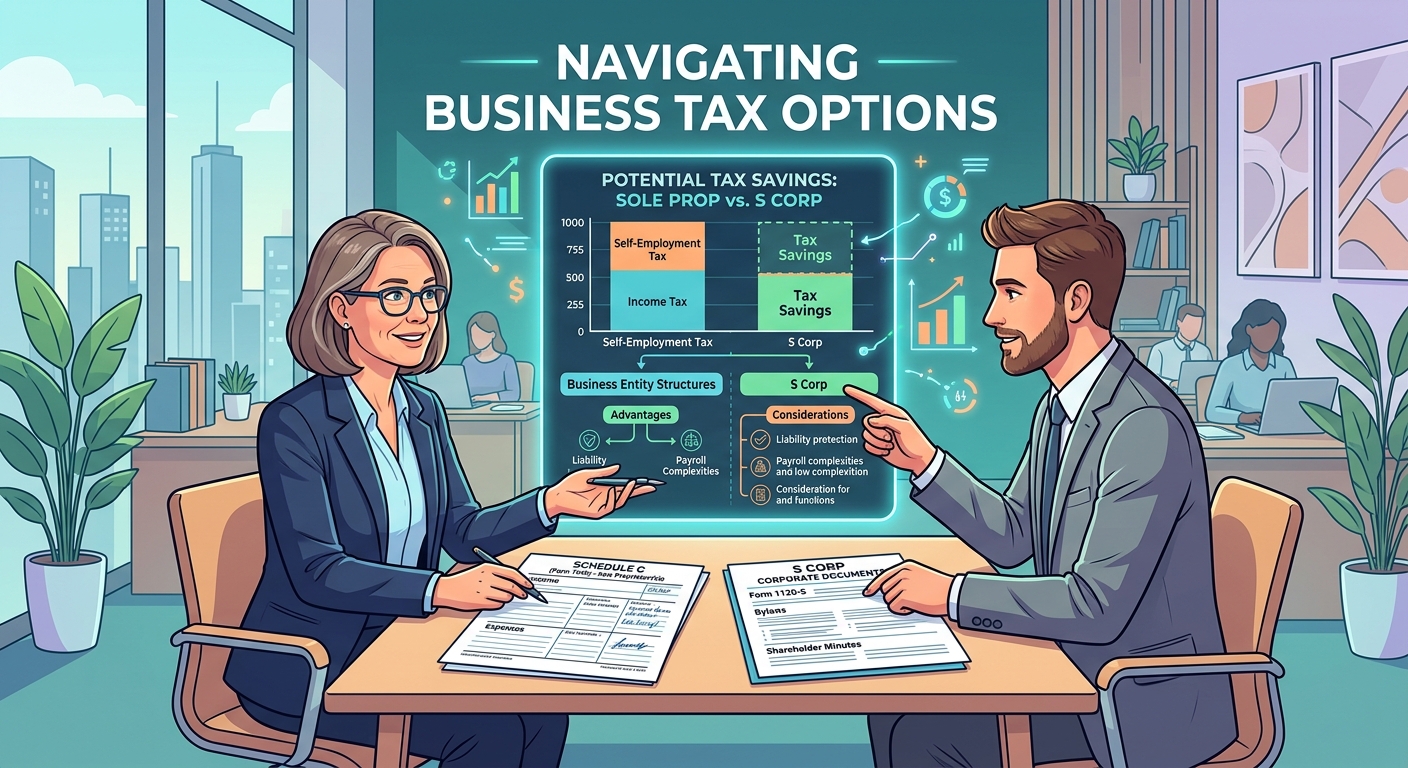
Most solo business owners never run the numbers on their entity choice. They file whatever their preparer suggests, or they stick with the default Schedule C and hope for the best. The result is often thousands of dollars lost to self employment tax every year. The question of schedule c versus s corp is not theoretical. It is a concrete math problem with a right answer for your situation.
This information is for the 2025 tax year and focuses on federal rules. States, including California, can add their own twists, which we will flag where it matters.
Quick Answer
If your profit from self employment is under roughly $50,000 per year, staying on Schedule C is usually fine. Between about $60,000 and $200,000 of consistent annual profit, an S Corporation can often save you several thousand dollars per year by cutting self employment tax on part of your income. Above that range, the savings can be significant, but only if you handle payroll, reasonable salary, and state S Corp costs correctly.
The best choice often changes as your income grows. What was right when you were making $30,000 can be a bad fit once you are clearing $150,000.
KDA Case Study: 1099 Consultant Chooses The Wrong Structure
Laura is a marketing consultant in her late 30s. She lives in California and works entirely on 1099 contracts. For years she reported her income on Schedule C. In 2023 and 2024, her net profit averaged about $95,000 per year after expenses.
On Schedule C, all $95,000 was subject to the 15.3 percent self employment tax, up to the Social Security wage base, plus regular income tax. That self employment piece alone was roughly $14,500 per year. Her prior preparer never raised the idea of an S Corporation, so she assumed this was just the cost of doing business.
When Laura came to KDA for a review, we walked her through schedule c versus s corp using her actual numbers. We set a reasonable salary at $65,000 based on industry data and her role, then modeled the S Corp paying her that salary through payroll with the remaining $30,000 as distributions.
Under the new structure, only the $65,000 salary is subject to Social Security and Medicare payroll taxes. The $30,000 of S Corp profit flows through to her return but is not hit with self employment tax. After allowing for employer payroll tax on the salary and higher bookkeeping costs, Laura’s first full year as an S Corp saved her about $6,800 in federal tax. Her total extra cost for payroll, entity maintenance, and our advisory fee was roughly $3,000. That is a first year after cost savings of about $3,800 and a return of more than 1.2 times her investment in year one, with larger savings expected as her income grows.
Ready to see how we can help you? Explore more success stories on our case studies page to discover proven strategies that have saved our clients thousands in taxes.
How Schedule C Taxation Really Works
Schedule C is the default way the IRS taxes a sole proprietor or single member LLC that has not elected corporate status. You report your gross income, subtract deductible expenses, and the net profit flows to your Form 1040. That same profit is also the base for self employment tax, which covers both the employer and employee portion of Social Security and Medicare.
For 2025, the self employment tax rate is 15.3 percent on net earnings up to the Social Security wage base plus 2.9 percent Medicare above that threshold. The Social Security part is 12.4 percent, and the Medicare part is 2.9 percent, as explained in IRS Publication 334. High earners can also face an extra 0.9 percent Medicare surtax on wages and self employment income.
A Simple Schedule C Example
Take Miguel, a self employed software engineer with $140,000 in revenue and $30,000 in expenses. His Schedule C profit is $110,000. Ignoring other factors, roughly $110,000 is subject to self employment tax. At 15.3 percent, that is about $16,800. Half of that tax is deductible as an adjustment to income, but it is still real cash leaving your bank account.
On top of self employment tax, Miguel pays ordinary income tax on that same $110,000 based on his tax bracket. Schedule C does not create a second layer of tax the way a C Corporation does, but it does fully expose your business profit to the 15.3 percent self employment tax.
Why Schedule C Is Not Always The Enemy
Schedule C has advantages. It is simple to file, you do not need a separate corporate tax return, and there is no need to run payroll for yourself. If your profit is modest or very inconsistent, the additional cost and complexity of an S Corp can easily eat up any potential savings.
For example, if you earn $35,000 of profit as a part time consultant, your self employment tax is about $5,200. The potential savings from an S Corp on that level of income is small compared to the real costs of payroll software, quarterly filings, and advisory fees. In that range, staying put on Schedule C is often the smart move.
But once profits climb and stay there, schedule c versus s corp becomes a live question, because the structure is what determines how much of your income is exposed to that 15.3 percent self employment tax.
How S Corp Taxation Really Works
An S Corporation is a tax election, not a separate type of corporation. You can elect S status for a traditional corporation or for an LLC that files Form 2553. The key twist is this: S Corps generally do not pay federal income tax at the corporate level. Instead, income passes through to owners, who report it on their personal returns. What changes compared to Schedule C is which part of that income is subject to payroll tax.
The IRS expects active S Corp owners who work in the business to pay themselves a reasonable salary. That salary is treated as W-2 wages, subject to Social Security and Medicare payroll taxes, just like any employee. Profits above that salary can be distributed as shareholder distributions that are not subject to self employment tax. IRS guidance on S Corporations and shareholder compensation is summarized in resources linked from the Form 1120-S instructions and IRS Publication 535.
Where The Savings Come From
Suppose instead of Miguel’s $110,000 of Schedule C profit, he elects S Corp status and the corporation earns $110,000 after all expenses but before his own pay. The S Corp pays him a $70,000 salary and distributes the remaining $40,000 as profit. The $70,000 salary is subject to payroll tax, split between employer and employee shares. The $40,000 distribution is not subject to self employment tax when handled correctly.
At the 15.3 percent rate, moving $40,000 from self employment tax territory to pure pass through status potentially avoids about $6,100 in federal payroll taxes. The S Corp must pay the employer share of payroll taxes on the $70,000 salary, but that cost is already baked into the numbers. After accounting for that and administrative costs, the net benefit might still be $4,000 to $5,000 per year.
When S Corps Do Not Help
If you set your salary unrealistically low to chase savings, the IRS can reclassify distributions as wages and assess back payroll taxes plus penalties. If your profit swings wildly year to year, the fixed cost of maintaining an S Corp and running payroll can overwhelm the benefit. Owners in very high income ranges may also find that state level S Corp taxes and fees, especially in California, reduce the edge over Schedule C.
This is why many business owners work with a strategist who can model several years of projected income rather than reacting to a single big year.
If you want a deeper dive into advanced entity tactics, KDA’s comprehensive S Corp tax guide walks through more complex California specific planning, including salary ranges and multi entity designs.
Strategic year by year decisions about schedule c versus s corp are part of what our tax planning services cover for growing businesses that want a clear, proactive roadmap instead of last minute surprises in March.
Comparing Schedule C Versus S Corp In Real Life
To decide between these two structures, you need to see how the math changes at different profit levels. Here are simplified federal comparisons using 2025 self employment tax rates and ignoring other deductions, credits, and state level taxes. The point is not to give you an exact prediction, but to show how the structure drives the self employment tax base.
Scenario 1: $60,000 Of Net Profit
- Schedule C: All $60,000 is subject to self employment tax. At 15.3 percent, that is about $9,180.
- S Corp assumption: Reasonable salary set at $50,000. Remaining $10,000 as distributions.
- Payroll tax: The $50,000 salary generates about $7,650 of combined employer and employee Social Security and Medicare tax.
- Potential savings: The $10,000 distribution avoids about $1,530 of self employment tax. After factoring in payroll service fees, extra tax prep, and state filings, the net savings might be only a few hundred dollars. That is often not worth the complexity at this level.
Scenario 2: $120,000 Of Net Profit
- Schedule C: All $120,000 is subject to self employment tax, up to the Social Security wage base. That is roughly $18,360 at 15.3 percent.
- S Corp assumption: Reasonable salary at $80,000, with $40,000 in distributions.
- Payroll tax: The $80,000 salary triggers about $12,240 in payroll taxes.
- Potential savings: The $40,000 distribution is not subject to self employment tax, avoiding about $6,120. Subtract maybe $2,000 to $3,000 of additional annual costs, and you could still be ahead by $3,000 to $4,000 per year.
Scenario 3: $220,000 Of Net Profit
- Schedule C: You pay self employment tax on income up to the Social Security wage base, plus Medicare on the rest, and may face the extra 0.9 percent Medicare surtax. The self employment portion alone can exceed $20,000.
- S Corp assumption: Salary at $120,000, distributions of $100,000.
- Payroll tax: Payroll tax on the salary is about $18,360 combined.
- Potential savings: Avoiding self employment tax on $100,000 of profit could mean more than $15,000 in reduced payroll taxes, before costs. Even after heavier admin expenses and state costs, five figure net annual savings are realistic for some high earners when the structure is tuned correctly.
If you want to ballpark your own situation, plug your expected profit into a self-employment tax calculator while you compare different salary and distribution mixes with a strategist.
These examples should make it clear that schedule c versus s corp is most important once your profit clears the $70,000 to $80,000 range and stays there. Below that, simplicity often wins. Above that, the tax savings potential grows quickly, but so does the risk if you cut corners.
Common Mistake That Triggers An Audit
The biggest mistake S Corp owners make is treating the S Corporation as a magic switch that eliminates self employment tax without changing their behavior. The IRS is very clear that shareholder employees must receive reasonable compensation for the services they provide. Paying yourself a $20,000 salary on $200,000 of profit is a red flag.
Red Flag Alert: If your salary is far below what you would have to pay someone else to perform your role, you are inviting the IRS to reclassify distributions as wages, assess back payroll taxes, and add penalties and interest.
Other Pitfalls To Avoid
- Late or missing payroll filings. S Corp owners who start payroll mid year and do not file Forms 941, W-2, and state returns on time can stack up penalties that wipe out most of the tax savings.
- Commingling funds. Using your S Corp bank account like a personal checking account makes it hard to defend your numbers and increases the odds of errors.
- No documentation of salary decisions. If the IRS asks how you arrived at your compensation, having no written rationale or market data makes it harder to argue that your salary is reasonable.
- Ignoring state specific S Corp taxes. California, for example, imposes a 1.5 percent S Corp income tax and an $800 minimum franchise tax. Those numbers need to be included in your comparison.
According to IRS data on sole proprietors, audit rates are still low overall, but when the IRS does examine returns with S Corp activity, compensation and payroll issues are frequent focus areas. Getting this wrong is not just a math error. It is a compliance problem that can haunt multiple years of returns.
Will Choosing An S Corp Automatically Trigger An Audit?
No. Simply electing S Corp status will not automatically flag you. Problems arise when the pattern of low or zero wages paired with large distributions stands out against your industry or when payroll filings are missing or inconsistent. A clean, well documented S Corp strategy is far less likely to attract negative attention than one built purely around cutting your tax bill.
How To Decide Between These Two Paths
Choosing between Schedule C and an S Corp is not a one time decision you make in a vacuum. It should reflect your income level, how stable that income is, your risk tolerance, and your willingness to handle corporate formalities.
Step 1: Get Honest About Your Real Profit
Start with your last two or three years of Schedule C net profit or S Corp K-1 income, not just your top line revenue. If your profit has been under $60,000 and highly variable, the math often favors staying on Schedule C until things stabilize. If you see a clear upward trend beyond $80,000, schedule c versus s corp should move to the front burner.
Step 2: Model A Realistic Salary
Reasonable salary is not set by a formula in the tax code. Instead, you look at what someone with your role, responsibilities, and experience would earn if hired in the market. For a solo engineer billing $180,000 with heavy technical responsibilities, a $110,000 salary may be reasonable. For a part time consultant billing $80,000 while working 15 hours per week, a $40,000 salary may fit.
Once you choose a salary, have your advisor model the after tax impact of converting some of the remaining profit into S Corp distributions. Include employer payroll tax, state S Corp taxes, local business taxes, payroll fees, and the cost of better bookkeeping.
Step 3: Factor In State Rules And Deadlines
Federal S Corp elections are generally made using Form 2553, but states can have separate rules and deadlines. California, for instance, has its own S Corp election requirement in addition to the federal election and imposes annual franchise taxes. You want to understand both layers before flipping the switch.
For the 2025 tax year, review IRS guidance and relevant state resources before you file election forms. The IRS provides background on S Corps and election timing in the instructions to Form 2553 and Form 1120-S. State tax agencies, such as the California Franchise Tax Board, publish their own guidance on S Corporations and franchise tax.
Step 4: Decide Who Will Maintain The Structure
An S Corp is not a set and forget entity. Someone needs to run payroll each pay period, file quarterly reports, maintain corporate minutes, and keep clean books. If you already work with a firm that offers outsourced bookkeeping and payroll support, the administrative lift may be minimal. If everything would fall on your shoulders, be realistic about whether you will keep up.
Pro Tip: Before you file an S Corp election, have your advisor walk you through the exact ongoing tasks you are signing up for and who will handle each one. The tax savings only matter if you can run the structure cleanly.
Key Questions About Schedule C And S Corps
Can I Switch Back To Schedule C If I Regret The S Corp Election?
In many cases, yes, but it is not as simple as flipping a switch. Terminating an S election or converting an S Corp back to a disregarded LLC can create tax consequences of its own, especially if the corporation owns appreciated assets. This is a decision you should make in consultation with a professional who can model the consequences over several years.
What If My Income Drops After I Elect S Corp Status?
If you have one strong year that justifies an S Corp and then your income falls sharply, the fixed costs of the entity can start to feel heavy. In that case, your advisor may recommend increasing your salary portion temporarily to keep your overall tax picture efficient or exploring whether a different entity strategy makes sense long term. The key is to review schedule c versus s corp annually rather than letting an outdated structure drag on.
Does The Qualified Business Income Deduction Change The Comparison?
The Qualified Business Income (QBI) deduction under Internal Revenue Code section 199A can apply to both Schedule C income and S Corp pass through income, subject to limits. For many taxpayers under the phaseout thresholds, the QBI deduction does not dramatically change the relative benefit of one structure over another. For higher earners, the interaction between wages, QBI limits, and entity choice becomes more complex and can tilt the math one way or the other. This is another area where detailed modeling pays off.
Is There Ever A Reason To Stay Schedule C At High Income Levels?
Yes. A high earning professional with very low expenses and a strong aversion to complexity may reasonably choose to stay Schedule C and accept higher self employment tax in exchange for administrative simplicity. Likewise, specific state rules, liability concerns, or plans to bring in partners may favor a different entity path entirely. Your personal risk tolerance and growth plans matter as much as the raw tax numbers.
How Often Should I Revisit My Entity Choice?
At a minimum, revisit your entity choice whenever your profit changes by more than about 25 percent from the prior year, when you move states, or when you add or remove owners. Building a habit of reviewing schedule c versus s corp as part of an annual tax planning meeting keeps you from waking up five years into a structure that no longer fits.
Ready to Reduce Your Tax Bill?
KDA Inc. specializes in strategic tax planning for business owners, S Corps, LLCs, and high-net-worth individuals. Book a personalized consultation and walk away with a clear plan.
Book Your Tax Strategy Session
This information is current as of 5/24/2026. Tax laws and IRS guidance change frequently, and the right answer on schedule c versus s corp depends on your specific numbers, state, and long term plans. If you are a self employed professional or small business owner wondering whether your current structure is quietly bleeding away thousands of dollars per year, it is time to get clarity.
If you want a customized, numbers driven comparison that factors in federal rules, California specific costs, and your growth plans, KDA can help you build a structure that fits. Book a focused strategy session with our advisory team and leave with a written game plan, not generic advice. Click here to book your consultation now.



