
Is Real Estate Tax and Property Tax the Same Thing?
You just closed on your first rental property in San Diego. Congratulations. Two months later, you get a bill labeled “property tax” from the county. Then your accountant emails asking about your “real estate tax” deduction. Wait. Are these two different taxes? Did you miss something?
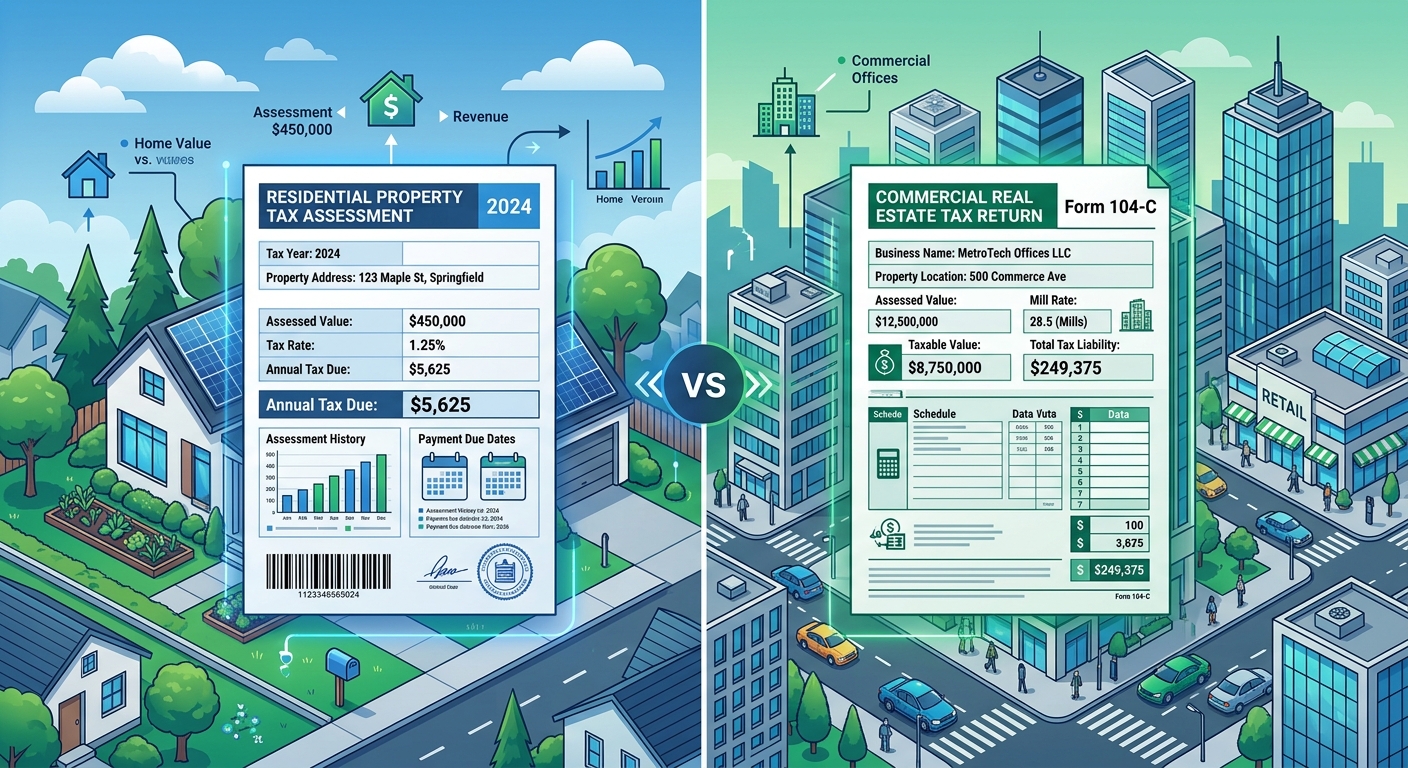
Here’s the truth most investors don’t realize until they’re knee-deep in Schedule E forms: is real estate tax and property tax the same thing? Yes. They’re identical. The IRS, your county assessor, and your CPA are all talking about the exact same annual tax on property you own. The confusion comes from inconsistent terminology across federal forms, state agencies, and local governments. One uses “real estate tax,” another says “property tax,” but they mean the same levy.
Quick Answer
Real estate tax and property tax are the same thing. Both terms refer to the annual tax assessed by local governments on real property you own, including land and buildings. The IRS uses “real estate tax” on federal forms, while most counties call it “property tax.” For rental property owners and real estate investors, this tax is fully deductible on Schedule E as an operating expense.
Why the Terminology Confusion Exists
The terminology split isn’t random. It reflects how different government agencies evolved their documentation over decades. The IRS officially uses “real estate taxes” in Publication 535 and on Schedule A instructions. Your county tax assessor sends you a bill for “property taxes.” Your mortgage servicer lists “property tax” in your escrow statement. Your tax preparer might use both terms interchangeably.
All of these entities are referencing the same thing: the ad valorem tax based on your property’s assessed value. The rate gets set by your local government, which could be a combination of city, county, school district, and special assessment districts. In California, Proposition 13 caps this combined rate at 1% of assessed value plus voter-approved bonds and assessments.
Federal vs. Local Language
The IRS defaults to “real estate taxes” because federal tax code distinguishes between taxes on real property (land and buildings) versus personal property (vehicles, boats, business equipment). This distinction matters for deduction eligibility. Real estate taxes are deductible under Section 164 of the Internal Revenue Code. Personal property taxes follow different rules.
Local governments prefer “property tax” as an umbrella term covering all taxable property within their jurisdiction. From their perspective, it’s simpler. They assess property, you pay the tax. The label doesn’t change the calculation or payment process.
What About Personal Property Tax?
Here’s where it gets technical. Some states assess separate taxes on personal property used in business. California doesn’t tax household personal property, but it does tax business personal property like equipment, furniture, and fixtures if you own a commercial space or run a business from a rental unit.
If you own a furnished short-term rental in Los Angeles and the county assesses your furniture separately, that’s personal property tax, not real estate tax. It’s still deductible as a business expense, but it shows up on a different line of Schedule E. For most residential rental investors, this distinction rarely applies.
How Real Estate Tax Works for Rental Property Owners
When you own investment property, your annual real estate tax becomes one of your largest predictable expenses and one of your most valuable deductions. Let’s break down exactly how this works.
Assessment and Billing Process
Your county assessor determines your property’s assessed value, usually based on purchase price or a periodic reassessment schedule. In California, Proposition 13 limits annual increases to 2% until the property sells. When you buy a rental property, the county reassesses it at the purchase price, and that becomes your new baseline.
Once assessed, the county applies the local tax rate. For example, if you bought a duplex in Sacramento for $650,000 and your combined tax rate is 1.12%, your annual real estate tax bill would be $7,280. The county typically bills this in two installments: the first half due November 1, the second half due February 1.
Deducting Real Estate Tax on Schedule E
Every dollar you pay in real estate tax on your rental property reduces your taxable rental income. You report this on Schedule E, Part I, Line 16 under “Taxes.” This is a direct operating expense deduction, meaning it reduces your net rental income before calculating your tax liability.
Here’s a real-world scenario: Sarah owns a single-family rental in Fresno that generates $36,000 in annual rent. Her real estate tax bill is $4,800. Her other expenses (insurance, repairs, management, mortgage interest) total $18,500. Her depreciation deduction is $10,500. Her taxable rental income calculation looks like this:
- Gross rental income: $36,000
- Real estate tax: -$4,800
- Other expenses: -$18,500
- Depreciation: -$10,500
- Net rental income: $2,200
Without that $4,800 real estate tax deduction, Sarah’s taxable income would be $7,000 instead of $2,200. At a 24% marginal tax rate, the deduction saves her $1,152 in federal taxes annually.
When You Close Mid-Year: Proration Rules
If you buy rental property in June, you don’t pay the full year’s real estate tax, you split it with the seller. This proration happens at closing. The seller pays their portion through the closing date, and you pay from closing through year-end. Your deduction is limited to what you actually paid.
Your settlement statement breaks this out. Look for “real estate taxes” in the credit/debit columns. The amount shown as your responsibility is what you deduct. Don’t assume you can deduct the full annual bill just because you own the property on December 31. The IRS matches deductions to actual payments.
The Difference Between Deductible and Non-Deductible Property Charges
Not every charge on your property tax bill is actually a deductible real estate tax. Some fees sneak onto the same statement but get treated differently for tax purposes. Knowing the distinction prevents audit risk and maximizes your legitimate deductions.
What Counts as Deductible Real Estate Tax
According to IRS Publication 530, you can deduct taxes imposed uniformly at a like rate on all real property throughout the community. These include:
- General property taxes based on assessed value
- School district taxes
- County and city taxes
- Voter-approved bond taxes for infrastructure
- Special assessments for maintenance and repairs (street cleaning, lighting)
If the charge is based on your property’s value and funds general government operations or ongoing services, it’s deductible. This applies whether you own the property as a primary residence (subject to the $10,000 SALT cap) or as a rental (fully deductible on Schedule E).
What’s Not Deductible
Some charges look like taxes but aren’t deductible as real estate tax:
- Special assessments for improvements that increase property value (new sidewalks, sewer lines, street paving)
- Homeowners association fees
- Transfer taxes paid when you buy property
- Trash collection fees billed separately
- Water and sewer usage charges
Special assessments for improvements get added to your property’s cost basis instead of deducted as current expenses. When you eventually sell, this increased basis reduces your capital gain. If you paid $3,500 for a sewer line special assessment, you add that to your purchase price for basis calculation purposes.
Reading Your Property Tax Statement
Your annual property tax bill typically includes multiple line items. Here’s how to parse a typical California statement:
| Line Item | Deductible? | Treatment |
|---|---|---|
| General Tax Levy | Yes | Fully deductible |
| School Bonds | Yes | Fully deductible |
| Mello-Roos Assessment | Depends | Maintenance = deductible; improvements = basis |
| Trash Collection Fee | No | Separate operating expense |
| Supplemental Tax | Yes | Deductible if based on value |
When in doubt, check the description. If it says “tax” or “assessment for maintenance,” it’s likely deductible. If it says “fee” or “charge” or mentions a specific improvement project, consult IRS Publication 530 or work with a tax professional.
California-Specific Real Estate Tax Rules
California’s property tax system operates differently than most states, thanks to Proposition 13. If you own California rental property, understanding these unique rules prevents surprises and helps you plan for long-term tax costs.
Proposition 13 Basics
Passed in 1978, Prop 13 limits your property tax rate to 1% of assessed value plus local bonds. It also caps annual assessment increases at 2% until ownership changes. When you buy a rental property, the county reassesses it at the purchase price. That becomes your new assessed value.
If you bought a rental duplex in 2020 for $500,000, your 2026 assessed value would be approximately $552,000 (assuming the full 2% annual increase). Your base tax would be $5,520 plus any local bonds and assessments. This predictability makes California rental property easier to budget long-term compared to states with frequent reassessments.
Supplemental Tax Bills
When you buy California property, you’ll receive a supplemental tax bill within months of closing. This isn’t a mistake or double charge. It’s a catch-up bill for the difference between the old assessed value and your purchase price, prorated for the remainder of the fiscal year.
Example: You buy a rental house in March 2026 for $700,000. The previous owner’s assessed value was $450,000. For the remaining months of the fiscal year (through June 30), you owe the difference in tax between the two values. If your rate is 1.1%, you’d owe approximately $2,750 for those 3.5 months. This supplemental tax is fully deductible in the year you pay it.
Mello-Roos and Special Assessments
Many California communities have Mello-Roos districts that fund schools, parks, and infrastructure through special assessments. These charges appear on your property tax bill but follow different deduction rules depending on what they fund.
If the Mello-Roos assessment pays for ongoing services (street lighting, landscaping, park maintenance), it’s deductible as real estate tax. If it pays for capital improvements (building new schools, installing infrastructure), it adds to your cost basis instead of providing a current deduction. Your annual property tax statement should specify, but if you’re unsure, request clarification from your county assessor or check our real estate tax preparation services for California-specific guidance.
Common Mistakes Real Estate Investors Make
Even experienced investors trip over real estate tax deductions. These errors trigger audits, reduce legitimate deductions, or create headaches during tax season. Here’s what to avoid.
Red Flag Alert: Deducting Escrowed Taxes in the Wrong Year
If your mortgage servicer collects property taxes through escrow, you can only deduct taxes in the year the servicer actually pays the county, not when you pay into escrow. Many investors mistakenly deduct their monthly escrow payments throughout the year. That’s wrong.
Your Form 1098 from your lender shows the actual real estate taxes paid on your behalf during the tax year. Use that number, not your total escrow contributions. If you paid $800 monthly into escrow but your lender only paid $8,500 to the county in that calendar year, your deduction is $8,500.
Red Flag Alert: Missing Supplemental Tax Bills
California supplemental tax bills arrive months after closing and often get lost in the shuffle. Miss the payment deadline and you’ll face penalties. Miss recording the payment and you’ll lose the deduction. Set a calendar reminder to check for supplemental bills 3-6 months after buying any California property.
Red Flag Alert: Forgetting to Allocate in Multi-Property Situations
If you own a property with mixed use (part rental, part personal), you must allocate the real estate tax proportionally. Rent out 60% of your square footage? You can deduct 60% of the property tax on Schedule E. The remaining 40% goes on Schedule A as an itemized deduction, subject to the $10,000 SALT cap.
The IRS pays attention to this. If you claim 100% of the property tax on Schedule E for a property where you also claim personal use, expect a CP2000 notice asking for clarification and potentially disallowing part of your deduction.
Pro Tip: Track Special Assessments Separately
When you receive a special assessment for capital improvements, document it separately in your property records. You can’t deduct it now, but it increases your cost basis when you sell. If you paid $12,000 in special assessments for sewer infrastructure over five years and forget to track it, you’ll overpay capital gains tax by approximately $1,800 to $2,400 when you eventually sell.
How Property Tax Impacts Your Investment Returns
Smart investors factor real estate tax into their cash flow analysis before buying. In high-tax states like California and New Jersey, property tax can consume 15-25% of gross rental income. That affects your cap rate, cash-on-cash return, and overall profitability.
Calculating After-Tax Cash Flow
When analyzing a rental property, include real estate tax as a line item in your operating expenses. Here’s a realistic California example:
Property purchase price: $600,000
Down payment (25%): $150,000
Monthly rent: $3,200
Annual gross rent: $38,400
Property tax (1.15%): $6,900
Insurance: $1,800
Management (8%): $3,072
Maintenance reserve: $1,920
Mortgage payment (P&I): $19,800
Total expenses: $33,492
Cash flow before income taxes: $4,908
Your property tax alone reduces your cash flow by $6,900 annually. But the deduction saves you approximately $1,656 to $2,415 in federal income taxes depending on your bracket (24-35%). This brings your effective property tax cost down to $4,485 to $5,244 after tax savings.
Comparing Markets by Tax Burden
Property tax rates vary dramatically by location. California’s Prop 13 cap makes it attractive for long-term holds. Texas has no income tax but property taxes averaging 1.6-2.0%. New Jersey averages 2.4%. These differences compound over decades of ownership.
A $400,000 property in Dallas with a 1.8% rate costs $7,200 annually. The same property in Orange County, California at 1.05% costs $4,200. Over 20 years, that’s $60,000 in extra expenses in Texas, though you’d save on state income taxes. The optimal market depends on your complete tax situation, not property taxes in isolation.
Real Estate Tax vs. Income Tax: Understanding the Difference
New investors sometimes confuse real estate tax with the income tax they pay on rental profits. These are completely separate taxes with different rules, rates, and due dates.
Real Estate Tax: Local Government Levy
Real estate tax funds local government, schools, and services. Your city or county assesses and collects it based on property value. The rate and due dates are set locally. You pay it whether your rental makes money or loses money. It’s an unavoidable ownership cost.
In California, real estate tax comes due in two installments: November 1 and February 1. Miss these deadlines and you’ll face 10% penalties plus monthly interest. The tax exists independent of whether you earned any rental income.
Income Tax: Federal and State Tax on Profit
Income tax applies to your net rental profit after all deductions, including the real estate tax deduction. You calculate it annually on Schedule E and pay it with your Form 1040 by April 15. If you operate at a loss, you might owe zero income tax on that property (subject to passive activity loss rules).
Your income tax rate varies from 10% to 37% federally, plus 1% to 13.3% in California depending on your total income. Real estate tax rates stay fixed locally. These are fundamentally different tax systems that interact but operate independently.
How They Interact in Practice
Here’s the relationship: You pay real estate tax to the county. That payment becomes a deduction on Schedule E. The deduction reduces your rental income. Lower rental income means lower income tax owed to the IRS and California FTB. The real estate tax deduction indirectly reduces your income tax burden.
Example: You pay $8,400 in property tax on a rental that generates $40,000 in rent. After all expenses including that property tax, your net income is $6,000. At a 24% federal rate plus 9.3% California rate, you owe approximately $1,998 in income taxes. Without the property tax deduction, your income would be $14,400 and your income tax would be approximately $4,795. The deduction saves you $2,797.
Special Situations and Edge Cases
Real estate tax deductions get complicated in non-standard ownership scenarios. Here’s how to handle situations most tax articles ignore.
Vacation Rentals with Personal Use
If you rent out your Lake Tahoe cabin but also use it personally for two weeks annually, you must allocate expenses proportionally. Calculate total days rented divided by total days used (rental plus personal). That percentage applies to your property tax deduction on Schedule E.
Rent it 40 weeks and use it personally 2 weeks? You can deduct 40/42 or 95.2% of your property tax on Schedule E. The remaining 4.8% goes on Schedule A subject to SALT limits. Keep a detailed log of rental versus personal days because the IRS routinely audits vacation rental allocations.
Property Transferred Mid-Year
When you sell rental property, the buyer and seller split property taxes proportionally based on ownership days. The settlement statement details this. You deduct only your prorated portion. If you owned the property for 200 days of the year and paid 200/365ths of the annual tax, that’s your deduction limit.
Sometimes sellers pay the full year’s taxes at closing and receive a credit from the buyer for the buyer’s portion. In this case, you still only deduct what you actually paid for your ownership period. The credit isn’t a tax payment by you, it’s reimbursement of buyer’s obligation.
LLC-Owned Property with Multiple Members
If you own rental property through an LLC with multiple members, the property tax deduction passes through to members based on ownership percentage. The LLC doesn’t pay income tax, but it does file Form 1065 and issues K-1s. Your K-1 will show your share of property taxes paid, which you report on your individual Schedule E.
Make sure the LLC’s tax return categorizes property tax correctly. If it’s listed as “other expense” instead of “taxes,” it still deducts the same, but proper categorization makes your individual return cleaner and reduces IRS questions.
Inherited Property with Stepped-Up Basis
When you inherit rental property, you receive a stepped-up basis equal to fair market value at death. This affects depreciation calculations but doesn’t change how you deduct property taxes. You deduct the full property tax amount paid regardless of basis.
However, if the estate paid property taxes before transferring the property to you, those payments were estate deductions, not yours. You can only deduct property taxes you personally paid after taking ownership. Check the estate’s settlement accounting to see what taxes were paid before transfer.
KDA Case Study: Real Estate Investor
Marcus owned four rental properties in Riverside County generating a combined $156,000 in annual rent. He’d been preparing his own taxes using online software, deducting “property taxes” based on his total payments to the county. During a KDA consultation, we discovered he’d been missing $4,200 in annual deductions.
The problem? Marcus had been deducting only the base property tax shown on page one of his county statements. He didn’t realize that the supplemental taxes, school bonds, and Mello-Roos service assessments listed on page two were also fully deductible. Over three years of ownership, he’d underclaimed $12,600 in legitimate deductions.
We filed amended returns for the previous two tax years (the statute of limitations still allowed this), recovering $3,780 in overpaid federal taxes plus $1,134 in California taxes. For current and future years, Marcus now deducts the complete property tax amount, saving an additional $1,400 annually at his marginal rate.
Total value: $6,314 recovered plus $1,400 in ongoing annual savings. Marcus paid $2,400 for the amended returns and ongoing tax prep. First-year ROI: 2.6x.
Ready to see how we can help you? Explore more success stories on our case studies page to discover proven strategies that have saved our clients thousands in taxes.
Ready to Reduce Your Tax Bill?
KDA Inc. specializes in strategic tax planning for business owners, S Corps, LLCs, and high-net-worth individuals. Book a personalized consultation and walk away with a clear plan.
Frequently Asked Questions
Can I deduct property tax if I pay it late?
Yes, you deduct property tax in the year you actually pay it, not when it’s due. If your 2025 property tax bill was due February 1, 2026, but you paid it March 15, 2026, you deduct it on your 2026 tax return. Cash-basis taxpayers (which includes most individual rental property owners) deduct expenses in the year paid regardless of the period the expense covers.
What if my property tax includes charges for things other than taxes?
Separate out the deductible taxes from non-deductible fees. Your property tax statement should itemize charges. General taxes, school taxes, and maintenance assessments are deductible. Trash fees, water charges, and capital improvement assessments are not deductible as real estate taxes, though some may be deductible as other operating expenses or added to your cost basis. When in doubt, consult IRS Publication 530 or work with a qualified tax professional who specializes in rental property taxation.
Do I need to pay real estate tax quarterly like estimated taxes?
No. Real estate taxes are billed and paid according to your local government’s schedule, typically annually or semi-annually. This is separate from federal and state estimated income tax payments. However, if you have substantial rental income, you should include your expected property tax deduction when calculating your quarterly estimated income tax payments to avoid underpayment penalties.
Can I deduct real estate tax on property I’m renovating before renting it out?
It depends on when you place the property in service as a rental. Before the property is available for rent, property taxes might need to be capitalized as part of your cost basis rather than deducted currently. Once you make the property available for rent, even if you haven’t found a tenant yet, you can deduct property taxes as a rental expense on Schedule E. The IRS considers “available for rent” to mean it’s marketable and you’re actively seeking tenants.
Action Items for Real Estate Investors
Don’t let confusion about terminology cost you money. Here’s what to do now:
- Review your most recent property tax statements for all rental properties you own.
- Identify every line item labeled as tax, assessment, or levy.
- Separate deductible taxes from capital improvement assessments and service fees.
- Check your last tax return to confirm you deducted the full amount of deductible property taxes.
- If you bought or sold property mid-year, verify your proration calculations match your settlement statement.
- If you have mixed-use property, confirm you’re allocating the deduction correctly between Schedule E and Schedule A.
- Set up a separate file to track capital improvement assessments that will increase your basis at sale.
This information is current as of 5/22/2026. Tax laws change frequently. Verify updates with the IRS or FTB if reading this later.
Stop Leaving Money on the Table with Your Real Estate Tax Deductions
If you’re managing multiple rental properties across California and you’re not 100% confident you’re claiming every dollar of legitimate property tax deductions, you’re likely overpaying. Between supplemental taxes, special assessments, and Mello-Roos confusion, the average investor leaves $1,200 to $3,400 in deductions on the table annually. Book a consultation with our real estate tax team and we’ll analyze your property tax statements, review your recent returns, and identify every missed deduction. Click here to schedule your real estate tax strategy session now.



