
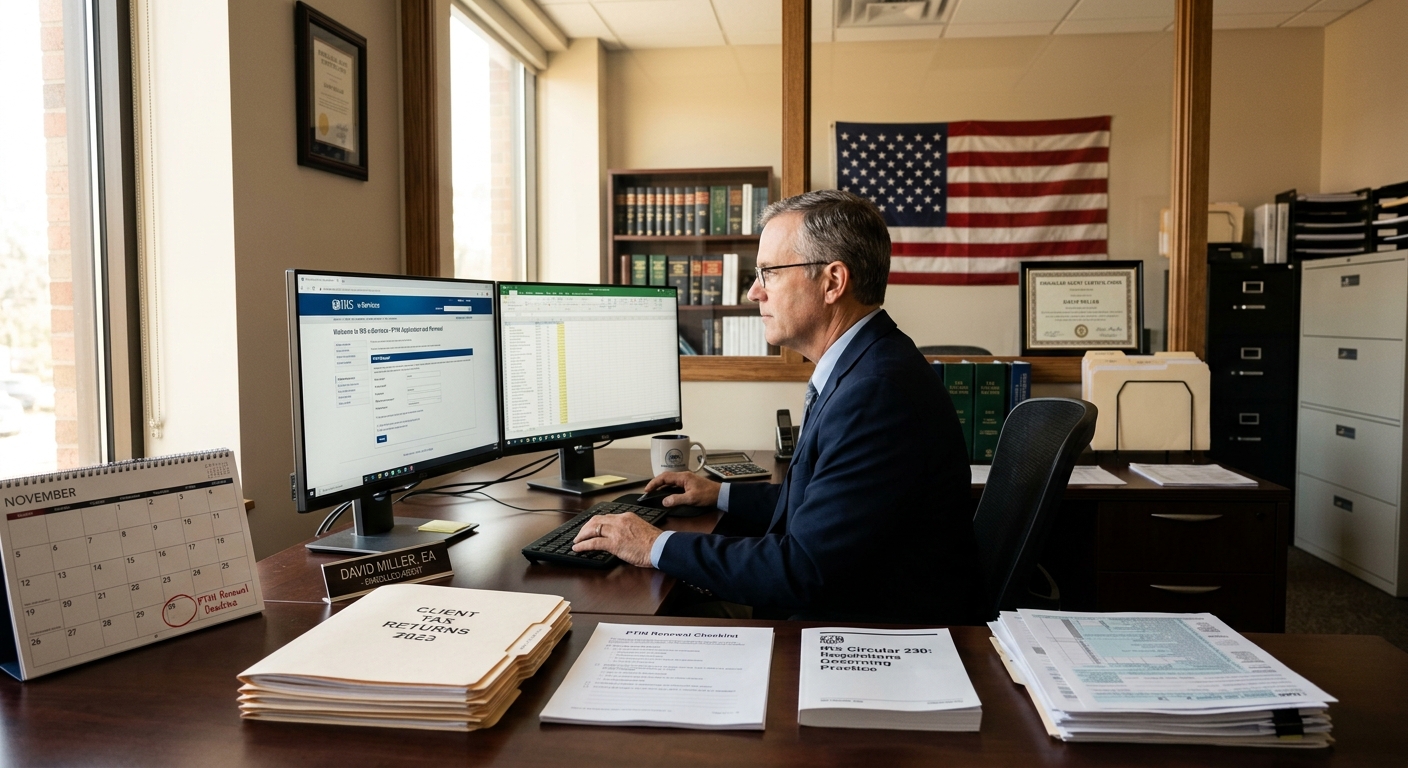
Your IRS PTIN account is not optional if you prepare tax returns for compensation. It’s a federal requirement, a compliance gate, and the first thing the IRS will check if your practice ever gets scrutinized. But most tax preparers treat PTIN renewal like a tedious checkbox instead of what it really is: a strategic credential that protects your practice, proves your legitimacy, and unlocks higher-value clients who demand real expertise.
If you’re filing returns in 2026, your PTIN must be active before you sign a single Form 1040. Miss the renewal window or let your account lapse, and you’re operating illegally, subject to penalties that start at $530 per return. That adds up fast.
Quick Answer: What Is an IRS PTIN Account?
An IRS PTIN account is a federal registration system that assigns a unique Preparer Tax Identification Number to anyone who prepares or assists in preparing federal tax returns for compensation. Every paid tax preparer, from CPAs to Enrolled Agents to bookkeepers who file a few returns, must have an active PTIN before signing any tax documents. Your PTIN expires every December 31 and must be renewed annually through the IRS online system. Without it, you cannot legally prepare returns, and the IRS can impose penalties starting at $530 per violation.
Why the IRS Created the PTIN System
Before 2011, the IRS had no centralized system to track who was preparing tax returns. Fraudulent preparers, ghost preparers, and unqualified operators flooded the market. The IRS launched the PTIN program under the Registered Tax Return Preparer initiative to bring structure, accountability, and enforcement to the tax prep industry.
The system serves three purposes: identify every paid tax preparer in the U.S., enforce continuing education and competency standards for non-credentialed preparers, and enable IRS oversight and disciplinary action when preparers violate rules or engage in fraudulent activity.
For tax professionals, the PTIN is proof you’re operating within federal compliance standards. For clients, it’s a signal that the person preparing their return is registered, traceable, and accountable to the IRS.
Who Needs an IRS PTIN Account?
If you prepare federal tax returns for compensation, you need a PTIN. That includes CPAs, Enrolled Agents, tax attorneys, Annual Filing Season Program participants, bookkeepers who prepare returns as part of client services, and seasonal tax preparers working for firms or independently.
You do not need a PTIN if you prepare returns as an employee under the supervision of an attorney, CPA, or Enrolled Agent, you’re preparing returns as a volunteer through a VITA or TCE program, or you’re not compensated in any form for your tax preparation work.
Compensation includes direct fees, indirect benefits, or barter arrangements. If you’re getting paid to prepare tax returns, you need a PTIN. No exceptions.
Red Flag Alert
Ghost preparers are individuals who prepare returns for money but refuse to sign them or provide a PTIN. These operators expose clients to audit risk and penalties while avoiding IRS accountability. If someone prepares your return and won’t sign it or include their PTIN, that’s a federal red flag. Walk away.
How to Register for Your IRS PTIN Account
The IRS operates a centralized PTIN registration system through the IRS Tax Professional PTIN portal. Registration is straightforward if you follow the exact process.
Step-by-Step: New PTIN Registration
- Visit the IRS PTIN System: Go to irs.gov/ptin and select “New PTIN” to begin registration. The system is only available online; there is no paper application for new PTINs.
- Create Your Account: You’ll need your Social Security Number, date of birth, and contact information. The system will verify your identity using IRS records and credit bureau data.
- Complete the Application: Provide your professional credentials (CPA, EA, attorney, or non-credentialed preparer), answer suitability questions about your tax compliance history, and disclose any disciplinary actions, suspensions, or IRS penalties.
- Pay the Fee: The PTIN registration fee is $19.75 for new applicants and $19.75 annually for renewals. Payment is processed through the IRS system via credit card, debit card, or electronic check.
- Receive Your PTIN: Upon approval, your PTIN is issued immediately and displayed on-screen. You’ll also receive a confirmation email. Print or save your PTIN confirmation for your records.
The entire process takes 15 to 20 minutes if you have all required information ready. Your PTIN is valid from the date of issue through December 31 of the current year.
Pro Tip
Register or renew your PTIN in October or November, before the year-end rush. The IRS system can experience delays in December, and you don’t want to be locked out when clients start calling in January.
How to Renew Your IRS PTIN Account
Your PTIN expires on December 31 every year, regardless of when you originally registered. Renewal is mandatory if you plan to prepare returns in the upcoming filing season. The IRS opens the renewal window in mid-October each year and keeps it open through December 31.
Step-by-Step: PTIN Renewal Process
- Log In to the PTIN System: Go to irs.gov/ptin and select “Renew PTIN.” Enter your existing PTIN and the last four digits of your Social Security Number to access your account.
- Update Your Information: Review your contact information, professional credentials, and firm affiliation. Update any changes to your address, phone number, email, or employer.
- Answer Compliance Questions: The system will ask whether you’ve had any tax compliance issues, penalties, or disciplinary actions since your last renewal. Answer accurately. The IRS cross-checks responses against federal databases.
- Pay the Renewal Fee: The renewal fee remains $19.75. Pay via credit card, debit card, or electronic check.
- Print Your Confirmation: Once processed, your renewed PTIN is active immediately. Save or print the confirmation page for your records.
Renewal takes 10 to 15 minutes. If you miss the December 31 deadline, your PTIN becomes inactive on January 1, and you cannot legally sign tax returns until you renew.
What Happens If You Miss the Renewal Deadline?
If you let your PTIN lapse, you’re not allowed to prepare or sign tax returns until you complete the renewal process. The IRS does not grant grace periods or retroactive renewals. Every return you sign with an expired PTIN is a violation, subject to a $530 penalty per return under IRC Section 6695(c).
If you realize your PTIN expired mid-season, renew immediately and notify any clients whose returns you signed while your PTIN was inactive. The IRS may require amended returns with a valid PTIN signature.
PTIN Fees and Costs
The IRS charges a flat fee for PTIN registration and renewal. As of 2026, the fee structure is $19.75 for new PTIN registration and $19.75 for annual PTIN renewal. These fees are non-refundable and non-transferable. You pay the fee every year, even if you only prepare a handful of returns.
The fee is significantly lower than it was historically. From 2011 to 2016, the IRS charged $50 to $64.25 per year, but a federal court ruling in Loving v. IRS limited the IRS’s authority to regulate non-credentialed preparers, and the fee dropped to the current rate.
Can You Deduct the PTIN Fee?
Yes. The PTIN fee is a deductible business expense for tax preparers. If you’re self-employed, report it on Schedule C as a professional license or regulatory fee. If you’re an employee and pay the fee yourself, it may be deductible under unreimbursed employee expenses, though those deductions are currently suspended under the Tax Cuts and Jobs Act for most employees through 2025.
How to Use Your PTIN on Tax Returns
Your PTIN must appear in the preparer section of every tax return you sign. On Form 1040, that’s the “Paid Preparer Use Only” box at the bottom of the return. You must include your PTIN, your printed name, your signature, the date you signed the return, your firm’s name (if applicable), the firm’s EIN, and the firm’s address and phone number.
Do not use your Social Security Number in place of your PTIN. The IRS requires the PTIN for all paid preparers. Using your SSN instead is a compliance violation and exposes your personal information unnecessarily.
Tax software platforms like Intuit ProConnect, Drake, UltraTax, and Lacerte automatically populate your PTIN information once you enter it into the software settings. Verify that your PTIN is active and correctly formatted before filing any returns electronically.
Pro Tip
If you work with multiple firms or operate your own practice, make sure your PTIN information reflects the correct firm affiliation for each return. The IRS tracks preparers by PTIN and firm EIN, and mismatched data can trigger compliance inquiries.
Common PTIN Mistakes and How to Avoid Them
Even experienced preparers make PTIN errors that create compliance risk and client confusion. Here’s what to watch for and how to stay compliant.
Mistake 1: Using an Expired PTIN
Your PTIN expires on December 31 every year. If you forget to renew and keep signing returns in January, you’re in violation. Solution: Set a recurring calendar reminder in October to renew your PTIN before the filing season starts.
Mistake 2: Sharing Your PTIN
Your PTIN is tied to your identity and your professional compliance history. Never let another preparer use your PTIN to sign returns. If someone else signs a return with your PTIN and commits fraud or error, you’re liable. Solution: Protect your PTIN like your Social Security Number. Only you should have access to it.
Mistake 3: Not Updating Your Contact Information
If the IRS needs to contact you about a return you prepared, they use the contact information in your PTIN account. If your address or email is outdated, you may miss critical notices or audit requests. Solution: Update your PTIN profile whenever your contact information changes, even mid-year.
Mistake 4: Operating Without a PTIN
Some preparers assume they don’t need a PTIN if they only prepare a few returns or work part-time. That’s incorrect. If you’re compensated, you need a PTIN, regardless of volume. Solution: Register for your PTIN before you prepare your first paid return, even if you’re just helping a friend.
KDA Case Study: Tax Preparer Compliance and PTIN Optimization
Maria is a bookkeeper in Sacramento who started preparing tax returns for her small business clients as an add-on service. She charged $150 to $300 per return and filed about 25 returns during her first tax season. Maria didn’t realize she needed a PTIN because she wasn’t a CPA or Enrolled Agent.
After filing 15 returns, one of her clients received an IRS notice questioning the preparer signature. The IRS flagged Maria’s Social Security Number instead of a PTIN, triggering a compliance inquiry. Maria faced potential penalties of $530 per return, totaling $7,950 for the 15 returns she had already filed.
Maria contacted KDA for help. We immediately registered her for a PTIN, prepared a disclosure letter to the IRS explaining the oversight, and worked with the IRS to reduce the penalties under first-time abatement relief. The IRS reduced the penalties to $1,500, and Maria avoided further action by agreeing to comply going forward.
Maria paid $3,200 for our representation and penalty negotiation. She saved $6,450 compared to the original penalty, a 2.0x return, and learned the importance of preparer compliance before taking on paid clients.
Ready to see how we can help you? Explore more success stories on our case studies page to discover proven strategies that have saved our clients thousands in taxes.
PTIN Continuing Education Requirements
The IRS requires certain tax preparers to complete continuing education as a condition of maintaining their PTIN. If you’re a CPA, Enrolled Agent, or attorney, your professional credentialing body already requires continuing education, and the IRS does not impose additional requirements.
If you’re a non-credentialed preparer and you participate in the Annual Filing Season Program (AFSP), you must complete 18 hours of continuing education annually, including six hours of federal tax law updates, three hours of federal tax law topics, two hours of ethics, and seven hours of elective federal tax topics.
If you don’t participate in the AFSP and you’re not credentialed, the IRS does not currently require continuing education to maintain your PTIN. However, many states impose their own preparer education requirements, and clients increasingly expect preparers to demonstrate ongoing professional development.
Pro Tip
Even if you’re not required to complete continuing education, doing so improves your technical skills, reduces your error rate, and makes you more marketable to higher-value clients. KDA recommends completing at least 16 hours of federal tax education annually, regardless of your credential status.
State-Specific PTIN and Preparer Registration Rules
The federal PTIN is required for anyone preparing returns nationwide, but some states impose additional registration, licensing, or bonding requirements for tax preparers. California, Oregon, Maryland, and New York have state-level preparer regulations that go beyond the federal PTIN system.
California-Specific Considerations
California does not require a separate state preparer license for CPAs, Enrolled Agents, or attorneys. However, non-credentialed preparers must register with the California Tax Education Council (CTEC) and complete 60 hours of qualifying education before preparing California tax returns. CTEC registration renews annually, and the fee is $33 per year.
If you prepare California returns and you’re not a CPA, EA, or attorney, you need both a federal PTIN and a CTEC registration number. Operating without CTEC registration in California subjects you to civil penalties and potential criminal charges if the violation is willful.
Oregon and Maryland
Oregon requires all paid tax preparers to be licensed or registered, regardless of credential. Maryland requires non-credentialed preparers to complete a state-approved education program and pass a competency exam before preparing returns. Both states cross-check preparer registrations with the IRS PTIN database.
If you prepare returns in multiple states, verify each state’s preparer requirements before taking on clients. State-level penalties for unlicensed preparation are often more severe than federal penalties.
How the IRS Enforces PTIN Compliance
The IRS monitors PTIN compliance through multiple channels. Every electronically filed return includes the preparer’s PTIN, and the IRS system automatically flags returns signed with expired or invalid PTINs. If you e-file a return with an expired PTIN, the system rejects the return and notifies you of the error.
For paper returns, the IRS manually reviews preparer information during processing. If your PTIN is missing, invalid, or expired, the IRS may issue a notice to you and the taxpayer, and the return may be delayed or rejected.
The IRS also conducts preparer compliance audits, selecting preparers for review based on error rates, client audit frequency, and red-flag patterns. If the IRS audits your practice and finds you’ve been operating without a valid PTIN, they can assess penalties retroactively for every return you signed.
Penalties for Operating Without a PTIN
Under IRC Section 6695(c), the penalty for failing to include a valid PTIN on a tax return is $530 per return. That penalty applies to each return you sign without a PTIN or with an expired PTIN. If you prepare 50 returns without a valid PTIN, your potential penalty is $26,500.
In addition to federal penalties, clients can sue you for malpractice or negligence if your lack of a valid PTIN causes their return to be rejected or delayed. If a client misses a refund deadline or incurs interest and penalties because of your compliance failure, you’re liable.
PTIN Security and Identity Protection
Your PTIN is a valuable credential, and it’s a target for identity thieves and fraudulent preparers. The IRS has seen cases where criminals steal PTINs from legitimate preparers and use them to file fraudulent returns, collect fake refunds, and disappear before the IRS catches on.
Protect your PTIN by never sharing it with anyone outside your firm, storing your PTIN confirmation and renewal documents in a secure location, monitoring your PTIN account regularly for unauthorized changes or suspicious activity, and reporting suspected PTIN theft or misuse to the IRS immediately through the preparer hotline at 1-877-613-7846.
If someone steals your PTIN and uses it to file fraudulent returns, you’re not automatically liable for the fraud, but you’ll face IRS scrutiny, client complaints, and potential disciplinary action until the issue is resolved. Prevention is far easier than cleanup.
Ready to Reduce Your Tax Bill?
KDA Inc. specializes in strategic tax planning for business owners, S Corps, LLCs, and high-net-worth individuals. Book a personalized consultation and walk away with a clear plan.
Frequently Asked Questions About IRS PTIN Accounts
Do I need a PTIN if I only prepare a few returns per year?
Yes. If you’re compensated for preparing any federal tax returns, you need a PTIN, regardless of volume. The IRS does not provide exemptions for low-volume preparers.
Can I use my Social Security Number instead of a PTIN?
No. The IRS requires all paid preparers to use a PTIN on tax returns. Using your Social Security Number instead is a compliance violation and exposes your personal information unnecessarily.
What if I prepare returns for family members for free?
If you’re not compensated in any form, you do not need a PTIN. Volunteer preparation for family or through approved programs like VITA does not require a PTIN.
How long does it take to get a PTIN?
New PTIN registration is processed immediately online. You receive your PTIN on-screen as soon as you complete the application and pay the fee. Renewals are also processed instantly.
Can I renew my PTIN after it expires?
Yes, but your PTIN remains inactive until you complete the renewal process. You cannot sign returns with an expired PTIN, and any returns you sign while your PTIN is inactive are subject to penalties.
How KDA Helps Tax Professionals Stay Compliant
KDA works with tax preparers, bookkeepers, and small accounting firms to ensure PTIN compliance, manage continuing education requirements, and resolve IRS preparer audits and penalty notices. If you’re launching a tax prep practice or you’ve received an IRS notice questioning your PTIN status, we can help you navigate the system, protect your license, and stay compliant.
We also support preparers with professional liability questions, client audit representation, and state-level licensing requirements. Our goal is to keep you focused on serving clients while we handle the regulatory and compliance burden.
For more information on our tax planning services, explore how we help professionals optimize their compliance strategies and protect their practices.
Book Your Tax Strategy Session
If you’re preparing returns for compensation and you’re not sure whether your PTIN setup is compliant, or if you’ve received an IRS notice about preparer penalties, let’s fix that now. Book a personalized consultation with our strategy team and get clear, compliant, and confident. Click here to book your consultation now.
This information is current as of 5/22/2026. Tax laws and IRS policies change frequently. Verify updates with the IRS if reading this later.



