
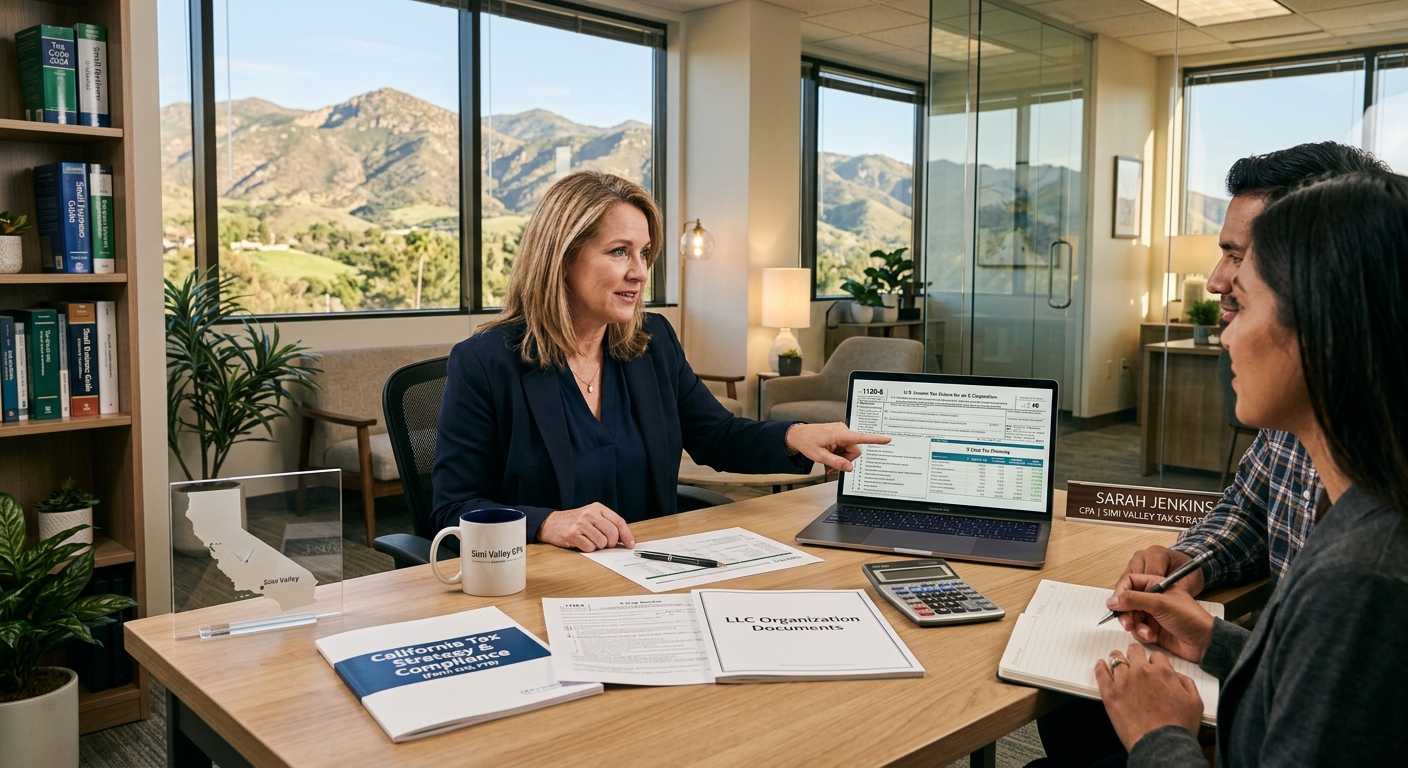
Why Simi Valley Business Owners Are Overpaying on Taxes in 2026
Most business owners in Simi Valley think they’re doing everything right with their taxes. They file on time, keep receipts, and maybe even work with a bookkeeper. But here’s the uncomfortable truth: without strategic tax planning from a CPA in Simi Valley who understands California’s aggressive enforcement landscape and federal reporting changes in 2026, you’re likely leaving $8,000 to $35,000 on the table every single year.
The gap between filing taxes and planning taxes is where wealth either accumulates or disappears. In 2026, that gap has widened significantly. California adopted the new $2,000 federal threshold for 1099-NEC and 1099-MISC reporting, sales tax compliance has become a front-row issue for small businesses, and the IRS continues tightening documentation requirements for deductions. If your current accountant is only looking backward at last year’s numbers instead of forward at next year’s strategies, you’re not getting tax planning. You’re getting tax preparation, and that’s a costly mistake.
Quick Answer
A CPA in Simi Valley specializing in proactive tax strategy helps business owners legally reduce tax liability through entity structuring, deduction optimization, payroll planning, and compliance with both California and federal regulations. This isn’t about filing forms correctly. It’s about engineering your financial structure so you keep more of what you earn while staying fully compliant with state and federal authorities.
What Makes a Strategic CPA Different From a Tax Preparer
Most people use the terms “CPA,” “accountant,” and “tax preparer” interchangeably. That’s a mistake that costs real money. A tax preparer records what happened last year. A bookkeeper organizes your transactions. But a strategic CPA in Simi Valley operates at a different level entirely.
The Three-Level Hierarchy of Tax Services
Level 1: Tax Preparation. This is compliance work. Someone takes your receipts, enters numbers into software, and submits forms to the IRS and FTB. You get a bill or a refund. Nothing is optimized. This is where most small business owners are stuck, paying thousands more than necessary because no one is looking ahead.
Level 2: Bookkeeping and Accounting. This adds organization. Your books are clean, categorized, and reconciled monthly. You can see profit and loss statements. But there’s still no strategy. You know what happened, but you don’t know how to change what happens next year.
Level 3: Strategic Tax Planning. This is where a specialized CPA in Simi Valley operates. They analyze your entity structure, model tax scenarios before year-end, coordinate payroll strategies for S Corp owners, identify missed deductions, and build compliance systems that protect you during audits. The savings here typically run $8,000 to $50,000 annually depending on business income.
Let’s get specific. A contractor in Simi Valley earning $180,000 as a sole proprietor will pay approximately $25,470 in self-employment tax alone. Convert that same contractor to an S Corp with a $90,000 reasonable salary, and self-employment tax drops to $13,770. That’s $11,700 in annual savings just from entity structuring. But you need a CPA who understands both California’s employment requirements and IRS reasonable compensation standards to execute this correctly.
California-Specific Complications That Demand Local Expertise
California doesn’t just follow federal tax law and call it a day. The state operates its own tax code with unique rules, aggressive enforcement, and penalties that can destroy businesses. This is where having a CPA in Simi Valley with California expertise becomes critical.
For instance, California’s Franchise Tax Board has adopted the $2,000 threshold for 1099-NEC and 1099-MISC reporting starting in 2026, aligning with recent federal changes under the One, Big, Beautiful Bill Act. But California also maintains a $600 threshold for third-party network payments to app-based drivers. Miss that distinction, and you’re facing penalties from the FTB. Our tax planning services specifically address these California-federal compliance intersections that trip up out-of-state firms.
Additionally, California has its own rules on S Corp recognition, community property income allocation for married taxpayers, and mandatory state disability insurance for owner-employees. A tax professional unfamiliar with these nuances will cost you money through missed opportunities or compliance failures.
The Five Tax Mistakes Simi Valley Business Owners Make in 2026
After working with hundreds of California small business owners, we see the same costly patterns repeat. These mistakes are entirely preventable with proper guidance from a qualified CPA in Simi Valley.
Mistake 1: Operating as the Wrong Business Entity
Your entity structure is your first line of tax defense. Yet most business owners choose their entity based on what a legal document service recommended or what their neighbor is using. That’s not strategy. That’s guessing.
Here’s the breakdown: If you’re a sole proprietor or single-member LLC taxed as a disregarded entity, you’re paying 15.3% self-employment tax on every dollar of net income up to $168,600 in 2026, plus 2.9% on amounts above that, plus California income tax rates up to 13.3%. For a Simi Valley consultant earning $150,000 net, that’s $22,950 in self-employment tax before even touching income tax.
Compare that to the same consultant operating as an S Corp, paying themselves a reasonable salary of $80,000 and taking $70,000 as distributions. Self-employment tax now applies only to the $80,000 salary, resulting in $12,240 in payroll taxes. The distributions avoid self-employment tax entirely. Annual savings: $10,710. Every single year.
But here’s where it gets complicated: The IRS requires “reasonable compensation” for S Corp owners who work in the business. Set your salary too low, and you’re inviting audit risk. Set it too high, and you’re overpaying. A strategic CPA in Simi Valley models multiple scenarios, references industry compensation data, and documents the rationale for your chosen salary to protect you during IRS scrutiny.
Mistake 2: Missing the Home Office Deduction
The home office deduction remains one of the most underutilized tax breaks for Simi Valley business owners, largely because of outdated fear about audit triggers. Let’s be clear: a legitimate home office deduction will not trigger an audit if you have proper documentation.
The simplified method allows you to deduct $5 per square foot, up to 300 square feet, for a maximum deduction of $1,500. No receipts required. But most business owners with significant home office usage should use the actual expense method instead. If you have a dedicated 250-square-foot office in a 2,000-square-foot home, you can deduct 12.5% of your mortgage interest, property taxes, utilities, insurance, HOA fees, and repairs. For a Simi Valley home with typical housing costs, that’s often $8,000 to $12,000 in annual deductions.
But documentation is everything. You need photos proving exclusive business use, a floor plan showing the office space, and records of all expenses. A CPA in Simi Valley helps you build this documentation system before the IRS asks for it.
Mistake 3: Neglecting Estimated Tax Payments
California and the IRS both require quarterly estimated tax payments if you expect to owe more than $1,000 federally or $500 to California. Miss these deadlines, and you’ll face underpayment penalties even if you file and pay your full tax bill on time in April.
The penalty isn’t small. For 2026, the IRS charges interest on underpayments at rates adjusted quarterly. California’s penalties are similarly aggressive. For a business owner who owes $40,000 at filing and made no estimated payments throughout the year, penalties can easily exceed $1,200 to $1,800.
A strategic CPA in Simi Valley calculates your estimated tax obligations quarterly, adjusting for income fluctuations, and ensures payments are made on time. If your income drops mid-year, they’ll recalculate to avoid overpaying. This level of ongoing oversight prevents both penalties and cash flow problems.
Mistake 4: Failing to Separate Business and Personal Expenses
Mixing business and personal expenses is the fastest way to lose deductions during an audit. The IRS requires clear documentation showing business purpose for every deduction. When your business credit card shows charges at Costco, Target, and restaurants alongside legitimate business expenses, you create an audit nightmare.
The solution is simple but requires discipline: separate bank accounts, separate credit cards, and a system for categorizing every transaction. Use accounting software like QuickBooks or Xero, connected to your bank feeds, and categorize transactions weekly. For purchases with both business and personal components, split them at the time of purchase and keep notes.
A CPA in Simi Valley sets up this system correctly from day one and reviews your books monthly to catch mistakes before they become problems. This isn’t about being paranoid. It’s about surviving an audit with your deductions intact.
Mistake 5: Ignoring Sales Tax Nexus Requirements
If you sell products online, you likely have sales tax obligations in multiple states. After the Supreme Court’s decision in South Dakota v. Wayfair, states can require sales tax collection from remote sellers based on economic nexus thresholds. Many Simi Valley e-commerce businesses have crossed these thresholds without realizing it.
Sales tax compliance has become a front-row issue for small businesses in 2026. According to recent data from the U.S. Census Bureau’s 2025 Annual Survey of State Government Tax Collections, sales and gross receipts taxes accounted for $697.4 billion, or 45.4% of total state tax collections. States are aggressively pursuing this revenue, and small businesses are easy targets.
Economic nexus thresholds vary by state but commonly sit at $100,000 in annual sales or 200 transactions. If you’ve hit these numbers in California, Texas, Florida, or any other state, you’re required to register, collect, and remit sales tax. Failure to do so results in back taxes, penalties, interest, and potential legal action.
A CPA in Simi Valley tracks your multi-state sales, monitors nexus thresholds, handles registrations, and either manages sales tax filings or coordinates with specialized sales tax software. This is particularly critical for Amazon FBA sellers, Shopify store owners, and other e-commerce businesses.
KDA Case Study: Simi Valley Marketing Consultant
Rachel runs a digital marketing consultancy from her home in Simi Valley. She was operating as a sole proprietor, filing Schedule C, and paying her tax preparer $800 annually to submit her returns. She earned $165,000 in 2025 and thought she was doing fine.
When Rachel came to KDA, our analysis revealed three immediate problems. First, she was paying $23,295 in self-employment tax that could be reduced through S Corp election. Second, she was using the simplified home office method and leaving $9,500 in deductions on the table. Third, she had economic nexus in four states and wasn’t registered for sales tax, creating $18,000 in exposure.
Our strategy: We filed an S Corp election, established a reasonable salary of $85,000 with the remaining $80,000 as distributions, switched to actual home office expenses, set up quarterly estimated payments, and registered Rachel for sales tax in the four nexus states. We also implemented mileage tracking for client meetings and documented her home office properly.
First-year tax savings: $14,200 in reduced self-employment tax, plus $9,500 in additional home office deductions, for total savings of $23,700. Rachel’s investment with KDA: $4,500 for comprehensive planning and S Corp setup. ROI: 5.3x in the first year, with ongoing annual savings of approximately $14,000 to $16,000.
Ready to see how we can help you? Explore more success stories on our case studies page to discover proven strategies that have saved our clients thousands in taxes.
How to Choose the Right CPA in Simi Valley
Not all CPAs are created equal. The credentials mean someone passed exams and met licensing requirements, but they don’t indicate specialization, strategy capabilities, or California expertise. When evaluating a CPA in Simi Valley, ask these specific questions.
Do You Specialize in Proactive Tax Planning or Just Preparation?
This is the most important distinction. If the answer is “we do both,” dig deeper. Ask how many planning meetings they conduct annually with clients. Ask whether their fee structure includes ongoing advisory or just annual filing. A firm focused on tax strategy will schedule quarterly or mid-year planning sessions, not just a post-year-end cleanup meeting.
How Do You Handle Multi-State and California-Specific Issues?
California tax law is complex and constantly changing. The FTB is more aggressive than the IRS in many areas. If your CPA doesn’t have deep California experience, you’re at risk. Ask about their familiarity with FTB notices, California’s unique S Corp rules, and state-specific credits and deductions.
What’s Your Experience With My Type of Business?
A CPA experienced with real estate investors understands depreciation, cost segregation, and 1031 exchanges. A CPA experienced with e-commerce understands inventory accounting, sales tax nexus, and COGS calculations. A CPA experienced with professional services understands reasonable compensation and retirement plan options. Make sure your potential CPA has a track record with businesses similar to yours.
How Do You Communicate Throughout the Year?
Tax strategy requires year-round communication, not a frantic scramble in March. Ask how often they’ll review your books, how quickly they respond to questions, and whether they proactively reach out with strategy recommendations. If they’re difficult to reach during the relationship-building phase, they’ll be even worse once you’re a client.
What’s Your Fee Structure?
Transparent pricing is a sign of a professional firm. Beware of CPAs who won’t provide pricing until after they “look at your situation.” That’s a red flag for surprise bills. Quality tax planning isn’t cheap, but it should be clearly explained upfront. Expect to invest $2,500 to $6,000 annually for comprehensive planning depending on business complexity. That investment should return 3x to 10x in tax savings.
The 2026 Tax Planning Calendar for Simi Valley Business Owners
Strategic tax planning operates on a calendar, not a crisis schedule. Here’s when to take action throughout the year to maximize savings and minimize stress.
January Through March: Entity Structure Review
This is the ideal time to evaluate whether your current entity structure still serves your needs. If you’re considering an S Corp election, Form 2553 must be filed by March 15, 2026, to be effective for the full 2026 tax year. Work with your CPA in Simi Valley to model different scenarios and make the election if it makes sense.
If you missed the March 15 deadline, you can still file a late election with reasonable cause, but it’s more complicated. Don’t wait until December to think about entity changes. By then, your options are limited.
April 15: First Quarter Estimated Payment Due
Your first estimated tax payment for 2026 is due April 15. This should be based on your projected income for the full year, not just Q1 results. A strategic CPA calculates this based on your prior year tax liability and anticipated changes in income or deductions. Overpay, and you’re giving the government an interest-free loan. Underpay, and you’ll face penalties.
June 15: Second Quarter Estimated Payment Due
By mid-year, you should have a clearer picture of your actual income. If it’s significantly higher or lower than projected, adjust your remaining estimated payments. Your CPA should be reviewing your books quarterly and making these recommendations proactively. Don’t wait until October to discover you’re drastically underpaid.
July Through September: Mid-Year Tax Planning Session
This is the most critical planning window of the year. By September, you have eight months of financial data showing exactly where you stand. You still have three months to implement strategies that reduce your 2026 tax bill. This is when you should discuss: large equipment purchases under Section 179, maximizing retirement contributions, bunching deductions into 2026 or deferring to 2027, and timing income recognition.
A CPA in Simi Valley will schedule this mid-year session automatically. If your current accountant doesn’t, that’s a red flag that you’re not getting strategic planning.
September 15: Third Quarter Estimated Payment Due
Based on your mid-year planning session, adjust this payment to reflect any changes in projected annual income or newly implemented strategies. If you made a large retirement contribution or equipment purchase in Q3, this payment should account for the reduced tax liability.
October Through December: Year-End Strategy Execution
The final quarter is when you execute the strategies identified in your mid-year planning session. Make retirement contributions before December 31. Complete equipment purchases to qualify for Section 179 or bonus depreciation. Pay deductible expenses before year-end if you’re a cash-basis taxpayer. Harvest tax losses in investment accounts if applicable.
But be careful with timing. Just because something reduces 2026 taxes doesn’t mean it’s the right move if it creates bigger problems in 2027. Your CPA should be modeling multi-year tax scenarios, not just optimizing for the current year.
January 15, 2027: Fourth Quarter Estimated Payment Due
The final estimated payment for 2026 is due January 15, 2027. This should true-up any differences between your projected and actual income. If you had a surprise windfall in Q4, make sure this payment reflects it to avoid underpayment penalties.
Red Flags That Your Current Accountant Isn’t Strategic Enough
How do you know if your current tax professional is holding you back? Here are seven warning signs that it’s time to find a strategic CPA in Simi Valley.
Red Flag 1: You Only Hear From Them During Tax Season
If your accountant goes silent from April through January and only resurfaces when they need your tax documents, you’re not getting tax planning. You’re getting tax preparation. Strategic planning requires year-round communication, quarterly reviews, and proactive outreach when tax law changes affect your situation.
Red Flag 2: They Never Ask About Your Business Goals
Tax strategy should align with business strategy. If your accountant doesn’t know whether you’re planning to hire employees, expand to a new location, sell the business in five years, or buy real estate, they can’t provide meaningful advice. A CPA focused on strategy will ask about your goals and build tax plans around them.
Red Flag 3: They’ve Never Discussed Entity Structure With You
If you’ve been operating as a sole proprietor or LLC for several years and your accountant has never mentioned S Corp election, that’s a massive red flag. Either they don’t understand entity optimization, or they’re too passive to make recommendations. Either way, it’s costing you thousands annually.
Red Flag 4: You’re Always Surprised by Your Tax Bill
There should be no surprises in strategic tax planning. By December, you should know within a few thousand dollars what you’ll owe or receive when you file. If you’re consistently shocked by your tax liability, your accountant isn’t providing projections or helping you prepare.
Red Flag 5: They Don’t Specialize in Small Business or California Tax
Generalists rarely provide the same value as specialists. If your accountant also does personal returns for retirees, corporate returns for large companies, and nonprofit tax work, they’re spread too thin to stay expert in small business taxation. Find a CPA in Simi Valley who focuses specifically on business owners and understands California’s unique requirements.
Red Flag 6: They’re Difficult to Reach
Tax questions don’t wait for convenient times. If you can’t get a response within 24 to 48 hours during non-peak season, find someone more responsive. During tax season, response times will slow, but you should still hear back within a few days. If your accountant regularly ghosts you for weeks, that’s unacceptable.
Red Flag 7: Their Fees Are Suspiciously Low
Quality tax planning isn’t cheap because it requires significant expertise and time. If someone is offering full-service tax planning for $500 or $800 annually, they’re either undercharging and overworked or they’re not actually doing planning. Either way, you’re not getting adequate service. Expect to invest $2,500 to $6,000 for comprehensive business tax planning. That investment should return several times its cost in tax savings.
Advanced Tax Strategies Your CPA in Simi Valley Should Be Discussing
Beyond the basics of entity structure and deductions, there are several advanced strategies that separate great CPAs from mediocre ones. If your current advisor isn’t bringing these up, you’re leaving money on the table.
Qualified Business Income (QBI) Deduction Optimization
The Section 199A deduction allows eligible business owners to deduct up to 20% of qualified business income. For a Simi Valley consultant earning $180,000 in qualified income, that’s a potential $36,000 deduction, saving $9,000 to $12,000 in taxes depending on your bracket.
But the rules are complicated. The deduction phases out for specified service trade or businesses at taxable income above $191,950 for single filers and $383,900 for married filing jointly in 2026. W-2 wages and property basis limitations can further restrict the deduction. A strategic CPA models your QBI deduction across different entity structures and salary levels to maximize this benefit.
Augusta Rule for Home-Based Businesses
Section 280A(g) allows you to rent your home to your business for up to 14 days per year without reporting the rental income. Your business deducts the rental expense at fair market rates. For a Simi Valley business owner who holds quarterly board meetings, strategic planning sessions, or client events at home, this can create $3,000 to $8,000 in additional deductions annually.
Documentation is critical. You need written rental agreements, proof of fair market rental rates in your area, agendas showing legitimate business purpose, and proof that meetings actually occurred. Your CPA should help you build this documentation system to survive IRS scrutiny.
Retirement Plan Contributions Beyond the 401(k)
Most business owners know about 401(k) contributions, but few maximize the full range of retirement planning opportunities. For 2026, you can contribute up to $23,500 to a 401(k) as an employee, plus up to $7,500 in catch-up contributions if you’re 50 or older. But the real power comes from employer profit-sharing contributions, which can bring total contributions to $70,000 or $77,500 with catch-up.
For high-income business owners, a defined benefit plan can allow contributions exceeding $200,000 annually. A strategic CPA in Simi Valley analyzes your income, retirement goals, and cash flow to recommend the optimal retirement plan structure. These contributions are fully deductible and dramatically reduce current-year tax liability while building long-term wealth.
Cost Segregation for Real Estate Investors
If you own commercial real estate or investment property in Simi Valley, cost segregation can accelerate depreciation and create massive first-year deductions. Instead of depreciating a building over 27.5 or 39 years, cost segregation identifies components that can be depreciated over 5, 7, or 15 years.
For a $1.5 million commercial property, a cost segregation study might reclassify $450,000 of the purchase price into shorter depreciation periods. Combined with bonus depreciation, this can create $150,000 to $300,000 in first-year deductions. That’s $40,000 to $80,000 in immediate tax savings. A CPA experienced with real estate will recommend cost segregation analysis for properties exceeding $500,000 in value.
What Happens If You Get Audited?
Nobody wants to face an IRS or FTB audit, but the risk is real. In 2024, the IRS audited approximately 0.4% of individual returns, but that percentage is significantly higher for business owners, especially those reporting losses or high deductions relative to income. California’s FTB is even more aggressive. Having a strategic CPA in Simi Valley isn’t just about saving taxes. It’s about surviving audits with your deductions intact.
What Triggers Business Tax Audits?
Certain red flags increase audit risk. Reporting consistent losses year after year makes the IRS question whether you’re running a business or a hobby. Large home office deductions relative to income draw scrutiny. Round numbers on tax forms suggest estimates rather than actual records. High deductions for meals, travel, or vehicle expenses trigger review. Cash-intensive businesses face higher audit rates because of unreported income concerns.
But here’s the truth: legitimate deductions with proper documentation don’t trigger audits, or if they do, you’ll win. The problem isn’t taking deductions. The problem is taking deductions without records to support them. A CPA in Simi Valley helps you build documentation systems that protect you before audits happen.
How Audit Defense Works
If you receive an audit notice, don’t panic. The IRS conducts correspondence audits, where they request documentation by mail, and field audits, where an agent visits your location. California’s FTB operates similarly. The key to surviving an audit is having organized records and a CPA who knows how to respond strategically.
Your CPA will review the audit notice, identify what the IRS or FTB is questioning, gather supporting documentation, and prepare a response. In many cases, providing clear documentation resolves the audit without changes to your tax liability. If the auditor proposes changes, your CPA negotiates on your behalf and, if necessary, appeals through administrative channels.
Audit defense is included in our comprehensive service packages. We don’t disappear when the IRS comes knocking. We stand with you through the entire process. For more information, see our audit representation services.
Special Situations: Multi-State Business, Real Estate, and High Net Worth
Certain business situations require specialized expertise beyond general small business tax knowledge. If you fall into one of these categories, make sure your CPA in Simi Valley has specific experience with your situation.
Multi-State Business Operations
If you have employees, property, or significant sales in multiple states, you face complex nexus and apportionment issues. Each state has its own rules for determining whether you owe income tax, how to allocate income among states, and what credits are available for taxes paid to other jurisdictions.
California uses a single-sales-factor apportionment formula for most businesses, meaning your California tax liability is based primarily on the percentage of sales delivered to California customers. But other states use different formulas, and getting these calculations wrong results in overpayment to one state and underpayment to another. A CPA experienced with multi-state taxation navigates these rules and minimizes your total state tax burden.
Real Estate Investment Strategies
Real estate investors in Simi Valley face unique tax opportunities and challenges. Depreciation provides annual deductions, but it must be recaptured when you sell. The qualified business income deduction applies differently to rental activities depending on whether they qualify as a trade or business. 1031 exchanges allow you to defer capital gains, but strict timing and identification rules must be followed precisely.
A CPA specializing in real estate understands these nuances and helps you structure acquisitions, dispositions, and operations to minimize tax. For investors with multiple properties, entity structuring becomes critical. Should each property be in a separate LLC? Should you elect S Corp status? These decisions have significant tax and liability implications.
High Net Worth Wealth Planning
For business owners with net worth exceeding $5 million, tax planning integrates with estate planning, asset protection, and multi-generational wealth transfer. Strategies like family limited partnerships, grantor retained annuity trusts, and charitable remainder trusts provide tax benefits while accomplishing personal financial goals.
A CPA in Simi Valley working with high-net-worth clients coordinates with estate planning attorneys, wealth managers, and insurance professionals to create comprehensive plans. This level of service requires deep expertise across multiple disciplines. If your CPA doesn’t have experience with high-net-worth planning, they should refer you to someone who does or bring in specialists to collaborate.
Ready to Reduce Your Tax Bill?
KDA Inc. specializes in strategic tax planning for business owners, S Corps, LLCs, and high-net-worth individuals. Book a personalized consultation and walk away with a clear plan.
Frequently Asked Questions About Working With a CPA in Simi Valley
How Much Does a Strategic CPA Cost?
Comprehensive tax planning for business owners typically costs $2,500 to $6,000 annually depending on business complexity, entity structure, number of entities, real estate holdings, and multi-state operations. This fee usually includes quarterly meetings, mid-year planning sessions, annual tax return preparation for business and personal returns, bookkeeping review, estimated tax calculations, and unlimited email or phone support for questions throughout the year.
Compare that cost to the tax savings. If you’re saving $12,000 to $30,000 annually through strategic planning, a $4,000 investment is a no-brainer. The ROI is immediate and compounds year after year.
What Records Do I Need to Provide?
Your CPA will need access to your accounting software, bank and credit card statements, payroll records if you have employees, receipts for large purchases, year-end tax forms including 1099s, W-2s, K-1s, and documentation supporting claimed deductions like home office measurements, mileage logs, and business travel itineraries. If your records are disorganized, a good CPA will help you build systems to maintain them going forward.
Can You Help If I’m Behind on Tax Filings?
Yes. Many business owners fall behind on tax filings due to disorganization, cash flow problems, or fear of what they might owe. A CPA experienced with back tax situations will reconstruct your records, prepare missing returns, negotiate payment plans with the IRS and FTB, and get you back into compliance. The penalties for unfiled returns are severe, increasing the longer you wait. Address the problem immediately rather than hoping it disappears.
Do You Work With Startups or Only Established Businesses?
We work with businesses at all stages. Startups need guidance on entity formation, initial tax elections, bookkeeping setup, and compliance requirements. Established businesses need ongoing planning, entity optimization, and advanced strategies. The key is finding a CPA who understands your current stage and can grow with you. Don’t wait until you’re making $500,000 to get strategic advice. The decisions you make in year one affect your taxes for years to come.
What If I Already Have a Bookkeeper?
That’s fine. Many of our clients have bookkeepers who handle day-to-day transaction recording and bank reconciliations. We review the bookkeeper’s work for accuracy, provide guidance on proper categorization, and handle all tax planning and preparation. This division of labor often works well, with the bookkeeper managing routine tasks and the CPA handling strategic planning and compliance.
How Quickly Can You Reduce My Tax Liability?
Some strategies provide immediate benefits. Electing S Corp status, maximizing retirement contributions, implementing home office deductions, and accelerating equipment purchases can reduce your current-year taxes. Other strategies, like entity restructuring or multi-year income deferral, take longer to implement but provide sustained benefits. During your initial consultation, we’ll identify both quick wins and long-term strategies specific to your situation.
What Makes KDA Different From Other CPAs in Simi Valley?
We focus exclusively on proactive tax strategy for business owners, real estate investors, and high-net-worth individuals. We don’t do personal returns for retirees or general bookkeeping for companies without planning needs. This specialization means we stay expert in the strategies that matter most to our target clients. We communicate year-round, not just during tax season. We provide fixed-fee pricing, so you know exactly what you’ll pay. And we stand by our clients during audits, providing full representation without additional fees. Our case studies demonstrate real-world results with documented savings.
Take Action Before Year-End to Maximize Your 2026 Tax Savings
Every day you wait to implement strategic tax planning is a day you’re overpaying taxes. The strategies discussed in this article work, but only if you take action. The best time to optimize your tax situation was five years ago. The second-best time is right now.
If you’re still working with a tax preparer who only looks backward, if you’re constantly surprised by your tax bill, if you haven’t discussed entity structure in years, or if you’re operating without a clear tax strategy, it’s time for a change. The difference between mediocre tax advice and strategic planning is measured in tens of thousands of dollars annually.
This information is current as of 5/21/2026. Tax laws change frequently. Verify updates with the IRS or FTB if reading this later.
Get a Personalized Tax Strategy Session
If you’re a Simi Valley business owner earning more than $100,000 annually and you’re frustrated with overpaying taxes year after year, let’s talk. Book a consultation with our team and discover exactly how much you’re leaving on the table. We’ll review your current situation, identify missed opportunities, and show you a clear path to keeping more of what you earn while staying fully compliant. Stop guessing about your taxes and start planning strategically. Click here to book your consultation now.



