
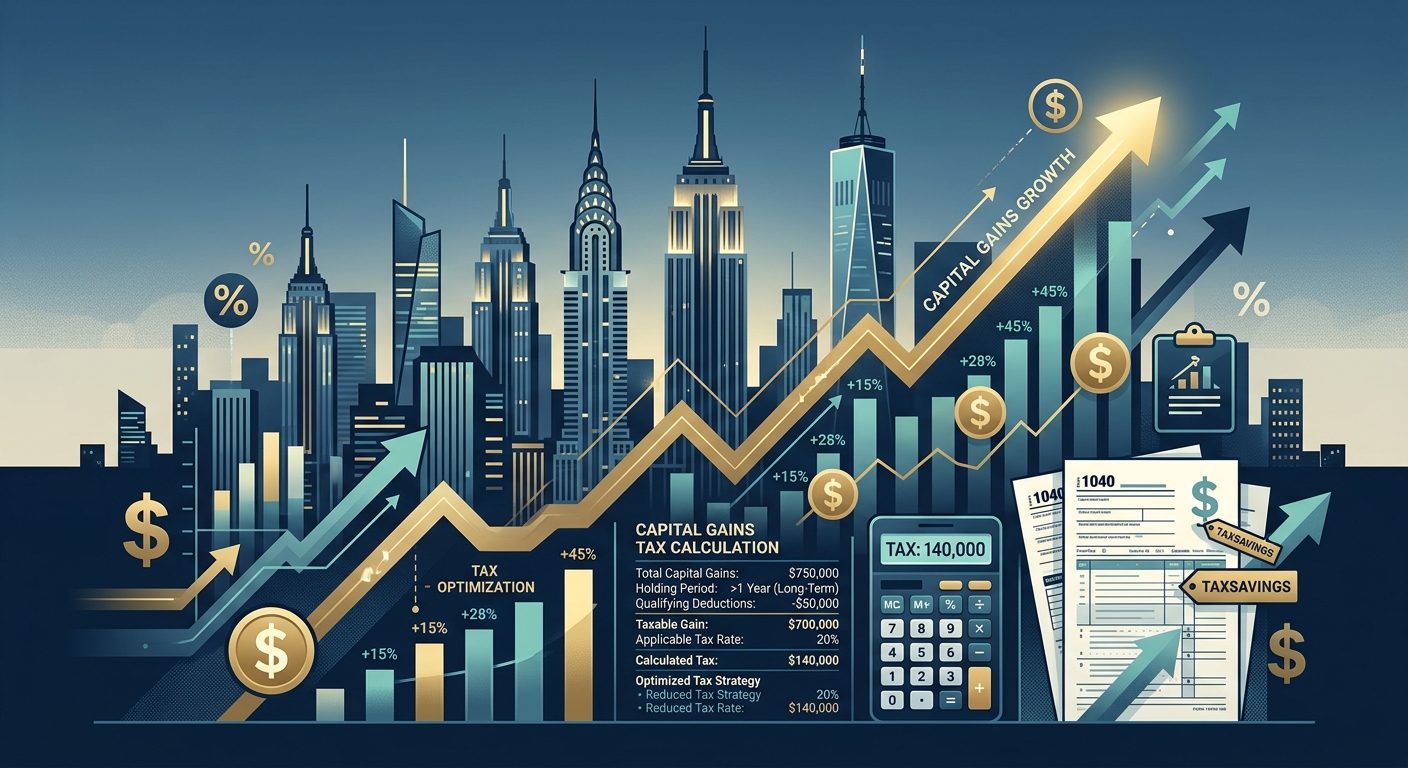
Why New York’s Capital Gains Tax Hits Harder Than You Think
You sold an investment property in Manhattan for a $200,000 gain. You held it for 18 months, so you assume you’ll pay the federal long-term capital gains rate of 15% or 20%. Then you get the bill: federal tax plus New York State tax plus New York City tax. Suddenly, your $200,000 gain costs you nearly $50,000 in combined taxes. Most investors don’t realize that ny long term capital gains tax isn’t a separate rate at all. New York treats capital gains as ordinary income, meaning your gains stack on top of your W-2 salary, rental income, and business profits at rates that can exceed 10% at the state and city level combined.
This isn’t just a New York problem. It’s a New York planning opportunity. With 2026 bringing new cash purchase taxes on $1 million+ properties and ongoing debates about pied-à-terre taxes targeting secondary homes over $5 million, real estate investors and high earners need to understand exactly how New York taxes long-term gains and what strategies exist to reduce the hit.
Quick Answer
New York long-term capital gains tax does not have a separate preferential rate. New York State taxes all capital gains as ordinary income at rates from 4% to 10.9%, and New York City adds another 3.078% to 3.876% for residents. Combined with federal long-term capital gains rates of 0%, 15%, or 20%, total tax on a long-term gain can reach 30% to 34% depending on your income level and residency status.
How New York State Taxes Long-Term Capital Gains
Unlike the federal system, which taxes long-term capital gains at preferential rates (0%, 15%, or 20% depending on income), New York State treats capital gains as ordinary income. This means your $150,000 gain from selling Apple stock after holding it for two years gets added to your salary, business income, and everything else, then taxed at New York’s progressive income tax rates.
New York State Income Tax Brackets for 2026
New York State tax rates range from 4% to 10.9%. Here’s how the brackets work for single filers in 2026:
- 4% on income up to $8,500
- 4.5% on income between $8,500 and $11,700
- 5.25% on income between $11,700 and $13,900
- 5.5% on income between $13,900 and $80,650
- 6% on income between $80,650 and $215,400
- 6.85% on income between $215,400 and $1,077,550
- 9.65% on income between $1,077,550 and $5,000,000
- 10.3% on income between $5,000,000 and $25,000,000
- 10.9% on income over $25,000,000
For married couples filing jointly, the brackets roughly double. But the key takeaway is this: a high earner in New York City pays 10.9% state tax plus 3.876% city tax on long-term capital gains, for a combined state and local rate of 14.776% before federal tax.
Real-World Example: Tech Executive Selling RSUs
Scenario: Marcus is a software engineer living in Brooklyn. He earns $180,000 in W-2 income and sells $100,000 worth of company stock he’s held for 14 months (long-term holding period).
Federal Tax: His total income of $280,000 puts him in the 15% long-term capital gains bracket federally. Federal tax on the gain: $100,000 × 15% = $15,000.
New York State Tax: The $100,000 gain is added to his $180,000 salary, so his New York taxable income is $280,000. The incremental state tax on that $100,000 gain is roughly $6,850 (6.85% marginal rate).
New York City Tax: As a city resident, Marcus also owes NYC tax. At his income level, the marginal city rate is 3.876%. City tax on the gain: $100,000 × 3.876% = $3,876.
Total Tax: $15,000 (federal) + $6,850 (state) + $3,876 (city) = $25,726, or 25.7% of his $100,000 gain.
Marcus nets $74,274 after taxes. If he lived in Florida or Texas (no state income tax), he’d keep $85,000. That’s a $10,726 difference.
New York City Residents Pay an Additional Layer
If you live in one of the five boroughs (Manhattan, Brooklyn, Queens, the Bronx, Staten Island), you’re subject to New York City personal income tax on top of state tax. NYC does not have a separate capital gains rate either. It taxes all income, including long-term capital gains, at rates between 3.078% and 3.876% depending on filing status and income.
NYC Income Tax Rates for 2026 (Single Filers)
- 3.078% on income up to $12,000
- 3.762% on income between $12,000 and $25,000
- 3.819% on income between $25,000 and $50,000
- 3.876% on income over $50,000
For high earners, this means an extra 3.876% on every dollar of capital gains. When you combine federal (20%), state (10.9%), and city (3.876%), the top marginal rate on long-term capital gains in New York City is 34.776%.
Example: Real Estate Investor Selling Rental Property
Scenario: Alicia owns a rental property in Queens that she bought for $400,000 in 2020. She sells it in 2026 for $650,000, netting a $250,000 long-term capital gain after depreciation recapture (simplified for this example).
Federal Tax: Alicia’s income puts her in the 20% long-term capital gains bracket. Federal tax: $250,000 × 20% = $50,000.
New York State Tax: At the 10.9% top rate, state tax is $250,000 × 10.9% = $27,250.
New York City Tax: City tax at 3.876%: $250,000 × 3.876% = $9,690.
Total Tax: $50,000 + $27,250 + $9,690 = $86,940, or 34.8% of her gain.
Alicia nets $163,060 after taxes on a $250,000 gain. That’s a brutal haircut. But with planning, she could have deferred or reduced this tax significantly.
Strategies to Reduce NY Long-Term Capital Gains Tax
New York’s treatment of capital gains as ordinary income creates challenges, but it also creates planning opportunities. Here are five strategies that work in 2026.
1. Use a 1031 Exchange to Defer Tax on Real Estate Sales
If you’re selling investment or business property, a 1031 exchange allows you to defer federal, state, and city capital gains tax by reinvesting the proceeds into a like-kind property within specific deadlines.
How it works: You sell your property and use a qualified intermediary to hold the proceeds. Within 45 days, you identify replacement properties. Within 180 days, you close on one or more of them. If structured correctly, you owe zero tax on the sale.
Who benefits: Real estate investors selling rental properties, commercial buildings, or land. This does not apply to primary residences or properties held for personal use.
New York twist: New York follows federal 1031 rules, so a properly executed exchange defers both state and city tax. If Alicia from the example above used a 1031 exchange, she’d defer the entire $86,940 tax bill and reinvest the full $250,000 gain into her next property.
2. Establish Residency Outside New York Before Selling
One of the most powerful strategies for high earners is changing your tax residency before triggering a large capital gain. If you’re no longer a New York resident when you sell, you avoid New York State and NYC tax on the gain entirely (assuming the asset isn’t New York real property).
New York’s statutory residency test: You’re a resident if you maintain a permanent place of abode in New York and spend more than 183 days in the state during the tax year. If you fail either test, you’re a non-resident.
Example: A hedge fund manager living in Manhattan plans to sell $2 million in stock. If he establishes residency in Florida (no state income tax) and spends fewer than 183 days in New York during the year of sale, he avoids the 10.9% state tax and 3.876% city tax. That’s a tax savings of $295,520 on a $2 million gain.
Red Flag Alert: New York aggressively audits residency changes, especially when they coincide with large capital gains. You must cut ties: change your driver’s license, voter registration, and mailing address. Keep a detailed day count log. New York will look at where your spouse and kids live, where you own property, and even where your pets are registered.
3. Harvest Losses to Offset Gains
Capital losses offset capital gains dollar-for-dollar at both the federal and state level. If you’re sitting on investments with unrealized losses, selling them in the same year you realize a gain can reduce your taxable gain and your New York tax bill.
How it works: You sell losing positions to generate capital losses. You use those losses to offset capital gains. If your losses exceed your gains, you can deduct up to $3,000 against ordinary income (federal rule, New York follows), and carry forward the rest to future years.
Example: Marcus (from earlier) has $30,000 in unrealized losses in a tech fund. He sells the fund in the same year he sells his $100,000 in company stock. His net gain drops to $70,000. Total tax savings: $30,000 × 25.7% = $7,710.
Pro Tip: Be mindful of the wash sale rule. If you sell a losing position and buy it back within 30 days, the IRS disallows the loss. Wait 31 days or buy a similar (but not identical) investment to maintain market exposure.
4. Donate Appreciated Assets to Charity
If you’re charitably inclined, donating appreciated stock, real estate, or other assets can eliminate capital gains tax while giving you a charitable deduction equal to the fair market value of the asset.
How it works: Instead of selling stock and donating cash, you donate the stock directly to a qualified charity or a donor-advised fund. You avoid capital gains tax on the appreciation, and you deduct the full current value as a charitable contribution (subject to AGI limits).
Example: You bought $50,000 of Tesla stock five years ago. It’s now worth $150,000. If you sell it, you owe capital gains tax on the $100,000 gain (roughly $25,700 in NYC). If you donate the stock directly to your alma mater, you owe zero capital gains tax and you get a $150,000 charitable deduction. At a 37% federal rate plus 10.9% state rate, that deduction saves you roughly $71,850.
Net benefit: You saved $25,700 in capital gains tax and generated $71,850 in income tax savings, for a total tax benefit of $97,550. You gave away $150,000, but the after-tax cost was only $52,450.
5. Time the Sale Across Multiple Tax Years
If you’re selling a large asset and you have flexibility on timing, consider structuring the sale as an installment sale under IRS Section 453. This allows you to spread the gain over multiple years, which can keep you out of higher tax brackets and reduce your effective rate.
How it works: You sell the property but receive payments over time. You report a portion of the gain each year as you receive payments. This can keep your income below the thresholds for the 20% federal capital gains rate or the 10.9% New York rate.
Who benefits: Business owners selling a company, real estate investors selling high-value properties, anyone facing a gain that would push them into a higher bracket in a single year.
KDA Case Study: Real Estate Investor Saves $34,000 on Queens Property Sale
Client Profile: Jennifer, a 42-year-old real estate investor, owns three rental properties in Queens. She planned to sell one property with a projected $180,000 long-term capital gain in 2026. Her combined federal, state, and city tax liability would have been approximately $58,000.
Problem: Jennifer didn’t realize she could defer the entire tax bill using a 1031 exchange. She also held several underperforming stocks with $25,000 in unrealized losses that she hadn’t considered selling.
What KDA Did: We structured a 1031 exchange to defer the $180,000 gain by reinvesting proceeds into a replacement property in the Bronx. We also implemented tax-loss harvesting on her brokerage account, realizing $25,000 in losses to offset other short-term gains she had from stock trading.
Tax Savings: By deferring the $180,000 gain, Jennifer avoided $58,000 in immediate taxes. The $25,000 in harvested losses saved her an additional $8,000 in taxes on short-term gains. Total first-year tax savings: $66,000. She paid KDA $4,500 for the strategy and execution.
ROI: Jennifer saved $66,000 and paid $4,500, for a net benefit of $61,500 in year one alone. That’s a 14.7x return on investment.
Ready to see how we can help you? Explore more success stories on our case studies page to discover proven strategies that have saved our clients thousands in taxes.
2026 New York Tax Changes Affecting Capital Gains
New York’s 2026 budget negotiations have produced two new taxes that indirectly affect capital gains planning for high-net-worth individuals and real estate investors.
New 1% Cash Purchase Tax on $1 Million+ Homes
New York lawmakers are planning a new tax on homes purchased in cash for at least $1 million in New York City, with potential expansion to suburbs and upstate New York. The tax would be levied at 1% of the buying price and paid by buyers.
Impact on capital gains planning: If you’re planning to sell an investment property and use a 1031 exchange, this new tax doesn’t apply because the purchase is being made through an intermediary using exchange proceeds (not a cash purchase in the traditional sense). However, if you’re selling stock and using the proceeds to buy a Manhattan condo outright in cash, you’ll owe an extra 1% on top of closing costs.
Example: You sell $2 million in stock (after-tax proceeds: $1.6 million) and buy a $1.5 million condo in cash. You owe 1% of $1.5 million = $15,000 as a cash purchase tax. This is in addition to mansion tax, transfer tax, and other closing costs, which can total another 2-3%. Your total transaction cost could exceed $60,000.
Pied-à-Terre Tax on Secondary Homes Over $5 Million
Governor Kathy Hochul and NYC Mayor Zohran Mamdani are pushing a pied-à-terre tax on secondary homes worth $5 million or more. The proposal targets ultra-wealthy property owners who use Manhattan luxury properties as part-time residences rather than primary homes. State officials estimate the measure could generate roughly $500 million annually.
Capital gains consideration: If you own a secondary property in NYC and it’s appreciated significantly, the new tax could affect your decision to hold or sell. If you sell before the tax takes effect, you trigger capital gains. If you hold, you face annual pied-à-terre taxes that reduce your net return on the property. Run the numbers carefully with a tax strategist to determine the optimal timing.
For high-net-worth families navigating complex multi-property and multi-state scenarios, our premium advisory services provide year-round guidance on entity structuring, residency planning, and tax optimization strategies.
Special Situations and Edge Cases
What If I’m a Part-Year New York Resident?
If you move into or out of New York during the tax year, you’re a part-year resident. New York taxes you on all income earned while you were a resident, plus any New York-source income earned while you were a non-resident.
Capital gains treatment: If you sell stock (intangible property) while you’re a non-resident, New York generally does not tax the gain. But if you sell New York real estate, New York taxes the gain regardless of your residency status at the time of sale.
Example: You lived in Manhattan from January 1 to June 30, 2026. You moved to Miami on July 1 and established Florida residency. In November, you sold $500,000 in Apple stock with a $150,000 gain. Because you were a non-resident at the time of sale and the stock is intangible personal property, New York does not tax the gain. You pay only federal tax (15% or 20%) and avoid the 10.9% state and 3.876% city rates entirely.
What About Depreciation Recapture on Real Estate?
When you sell rental property, a portion of your gain may be depreciation recapture, taxed federally at a maximum of 25% instead of the preferential long-term capital gains rate. New York does not have a separate depreciation recapture rate. It taxes the entire gain (including recapture) as ordinary income at your marginal rate.
Planning note: This is another reason why a 1031 exchange is so powerful for New York real estate investors. By deferring the entire gain, you defer both the capital gain and the depreciation recapture at the state and city level.
Married Filing Separately in New York
If you file separately, New York’s tax brackets are not doubled like they are for joint filers. This can push you into higher marginal rates faster, increasing the tax on capital gains. In most cases, married couples benefit from filing jointly in New York, but if one spouse has significant capital gains and the other has capital losses or deductions, running the numbers both ways is worth the effort.
Common Mistakes New York Taxpayers Make
Mistake 1: Assuming New York Has a Preferential Capital Gains Rate
Many taxpayers assume New York taxes long-term gains at a lower rate like the federal government does. This is wrong. New York taxes all capital gains as ordinary income. If you’re in the 10.9% bracket, your long-term gains are taxed at 10.9% at the state level, not at some preferential lower rate.
Mistake 2: Failing to Track Days for Residency Purposes
If you’re planning to change residency to avoid New York tax, you must keep a detailed log of every day you spend in New York versus other states. New York auditors will request credit card statements, cell phone records, E-ZPass data, and even social media posts to verify your day count. Failing to document your days can cost you hundreds of thousands in taxes and penalties.
Mistake 3: Not Considering a 1031 Exchange Early Enough
A 1031 exchange must be set up before you close on the sale of your property. You cannot sell, receive the proceeds, and then decide to do a 1031 exchange. The money must go to a qualified intermediary at closing. Many investors lose out on this strategy because they didn’t plan ahead.
Mistake 4: Ignoring State Tax When Calculating After-Tax Returns
A common error among New York investors is using only the federal capital gains rate when projecting after-tax returns. If you assume a 20% federal rate and ignore the 10.9% state and 3.876% city rates, you’ll be short by nearly 15 percentage points. Always calculate the combined rate when modeling investment returns.
Step-by-Step: How to Plan for a Large Capital Gain in New York
If you’re anticipating a significant capital gain from selling a business, real estate, or concentrated stock position, follow this process to minimize your New York tax liability.
Step 1: Estimate Your Total Tax Liability
Calculate your expected gain and apply the combined federal, state, and city rates based on your income level. Use 20% federal (if high income), 10.9% state (if top bracket), and 3.876% city (if NYC resident). Assume a total rate of 34.776% for top earners.
Step 2: Evaluate Residency Change Opportunities
If your gain is large enough (typically $500,000+), changing your tax residency to a no-income-tax state can save six figures. Consult with a tax strategist to determine if you meet the requirements and whether the move makes financial sense. Remember: real property sales are always taxed by New York regardless of residency.
Step 3: Explore Deferral Strategies
For real estate, investigate a 1031 exchange. For business sales, consider an installment sale or an ESOP (employee stock ownership plan) if applicable. For stock, explore a charitable remainder trust if you’re charitably inclined.
Step 4: Harvest Losses to Offset Gains
Review your brokerage accounts, real estate holdings, and business investments for unrealized losses. Selling losing positions in the same tax year as your gain reduces your taxable gain and lowers your combined tax bill.
Step 5: Engage a Tax Strategist Before the Sale
The worst time to ask about tax strategies is after you’ve closed the sale and received the proceeds. Engage a tax advisor at least 90 days before the anticipated sale to structure the transaction for maximum tax efficiency.
Ready to Reduce Your Tax Bill?
KDA Inc. specializes in strategic tax planning for business owners, S Corps, LLCs, and high-net-worth individuals. Book a personalized consultation and walk away with a clear plan.
FAQ: New York Long-Term Capital Gains Tax
Does New York Have a Separate Capital Gains Tax Rate?
No. New York State taxes all capital gains, including long-term gains, as ordinary income. There is no preferential rate. Your capital gains are added to your other income and taxed at your marginal state income tax rate, which ranges from 4% to 10.9%.
How Much Is Capital Gains Tax in NYC?
New York City residents pay an additional 3.078% to 3.876% on top of state tax. Combined with federal tax (0%, 15%, or 20%) and state tax (up to 10.9%), the total tax on long-term capital gains for high earners in NYC can reach 34.776%.
Can I Avoid New York Capital Gains Tax by Moving?
Yes, but only on certain assets. If you establish residency in another state before selling intangible assets like stocks or business interests, you can avoid New York State and City tax. However, if you sell New York real estate, New York taxes the gain regardless of where you live.
What Is the 183-Day Rule in New York?
New York uses a 183-day test to determine residency. If you maintain a permanent place of abode in New York and spend more than 183 days in the state during the tax year, you’re considered a resident and subject to New York tax on all income, including capital gains from sales anywhere in the world.
Are 1031 Exchanges Allowed in New York?
Yes. New York follows federal 1031 exchange rules. If you’re selling investment or business real estate and reinvesting the proceeds into like-kind property, you can defer federal, state, and city capital gains tax. This is one of the most powerful strategies available to New York real estate investors.
Key Takeaway
New York does not offer a preferential long-term capital gains rate. All capital gains are taxed as ordinary income at rates up to 10.9% at the state level and 3.876% at the city level for NYC residents. Combined with federal tax, high earners can face a total rate exceeding 34%. Strategic planning including 1031 exchanges, residency changes, tax-loss harvesting, and charitable donations can significantly reduce or defer this tax burden. The key is planning ahead and engaging a tax strategist before you trigger the gain.
Take Control of Your Capital Gains Tax Strategy
If you’re facing a large capital gain in New York and you’re unsure how to minimize the tax hit, don’t wait until after the sale. The strategies that save the most money require advance planning. Book a personalized consultation with our tax strategy team and we’ll build a plan tailored to your situation, your timeline, and your goals. Click here to book your consultation now.
This information is current as of 5/18/2026. Tax laws change frequently. Verify updates with the IRS or applicable state tax authority if reading this later.



