
What Is the Current Tax Rate for Capital Gains in 2026?
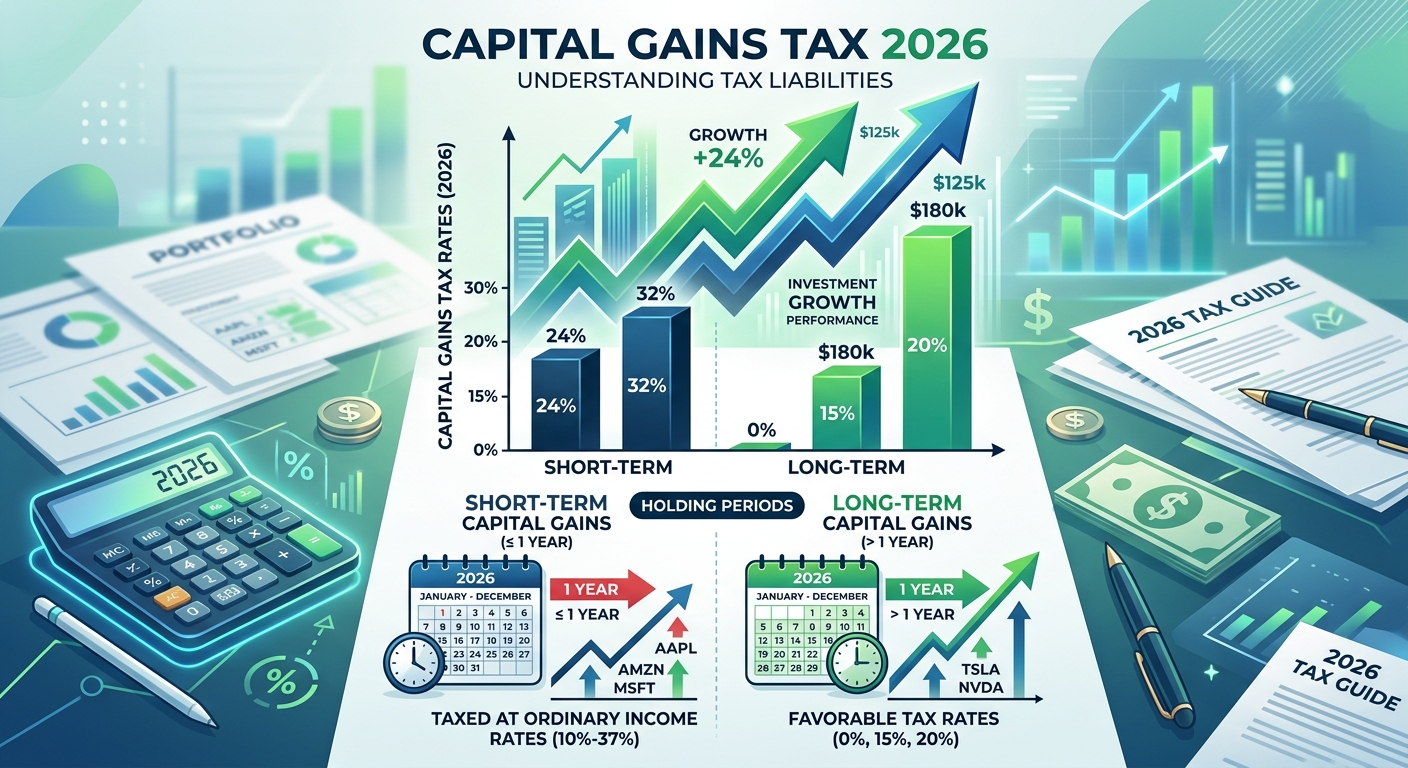
The current tax rate for capital gains depends on two factors: how long you held the asset and your total taxable income. For 2026, short-term capital gains (assets held one year or less) are taxed as ordinary income at rates up to 37%. Long-term capital gains (assets held longer than one year) receive preferential treatment with rates of 0%, 15%, or 20% depending on your income level.
Here’s what most investors miss: the difference between a short-term and long-term sale can cost you thousands. Sell stock after 11 months, and you might pay $8,140 on a $22,000 gain. Wait one more month, and that same gain could be taxed at just $3,300. That’s a $4,840 penalty for being 30 days too early.
If you’re sitting on appreciated assets like stocks, real estate, crypto, or business equity, understanding the current capital gains tax structure isn’t optional anymore. It’s the difference between keeping your profits and handing them to the IRS.
2026 Long-Term Capital Gains Tax Rates and Income Thresholds
Long-term capital gains are taxed at three federal rates: 0%, 15%, and 20%. Your rate is determined by your taxable income and filing status. For 2026, here are the thresholds:
| Filing Status | 0% Rate (Taxable Income) | 15% Rate (Taxable Income) | 20% Rate (Taxable Income) |
|---|---|---|---|
| Single | Up to $47,025 | $47,026 to $518,900 | Over $518,900 |
| Married Filing Jointly | Up to $94,050 | $94,051 to $583,750 | Over $583,750 |
| Married Filing Separately | Up to $47,025 | $47,026 to $291,850 | Over $291,850 |
| Head of Household | Up to $63,000 | $63,001 to $551,350 | Over $551,350 |
Notice the income thresholds are based on your total taxable income, not just the capital gain itself. This creates planning opportunities. If your regular income is $80,000 and you’re married filing jointly, you can potentially realize up to $14,050 in long-term gains at the 0% rate before hitting the 15% bracket.
How to Calculate Your Effective Capital Gains Rate
Your effective rate depends on where your income falls within these brackets. Let’s say you’re single with $60,000 in W-2 income and you sell stock for a $30,000 long-term gain. Your total taxable income is now $90,000 (assuming standard deduction was already applied).
Here’s the breakdown:
- First $47,025 of income → 0% on gains in this range
- Income from $47,026 to $90,000 → 15% on gains in this range
You won’t pay 15% on the entire $30,000 gain. Instead, you’re in a blended situation where part of your gain may fall into the 0% bracket depending on your other income sources.
Short-Term Capital Gains: Taxed as Ordinary Income
Short-term capital gains have no special treatment. If you buy and sell an asset within one year, your profit is taxed at your ordinary income tax rates, which range from 10% to 37% in 2026. For high earners, this means nearly 40% of your gain goes straight to federal taxes before you even consider state taxes.
Here’s a real-world scenario: Maria, a software engineer earning $180,000 annually, bought shares of a tech stock in March 2025. By February 2026, the stock had doubled, and she cashed out for a $25,000 gain. Because she held it for less than 12 months, that $25,000 is added to her income and taxed at her marginal rate of 32%. She owes $8,000 in federal tax on the gain.
If Maria had waited until April 2026 to sell (holding for 13 months instead of 11), the same $25,000 gain would be taxed at the long-term rate of 15%, resulting in just $3,750 in federal tax. Waiting two extra months saved her $4,250.
Why Day Traders and Frequent Sellers Pay More
Active traders and short-term investors face consistently higher tax bills because every profitable trade is taxed at ordinary income rates. If you’re buying and flipping stocks, crypto, or even real estate within a year, you’re effectively giving up 24% to 37% of your profits depending on your bracket. There’s no way around it unless you hold longer.
The IRS doesn’t care if you intended to hold long-term. The clock starts the day after you buy and ends the day you sell. Selling on day 365? You’re short-term. Selling on day 366? You qualify for long-term treatment. This one-day difference can mean thousands in taxes.
State Capital Gains Taxes: California and Beyond
The federal current tax rate for capital gains is only part of the equation. If you live in California, you’re also subject to state capital gains taxes, which are treated as ordinary income regardless of holding period. California’s top marginal rate is 13.3%, which applies to taxable income over $1 million for both individuals and couples.
Let’s revisit Maria’s example, but assume she lives in California. Her $25,000 short-term gain is taxed at 32% federally and around 9.3% by California (assuming her income bracket). Her combined tax bill jumps to over $10,300. Had she held long-term, she’d pay 15% federal and 9.3% state, totaling roughly $6,075. The difference between short-term and long-term just grew to $4,225 in combined taxes.
States with No Capital Gains Tax
If you’re strategic about your residency, consider these states with no state income tax (and therefore no capital gains tax): Alaska, Florida, Nevada, South Dakota, Tennessee, Texas, Washington, and Wyoming. High earners and investors sometimes relocate to these states before realizing large capital gains to avoid state-level taxation entirely.
However, California has an “exit tax” trap for former residents. If you move out of California but maintain significant ties (property, business interests, family), the Franchise Tax Board may still claim you’re a resident and tax your gains. Establish clear domicile in your new state before selling appreciated assets.
Net Investment Income Tax: The 3.8% Surtax
High earners face an additional 3.8% Net Investment Income Tax (NIIT) on capital gains. This surtax applies to individuals with modified adjusted gross income over $200,000 (single) or $250,000 (married filing jointly). The NIIT is calculated on the lesser of your net investment income or the amount by which your MAGI exceeds the threshold.
Example: You’re single with $220,000 in total income, including $40,000 in long-term capital gains. Your MAGI exceeds the $200,000 threshold by $20,000. The 3.8% NIIT applies to that $20,000 excess, adding $760 to your tax bill. The remaining $20,000 of gain is not subject to NIIT because it doesn’t exceed the threshold.
This means wealthy investors can face a combined federal rate of 23.8% on long-term gains (20% capital gains rate plus 3.8% NIIT). Add California’s 13.3% state tax, and you’re at 37.1% total. Suddenly, long-term capital gains aren’t as “preferential” as they seem.
How to Minimize Net Investment Income Tax
The NIIT is based on MAGI, so reducing your overall income can help you avoid or reduce the surtax. Consider timing strategies like:
- Deferring capital gains to a year when your income is lower
- Maximizing retirement account contributions to reduce MAGI
- Harvesting capital losses to offset gains and lower net investment income
- Using installment sales to spread gain recognition over multiple years
Our tax planning services help high earners structure asset sales to stay below NIIT thresholds or minimize exposure when avoidance isn’t possible.
KDA Case Study: Real Estate Investor
James, a 48-year-old real estate investor in San Diego, purchased a rental property in 2020 for $425,000. By early 2026, the property appreciated to $650,000, giving him a $225,000 gain. James was considering selling in May 2026 to fund a new investment opportunity, but he contacted KDA first to assess the tax impact.
Our team identified that James’s combined federal and California tax liability on the gain would exceed $67,000 if he sold outright (15% federal long-term rate + 9.3% California + 3.8% NIIT). Instead, we recommended a 1031 exchange to defer the entire gain by reinvesting proceeds into a like-kind property.
James completed the exchange within the required 180-day window, acquired a higher-value property in a better market, and deferred all $67,000 in taxes. His out-of-pocket cost for our advisory and structuring service was $4,200. The result: James preserved his equity, upgraded his real estate portfolio, and avoided a six-figure tax bill, achieving a first-year return of 16x on his advisory investment.
Ready to see how we can help you? Explore more success stories on our case studies page to discover proven strategies that have saved our clients thousands in taxes.
Capital Gains on Specific Assets: Stocks, Real Estate, and Crypto
The current tax rate for capital gains applies across asset classes, but each comes with unique considerations:
Stocks and Securities
Capital gains from publicly traded stocks, bonds, mutual funds, and ETFs are straightforward. The IRS uses the trade date to determine your holding period, not the settlement date. If you buy stock on June 1, 2025, and sell it on June 2, 2026, you qualify for long-term treatment.
One trap: wash sale rules. If you sell stock at a loss and repurchase the same or substantially identical security within 30 days, the IRS disallows the loss deduction. You can’t harvest losses for tax purposes and immediately buy back in. You must either wait 31 days or buy a different security.
Real Estate Sales
Real estate gains receive long-term treatment if you held the property for more than one year. However, if you claimed depreciation deductions during ownership, a portion of your gain is “recaptured” and taxed at a maximum rate of 25% under Section 1250. The remaining gain is taxed at standard long-term rates (0%, 15%, or 20%).
Primary residence exclusion: If you sell your main home, you can exclude up to $250,000 of gain (single) or $500,000 (married filing jointly) if you owned and lived in the home for at least two of the last five years. This exclusion doesn’t apply to investment properties or second homes.
Cryptocurrency and Digital Assets
The IRS treats crypto like property, meaning every sale, trade, or exchange triggers a capital gain or loss. If you bought Bitcoin in January 2025 for $30,000 and sold it in March 2026 for $45,000, you have a $15,000 long-term gain taxed at 15% (assuming you’re in that bracket).
Here’s the complication: trading one crypto for another (like Bitcoin for Ethereum) is a taxable event. You can’t defer gains by swapping coins. Each trade must be tracked with cost basis, sale price, and holding period. Many crypto investors underreport because they don’t realize every transaction creates a tax consequence.
Tax-Loss Harvesting: Offset Gains with Losses
Capital losses can offset capital gains dollar-for-dollar. If you have $30,000 in long-term gains and $10,000 in long-term losses, you only owe tax on the $20,000 net gain. Short-term losses offset short-term gains first, then long-term gains. Long-term losses offset long-term gains first, then short-term gains.
If your losses exceed your gains, you can deduct up to $3,000 of the excess loss against ordinary income each year. Any remaining loss carries forward indefinitely to future tax years. This makes loss harvesting a powerful year-end strategy, especially in volatile markets.
How to Execute Tax-Loss Harvesting
Identify underperforming positions in your portfolio before year-end. Sell them to realize the loss, then either wait 31 days to repurchase (avoiding wash sale rules) or buy a similar but not substantially identical security. For example, if you sell an S&P 500 index fund at a loss, you could immediately buy a total market index fund to maintain market exposure while still claiming the loss.
Don’t harvest losses just for the sake of it. The strategy works best when you were planning to rebalance anyway or when you want to exit a position permanently. Selling solely to generate a loss and then buying back the same asset 31 days later may not be worth the effort unless the tax savings are substantial.
Qualified Small Business Stock (QSBS): The 0% Loophole
Section 1202 allows investors to exclude up to $10 million (or 10x their basis, whichever is greater) in capital gains from the sale of qualified small business stock. To qualify, the stock must be issued by a domestic C corporation with less than $50 million in assets at the time of issuance, and you must hold it for at least five years.
This is one of the most powerful tax breaks for early-stage investors and startup employees. If you bought QSBS in 2021 and sell in 2026 or later, you could realize millions in gains completely tax-free at the federal level. California only partially recognizes QSBS exclusions, so state tax may still apply.
If you’re holding stock from a startup or small business, verify whether it qualifies under Section 1202. Many investors miss this exclusion because they don’t know it exists or fail to confirm eligibility before selling.
Red Flag Alert: Common Capital Gains Mistakes
Taxpayers make preventable errors every year that cost them thousands. Here are the most common:
- Selling one day too early: Missing the one-year holding period by even a single day converts a 15% long-term gain into a 32% short-term gain.
- Ignoring state taxes: California, New York, and other high-tax states treat capital gains as ordinary income. Factor this into your planning.
- Forgetting about NIIT: The 3.8% surtax applies to high earners but is often overlooked until tax filing.
- Not tracking crypto trades: Every coin-to-coin swap is taxable. The IRS receives exchange data and will catch underreporting.
- Miscalculating cost basis: If you don’t know your original purchase price, you can’t accurately calculate gain or loss. Keep records.
Pro Tip: If you inherited assets, your cost basis is “stepped up” to the fair market value on the date of the decedent’s death. This means you may owe little or no capital gains tax when you sell inherited property, even if it appreciated significantly during the original owner’s lifetime.
Should You Use a 1031 Exchange or Opportunity Zone?
Two strategies allow you to defer or reduce capital gains taxes on specific transactions: 1031 exchanges and Qualified Opportunity Zones (QOZs).
1031 Exchange (Like-Kind Exchange)
Real estate investors can defer 100% of capital gains by selling one property and reinvesting the proceeds into another “like-kind” property within strict timelines. You must identify replacement property within 45 days and close within 180 days. The IRS allows you to defer gains indefinitely as long as you keep exchanging properties.
Example: You sell a rental property for a $200,000 gain. Instead of paying $50,000 in taxes (combined federal and state), you execute a 1031 exchange and buy another rental property. The gain is deferred, and your tax bill is $0 until you eventually sell without exchanging.
Qualified Opportunity Zones
If you invest capital gains into a Qualified Opportunity Fund within 180 days of realizing the gain, you can defer tax until December 31, 2026 (or when you sell the QOZ investment, whichever is earlier). If you hold the QOZ investment for at least 10 years, any appreciation in the fund is tax-free.
QOZs work for any type of capital gain, not just real estate. However, the program has complex compliance requirements, and not all QOZ investments perform well. Consult with a tax strategist before committing capital.
Ready to Reduce Your Tax Bill?
KDA Inc. specializes in strategic tax planning for business owners, S Corps, LLCs, and high-net-worth individuals. Book a personalized consultation and walk away with a clear plan.
Frequently Asked Questions
What is the current capital gains tax rate if I’m retired?
Retirees often have lower taxable income, which can push them into the 0% long-term capital gains bracket. If your taxable income (including the gain) stays below $94,050 (married filing jointly) or $47,025 (single) in 2026, you pay zero federal tax on long-term gains. This creates significant planning opportunities for retirees managing brokerage accounts or selling appreciated assets.
Do I pay capital gains tax when I sell my primary home?
Not if you qualify for the primary residence exclusion. You can exclude up to $250,000 of gain (single) or $500,000 (married) if you owned and lived in the home for at least two of the last five years before the sale. Gains exceeding the exclusion are taxed at long-term capital gains rates if you held the property for more than one year.
How do capital losses carry forward?
If you have more capital losses than gains in a given year, you can deduct up to $3,000 of the excess loss against ordinary income. Any remaining loss carries forward indefinitely to offset future gains or ordinary income. For example, if you lost $15,000 in 2025 and had no gains, you’d deduct $3,000 in 2025, $3,000 in 2026, $3,000 in 2027, and so on until the loss is fully used.
Are capital gains taxed differently for high earners?
Yes. High earners face the 20% federal long-term rate (instead of 15%), plus the 3.8% Net Investment Income Tax, resulting in a combined 23.8% federal rate. When you add state taxes (like California’s 13.3%), total capital gains tax can exceed 37% even on long-term holdings.
Can I avoid capital gains tax by gifting stock to family?
Gifting appreciated stock doesn’t eliminate the gain, it transfers it. The recipient inherits your cost basis, meaning they’ll owe capital gains tax when they sell based on your original purchase price, not the value when gifted. However, gifting can be strategic if the recipient is in a lower tax bracket or qualifies for the 0% capital gains rate.
Book Your Capital Gains Strategy Session
Knowing the current tax rate for capital gains is just the starting point. The real savings come from timing your sales, structuring transactions strategically, and leveraging deferrals like 1031 exchanges or Opportunity Zones when appropriate. If you’re sitting on six-figure gains or planning to sell a major asset in the next 12 months, don’t guess your way through the tax implications. Book a personalized consultation with our tax strategy team to map out your best move. Click here to book your consultation now.
This information is current as of 5/17/2026. Tax laws change frequently. Verify updates with the IRS if reading this later.



