
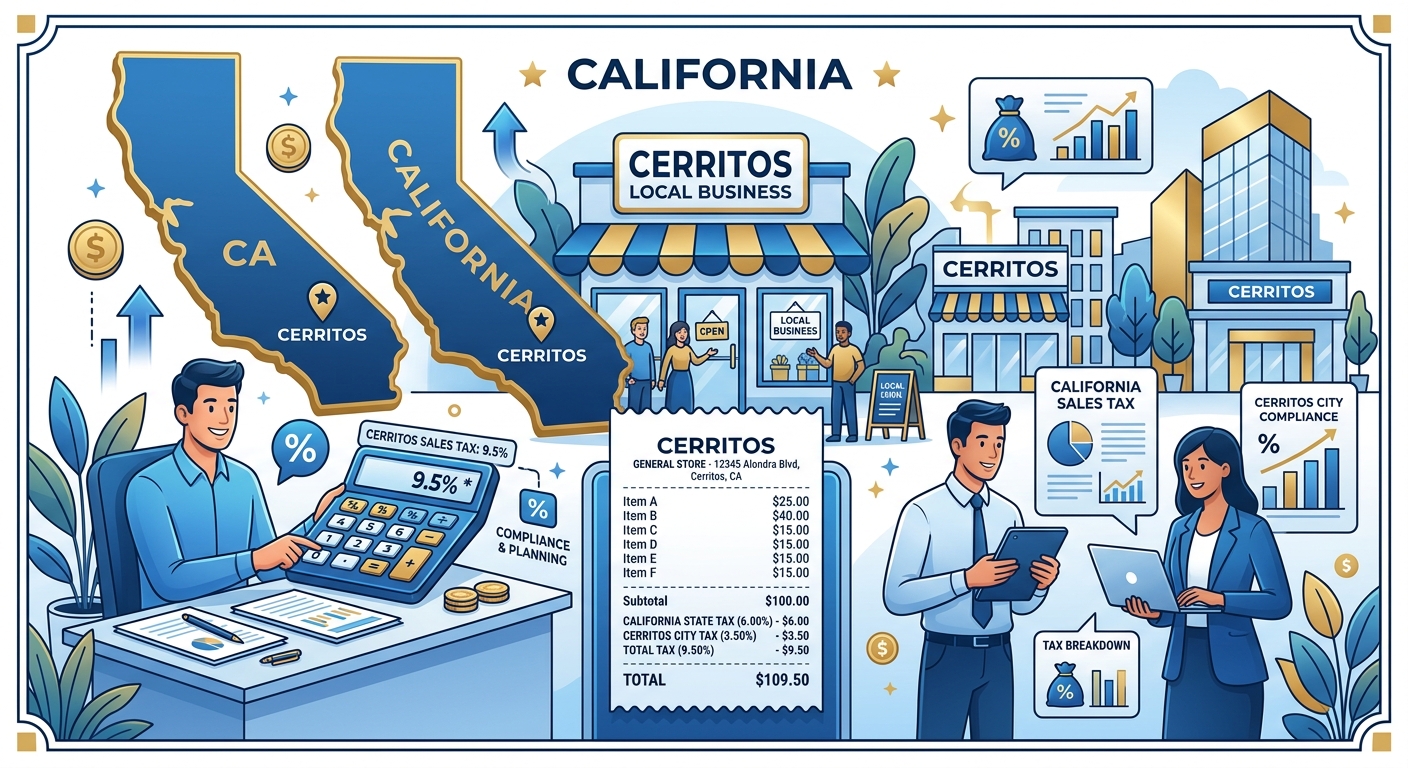
What Is the Sales Tax Rate in Cerritos, CA?
The sales tax rate in Cerritos, California is 10.25% as of May 16, 2026. This combined rate includes the California state sales tax of 7.25% plus a local tax component of 3.00%. For business owners operating in Cerritos, understanding this tax structure is critical for compliance, pricing strategy, and accurate financial planning.
If you run a retail business, e-commerce operation, or service-based company collecting sales tax in Cerritos, you’re working with one of the higher combined rates in Southern California. That 10.25% impacts your customers’ purchasing decisions, your cash flow management, and your quarterly remittance obligations to the California Department of Tax and Fee Administration (CDTFA).
The sales tax rate Cerritos CA applies to most tangible personal property sold at retail, including goods, certain services, and digital products under expanded California tax rules. Businesses must collect this tax at the point of sale, track it separately from revenue, and remit it to the state on schedule. Errors or late payments trigger penalties that can cost thousands of dollars annually.
Breaking Down the 10.25% Sales Tax Rate in Cerritos
California’s sales tax system operates on a layered structure. The state sets a base rate, and local jurisdictions add their own district taxes to fund county services, transportation projects, and municipal budgets. Here’s how the 10.25% rate in Cerritos breaks down:
State Base Rate: 7.25%
Every jurisdiction in California collects at least 7.25% in sales tax. This base rate is distributed across multiple state funds. The breakdown of the 7.25% state portion includes:
- 6.00% goes to the state General Fund
- 1.00% goes to city and county operations (Bradley-Burns Uniform Local Sales and Use Tax)
- 0.25% funds county transportation projects
This base rate applies statewide, from San Francisco to San Diego. Every retailer in California collects at least this much, making it one of the highest state base rates in the nation.
Local District Taxes: 3.00%
Cerritos adds an additional 3.00% on top of the state base. This local component funds Los Angeles County services, regional transportation improvements, and municipal infrastructure. The local add-on is why Cerritos sits at 10.25% while some neighboring cities may have different combined rates.
Los Angeles County voters have approved several sales tax measures over the past decade to fund Metro rail expansion, road repairs, and homeless services. These measures directly affect the local portion of your sales tax rate. Businesses operating in multiple California cities must track different combined rates for each location.
Why This Matters for Business Owners
That 3.00% local addition might seem small, but it compounds quickly. On $500,000 in annual taxable sales, you’re collecting $51,250 in total sales tax. Of that amount, $15,000 represents the local portion alone. Mismanaging these funds or failing to remit on time exposes your business to costly penalties, interest charges, and potential audits from the CDTFA.
Quick Answer: How Does Cerritos Compare to Other California Cities?
Cerritos’ 10.25% rate is higher than the state average but typical for Los Angeles County. For comparison, nearby Long Beach charges 10.25%, while neighboring Artesia also sits at 10.25%. However, some California cities reach as high as 10.75%, particularly in areas with voter-approved transportation or public safety measures.
Understanding your exact rate by jurisdiction is essential if you operate multiple storefronts or sell across county lines. California’s complex district tax system means rates can change within a few miles. Always verify your location-specific rate through the CDTFA’s online tax rate tool before setting your point-of-sale systems.
What Transactions Are Subject to the 10.25% Sales Tax in Cerritos?
California’s sales tax applies broadly to retail sales of tangible personal property, but exemptions and special rules create complexity. Here’s what you need to know about taxable versus nontaxable transactions in Cerritos:
Taxable Goods and Services
The 10.25% rate applies to:
- Retail merchandise: Clothing, electronics, furniture, home goods, and most consumer products
- Prepared food: Restaurant meals, catering services, and to-go orders over certain thresholds
- Digital products: California now taxes many software downloads, streaming subscriptions, and digital content under expanded nexus rules
- Certain services: Fabrication labor, installation services, and bundled service-product transactions
- Leases and rentals: Equipment rentals, vehicle leases, and other tangible property rentals
If you sell any of these categories in Cerritos, you must collect the full 10.25% at checkout and track it separately from your revenue for remittance to the state.
Exempt Transactions
California provides exemptions for specific categories, including:
- Unprepared food: Groceries sold for home consumption are generally exempt (but prepared foods are taxable)
- Prescription medications: Both human and veterinary prescriptions are exempt
- Resale purchases: Inventory bought for resale with a valid resale certificate is not taxed at purchase
- Manufacturing equipment: Certain equipment used in production may qualify for partial exemptions
- Farm equipment and feed: Qualified agricultural purchases are exempt
Proper documentation is critical for exempt sales. If the CDTFA audits your business and you can’t prove an exemption was valid, you’ll owe the tax plus penalties and interest. Keep resale certificates, exemption certificates, and supporting documentation for at least four years as recommended by the CDTFA in Publication 73.
The “80/80 Rule” for Food Sales
California uses the “80/80 rule” to determine whether food sales are taxable. If more than 80% of your gross receipts come from food products, and more than 80% of your food sales are exempt cold food, you may qualify to treat all food sales as exempt. This rule affects convenience stores, delis, and small markets operating in Cerritos. Misapplying it can result in significant tax liabilities during an audit.
How to Register and Remit Sales Tax in Cerritos
If you’re starting a business in Cerritos or expanding your existing operation, you must register with the CDTFA before making your first sale. Here’s the step-by-step process:
Step 1: Obtain a Seller’s Permit
Apply online through the CDTFA online registration portal. You’ll need your Federal Employer Identification Number (FEIN) or Social Security Number, business structure details, and estimated monthly sales figures. The permit is free, and approval typically takes 7-10 business days.
Once approved, you’ll receive a seller’s permit number. Display this permit at your business location and include it on all sales tax returns and correspondence with the CDTFA.
Step 2: Collect Sales Tax at the Correct Rate
Program your point-of-sale system to charge 10.25% on taxable transactions in Cerritos. If you operate in multiple California locations, ensure your system applies the correct rate based on the delivery or pickup location. California uses destination-based sourcing for remote sales, meaning you charge the rate where the customer receives the product, not where you’re located.
Step 3: Track Sales Tax Separately
Sales tax is not your revenue. It’s a liability you hold in trust for the state. Set up a dedicated bank account or accounting system category to track collected sales tax separately from your operating income. This prevents you from accidentally spending tax dollars and facing a cash shortfall when quarterly payments come due.
Step 4: File and Remit on Schedule
The CDTFA assigns filing frequencies based on your tax liability:
- Monthly filers: Businesses reporting more than $17,000 in quarterly sales tax
- Quarterly filers: Businesses reporting between $1,100 and $17,000 in quarterly sales tax
- Annual filers: Businesses reporting less than $1,100 in annual sales tax
Returns are due on the last day of the month following the reporting period. For example, Q1 returns (January-March) are due April 30. Late filing triggers a 10% penalty, and late payment adds another 10% penalty plus daily interest calculated at the state’s current rate.
Step 5: Maintain Detailed Records
California requires you to keep sales records, exemption certificates, invoices, and supporting documentation for at least four years. During a CDTFA audit, the burden of proof falls on you to justify exempt sales, resale transactions, and tax calculations. Missing documentation can result in tax assessments based on the auditor’s estimates, which are rarely favorable to the taxpayer.
If you need help setting up compliant sales tax systems or want a review of your current processes, our bookkeeping and payroll services can help you avoid costly mistakes and streamline your compliance obligations.
Common Sales Tax Mistakes That Trigger CDTFA Audits
The CDTFA uses sophisticated data analytics to identify businesses with reporting anomalies. Here are the red flags that most often lead to audits:
Red Flag Alert: Underreporting Taxable Sales
If your reported sales tax doesn’t align with your income reported on federal tax returns or third-party payment processor data (Square, Stripe, PayPal), the CDTFA will notice. They cross-reference your 1099-K forms, bank deposits, and sales tax returns to identify discrepancies. Underreporting by even 10-15% can trigger a full audit covering three to four years of transactions.
Red Flag Alert: Excessive Exempt Sales
Claiming a high percentage of exempt sales without proper documentation raises suspicion. If you operate a retail business and report that 40% of your sales are resale or exempt transactions, expect the CDTFA to request detailed proof. Without valid resale certificates or exemption documentation, those sales will be reclassified as taxable, and you’ll owe back taxes plus penalties.
Red Flag Alert: Inconsistent Filing Patterns
Large swings in reported sales tax from quarter to quarter without business explanation look suspicious. Seasonal businesses should maintain documentation explaining revenue fluctuations. Otherwise, the CDTFA may assume you’re manipulating reporting to stay below certain thresholds or avoid detection.
Red Flag Alert: Out-of-State Sales Without Use Tax
If you purchase inventory, equipment, or supplies from out-of-state vendors who don’t charge California sales tax, you owe use tax on those purchases. Many businesses ignore this obligation, creating significant liability. The CDTFA actively pursues use tax compliance, especially for businesses with large out-of-state vendor relationships.
Pro Tip: Voluntary Disclosure Saves Money
If you discover past sales tax errors, consider filing a voluntary disclosure with the CDTFA before they find the problem. Voluntary disclosures often reduce or eliminate penalties and limit the lookback period to three years instead of the standard four. This can save tens of thousands of dollars for businesses with significant unreported tax liabilities.
KDA Case Study: Cerritos Retail Business Owner
Maria runs a home décor boutique in Cerritos with $850,000 in annual sales. She came to KDA after receiving a CDTFA audit notice claiming she underreported sales tax by $18,500 over three years. The audit alleged she failed to collect tax on installation services bundled with furniture sales and improperly classified some transactions as resale.
Our team reviewed her sales records, point-of-sale data, and exemption certificates. We identified that Maria had valid resale documentation for 80% of the disputed transactions but had failed to organize them in the format the CDTFA required. For the installation services, we successfully argued that a portion qualified as nontaxable labor under California’s fabrication labor exemption rules.
After representing Maria through the audit process, we reduced her tax liability from $18,500 to $4,200. We also helped her implement compliant record-keeping systems and sales tax automation to prevent future issues. The total cost of our services was $3,800, delivering a first-year ROI of 3.8x through audit savings alone.
Ready to see how we can help you? Explore more success stories on our case studies page to discover proven strategies that have saved our clients thousands in taxes.
Special Sales Tax Considerations for E-Commerce Businesses in Cerritos
If you sell online from a Cerritos location, California’s complex economic nexus and marketplace facilitator rules apply. Here’s what you need to know:
Economic Nexus Thresholds
California requires out-of-state sellers to collect sales tax if they exceed $500,000 in California sales during the current or prior calendar year. If your Cerritos-based business also sells to customers in other states, you may have economic nexus obligations in those states as well. Most states use thresholds between $100,000 and $500,000 in sales or 200 transactions annually.
Marketplace Facilitator Rules
If you sell through Amazon, eBay, Etsy, or other online marketplaces, the platform typically collects and remits sales tax on your behalf. However, you’re still responsible for direct sales through your own website or in-person transactions. Don’t double-report marketplace sales on your CDTFA returns, as this creates overpayment complications and accounting headaches.
Drop Shipping Tax Obligations
Drop shipping creates unique sales tax challenges. If you’re the retailer selling to the end customer, you must collect sales tax based on the customer’s location. However, if your supplier ships directly from another state, you may owe use tax on your wholesale purchase unless the supplier charges you sales tax. Proper documentation and vendor communication are essential to avoid double taxation or missed obligations.
Digital Products and SaaS Taxation
California has expanded sales tax to cover many digital products, including downloaded software, mobile applications, and streaming services. If you sell digital goods to California customers, the 10.25% Cerritos rate applies to customers located within the city limits. Cloud-based software subscriptions (SaaS) face more complex rules depending on how the software is accessed and used. Consult the CDTFA’s software taxation guidance to determine your specific obligations.
How Sales Tax Rate Changes Affect Your Business Planning
Sales tax rates in California change periodically when local jurisdictions add or sunset voter-approved measures. Los Angeles County has seen multiple sales tax increases over the past decade, and more may be coming. Here’s how to prepare:
Monitor Local Ballot Measures
Los Angeles County voters recently considered a temporary 0.5% sales tax increase to fund healthcare services. While this specific measure’s status is still being decided, similar proposals appear on ballots every election cycle. If approved, your combined rate in Cerritos could increase from 10.25% to 10.75%. That’s an additional $2,500 in collected tax on every $500,000 in sales.
Update Your Pricing Strategy
When rates increase, you have three options:
- Absorb the increase: Keep prices the same and accept lower margins
- Pass it to customers: Increase prices to maintain margins, potentially affecting sales volume
- Split the difference: Slightly increase prices while accepting some margin compression
Most retail businesses pass the full tax increase to customers since sales tax is separately stated on receipts. However, if you advertise “out-the-door” pricing or operate in a price-sensitive market, rate increases require strategic planning.
Reprogram Point-of-Sale Systems Promptly
When rates change, update your POS system immediately. Collecting too little creates personal liability for the business owner, as California holds you responsible for the shortfall even if you didn’t charge the customer. Collecting too much violates consumer protection laws and exposes you to class-action lawsuits or CDTFA penalties.
Rate changes typically take effect on April 1 or October 1 to align with CDTFA reporting quarters. Sign up for CDTFA email notifications to receive advance warning of rate changes in your jurisdiction.
Use Tax: The Hidden Obligation Many Cerritos Businesses Miss
Use tax is sales tax’s lesser-known cousin, but it carries the same enforcement priority and penalty structure. If you purchase items for business use from out-of-state vendors who don’t charge California sales tax, you owe use tax at the 10.25% Cerritos rate.
Common Use Tax Scenarios
- Office equipment purchased online: Desks, computers, and furniture from out-of-state retailers
- Inventory from international suppliers: Imports where sales tax wasn’t collected at entry
- Trade show purchases: Equipment or inventory purchased at out-of-state trade shows
- Vehicle purchases: Cars, trucks, or equipment purchased outside California for business use
How to Report and Pay Use Tax
Report use tax on the same return as your sales tax. The CDTFA provides a separate line for use tax liability. Calculate the tax on your total out-of-state purchases of tangible personal property and remit it with your regular sales tax payment.
Failing to report use tax is a common audit finding. The CDTFA reviews your accounts payable records during audits to identify out-of-state vendor payments. If they find significant unreported use tax, penalties can double or triple your liability. On $50,000 in unreported out-of-state purchases over three years, you could face $15,375 in use tax plus $3,075 in late penalties and $2,200 in interest at current rates.
Pro Tip: Set Up a Use Tax Accrual System
Track out-of-state purchases monthly and accrue the use tax liability in your accounting system. This prevents surprise tax bills at year-end and ensures you have cash available to pay when quarterly returns are due. Many businesses use their accounting software to flag out-of-state vendors and automatically calculate use tax accruals.
Ready to Reduce Your Tax Bill?
KDA Inc. specializes in strategic tax planning for business owners, S Corps, LLCs, and high-net-worth individuals. Book a personalized consultation and walk away with a clear plan.
Frequently Asked Questions About Cerritos Sales Tax
Do I charge sales tax on shipping charges in Cerritos?
Yes, if shipping is part of the sale of tangible personal property. California taxes delivery charges if they’re part of a taxable transaction. However, separately stated shipping charges for nontaxable items (like exempt groceries) remain nontaxable. Document shipping charges separately on invoices to support your tax treatment during audits.
What happens if I forget to collect sales tax from a customer?
You’re personally liable for the uncollected tax. California law makes the seller responsible for sales tax regardless of whether it was collected from the customer. If you realize the error quickly, you can request payment from the customer. Otherwise, you must pay the tax out of pocket. This is why proper POS programming and staff training are critical.
Can I claim a sales tax deduction on my business tax return?
No. Sales tax you collect and remit to California is not a business expense or deduction. It’s a liability you hold in trust for the state. However, sales tax you pay on business purchases (if you don’t have a valid resale certificate) may be deductible as part of the cost of goods sold or as an ordinary business expense on your federal and state tax returns.
How long does a CDTFA audit take?
Most sales tax audits take 4-8 months from notice to completion. Complex audits involving multiple locations, large transaction volumes, or significant disputes can extend to 12-18 months. The CDTFA can audit up to four years of records (three years plus the current year), or longer if they suspect fraud or deliberate underreporting.
Do I need a separate seller’s permit for each business location?
No, but you must register each location with the CDTFA. Your seller’s permit number covers all locations under the same legal entity, but you’ll receive sub-permits for each physical address. If you operate as a multi-location business, you may need to file consolidated returns or separate returns by location depending on your business structure.
What’s the penalty for filing a sales tax return late in California?
The CDTFA charges a 10% penalty for late filing plus a 10% penalty for late payment. If both apply, that’s 20% of the tax due. Interest accrues daily at the California state rate (currently around 5% annually, adjusted quarterly). On a $5,000 quarterly payment that’s 60 days late, you’d owe $1,000 in penalties plus approximately $41 in interest.
Can I get a refund if I overpaid sales tax to California?
Yes, but you must file a claim within three years of the overpayment. Use the CDTFA’s claim for refund process to document the overpayment and request a refund or credit against future tax liability. Most businesses opt for credits to simplify the process and avoid lengthy refund waiting periods.
What This Information Is Current As Of
This information is current as of May 16, 2026. Tax laws change frequently. Verify updates with the IRS or CDTFA if reading this later.
Protect Your Business from Sales Tax Compliance Issues
The 10.25% sales tax rate in Cerritos, CA might seem straightforward, but California’s complex rules around exemptions, use tax, and multi-jurisdiction compliance create significant risk for unprepared business owners. A single audit can cost thousands in back taxes, penalties, and professional fees.
If you’re operating a retail business, e-commerce platform, or service company in Cerritos, don’t wait for a CDTFA audit notice to address your sales tax compliance. Our tax strategy team has helped dozens of Southern California businesses implement compliant sales tax systems, resolve audit disputes, and avoid costly penalties.
Whether you need help registering for your first seller’s permit, cleaning up years of unfiled returns, or defending against a CDTFA audit, we provide practical, results-driven guidance that protects your business and your bottom line.
Book Your Sales Tax Strategy Consultation
Not sure if your sales tax setup is costing you money or exposing you to audit risk? Let’s fix that before the CDTFA comes knocking. Book a personalized consultation with our strategy team and get clear, compliant, and confident about your California sales tax obligations. Click here to book your consultation now.



