
Quick Answer
Rental property depreciation is a powerful tax deduction that allows California real estate investors to write off the cost of their investment properties over 27.5 years, reducing taxable income without any actual cash expense. For a $550,000 rental property (with $495,000 in depreciable building value), that’s $18,000 in annual deductions that can save investors $5,000 to $8,000 in taxes each year, depending on their tax bracket.
Why Most California Rental Property Owners Leave Money on the Table
You bought a rental property in San Diego or Sacramento. You’re collecting rent, paying down the mortgage, maybe even cash-flowing a few hundred dollars a month. But here’s the part most investors miss: the IRS is offering you thousands of dollars in tax savings every year through rental property depreciation, and you’re probably not maximizing it.
Depreciation isn’t just a line item on your tax return. It’s the single most underutilized deduction in real estate investing, especially in California where property values are sky-high. The difference between doing this right and doing it wrong can mean $10,000 to $30,000 in lost deductions over just five years.
Let’s break down exactly how rental property depreciation works, what California investors are missing, and how to claim every dollar you’re entitled to without triggering an audit.
What Is Rental Property Depreciation and How Does It Work?
Rental property depreciation is a non-cash tax deduction that reflects the theoretical wear and tear on your investment property over time. The IRS allows you to deduct a portion of your property’s value each year, even though the property might actually be appreciating in market value.
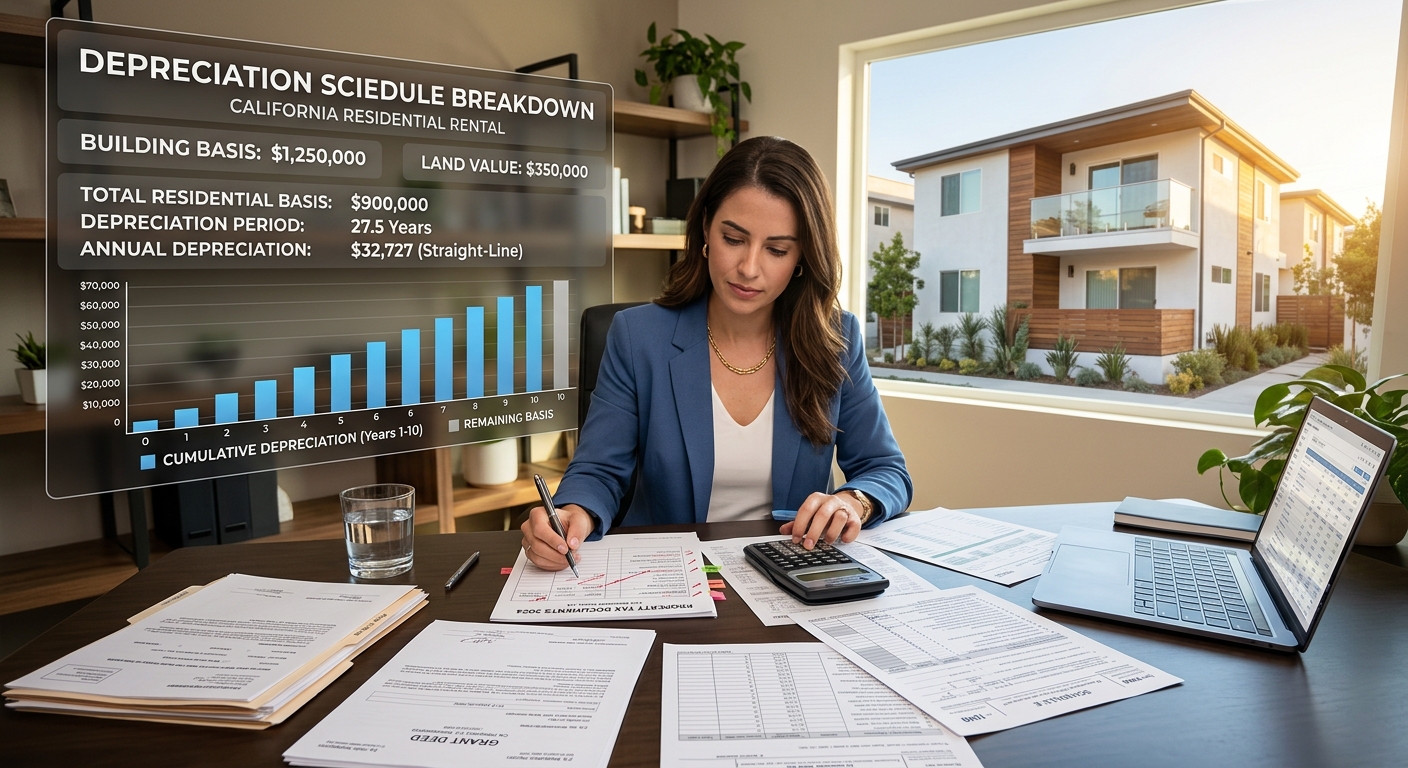
Here’s the foundation: residential rental properties depreciate over 27.5 years under IRS rules. That means you divide the depreciable basis of your property by 27.5 to get your annual deduction.
The Formula That Saves Thousands
Not your entire purchase price is depreciable. Land doesn’t depreciate (it doesn’t wear out), so you can only depreciate the building and improvements.
Example calculation for a $600,000 California rental property:
- Total purchase price: $600,000
- Land value (typically 15-25% in CA): $120,000
- Depreciable building basis: $480,000
- Annual depreciation: $480,000 ÷ 27.5 = $17,455
If you’re in the 32% federal tax bracket, that $17,455 deduction saves you $5,586 in federal taxes alone. Every single year. For doing absolutely nothing except owning the property.
Where Investors Make Their First Mistake
Most real estate investors accept whatever land-to-building allocation their county assessor assigns. In California, that’s often conservative and leaves money on the table. A proper cost segregation study or independent appraisal can shift more value to the building, increasing your annual deductions.
Red Flag Alert: If your CPA is using the generic county assessment without questioning it, you’re probably under-depreciating your property by $2,000 to $5,000 per year.
California-Specific Depreciation Opportunities (That Out-of-State Investors Don’t Have)
California’s real estate market has unique characteristics that create additional depreciation opportunities. Property values here are higher, renovation costs are steeper, and the regulatory environment creates specific deduction scenarios.
Earthquake Retrofitting and Seismic Upgrades
If you’ve retrofitted your rental property for earthquake safety, those improvements have their own depreciation schedule. Foundation bolting, cripple wall bracing, and soft-story retrofits are capital improvements that depreciate over 27.5 years separately from your original building basis.
A $45,000 seismic retrofit adds $1,636 per year in additional depreciation deductions.
Solar Installations and Energy Upgrades
Solar panels installed on rental properties in California have special tax treatment. While you may qualify for the federal Investment Tax Credit (ITC), the system also depreciates over five years under MACRS (Modified Accelerated Cost Recovery System) for commercial property.
Pro Tip: If you installed a $30,000 solar system on your rental property in 2026, you can claim both the 30% federal tax credit ($9,000) and accelerated depreciation on the remaining basis. First-year depreciation using bonus depreciation rules could give you an additional $4,200 deduction.
ADU Construction and Bonus Depreciation Acceleration
California’s ADU boom creates a depreciation goldmine. An Accessory Dwelling Unit added to your rental property is a separate improvement that can be depreciated independently. Better yet, if you’re using the ADU for business purposes or renting it separately, you may qualify for bonus depreciation under current tax law.
Building a $150,000 ADU on your existing rental property doesn’t just increase rental income. It creates $5,455 in annual depreciation deductions (if depreciated over 27.5 years) or potentially allows 100% bonus depreciation in year one if it qualifies under current rules.
Cost Segregation: The Depreciation Accelerator California Investors Need to Know
Standard depreciation spreads your deduction over 27.5 years. Cost segregation compresses those deductions into the early years of ownership by identifying components of your property that depreciate faster.
How Cost Segregation Works
A cost segregation study breaks down your rental property into different asset classes:
- 5-year property: Carpet, appliances, window treatments
- 7-year property: Furniture, office equipment
- 15-year property: Landscaping, fencing, site improvements
- 27.5-year property: Building structure
By reclassifying components that typically get lumped into the 27.5-year building category, you accelerate deductions and reduce current-year tax liability.
Real Numbers: Cost Segregation ROI
Let’s say you purchased a $900,000 fourplex in Oakland. Standard depreciation (after removing $180,000 land value) gives you $26,182 per year.
After a cost segregation study identifies $180,000 in 5, 7, and 15-year property:
- Year 1 depreciation jumps to $68,000 (using accelerated methods)
- Tax savings in year 1: $21,760 (at 32% bracket)
- Cost of study: $6,000
- Net first-year benefit: $15,760
You just turned a $6,000 expense into a $15,760 tax reduction. That’s a 2.6x first-year return.
When Cost Segregation Makes Sense
Not every property needs a cost segregation study. Here’s when it’s worth it:
- Property purchase price exceeds $500,000
- You’re in a high tax bracket (32% or higher)
- You plan to hold the property for at least 5 years
- The property has significant improvements (not just raw land and basic structure)
- You have passive income to offset (more on this below)
Cost segregation studies typically cost $5,000 to $15,000 depending on property complexity. In California, where property values and improvement costs run high, the breakeven point is usually reached in year one.
Looking to maximize depreciation on a high-value California rental property? Our cost segregation services identify every dollar of accelerated deductions you’re entitled to claim.
The Passive Activity Loss Trap (And How California Investors Escape It)
Here’s where depreciation gets tricky. Rental real estate is considered a passive activity by the IRS. That means rental losses (including depreciation deductions) can only offset passive income, not your W-2 wages or business income.
There are three exceptions that matter:
Exception 1: The $25,000 Active Participation Allowance
If you actively participate in managing your rental property and your modified adjusted gross income (MAGI) is under $100,000, you can deduct up to $25,000 in rental losses against ordinary income.
This allowance phases out between $100,000 and $150,000 MAGI. If you’re a high-earning California professional making $180,000 per year, you can’t use this exception.
Exception 2: Real Estate Professional Status
If you qualify as a real estate professional under IRS rules, your rental activities are no longer passive. That means depreciation and other rental losses can offset your W-2 or business income without limits.
To qualify, you must:
- Spend more than 750 hours per year in real property trades or businesses
- Spend more than 50% of your working time in real property activities
- Materially participate in each rental activity (or make a grouping election)
This is huge for full-time real estate investors or spouses of high earners who manage the family’s rental portfolio. A California couple where one spouse works in tech ($250,000 salary) and the other qualifies as a real estate professional can use rental depreciation to offset that W-2 income.
Exception 3: Short-Term Rentals (The Airbnb Loophole)
If your average guest stay is seven days or less AND you provide substantial services (like daily cleaning), your rental isn’t treated as passive. It’s considered an active business.
California investors running short-term rentals in Lake Tahoe, Palm Springs, or coastal beach towns can use this rule to deduct depreciation against their ordinary income without needing real estate professional status.
Red Flag Alert: The IRS scrutinizes short-term rental classifications. You need documented proof of average stay length and substantial services. Keep reservation records, cleaning logs, and service invoices for at least three years.
Depreciation Recapture: What Happens When You Sell
Depreciation isn’t free money. When you sell your rental property, the IRS wants some of it back through depreciation recapture.
How Recapture Works
All depreciation deductions you’ve claimed (or should have claimed, even if you didn’t) are taxed at your ordinary income rate up to a maximum of 25% when you sell.
Example scenario:
- You bought a rental property for $500,000 (with $400,000 depreciable basis)
- Over 10 years, you claimed $145,455 in depreciation deductions
- You sell the property for $700,000
- Your adjusted basis is now $354,545 ($500,000 purchase price minus $145,455 depreciation)
- Capital gain: $345,455
- Depreciation recapture: $145,455 taxed at 25%
- Remaining gain: $200,000 taxed at long-term capital gains rates (0%, 15%, or 20%)
Recapture tax on $145,455 at 25% = $36,364.
Sounds painful, but remember: you’ve been saving 32% to 37% on those depreciation deductions for 10 years. You still come out ahead.
The 1031 Exchange Escape Hatch
California real estate investors have a powerful tool to defer both capital gains and depreciation recapture indefinitely: the 1031 exchange.
By selling your rental property and reinvesting the proceeds into a like-kind replacement property within strict timelines, you defer all taxes until you eventually sell without exchanging.
Pro Tip: If you’ve accumulated $200,000 in depreciation deductions over 15 years and face a $50,000 recapture tax on sale, a 1031 exchange into a $1.2 million replacement property lets you defer that tax and start a fresh 27.5-year depreciation schedule on the new property. You just reset the clock.
Want to execute a tax-deferred property sale? Our team helps California investors structure 1031 exchanges and advanced real estate tax strategies that preserve wealth across multiple transactions.
KDA Case Study: Bay Area Investor Unlocks $94,000 in Missed Deductions
Sarah owns three rental properties in the East Bay. She bought her first duplex in 2019 for $680,000, a single-family home in 2021 for $790,000, and a triplex in 2023 for $1,150,000. Her previous CPA filed her taxes using basic depreciation schedules and never questioned the county’s land allocations.
When Sarah came to KDA in early 2026, she was frustrated. Her rental income barely exceeded her expenses on paper, and she was paying $18,000 per year in taxes on her W-2 income as a software engineer.
Here’s what we did:
- Ordered cost segregation studies on all three properties
- Identified $340,000 in 5, 7, and 15-year property across her portfolio
- Filed amended returns for 2023-2025 to claim missed bonus depreciation
- Helped her spouse qualify for real estate professional status to unlock passive loss usage
- Restructured her rental activities under a grouping election
Results:
- First-year additional depreciation: $94,000
- Tax savings (at 35% combined rate): $32,900
- Refunds from amended returns: $41,000
- Ongoing annual benefit: $15,000+ for the next 4 years
Sarah paid $14,500 for the cost segregation studies and our strategic planning. Her first-year return was 5.0x, and she’ll continue saving $15,000 annually on her tax bill going forward.
Ready to see how we can help you? Explore more success stories on our case studies page to discover proven strategies that have saved our clients thousands in taxes.
Special Situations: Bonus Depreciation, Section 179, and Recent Law Changes
Federal tax law changes in recent years have expanded depreciation benefits for certain types of property and taxpayers. Here’s what matters in 2026.
Bonus Depreciation Phase-Down
Bonus depreciation, which previously allowed 100% first-year expensing of qualified property, is phasing down:
- 2023: 80% bonus depreciation
- 2024: 60% bonus depreciation
- 2025: 40% bonus depreciation
- 2026: 20% bonus depreciation
- 2027: 0% (unless Congress extends it)
This applies to short-life property identified in cost segregation studies. If you’re doing a cost seg in 2026, you can still claim 20% bonus depreciation on the 5, 7, and 15-year components in year one, with the remaining 80% depreciating under regular MACRS schedules.
Section 179 Expensing for Rental Property
Section 179 allows immediate expensing of certain property up to $1,220,000 in 2026 (adjusted annually for inflation). However, rental real estate generally doesn’t qualify unless you’re in the business of renting property (not just passively holding a few rentals).
There’s an exception: qualified improvement property placed in service after the property was first placed in service as a rental. If you gut-renovate the interior of your rental property after acquiring it, those improvements may qualify for Section 179 expensing.
California Conformity Issues
California doesn’t automatically conform to federal depreciation rules. The state has its own bonus depreciation and Section 179 rules that often differ from federal law.
For 2026:
- California doesn’t conform to federal bonus depreciation
- California has its own Section 179 limits (currently $25,000 versus $1,220,000 federal)
- You’ll need separate depreciation schedules for federal and California returns
This creates a timing difference. You get bigger deductions on your federal return in early years and smaller deductions on your California return. Over the life of the property, the total depreciation is the same, but the timing shifts tax liability between jurisdictions.
Bottom Line: Always run the numbers for both federal and California tax impact. A strategy that saves $10,000 federally might only save $3,000 in California due to conformity differences.
Common Depreciation Mistakes California Investors Make
Mistake 1: Not Taking Depreciation Because the Property Is Appreciating
The IRS doesn’t care what your property’s market value is doing. Depreciation is mandatory, not optional. If you don’t claim it, the IRS will still recapture it when you sell as if you had claimed it.
You literally pay the recapture tax without getting the benefit of the deductions. Don’t make this mistake.
Mistake 2: Depreciating Land Along with the Building
Land doesn’t depreciate. If you’re not allocating a portion of your purchase price to land value, you’re overstating your depreciation and setting yourself up for an audit adjustment.
Use your property tax assessment, an appraisal, or a cost segregation study to properly split building and land value.
Mistake 3: Forgetting to Depreciate Improvements and Renovations
That $60,000 kitchen remodel? It’s depreciable over 27.5 years. The new roof? Depreciable. The HVAC replacement? Depreciable.
Every capital improvement starts its own depreciation schedule. If you’re only depreciating your original purchase price and ignoring subsequent improvements, you’re leaving thousands on the table.
Mistake 4: Not Adjusting Basis When You Convert Personal Residence to Rental
If you moved out of your primary residence and started renting it, your depreciable basis is the lower of:
- Your adjusted basis in the property (what you paid plus improvements)
- Fair market value on the conversion date
California property owners who bought in 2010 for $350,000 and converted to rental in 2024 when the property was worth $750,000 can only depreciate based on the $350,000 basis (plus improvements), not the $750,000 current value.
Mistake 5: Claiming Depreciation on Property You Don’t Use for Rental
Depreciation only applies when property is placed in service as a rental. If you bought a property in June but didn’t start renting it until October, you can’t depreciate those first four months.
Similarly, if your rental sits vacant for three months between tenants, you can still depreciate during that period because the property is still held out for rent. But if you’re holding it vacant while deciding whether to sell, the IRS might argue depreciation doesn’t apply during that period.
How to Document Your Depreciation to Survive an Audit
The IRS loves to challenge depreciation deductions, especially large ones from cost segregation studies. Here’s what you need to keep.
Essential Documentation
- Closing statement (HUD-1 or settlement statement): Proves purchase price and closing date
- Property tax assessment: Shows county’s land-to-building allocation
- Independent appraisal: Supports your basis allocation if different from county assessment
- Cost segregation study: Must be done by qualified professional with engineering background
- Improvement receipts: Invoices, contracts, and proof of payment for all capital improvements
- Placed-in-service documentation: Lease agreements, rental listings, or other proof of when property became available for rent
- Depreciation schedules: Year-by-year tracking of all depreciation claimed
How Long to Keep Records
The IRS has three years from filing to audit in most cases, but six years if you underreported income by 25% or more. For depreciation, keep records for at least three years after you sell the property and file your final return showing the sale.
Practically speaking: If you bought a rental property in 2020 and sell it in 2030, keep all depreciation records through at least 2033.
Ready to Reduce Your Tax Bill?
KDA Inc. specializes in strategic tax planning for business owners, S Corps, LLCs, and high-net-worth individuals. Book a personalized consultation and walk away with a clear plan.
Frequently Asked Questions About Rental Property Depreciation
Can I claim depreciation on a rental property I inherited?
Yes, but your depreciable basis is the stepped-up fair market value on the date of the decedent’s death, not what they originally paid. If you inherited a $900,000 California rental property, you get to depreciate based on that $900,000 value (minus land allocation), even though the original owner may have paid $200,000 for it decades ago.
What if I forgot to claim depreciation in prior years?
You can file Form 3115 (Change in Accounting Method) to catch up on missed depreciation. This allows you to claim all prior-year missed depreciation as a one-time adjustment in the current year without amending previous returns. There’s no penalty for not taking depreciation in prior years, but you must correct it before you sell to avoid paying recapture tax on deductions you never benefited from.
Do I have to recapture depreciation if I do a 1031 exchange?
No. Depreciation recapture is deferred along with capital gains when you complete a valid 1031 exchange. Your depreciation from the relinquished property carries over and reduces your basis in the replacement property, but you don’t pay recapture tax until you eventually sell without exchanging.
Can I depreciate a property I rent to my own business?
Yes, if you own the property personally and rent it to your S corp or LLC at fair market rent, you can depreciate the property as a rental. Your business deducts the rent as an expense, and you report the rental income and depreciation on Schedule E. Just make sure the rent amount is reasonable and documented with a written lease.
What happens to depreciation if I convert my rental back to a personal residence?
Depreciation stops when you convert the property back to personal use. If you later sell it as your primary residence and qualify for the Section 121 exclusion ($250,000 or $500,000 gain exclusion), you must still recapture all depreciation claimed during the rental period. That recapture doesn’t qualify for the exclusion.
Take Control of Your Rental Property Tax Strategy
Rental property depreciation is the most powerful wealth-building tax strategy available to California real estate investors. It’s not optional, it’s not complicated, and when done right, it can save you $5,000 to $30,000 per property per year.
But here’s what separates investors who build million-dollar portfolios from those who just break even: they don’t leave strategy to chance. They don’t accept generic tax prep. And they don’t wait until April to think about depreciation.
If you own California rental property and you’re not using cost segregation, not tracking improvements properly, or not structuring your activities to maximize passive loss usage, you’re paying more tax than the law requires.
This information is current as of 5/15/2026. Tax laws change frequently. Verify updates with the IRS or FTB if reading this later.
Maximize Your California Rental Property Tax Savings
Stop leaving depreciation deductions on the table. If you own rental property in California and want to know exactly how much you could be saving through proper depreciation strategies, cost segregation, or real estate professional status planning, let’s talk. Book a consultation with our real estate tax strategy team and get a clear roadmap to reduce your tax bill by thousands starting this year. Click here to schedule your rental property tax strategy session now.



