
Quick Answer
IRS penalty relief lets you eliminate or reduce penalties the IRS charged you for filing late, paying late, or missing estimated tax payments. Right now, millions of taxpayers qualify for pandemic-era penalty refunds based on the Kwong v. United States court case, but you must file Form 843 by July 10, 2026, to claim it. This is not automatic, and the IRS will not tell you.
The Hidden Refund Most Taxpayers Are Missing
Here’s what the IRS isn’t broadcasting: If you were charged failure-to-file penalties, failure-to-pay penalties, or penalties for missing estimated tax payments between January 20, 2020, and July 10, 2023, you might be entitled to a full refund. The reason? A federal court ruled that the COVID-19 pandemic qualified as a disaster period under tax law, which means tax deadlines should have been automatically extended and those penalties should never have been assessed.
But there’s a catch. You have until July 10, 2026, to file a claim, and the IRS is not required to notify you. That means if you don’t act now, you lose the money forever.
This isn’t some niche loophole for a handful of taxpayers. According to the National Taxpayer Advocate, over 14.2 million individual estimated tax penalties and 18.6 million failure-to-pay penalties were assessed in fiscal year 2023 alone. The impact reaches individuals, small business owners, 1099 contractors, real estate investors, estates, trusts, and even large corporations.
Who Qualifies for IRS Penalty Relief Right Now
You may qualify for a refund or abatement if you were assessed any of the following penalties between January 20, 2020, and July 10, 2023:
- Failure-to-file penalty (5% per month, capped at 25% of unpaid taxes)
- Failure-to-pay penalty (0.5% per month, capped at 25%)
- Estimated tax penalties for individuals and businesses
- Late filing penalties on international information returns
- Interest charged on any of these penalties during the disaster period
This relief applies to income taxes, employment taxes, estate and gift taxes, and even excise taxes. If you’re a small business owner who struggled to make payroll tax deposits during the pandemic, or a 1099 contractor who missed estimated payments while your income was unpredictable, you likely qualify.
Real-World Example: The $8,400 Refund a California Consultant Didn’t Know She Was Owed
Take Maria, a self-employed marketing consultant in San Diego. In 2021, her income spiked unexpectedly after landing two large clients in Q4. She didn’t make her fourth-quarter estimated payment on time and got hit with a $2,100 estimated tax penalty. She also filed her 2020 return three months late due to COVID-related disruptions and was charged a $6,300 failure-to-file penalty.
Maria assumed those penalties were permanent. She paid them and moved on. But under the Kwong ruling, both penalties fall within the disaster period and should never have been assessed. By filing Form 843 before the July 10 deadline, Maria can recover the full $8,400. That’s real money back in her business account.
How First-Time Penalty Abatement Works (Even If You Don’t Qualify for Kwong Relief)
Even if your penalties fall outside the pandemic window, you still have options. The IRS offers first-time penalty abatement (FTA) for taxpayers with a clean compliance history. This administrative waiver is one of the most underused tools in the tax code.
To qualify for FTA, you need to meet three conditions:
- You didn’t have any penalties in the prior three tax years (or you had penalties that were abated).
- You filed all required tax returns or filed an extension.
- You have paid (or arranged to pay) any tax owed.
FTA typically applies to failure-to-file, failure-to-pay, and failure-to-deposit penalties. It does not apply to accuracy-related penalties or fraud penalties. You can request FTA by calling the IRS directly or by submitting a written request. The IRS does not require you to provide a reason beyond meeting the eligibility criteria.
If you’ve already used FTA once, you’ll need to wait three years before you’re eligible again. But if it’s your first time requesting relief and you meet the criteria, approval is almost guaranteed.
Step-by-Step: How to Request First-Time Penalty Abatement
- Verify your penalty-free history. Request your IRS transcript for the past three years at IRS.gov/Individuals/Get-Transcript. Look for codes 166, 276, or 336, which indicate penalties.
- Confirm compliance status. Make sure all tax returns are filed and all current taxes are paid or under a payment plan.
- Call the IRS at 800-829-1040 or submit a written request. State: “I am requesting first-time penalty abatement under IRS Policy Statement 5-1.” Reference the penalty notice and provide your taxpayer identification number.
- Follow up in writing if calling doesn’t work. Send a letter to the address on your penalty notice. Include your name, taxpayer ID, tax year, and a statement that you meet all three FTA criteria.
- Document everything. Keep copies of your request and any IRS correspondence confirming abatement.
First-time abatement is a straightforward process, but it requires you to take action. The IRS will not volunteer this relief. You have to ask for it.
Reasonable Cause: Your Safety Net When FTA Doesn’t Apply
If you don’t qualify for first-time abatement, you can still request penalty relief based on reasonable cause. This is a higher bar to clear, but it works when you can show that you had a legitimate reason for missing a deadline and that you exercised ordinary business care despite the circumstances.
The IRS considers reasonable cause on a case-by-case basis. Common scenarios that qualify include:
- Death or serious illness of the taxpayer or immediate family member
- Natural disaster (fire, flood, earthquake)
- Inability to obtain records due to circumstances beyond your control
- IRS error or incorrect written advice
- Unavoidable absence (military deployment, mandatory hospitalization)
To request reasonable cause relief, you’ll need to submit a written statement explaining what happened, when it happened, and how it prevented you from meeting your tax obligation. You’ll also need to provide supporting documentation: medical records, insurance claims, legal documents, or third-party correspondence.
The key is specificity. Don’t just say “I was sick.” Explain: “I was hospitalized from March 10 to March 28, 2025, for emergency surgery, which prevented me from accessing my financial records or meeting with my accountant. I filed my return within two weeks of my discharge.” Attach the hospital discharge summary and a letter from your CPA confirming the timeline.
Special Situations Where Reasonable Cause Often Applies
Business owners with payroll issues: If you missed a payroll tax deposit because your bookkeeper quit unexpectedly or your bank froze your account due to suspected fraud, document the disruption and show you corrected it as soon as possible.
Real estate investors hit by tenant non-payment: If your rental income dropped sharply due to tenant defaults and you couldn’t afford your estimated tax payment, provide lease agreements, eviction filings, and a summary of your cash flow during the period.
1099 contractors with delayed client payments: If a major client paid you 90 days late and you couldn’t make your quarterly estimated payment on time, include the invoice, payment records, and correspondence with the client showing you attempted to collect.
The IRS evaluates each case individually, so the more detailed and well-documented your explanation, the better your chances of approval. Our tax planning services include penalty abatement representation, and we’ve successfully secured relief for clients in all of these scenarios.
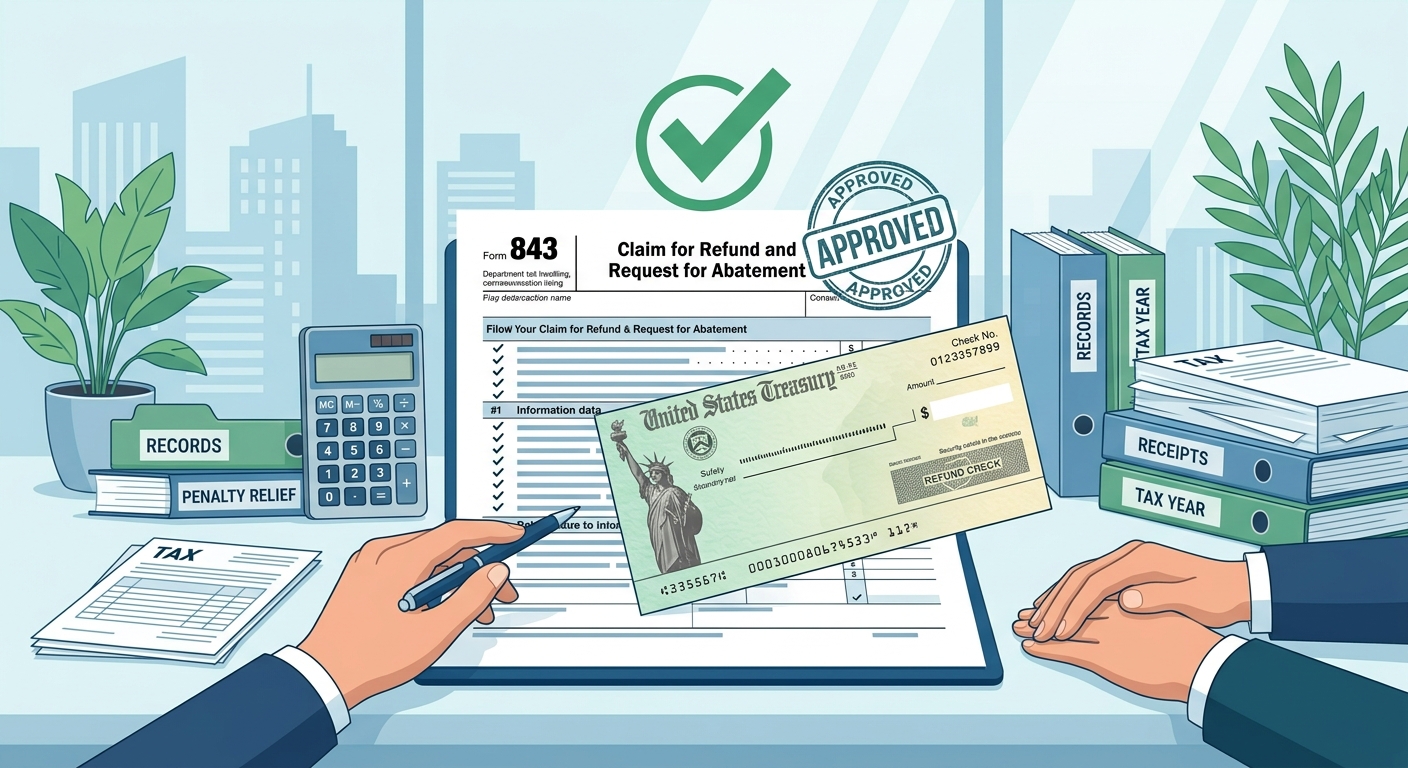
How to File Form 843 for Kwong Pandemic-Era Refunds
If your penalties fall within the January 20, 2020, to July 10, 2023, window, you need to file Form 843, Claim for Refund and Request for Abatement. This is a two-page form, but filling it out correctly is critical. One wrong box or incomplete field can delay or disqualify your claim.
Step-by-Step Form 843 Filing Process
- Download Form 843 from IRS.gov. Use the most current version. Form 843 cannot be filed electronically. You must mail it.
- Complete Section 1: Taxpayer Information. Enter your name, address, Social Security number or EIN, and daytime phone number exactly as they appear on your tax return.
- Complete Section 2: Request for Abatement or Refund. Check the box that applies to you:
- Box 4a if you already paid the penalty and want a refund
- Box 4b if the penalty is unpaid and you want an abatement
- Complete Section 3: Explanation. In the “Reason for Claim” field, write: “Penalties assessed during COVID-19 federal disaster period (Jan 20, 2020 – July 10, 2023) should be abated under IRC Section 7508A based on Kwong v. United States.” Include the specific tax years, penalty types, and amounts.
- Attach supporting documents. Include copies of penalty notices, IRS transcripts showing the penalties, and payment records if applicable.
- Mail via certified mail. Send your completed Form 843 to the IRS address listed in the form instructions for your location. Use certified mail with return receipt so you have proof of mailing before the July 10 deadline.
- Keep copies of everything. Retain a copy of the completed form, all attachments, your mailing receipt, and the certified mail tracking number.
You can file one Form 843 per tax year, or you can consolidate multiple years on a single form if the penalties are similar. The IRS recommends filing separate forms for different tax types (income tax vs. employment tax).
What Happens After You File Form 843
The IRS will review your claim and issue a determination. Processing times vary, but expect at least 90 to 180 days. If the IRS approves your claim, you’ll receive a refund check or a credit applied to your account. If your claim is denied, you’ll receive a letter explaining why, and you can appeal the decision.
Because the Kwong case is not yet final and the government may appeal, the IRS may hold your claim in suspense until the legal issue is resolved. That’s why filing before the July 10 deadline is critical. Even if the IRS doesn’t process your claim immediately, submitting it on time preserves your right to a refund if the court decision ultimately stands.
Red Flag Alert: Common Mistakes That Kill Penalty Relief Requests
Even if you qualify for relief, mistakes on your Form 843 or FTA request can result in automatic denial. Here are the errors we see most often:
Red Flag #1: Filing after the deadline. The July 10, 2026, deadline for Kwong-related claims is absolute. If your Form 843 is postmarked July 11 or later, the IRS will reject it. For FTA, there’s no statutory deadline, but the longer you wait after receiving a penalty notice, the weaker your case becomes.
Red Flag #2: Incomplete or inaccurate information. Missing fields, wrong tax years, or incorrect penalty amounts will delay processing or trigger a denial. Double-check every entry against your IRS transcripts.
Red Flag #3: No supporting documentation. If you’re claiming reasonable cause, you must provide evidence. The IRS will not take your word for it. If you say you were hospitalized, attach medical records. If you say your bookkeeper disappeared, provide a termination letter or police report.
Red Flag #4: Requesting relief for non-qualifying penalties. FTA does not apply to accuracy-related penalties, fraud penalties, or trust fund recovery penalties. If you request FTA for an ineligible penalty, the IRS will deny the entire request.
Red Flag #5: Ignoring your compliance status. If you have unfiled returns or unpaid taxes, the IRS will deny your penalty relief request outright. Get current before you request abatement.
Pro Tip: Use IRS Transcripts to Verify Your Penalties
Before you file Form 843 or request FTA, pull your IRS account transcript at IRS.gov/Individuals/Get-Transcript. This document shows every penalty assessed, every payment made, and every abatement or credit applied. Use it to confirm:
- Which penalties were assessed and when
- Whether you’ve had penalties in the prior three years (for FTA eligibility)
- Whether any penalties have already been abated
- The exact dollar amounts to include on Form 843
Transaction codes matter. Code 166 indicates a failure-to-file penalty, Code 276 indicates a failure-to-pay penalty, and Code 336 indicates an estimated tax penalty. If you see Code 161, 271, or 331, those penalties have already been abated, which strengthens your FTA eligibility.
KDA Case Study: How We Saved a San Jose Business Owner $12,600 in Penalties
Jason runs a small HVAC company in San Jose. In 2021, his accountant retired unexpectedly, and Jason missed the deadline to file his S Corp return and pay his estimated taxes. The IRS assessed a $7,800 failure-to-file penalty and a $4,800 failure-to-pay penalty. Jason thought he was stuck with the bill.
When Jason came to KDA, we reviewed his IRS transcripts and identified two opportunities. First, the penalties fell squarely within the Kwong disaster period, which meant they should never have been assessed. Second, Jason had a clean three-year penalty history, which made him eligible for first-time abatement as a backup strategy.
We filed Form 843 referencing Kwong and simultaneously submitted an FTA request. Within 120 days, the IRS abated the full $12,600. Jason paid KDA $2,400 for representation, which means his net savings was $10,200. That’s a 4.25x return on investment.
Jason’s case highlights why professional representation matters. He didn’t know about Kwong, he didn’t know about FTA, and he didn’t know how to navigate the IRS bureaucracy. By working with a tax strategist who understands the system, he recovered money he thought was gone forever.
Ready to see how we can help you? Explore more success stories on our case studies page to discover proven strategies that have saved our clients thousands in taxes.
California-Specific Considerations: FTB Penalties Are Different
If you live or do business in California, you need to know that the Kwong decision applies only to federal IRS penalties. The California Franchise Tax Board (FTB) operates under different rules and has not issued guidance suggesting it will follow the Kwong precedent.
However, California does offer its own penalty relief programs:
First-time abatement for FTB penalties: California mirrors the IRS first-time abatement policy. If you have a clean three-year history with the FTB and you’re otherwise compliant, you can request abatement of failure-to-file and failure-to-pay penalties. Call the FTB at 800-689-4776 or submit a written request to the address on your penalty notice.
Reasonable cause relief for FTB penalties: California recognizes the same reasonable cause standards as the IRS. You’ll need to submit Form FTB 2917 (Reasonable Cause Claim) along with supporting documentation.
Statute of limitations differences: California uses an eight-year statute for fraud cases, which is longer than the federal three-year window. If the FTB believes you engaged in fraud, it can assess penalties going back eight years. This makes clean recordkeeping even more critical for California taxpayers.
If you’re facing both federal and California penalties, you need to address them separately. Don’t assume that federal relief automatically applies to state penalties. We’ve seen taxpayers successfully abate IRS penalties only to discover the FTB still expects full payment.
Ready to Reduce Your Tax Bill?
KDA Inc. specializes in strategic tax planning for business owners, S Corps, LLCs, and high-net-worth individuals. Book a personalized consultation and walk away with a clear plan.
Frequently Asked Questions About IRS Penalty Relief
Can I request penalty relief if I still owe taxes?
Yes, but you must be in compliance. The IRS will not abate penalties if you have unfiled returns or unpaid taxes outside of an approved payment plan. If you owe taxes but can’t pay in full, set up an installment agreement first, then request penalty relief. The IRS is more likely to approve abatement if you’re actively working to resolve your balance.
What if the IRS denies my Form 843 request?
You have the right to appeal. If the IRS denies your Kwong-related claim, you can file an appeal with the IRS Office of Appeals within 30 days of the denial notice. You’ll need to submit Form 12203 (Request for Appeals Review) and provide a detailed explanation of why the Kwong decision applies to your case. Many taxpayers also choose to file a protective claim with the U.S. Tax Court if the government appeals Kwong and the issue remains unresolved.
Does requesting penalty relief trigger an audit?
No. Filing Form 843 or requesting first-time abatement does not increase your audit risk. The IRS reviews penalty relief requests separately from audit selection processes. However, if you’re already under audit and you request penalty relief, the IRS may use the opportunity to review your entire return more closely. In that situation, professional representation is critical.
Can I request penalty relief for multiple years at once?
Yes. You can file one Form 843 for each tax year, or you can consolidate multiple years on a single form if the penalties are similar and the explanations are the same. For FTA requests, you can request relief for multiple years in a single phone call or letter, as long as all years meet the eligibility criteria.
What if I already paid the penalty years ago?
You can still request a refund using Form 843, as long as you’re within the statute of limitations. For Kwong-related penalties, the deadline is July 10, 2026. For non-Kwong penalties, you generally have three years from the date you filed your return or two years from the date you paid the tax, whichever is later.
What Happens After July 10, 2026
If you miss the July 10 deadline, you lose your right to a refund or abatement for pandemic-era penalties covered by the Kwong case. The statute of limitations is absolute, and the IRS has no authority to extend it.
That doesn’t mean all hope is lost if you miss the deadline. You can still pursue first-time abatement or reasonable cause relief for penalties outside the Kwong window. But for penalties assessed between January 20, 2020, and July 10, 2023, July 10, 2026, is your last chance.
Here’s what you should do right now:
- Request your IRS transcripts for tax years 2019 through 2023.
- Identify all penalties assessed during the disaster period.
- Calculate your total potential refund or abatement.
- Download Form 843 and complete it accurately.
- Mail your claim via certified mail before July 10, 2026.
If you’re unsure how to interpret your transcripts or whether you qualify, don’t wait. The clock is ticking, and the IRS will not remind you.
This information is current as of May 14, 2026. Tax laws change frequently. Verify updates with the IRS or FTB if reading this later.
Stop Paying Penalties You Don’t Owe
The IRS assessed billions of dollars in penalties during the pandemic, and millions of taxpayers paid them without question. But just because the IRS sent you a bill doesn’t mean you owe it. Between the Kwong decision, first-time abatement, and reasonable cause relief, most taxpayers have at least one path to eliminate or reduce penalties.
The difference between taxpayers who recover their money and taxpayers who don’t is simple: action. The IRS will not volunteer this information. You have to know your rights, understand the deadlines, and file the correct forms.
If you’ve been hit with IRS penalties and you’re not sure whether you qualify for relief, don’t guess. The cost of missing the July 10 deadline or filing an incomplete Form 843 is permanent. The cost of professional guidance is a fraction of what you’ll recover.
Get Your Penalty Relief Strategy Session
If you’re sitting on penalty notices and you’re not sure what to do next, let’s fix that. Whether you’re eligible for Kwong refunds, first-time abatement, or reasonable cause relief, KDA’s strategy team will review your transcripts, identify every available option, and handle the paperwork so you don’t miss the deadline. Click here to book your penalty relief consultation now.



