
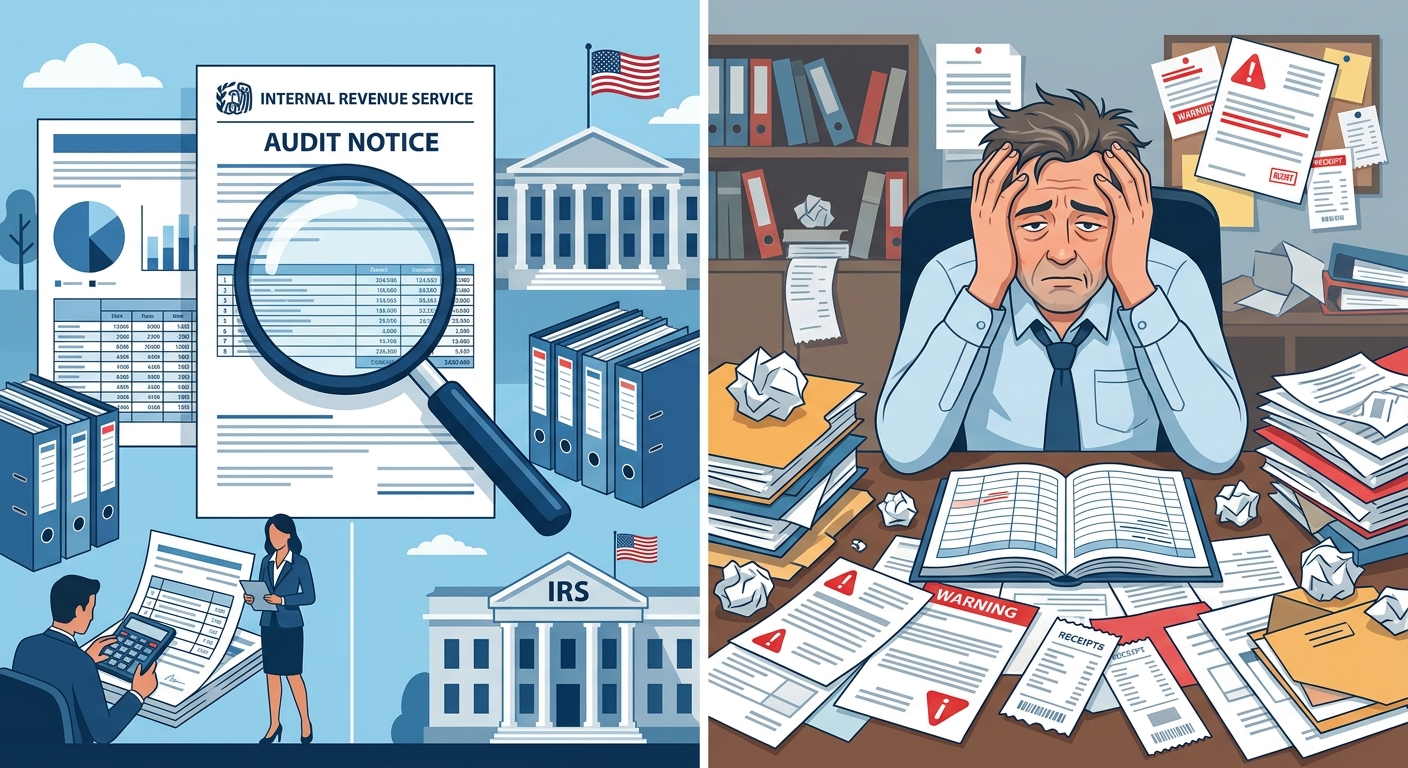
What the IRS Actually Considers Tax Evasion (And Why Small Mistakes Can Look Like Big Crimes)
Most business owners are not trying to cheat the IRS. They are juggling payroll, managing growth, and trying to stay afloat in an economy where every dollar counts. But here is the problem: the IRS does not always differentiate between an honest mistake and intentional IRS and tax evasion. In 2026, with advanced data-matching algorithms and automated enforcement systems, even small compliance failures can trigger investigations that look exactly like criminal tax evasion cases.
You might think you are just taking reasonable deductions or filing a little late. The IRS sees patterns: unreported income, inconsistent filings across state and federal returns, missing forms, or repeated corrections. These patterns do not just result in penalties. They can escalate into Criminal Investigation (CI) division reviews, where the stakes shift from back taxes to potential prosecution.
This information is current as of 5/14/2026. Tax laws change frequently. Verify updates with the IRS or FTB if reading this later.
Quick Answer: When Does the IRS Draw the Line Between Mistakes and Evasion?
The IRS distinguishes between negligence and tax evasion based on intent and pattern. A single error on your return, even if it results in underpayment, is typically treated as negligence subject to accuracy penalties (20% of the underpayment under IRC Section 6662). Tax evasion, by contrast, requires willful intent to defraud the government. This means deliberately hiding income, fabricating deductions, maintaining double books, or using nominees to conceal assets. The Criminal Investigation division looks for consistent behavior over multiple years, supported by evidence of concealment, that demonstrates you knew your reporting was false and took affirmative steps to avoid detection.
The Compliance Patterns That Trigger IRS Scrutiny in 2026
The IRS Criminal Investigation division does not randomly select taxpayers for review. According to recent enforcement reports, the agency prioritizes cases with clear behavioral patterns that suggest intentional noncompliance. In 2026, these patterns are easier to detect than ever before, thanks to automated data-matching systems like the Information Returns Processing (IRP) system and third-party reporting from payment processors, brokers, and banks.
Income Mismatches Across Third-Party Reports
Every 1099-NEC, 1099-K, W-2, and 1099-INT filed with the IRS is matched against your tax return. If you report $78,000 in gross receipts on Schedule C but your payment processor reports $112,000 in transactions via Form 1099-K, the IRS flags that discrepancy immediately. One instance might generate an automated CP2000 notice. A pattern of underreporting income across three or more years, especially when combined with lifestyle indicators that do not match reported income, moves you into the Criminal Investigation pipeline.
For California taxpayers, this problem compounds when federal and state filings do not align. If your IRS Schedule C shows $80,000 in income but your California FTB Form 540 Schedule C shows $65,000, both agencies flag the inconsistency. The FTB shares data with the IRS under reciprocal agreements, and discrepancies between state and federal income reporting are one of the clearest signals of potential fraud.
Repeated Late Filings or Amended Returns
Filing late once does not make you a criminal. Filing late every year, or filing multiple amended returns that progressively reduce your tax liability, creates a compliance profile that suggests you are testing the system to see what you can get away with. The IRS tracks filing history across all years. When auditors see a taxpayer who consistently files extensions, then amends the return six months later to claim additional deductions, they start asking why the original filing was incomplete.
For foreign-owned LLCs, repeated corrections to Form 5472 (Information Return of a 25% Foreign-Owned U.S. Corporation) are particularly dangerous. Because this form carries a mandatory $25,000 penalty per failure to file, the IRS scrutinizes it closely. Multiple corrections, missing disclosures, or transactions that were initially omitted and later added through amendments raise immediate red flags.
Cryptocurrency and Digital Asset Underreporting
Starting in tax year 2025, digital asset exchanges are required to report all transactions via Form 1099-DA, just like stock brokerages report sales on Form 1099-B. If you traded $200,000 worth of Bitcoin through Coinbase but your Schedule D only shows $15,000 in capital gains, the IRS will know. In 2026, the IRS is aggressively targeting cryptocurrency noncompliance because the reporting infrastructure is now fully operational. Failing to report crypto gains, especially when the exchange has already filed a 1099-DA with the IRS, is one of the fastest paths to an audit that could escalate into an evasion investigation.
California taxpayers face dual exposure here. The California Digital Financial Assets Law (DFAL) went into full effect in July 2026, meaning the FTB now receives the same crypto transaction data as the IRS. If you report crypto income federally but omit it on your California return, the FTB’s Enterprise Data to Revenue (EDR 2.0) system will catch it within weeks.
What Separates Negligence from Willful Tax Evasion
The legal standard for criminal tax evasion under IRC Section 7201 requires the government to prove three elements beyond a reasonable doubt: (1) the existence of a tax deficiency, (2) an affirmative act of evasion or attempted evasion, and (3) willfulness. This is a much higher burden than civil fraud, which only requires proof by clear and convincing evidence that you intended to evade tax you knew was owed.
What Counts as an Affirmative Act of Evasion
Simple underreporting is not enough to support a criminal conviction. The IRS must prove you took deliberate steps to conceal income or inflate deductions. Examples include maintaining two sets of books (one accurate, one sanitized for the IRS), using cash transactions to avoid creating a paper trail, filing false W-2s or 1099s to create phantom deductions, claiming personal expenses as business write-offs with fabricated invoices, or using shell LLCs or nominee accounts to hide asset ownership.
In a recent case prosecuted by the IRS Criminal Investigation division in 2025, a California contractor was convicted of tax evasion after investigators found he deposited over $900,000 in checks from clients into a business account but only reported $340,000 on his Schedule C. The contractor had created fake subcontractor invoices to justify business expense deductions that never occurred. This was not a mistake. It was a multi-year scheme supported by fabricated documentation.
How the IRS Proves Willfulness
Willfulness means you voluntarily and intentionally violated a known legal duty. The IRS does not need to prove you are a tax expert or that you read the Internal Revenue Code. They only need to show you knew you had an obligation to report income or pay tax and you deliberately chose not to comply. Evidence of willfulness includes prior IRS notices or audit adjustments that put you on notice of your reporting obligations, education or professional background suggesting you understand tax rules, large cash withdrawals or deposits designed to avoid reporting thresholds, or consistent patterns of underreporting the same type of income across multiple years.
If you received a CP2000 notice in 2023 for underreported 1099 income, corrected it, and then underreported 1099 income again in 2024 and 2025, the IRS has strong evidence you knew your reporting was deficient and chose to continue the behavior anyway.
Red Flag Alert: Compliance Failures That Start as Negligence and End as Evasion Investigations
Most tax evasion cases do not start with a Criminal Investigation division knock on your door. They start with civil audits that uncover patterns too suspicious to ignore. Here are the compliance failures that most frequently escalate from civil to criminal review.
Filing Federal Returns But Ignoring State Obligations
California business owners who file IRS Form 1120S or 1040 Schedule C but never file the corresponding California FTB Form 100S or 540 Schedule C are playing a dangerous game. The FTB suspension process is automated, and the agency will eventually issue Demand for Tax Return notices. If you ignore those demands for multiple years while continuing to operate the business and collect income, the FTB can refer your case to the California Attorney General’s office for criminal prosecution under California Revenue and Taxation Code Section 19706, which makes it a felony to willfully fail to file a required return.
The IRS and FTB share data. If the FTB prosecutes you for failing to file state returns, that criminal conviction becomes evidence the IRS can use to support a federal tax evasion case based on the same underreported income.
Paying Employees or Contractors Off the Books
Running payroll off the books is not just an employment tax issue. It is a tax evasion issue. When you pay workers in cash and do not issue W-2s or 1099s, you are evading employer payroll taxes (Social Security, Medicare, federal unemployment tax) and also enabling your workers to evade income tax. The IRS treats payroll tax fraud as one of the most serious compliance violations because it directly undermines the Social Security and Medicare trust funds.
If the IRS audits your business and discovers you paid $150,000 in cash wages over three years without filing Form 941 or issuing W-2s, you are looking at civil penalties that can exceed 100% of the unpaid tax, plus potential criminal referral to the IRS Criminal Investigation division. The Department of Justice prosecuted over 200 employment tax evasion cases in fiscal year 2025, with an average prison sentence of 14 months for convicted defendants.
Ignoring Foreign Account and Asset Reporting Requirements
If you have signature authority over a foreign bank account with a balance exceeding $10,000 at any point during the year, you must file FinCEN Form 114 (FBAR) by April 15. If you have an ownership interest in a foreign corporation, partnership, or trust, you may also be required to file IRS Form 5471, 8865, or 3520. The penalties for willful failure to file these forms are severe: up to 50% of the account balance per year for FBAR violations, and $10,000 per form per year for information return failures.
The IRS aggressively pursues criminal prosecutions for willful FBAR violations. If you transferred $500,000 to a foreign account, never disclosed it on your tax return or FBAR, and used the money to fund personal expenses while reporting minimal U.S. income, you have created a textbook tax evasion case. The government does not need to prove you evaded U.S. tax on foreign income. They only need to prove you willfully failed to report the account, which is a separate crime under 31 U.S.C. Section 5322.
KDA Case Study: Business Owner Facing IRS Evasion Investigation After Multi-Year Underreporting
A San Diego-based e-commerce business owner came to KDA after receiving an IRS Criminal Investigation division summons requesting five years of bank records, business accounting files, and personal financial statements. The client had been operating a profitable Amazon FBA business generating approximately $400,000 annually in gross sales but had only been reporting $180,000 to $220,000 per year on Schedule C. The underreporting was not intentional fraud. The client had been using cash-basis accounting and was not tracking inventory properly, leading to massive understatement of gross receipts. However, the IRS had already received 1099-K reports from Amazon showing the full sales volume, and the discrepancy across multiple years triggered the Criminal Investigation review.
KDA immediately engaged a criminal tax defense attorney and worked in parallel to reconstruct accurate financials for all five years. We identified that the client had legitimate cost of goods sold that were not being deducted, as well as business expenses that were being paid personally and never claimed. After properly accounting for inventory and expenses, the actual tax deficiency was $47,000 across five years, not the $180,000 the IRS initially estimated based on gross receipts alone. We prepared amended returns, submitted a detailed narrative explaining the accounting errors, and negotiated a civil resolution under the IRS’s voluntary disclosure framework. The Criminal Investigation division declined prosecution, the client entered into an installment agreement for the $47,000 deficiency plus interest and penalties, and KDA implemented a monthly bookkeeping system to ensure accurate reporting going forward.
Total KDA engagement cost: $12,800 (including legal fees). Net outcome: Criminal prosecution avoided, tax liability reduced by $133,000, and business operations preserved. The client saved an estimated 10 years of compliance risk and potential incarceration by addressing the issue proactively rather than waiting for the IRS to complete its investigation.
Ready to see how we can help you? Explore more success stories on our case studies page to discover proven strategies that have saved our clients thousands in taxes.
How California FTB Enforcement Compounds Federal Tax Evasion Risk
California operates the most aggressive state tax enforcement system in the country. The FTB’s Enterprise Data to Revenue (EDR 2.0) system cross-references IRS filings, third-party income reports, Secretary of State business registrations, and Franchise Tax Board payment history to identify noncompliant taxpayers. In 2026, the FTB is issuing automated Notice 5818 corrections at record volume, and the threshold for escalating cases to the California Attorney General for criminal prosecution has dropped significantly.
The $800 Minimum Franchise Tax Trap
Every California LLC and corporation owes an $800 annual minimum franchise tax regardless of profit. This is due even if your business had zero income, operated at a loss, or was inactive for the year. Failure to pay this tax and file the corresponding return (Form 568 for LLCs, Form 100 or 100S for corporations) results in automatic penalties, interest, and eventual suspension of your business entity by the FTB.
When an LLC is suspended, it loses its liability protection, cannot enforce contracts, and may have its bank accounts frozen. More importantly, if you continue operating the business and collecting income while suspended, the FTB treats that as willful tax evasion. You are generating taxable income in California, you know you have a filing obligation, and you are deliberately ignoring it. That behavior can support both civil fraud penalties (75% of the unpaid tax) and criminal referral under California Revenue and Taxation Code Section 19706.
NOL Suspension and Bonus Depreciation Discrepancies
California does not conform to federal bonus depreciation rules. If you claimed 100% bonus depreciation on a $60,000 equipment purchase on your federal return but did not file California Form 3885 to add back the difference, your California taxable income is understated. The FTB’s EDR system automatically catches this by comparing your federal Schedule C or Form 1120S to your California filing. One year of missed addbacks generates an automated correction notice. Three years of the same error, especially when your federal return shows large depreciation deductions that do not appear on your California return, starts to look like intentional underreporting.
Similarly, California suspended net operating loss (NOL) deductions for businesses with income exceeding $1 million for tax years 2024 through 2026. If you deducted a $200,000 NOL carryforward on your California return when your income exceeded the threshold, the FTB will disallow it and assess penalties for substantial understatement.
What to Do If You Have Unreported Income or Unfiled Returns
If you realize you have underreported income, failed to file required returns, or made other compliance errors that could escalate into an evasion investigation, your next steps determine whether you face civil penalties or criminal prosecution. The IRS offers several voluntary disclosure options that can help you get compliant before the agency initiates an audit or criminal investigation.
Step 1: Stop the Noncompliance Immediately
Do not file another inaccurate return. If you have been underreporting income or overclaiming deductions, your first priority is to stop the behavior. Going forward, report all income accurately and claim only legitimate deductions supported by documentation. This does not fix past years, but it prevents the pattern from continuing, which is critical if the IRS is already reviewing your account.
Step 2: Assess the Scope of the Problem
Determine how many years are affected, how much income was underreported, and whether the errors were limited to one type of income or span multiple categories (W-2, 1099, capital gains, foreign income, etc.). Calculate the approximate tax deficiency for each year. If the total exceeds $25,000 or involves three or more years, you should consult a tax attorney before proceeding. Large, multi-year deficiencies carry a higher risk of criminal referral, and anything you say to a CPA or enrolled agent could potentially be used against you if the IRS opens a Criminal Investigation. Communications with a tax attorney, by contrast, are protected by attorney-client privilege.
Step 3: Consider Voluntary Disclosure
The IRS offers several voluntary disclosure options depending on the type of noncompliance. For domestic income underreporting, you can file amended returns (Form 1040-X) for the affected years, pay the tax, interest, and accuracy penalties, and hope the IRS accepts the corrections without further investigation. This works best when the underreporting was relatively small and there is a clear explanation for the error (accounting mistake, misunderstood tax law, etc.).
For foreign account and asset reporting failures, the IRS Voluntary Disclosure Practice allows you to come forward, disclose the unreported foreign income and accounts, file delinquent FBARs and information returns, and pay back taxes, interest, and a miscellaneous offshore penalty equal to 12.5% to 50% of the highest aggregate account balance. In exchange, the IRS agrees not to recommend criminal prosecution. To qualify, you must come forward before the IRS contacts you about the issue.
Step 4: Reconstruct Accurate Records
You cannot file accurate amended returns without accurate records. If your books are incomplete, start reconstructing them now. Gather bank statements, credit card statements, 1099s, invoices, receipts, and any other documents that show actual income and expenses. For e-commerce sellers, download transaction reports from your selling platforms (Amazon, eBay, Shopify, etc.). For contractors, pull deposit records from your business bank account to verify actual receipts. This process is tedious, but it is essential. The IRS will not accept vague estimates, and if you file an amended return that is still inaccurate, you make the problem worse.
Common Myths About IRS Tax Evasion Enforcement
Myth: The IRS Only Prosecutes High-Income Taxpayers
The Criminal Investigation division prosecutes taxpayers at all income levels. While it is true that high-dollar cases receive more media attention, the IRS also prosecutes small business owners, gig workers, and wage earners who engage in brazen noncompliance. In fiscal year 2025, the average tax loss in prosecuted evasion cases was $380,000, but cases involving as little as $50,000 in evaded tax were successfully prosecuted when the evidence of willfulness was strong.
Myth: You Can Avoid Detection by Dealing in Cash
Cash does not make you invisible. The IRS uses indirect methods of proof (bank deposits analysis, net worth analysis, source and application of funds analysis) to reconstruct income when taxpayers fail to keep records. If your reported income is $40,000 but you purchased a $90,000 car, made $60,000 in mortgage payments, and paid $25,000 in credit card bills, the IRS will calculate that you had at least $175,000 in funds available. Where did that money come from? If you cannot explain it with documented non-taxable sources (gifts, loans, inheritances), the IRS will presume it was unreported taxable income.
Myth: Amending Your Return Fixes Everything
Amending a return stops the accumulation of additional interest and penalties, but it does not erase the original violation. If you filed a fraudulent return in 2022, the three-year statute of limitations for assessment does not begin to run. The IRS has unlimited time to assess tax when fraud is involved. Filing an amended return in 2026 helps demonstrate good faith, but it does not prevent the IRS from pursuing civil fraud penalties or criminal prosecution if the evidence supports it.
Myth: The IRS Has to Prove You Knew the Tax Law
The IRS does not need to prove you are a tax expert. They only need to prove you knew you had income and chose not to report it. Ignorance of the tax code is not a defense to evasion. If you are a self-employed consultant who receives $80,000 in 1099 income and reports zero on your tax return, the IRS does not need to prove you knew the exact tax rate or filing requirements. They only need to prove you knew you earned the money and deliberately chose not to report it.
Ready to Reduce Your Tax Bill?
KDA Inc. specializes in strategic tax planning for business owners, S Corps, LLCs, and high-net-worth individuals. Book a personalized consultation and walk away with a clear plan.
Frequently Asked Questions
What is the difference between tax avoidance and tax evasion?
Tax avoidance is legal. It means using deductions, credits, and tax planning strategies authorized by the Internal Revenue Code to minimize your tax liability. For example, contributing to a 401(k) to reduce taxable income, structuring your business as an S Corp to save on self-employment tax, or timing asset sales to take advantage of lower long-term capital gains rates are all forms of legal tax avoidance. Tax evasion is illegal. It means deliberately underreporting income, fabricating deductions, hiding assets, or taking other affirmative steps to defraud the government. The key distinction is intent and honesty. Avoidance is transparent and documented. Evasion is concealed and fraudulent.
Can the IRS send me to jail for not paying taxes?
The IRS cannot jail you simply for owing taxes. Owing money is a civil matter, not a crime. However, the IRS can prosecute you criminally for willfully failing to file required returns (IRC Section 7203, up to one year in prison per count) or for willfully attempting to evade or defeat tax (IRC Section 7201, up to five years in prison). The government must prove willfulness beyond a reasonable doubt. If you owe taxes but made good-faith efforts to comply, you will not face criminal charges. If you deliberately hid income, filed false returns, or took other affirmative steps to evade tax, you are at risk of prosecution.
What should I do if I receive a Criminal Investigation summons?
Do not respond without consulting a criminal tax defense attorney immediately. A Criminal Investigation summons is not a routine audit notice. It means the IRS has opened a criminal investigation and is gathering evidence to determine whether to recommend prosecution to the Department of Justice. Anything you say or produce can be used against you in a criminal trial. Do not speak to IRS agents, do not turn over documents, and do not try to explain the situation on your own. Invoke your Fifth Amendment right to remain silent and your Sixth Amendment right to counsel, and let your attorney handle all communications with the IRS.
How far back can the IRS go to prosecute tax evasion?
For civil tax assessments, the IRS generally has three years from the date you filed your return to assess additional tax (IRC Section 6501). If you substantially understated your income by more than 25%, the statute extends to six years. If you never filed a return or filed a fraudulent return, there is no statute of limitations. The IRS can assess tax at any time. For criminal prosecution, the statute of limitations is six years from the date the crime was committed (usually the filing deadline for the tax year in question). However, the government can extend this period if you take affirmative acts to conceal the crime, such as filing false amended returns or obstructing an IRS investigation.
Can I go to jail for making a mistake on my tax return?
No. Mistakes, even costly ones, are not crimes. The IRS distinguishes between negligence (careless errors, misunderstandings of tax law, poor record-keeping) and fraud (deliberate misrepresentation, falsified documents, intentional concealment). If you make a math error, forget to report a 1099, or claim a deduction you were not entitled to, the IRS will assess additional tax, interest, and possibly an accuracy penalty. But you will not face criminal charges unless the government can prove you acted willfully to evade tax. Intent is the key. If you made an honest effort to comply and simply got it wrong, you are looking at civil penalties, not prison.
Why Proactive Compliance Beats Reactive Defense Every Time
The taxpayers who end up in Criminal Investigation interviews are not the ones who made small mistakes and corrected them promptly. They are the ones who ignored problems for years, assuming the IRS would never catch up. In 2026, that assumption is more dangerous than ever. The IRS has rebuilt its enforcement capacity with $80 billion in new funding under the Inflation Reduction Act, hired thousands of new revenue agents and criminal investigators, and deployed AI-powered data analytics that flag suspicious returns faster than any human auditor ever could.
If you have unreported income, unfiled returns, or compliance gaps you have been avoiding, the time to fix them is now, before the IRS contacts you. Once an audit starts, your options narrow. Once a Criminal Investigation opens, your risk of prosecution becomes real. Voluntary disclosure, accurate recordkeeping, and proactive compliance are not just good tax hygiene. They are your best defense against an accusation of tax evasion that could cost you your freedom, your business, and your financial future.
For expert guidance on IRS compliance, audit defense, and voluntary disclosure strategies, explore our tax planning services. We help business owners navigate complex tax situations with strategies designed to minimize risk and maximize legal protection.
Get Compliant Before the IRS Finds You
If you are sitting on unfiled returns, unreported income, or years of questionable deductions, the worst decision you can make is to do nothing. The IRS is not going to forget about you. The data is already in their system. The only question is when, not if, they will contact you. Book a confidential strategy session with KDA and let us assess your situation, calculate your actual exposure, and build a compliance plan that protects you from criminal referral. We have helped hundreds of business owners resolve multi-year tax problems without prosecution, and we can do the same for you. Click here to book your consultation now.



