
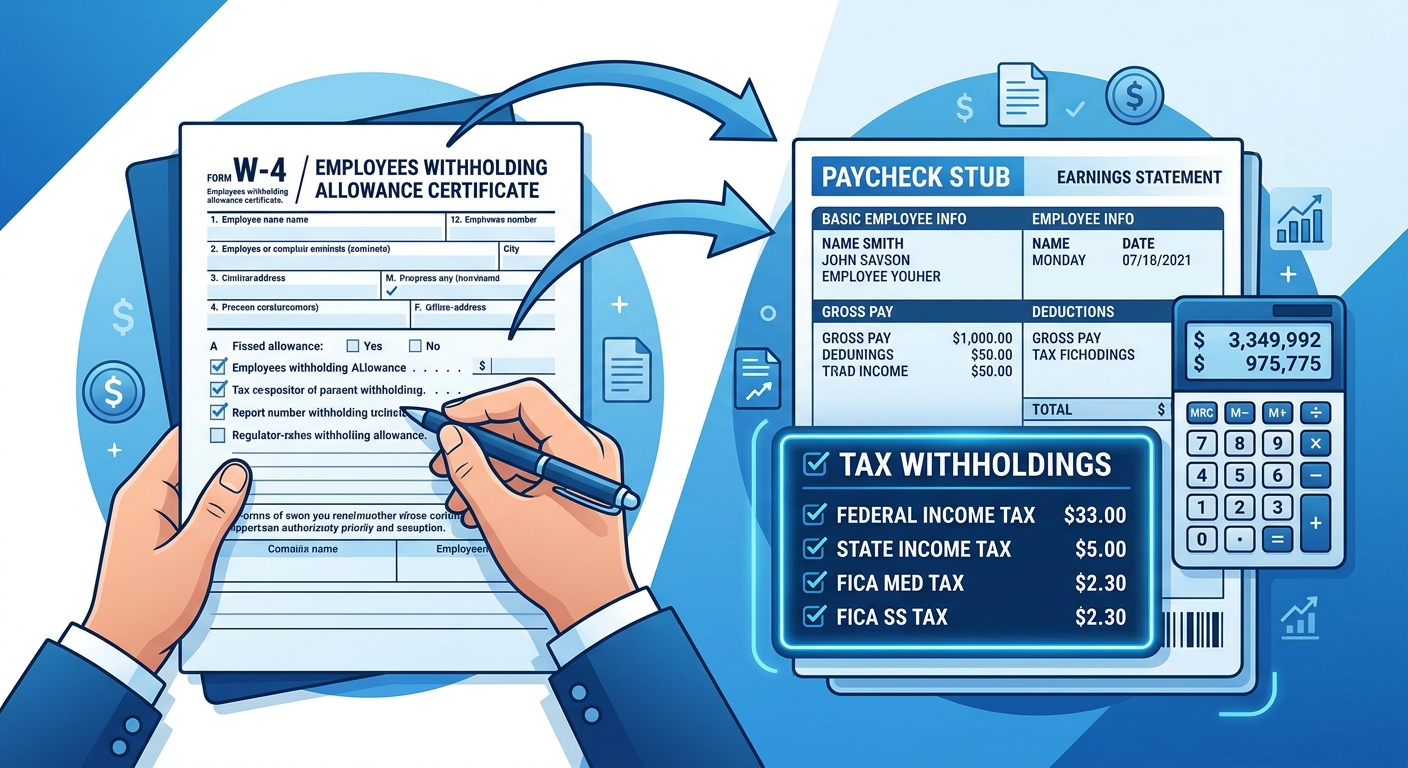
What Is Withholding Tax and Why It Matters More Than You Think
You check your paycheck, and you expect to see the amount you agreed to when you took the job. Instead, you see a smaller number, with a chunk already sent to the IRS before you even touch it. That money is called withholding tax, and if you don’t understand how it works, you could be overpaying the government all year long or setting yourself up for a painful tax bill in April.
Here’s the truth most employers won’t tell you: withholding tax isn’t just a random deduction. It’s a prepayment system controlled by what you put on your Form W-4, and getting it wrong costs you either cash flow throughout the year or a surprise four-figure bill at tax time. The good news? Once you understand how withholding tax actually works, you can adjust it to match your real tax liability and keep more money in your pocket every single month.
Quick Answer
Withholding tax is the amount your employer takes out of your paycheck and sends directly to the IRS to cover your federal income tax liability throughout the year. This system ensures the government collects taxes continuously rather than waiting until April 15. The amount withheld depends on your income, filing status, and the information you provide on Form W-4.
How Withholding Tax Actually Works
Every time you receive a paycheck, your employer calculates how much federal income tax to withhold based on IRS tax tables and the W-4 form you filled out when you started. This isn’t optional. Federal law requires employers to withhold income tax, Social Security tax (6.2%), and Medicare tax (1.45%) from every employee’s wages.
The withholding calculation uses several factors. First, your gross pay for that pay period. Second, your filing status (single, married filing jointly, head of household). Third, the number of dependents you claim. Fourth, any additional withholding amounts you’ve requested. The IRS publishes withholding tables each year that employers use to determine exactly how much to take from each paycheck.
Here’s where it gets interesting: withholding tax is an estimate, not a final calculation. The IRS assumes your income will stay consistent throughout the year. If you get a bonus, change jobs, or have a major life event, your withholding might no longer match your actual tax liability. That’s when you either get a refund in April or owe money.
The Three Types of Employment Taxes
Understanding the full picture requires knowing all three employment tax categories:
- Federal Income Tax: Variable rate based on your income bracket (10% to 37% in 2026), determined by your W-4 elections
- Social Security Tax: Flat 6.2% on wages up to $168,600 in 2026 (this cap increases annually)
- Medicare Tax: Flat 1.45% on all wages, plus an additional 0.9% on wages exceeding $200,000 for single filers or $250,000 for married filing jointly
When people say “withholding tax,” they usually mean federal income tax withholding, but all three come out of your paycheck automatically. The key difference is that Social Security and Medicare rates are fixed, while income tax withholding varies widely based on your W-4 choices.
Why Your W-4 Form Controls Everything
Form W-4 is the single most important document controlling your monthly cash flow. Fill it out wrong, and you’re essentially giving the IRS an interest-free loan all year long, or you’re setting yourself up for a surprise tax bill that could hit $3,000 or more.
The 2026 version of Form W-4 eliminated the old “allowances” system that confused millions of taxpayers. Now you directly enter dollar amounts for dependents, other income, deductions, and extra withholding. This gives you more control but also more responsibility to get it right.
Step-by-Step: How to Fill Out Form W-4 Correctly
- Step 1: Enter Personal Information: Include your name, address, Social Security number, and filing status. This is straightforward but critical because your filing status drives the tax brackets used for withholding.
- Step 2: Multiple Jobs or Spouse Works: If you have more than one job or your spouse works, complete this section to avoid under-withholding. The IRS provides a worksheet or online calculator to determine the right amount.
- Step 3: Claim Dependents: Multiply the number of qualifying children under 17 by $2,000. Add $500 for each other dependent. Enter the total. This reduces your withholding to reflect your Child Tax Credit.
- Step 4: Other Adjustments: Enter other income not subject to withholding (like investment income or side gig profits), deductions you expect to claim beyond the standard deduction, and any extra withholding amount you want taken out.
- Step 5: Sign and Date: Your W-4 isn’t valid without your signature. Submit it to your employer’s HR or payroll department immediately.
Pro Tip: Use the IRS Tax Withholding Estimator at irs.gov/W4App before filling out your W-4. It takes about 10 minutes and prevents costly mistakes. If you want to see how withholding affects a bonus or year-end income spike, run the numbers through this bonus tax calculator to understand the real impact.
Real-World Scenario: How Withholding Tax Impacts Your Paycheck
Meet Jessica, a marketing manager in San Diego earning $85,000 annually. She’s single with no dependents and filled out her W-4 claiming single filing status with no additional adjustments. Her employer withholds approximately $1,100 per month in federal income tax, plus $439 for Social Security and $103 for Medicare.
Jessica’s total monthly withholding is around $1,642, leaving her with a net monthly paycheck of approximately $5,441. At the end of the year, she files her tax return and discovers her actual federal tax liability is $12,500. Her employer withheld $13,200 over 12 months, resulting in a $700 refund.
That refund sounds nice until Jessica realizes she gave the government $700 of her money interest-free for an entire year. If she had adjusted her W-4 to reduce withholding by $60 per month, she could have invested that money, paid down credit card debt charging 22% interest, or simply had more cash flow each month.
The Cost of Overwithholding
The average tax refund in 2025 was $3,011 according to IRS data. That’s $250 per month you could have used for emergency savings, retirement contributions, or debt payoff. If you consistently receive large refunds, you’re overwithholding, and it’s costing you opportunity.
Here’s the math: $250 per month invested in an index fund earning 8% annually over 20 years grows to approximately $148,000. That same money sent to the IRS early each year and refunded with zero interest grows to zero. The cost of overwithholding isn’t just lost cash flow, it’s lost wealth building.
KDA Case Study: W-2 Employee with Side Income
Marcus, a software engineer at a tech company, earned $110,000 from his W-2 job plus $25,000 from freelance consulting work in 2025. His employer withheld federal taxes based only on his W-2 income. Marcus didn’t adjust his W-4 or make quarterly estimated tax payments on his side income.
In April 2026, Marcus filed his tax return and discovered he owed $5,800 in additional federal tax plus a $450 underpayment penalty. His W-2 withholding covered his employment income but none of his self-employment income or the 15.3% self-employment tax on his consulting profits.
Marcus came to KDA for a tax strategy consultation. We adjusted his W-4 to increase withholding by $150 per month and set him up on a quarterly estimated payment schedule for his consulting income. We also helped him establish a single-member LLC to track business expenses properly, resulting in $3,200 in additional deductions he had been missing.
Total tax savings in year one: $3,200 in recovered deductions. Avoided underpayment penalties in year two: $450. KDA strategy session cost: $750. First-year ROI: 4.9x. Marcus now pays the right amount of tax throughout the year with zero surprises in April.
Ready to see how we can help you? Explore more success stories on our case studies page to discover proven strategies that have saved our clients thousands in taxes.
Common Withholding Tax Mistakes That Cost You Money
Most taxpayers make one of five critical withholding errors. Each one either drains your monthly cash flow or sets you up for a painful tax bill. Here’s what to avoid:
Mistake 1: Never Updating Your W-4 After Life Changes
You got married, had a baby, bought a house, or started a side business, but you never updated your W-4. Your withholding is now based on outdated information that no longer reflects your tax situation. Result: either massive overwithholding or a surprise tax bill.
Red Flag Alert: If you experienced a major life change in the past year and haven’t updated your W-4, you’re likely withholding the wrong amount. The IRS requires accuracy, and outdated W-4 information is your responsibility to fix, not your employer’s.
Mistake 2: Claiming Exempt When You Don’t Qualify
Some employees write “EXEMPT” on their W-4 thinking they won’t owe taxes. This is almost always wrong and can trigger IRS penalties. You can only claim exempt if you had no tax liability last year AND you expect no tax liability this year. If you earn more than the standard deduction ($14,600 for single filers in 2026), you don’t qualify.
Claiming exempt when you’re not eligible results in zero withholding all year. Come April, you’ll owe the full tax amount plus underpayment penalties and interest. For someone earning $50,000, that could mean a $6,000+ surprise bill.
Mistake 3: Not Coordinating Withholding Between Multiple Jobs
If you work two jobs or you and your spouse both work, each employer withholds based only on what they pay you. Neither employer knows about your other income. The result is under-withholding because your combined income pushes you into higher tax brackets.
Example: You earn $45,000 at Job A and $30,000 at Job B. Each employer withholds as if you’re in the 12% bracket. But your combined $75,000 income puts you partially in the 22% bracket. You’ll owe extra tax in April unless you complete Step 2 on Form W-4 or request additional withholding.
Mistake 4: Ignoring State Withholding
Everything we’ve discussed applies to federal withholding. But if you live in California, you also have state income tax withholding to manage via Form DE-4. California has its own tax brackets, and your state withholding won’t automatically match your federal elections.
California’s top tax rate hits 13.3% for high earners. If you’re not withholding enough for state taxes, you could owe thousands to the Franchise Tax Board even if your federal withholding is perfect. Always review both federal and state withholding together, especially if you work in one state and live in another.
Mistake 5: Treating Your Refund Like a Savings Account
Many people intentionally overwithhold because they like getting a big refund check. This feels good emotionally but costs you financially. You’re giving the government your money early with zero return instead of keeping that cash flow for your own use.
A $3,000 refund means you overpaid by $250 per month. That money could have gone into a high-yield savings account earning 4.5%, reduced credit card debt costing 22% in interest, or increased your 401(k) contributions. The opportunity cost of overwithholding is real wealth building foregone.
How to Adjust Your Withholding Right Now
You don’t have to wait until next year or your next job to fix your withholding. You can submit a new W-4 to your employer any time your tax situation changes. Here’s exactly how to do it:
- Calculate Your Actual Tax Liability: Use the IRS Tax Withholding Estimator or work with a tax professional to determine your expected total tax for the year based on all income sources.
- Review Your Current Withholding: Check your most recent pay stub to see year-to-date federal withholding. Multiply your per-paycheck withholding by the number of remaining paychecks to project end-of-year withholding.
- Determine the Gap: Subtract your year-to-date withholding and projected future withholding from your estimated total tax liability. If the number is positive, you’re under-withholding. If negative, you’re over-withholding.
- Complete a New W-4: Download Form W-4 from irs.gov. In Step 4(c), enter the additional amount you want withheld from each paycheck to close the gap, or reduce withholding by claiming more accurately in Steps 3 and 4.
- Submit to Your Employer: Give the completed W-4 to your HR or payroll department. Changes typically take effect within one to two pay periods.
Pro Tip: If you’re significantly under-withheld and it’s late in the year, you can request a specific dollar amount of extra withholding from your remaining paychecks to catch up. The IRS doesn’t care when withholding happens during the year, only that the total is close to your actual liability.
Special Situations and Edge Cases
Standard W-4 guidance works for most employees, but certain situations require additional planning. Here’s how to handle withholding tax when your situation is more complex:
Multiple States: Working Remote for Out-of-State Employer
If you live in California but work remotely for a Texas company, California will tax your income even though Texas has no state income tax. Your employer might not automatically withhold California state tax. You’ll need to make quarterly estimated payments to California or face penalties.
Alternatively, some employers will withhold for your resident state if you provide them with a state W-4 form. Check with your HR department and consider working with tax planning professionals who understand multi-state withholding rules.
Bonuses, Commissions, and Supplemental Wages
When you receive a bonus or commission check, employers typically withhold at a flat 22% federal rate (or 37% if the bonus exceeds $1 million). This supplemental wage withholding rate might not match your actual tax bracket.
If you’re in the 12% bracket and get a $10,000 bonus with 22% withheld, you’ve overpaid by $1,000. If you’re in the 35% bracket with the same bonus, you’ve underpaid by $1,300. You can’t control how employers withhold bonuses, but you can adjust your regular W-4 withholding to compensate.
Stock Options, RSUs, and Equity Compensation
Restricted stock units (RSUs) and stock option exercises are taxable as ordinary income when they vest or when you exercise. Employers typically withhold 22% federal tax, but depending on your total income, your actual rate could be much higher.
High earners with significant equity comp often face surprise tax bills because standard withholding doesn’t account for the additional income pushing them into higher brackets or triggering Alternative Minimum Tax. If you receive equity compensation, work with a tax strategist to calculate the right amount of extra withholding or estimated payments.
Divorced or Separated: Who Claims the Kids?
If you’re divorced and share custody, only one parent can claim the child as a dependent for tax purposes each year, even if both parents support the child financially. Make sure your W-4 accurately reflects how many dependents you’re actually claiming on your tax return.
Claiming three dependents on your W-4 but only being entitled to claim one on your tax return will cause under-withholding and a tax bill plus penalties. The IRS doesn’t care about informal custody arrangements. They only care about what your divorce decree or Form 8332 says.
California-Specific Withholding Considerations
California has the highest state income tax rates in the nation, ranging from 1% to 13.3%. If you’re a California resident, you need to manage both federal and state withholding carefully. The state uses Form DE-4 (Employee’s Withholding Allowance Certificate) to determine state withholding amounts.
California’s withholding system works similarly to federal withholding, but the calculations are separate. Changes you make to your federal W-4 don’t automatically update your state DE-4. If you adjust one, consider whether you need to adjust the other.
Common California Withholding Issues
California residents working remotely for out-of-state companies often discover their employer isn’t withholding California state tax. The employer might be based in a no-income-tax state like Texas or Florida and doesn’t have systems set up for California withholding. You’re still liable for California taxes and will need to make estimated payments quarterly or face penalties.
Moving to or from California mid-year creates withholding complexity. You might be a part-year resident, meaning only income earned while a California resident is subject to California tax. Your withholding needs to reflect your actual California liability, not your full-year income. This requires careful calculation or professional guidance.
High earners in California face combined federal and state marginal rates exceeding 50% when you include the top federal rate of 37% plus California’s 13.3% top rate. If you’re in this bracket, even small withholding errors translate to large surprise tax bills or massive overwithholding. Precision matters at high income levels.
Withholding Tax vs. Estimated Tax Payments
Withholding tax applies to W-2 employees. But if you have income not subject to withholding, like self-employment income, rental income, investment gains, or retirement distributions, you need to make quarterly estimated tax payments instead.
The IRS requires you to pay at least 90% of your current year tax liability or 100% of your prior year tax liability (110% if your adjusted gross income exceeds $150,000) throughout the year. If withholding from your W-2 job doesn’t cover this threshold, you must make estimated payments or face underpayment penalties.
Combining Withholding and Estimated Payments
You can use increased W-4 withholding as a substitute for estimated payments. This is actually advantageous because the IRS treats withholding as paid evenly throughout the year, even if you increase it late in the year. Estimated payments, however, are credited to the quarter when you make them.
Example: You realize in November you’re $4,000 short on tax payments for the year. If you make a $4,000 estimated payment in November, the IRS will assess underpayment penalties for the earlier quarters. But if you increase your W-4 withholding to pull an extra $4,000 from your November and December paychecks, the IRS treats it as if that withholding occurred evenly all year, and you avoid penalties.
How Withholding Tax Affects Your Refund or Balance Due
Your tax refund or balance due is simply the difference between your total tax liability for the year and the total amount withheld or paid through estimated payments. Three scenarios exist:
- Scenario 1: Withholding Matches Liability: You owe zero and receive zero refund. This is the optimal outcome because you kept your money throughout the year and paid exactly what you owed.
- Scenario 2: Withholding Exceeds Liability: You receive a refund. This means you overpaid throughout the year and gave the government an interest-free loan.
- Scenario 3: Withholding Falls Short of Liability: You owe money when you file. If you owe more than $1,000 and didn’t meet safe harbor thresholds, you’ll also owe underpayment penalties.
The goal is to get within $500-$1,000 of breaking even. This gives you maximum cash flow during the year while avoiding penalties for under-withholding. It requires active management and annual review, but the payoff is keeping your own money instead of lending it to the IRS.
Ready to Reduce Your Tax Bill?
KDA Inc. specializes in strategic tax planning for business owners, S Corps, LLCs, and high-net-worth individuals. Book a personalized consultation and walk away with a clear plan.
Frequently Asked Questions About Withholding Tax
Can I change my withholding multiple times per year?
Yes. You can submit a new Form W-4 to your employer whenever your tax situation changes. There’s no limit on how many times you can adjust your withholding. Major life events like marriage, divorce, having a child, or buying a home are all good reasons to update your W-4 immediately.
What happens if I don’t have enough withholding?
If your withholding plus estimated payments don’t equal at least 90% of your current year tax liability or 100% of your prior year tax liability, you’ll owe underpayment penalties. The penalty rate changes quarterly but generally runs around 8% annually. Additionally, you’ll owe the balance of tax due when you file your return. For someone owing $5,000, penalties could add $200-400 to your bill.
Is it better to get a refund or owe a small amount?
From a pure financial perspective, owing a small amount (under $1,000) is better than receiving a large refund. This means you kept your money throughout the year and had access to it for savings, investing, or debt reduction. However, the practical answer depends on your financial discipline. If receiving a refund is the only way you save money, overwithholding might be worth the opportunity cost.
Does withholding tax apply to 1099 contractors?
No. If you’re an independent contractor receiving 1099-NEC income, no taxes are withheld from your payments. You’re responsible for paying your own income tax and self-employment tax through quarterly estimated payments. This is a major difference between W-2 employment and self-employment that catches many new freelancers by surprise.
Can I claim exempt from withholding if I’m retired?
It depends on your income. If your only income is Social Security and it’s below the taxable threshold, you might qualify to claim exempt. However, if you have pension income, retirement account distributions, investment income, or part-time work that creates tax liability, you cannot claim exempt. You’ll need to complete a W-4 that accurately reflects your tax situation or face penalties.
What to Do Right Now
Don’t wait until April to discover your withholding was wrong all year. Take these three actions this week:
- Pull your most recent pay stub and check your year-to-date federal withholding amount. Compare it to your expected tax liability for the year.
- Use the IRS Tax Withholding Estimator at irs.gov/W4App to see if you’re on track or need to adjust.
- Submit a new W-4 if your current withholding doesn’t match your actual tax situation. Don’t overthink it, just make the adjustment.
If you have multiple income sources, self-employment income, investment gains, or a complex tax situation, these DIY tools might not be enough. That’s when working with a tax strategist makes sense.
Book Your Tax Strategy Session
If you’re tired of surprise tax bills or giving the IRS thousands in interest-free loans through overwithholding, let’s fix that. Our team specializes in helping W-2 employees, business owners, and high earners optimize their withholding and estimated payments to match their actual tax liability. Book a personalized consultation with our strategy team and get clear, compliant, and confident about your withholding. Click here to book your consultation now.
This information is current as of 5/13/2026. Tax laws change frequently. Verify updates with the IRS or FTB if reading this later.



