
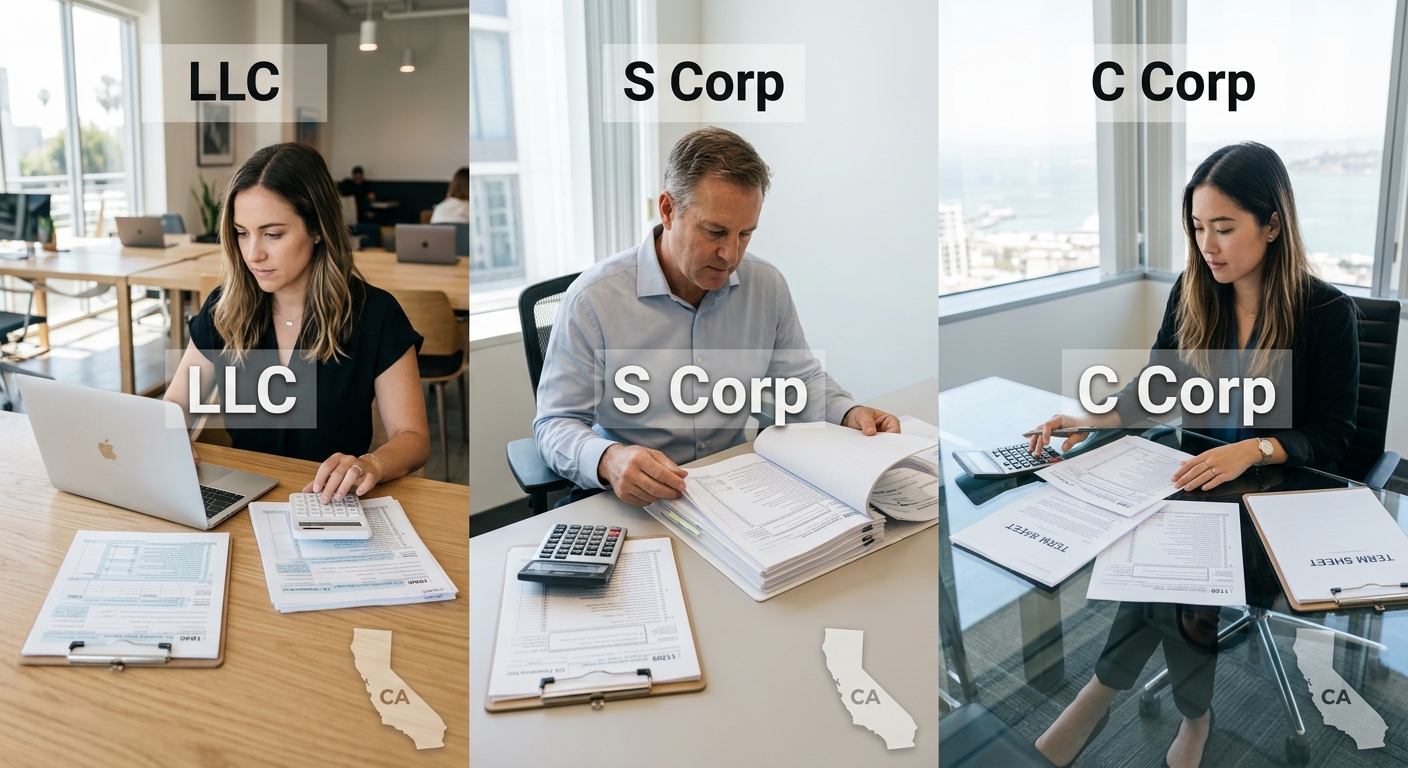
Meta Description: Confused about the difference between llc s corp and c corp california? See the real tax math, CA fees, payroll traps, and when each wins.
Most California owners pick an entity the same way they pick a phone plan: whatever sounds familiar and has the least paperwork. That is how you end up paying an extra $8,000 to $25,000 a year in taxes and fees without realizing it.
Here is the uncomfortable truth: the difference between llc s corp and c corp california is not a legal trivia question. It is a money question. It is also a risk question. Your choice determines which return you file, what the Franchise Tax Board expects from you, whether you must run payroll, and whether your profits get taxed once or twice.
This information is current as of 5/12/2026. Tax laws change frequently. Verify updates with the IRS or FTB if reading this later.
Quick Answer: The difference that actually matters
If you are comparing the difference between llc s corp and c corp california, think in three buckets:
- LLC (default tax): simplest for tax filing, but California charges an $800 minimum and may add an LLC gross receipts fee, and self-employment tax can apply to a large share of profit.
- S Corp: designed for owner-operators who want payroll tax savings by splitting income into salary and distributions, but you must run payroll and pay California’s S Corp tax (generally 1.5% of net income with an $800 minimum).
- C Corp: pays corporate tax (federal and California), and profits can be taxed again when distributed as dividends, but it can make sense for certain growth, benefits, or reinvestment plans.
Bottom line: Most service businesses in California that consistently net $80,000+ and have an owner actively working in the business should at least model an S Corp election. Many people stay in an LLC for too long because nobody showed them the math.
Start with this: what you are really choosing (legal entity vs tax status)
The biggest misunderstanding in “LLC vs S Corp vs C Corp” comparisons is that people mix up state law and federal tax law.
LLC is a legal entity, not a tax return
An LLC is formed under California law. For federal taxes, the IRS treats most LLCs as “disregarded entities” (single-member) or partnerships (multi-member) unless you elect corporate taxation. The practical result is that your LLC could file:
- Schedule C on your personal return (single-member LLC),
- Form 1065 partnership return (multi-member LLC),
- Form 1120-S if the LLC elects S Corp treatment, or
- Form 1120 if the LLC elects C Corp treatment.
If you are a 1099 earner using an LLC as your “business,” you are usually still living in Schedule C world until you make an election.
S Corp and C Corp are tax classifications with strict rules
S Corporation is a tax status under Internal Revenue Code Section 1361 and related rules. The corporation files IRS Form 1120-S and issues K-1s to shareholders. To be an S Corp, you must meet eligibility rules (one class of stock, limited shareholder types, etc.).
C Corporation is the default corporate tax status. It files IRS Form 1120. It can have multiple stock classes and is often used when bringing in investors, issuing different equity rights, or retaining earnings for reinvestment.
Where California makes this more expensive than other states
California adds friction through minimum taxes and entity-level taxes. Even when your federal tax situation looks “fine,” the state fees can turn a so-so structure into a bad one. That is why the difference between llc s corp and c corp california should be modeled with California numbers, not generic national blog advice.
Pro Tip: If your advisor compares only federal tax rates and ignores California minimums, payroll overhead, and the LLC fee, you are getting an incomplete recommendation.
California tax and fee reality check (the part most blogs gloss over)
Let’s talk about the taxes and fees that hit you simply for existing as an entity in California.
LLC: $800 minimum tax plus possible LLC fee
Most California LLCs pay an $800 annual franchise tax. On top of that, many LLCs owe an additional LLC fee based on total income. The fee is not based on profit. It is based on gross income levels, which can surprise high-volume, lower-margin businesses.
For reference, see FTB guidance on California LLC tax and fee rules.
S Corp: $800 minimum plus 1.5% tax on net income
California generally taxes S Corps at 1.5% of net income with an $800 minimum. That tax applies even though the S Corp is “pass-through” federally. California is not impressed by your pass-through status.
See FTB guidance on California S corporation tax.
C Corp: corporate tax plus potential second tax on dividends
California taxes C Corps at a corporate rate. Federally, C Corps pay corporate income tax and then shareholders may pay tax again on dividends. This is the “double tax” people mention, and it is real. But it is not always a dealbreaker if you do not distribute profits or if you are optimizing benefits and reinvestment.
See FTB guidance on California corporation tax.
Quick comparison table: the decision points that move the needle
| Factor | LLC (default) | S Corp | C Corp |
|---|---|---|---|
| CA minimum | $800 | $800 | $800 |
| CA entity tax | LLC fee possible | 1.5% of net income | CA corporate tax rate |
| Payroll requirement | No (unless employees) | Yes for owner salary | Yes if you pay wages |
| Self-employment tax | Often on most profit | Only on wages | Not on dividends |
| Investor friendliness | Medium | Low to medium | High |
The question most owners should ask
Not “Which entity pays the least taxes?” The right question is: What structure gives me the best after-tax cash while staying defensible with the IRS and FTB?
Payroll tax is where the S Corp usually wins (and where owners get sloppy)
If you are an owner-operator, the biggest driver of the difference between llc s corp and c corp california is usually payroll tax.
Why LLC profit gets hit harder for active owners
When you are a single-member LLC reporting on Schedule C, your net profit is generally subject to self-employment tax. That is the Social Security and Medicare tax that W-2 employees split with an employer. Self-employed people pay both sides.
For the core rules, see IRS Publication 334 and IRS self-employment tax guidance.
What an S Corp changes in plain English
An S Corp lets you pay yourself a W-2 wage (subject to payroll taxes), and then take additional profits as distributions (generally not subject to payroll taxes). You do not “avoid taxes.” You change which bucket applies.
Example: 1099 consultant in California at $180,000 net profit
Meet Daniel, a California-based software implementation contractor. He nets $180,000 after ordinary business expenses.
- LLC default: much of the $180,000 is exposed to self-employment tax, plus income tax.
- S Corp: Daniel sets a reasonable salary of $90,000 and takes $90,000 as distributions.
At a high level, the payroll tax exposure is dramatically different because only the wage portion triggers payroll taxes. You still pay income tax on both wages and pass-through profit, but the payroll tax piece is where the savings can show up.
Key Takeaway: An S Corp is usually a payroll tax planning tool for active owners, not an “income tax hack.”
Reasonable compensation: the IRS is not guessing, they are auditing
The IRS expects shareholder-employees to take a reasonable salary. If you take $20,000 of wages on $400,000 of profit, you are inviting scrutiny. The most common audit outcome is reclassifying distributions as wages and assessing payroll taxes and penalties.
A widely cited case is Watson v. Commissioner (T.C. Memo 2012-167), where the Tax Court supported the IRS in recharacterizing distributions when wages were unreasonably low based on the services performed.
What if I do not want payroll?
Then you may not be ready for an S Corp. Payroll is not optional. If the thought of running payroll makes you avoid the structure, staying in an LLC might be the right short-term move. But do not pretend it is “more compliant.” It is simply simpler.
KDA Case Study: LLC Owner Stops Overpaying in CA
Ashley runs a Southern California marketing agency. She started as a single-member LLC and had a strong year: about $240,000 in revenue and $155,000 in net profit. Her prior preparer filed Schedule C and told her an S Corp was “only for bigger companies.”
We modeled the difference between llc s corp and c corp california using her real numbers. The C Corp option looked attractive to her because she heard “21% flat tax,” but once we mapped dividends, California corporate tax drag, and her need for personal cash, the C Corp route was not the fit for her current stage.
KDA helped her elect S Corp taxation, implement payroll, and document a reasonable salary of $85,000 based on role and market comps. The remaining profit flowed as distributions. We also tightened her expense substantiation using categories consistent with IRS Publication 535.
Result: Approximately $10,900 in estimated annual payroll tax reduction, net of added compliance costs and California S Corp tax. KDA advisory and setup fees were $3,800, producing a 2.9x first-year ROI, plus a cleaner audit trail going forward.
Ready to see how we can help you? Explore more success stories on our case studies page to discover proven strategies that have saved our clients thousands in taxes.
When a C Corp in California is not crazy (but you must know what you are buying)
A C Corp is not “bad.” It is just easy to misuse. The difference between llc s corp and c corp california gets distorted online because people treat the 21% federal corporate tax rate like the entire story. It is not.
Scenario 1: You are reinvesting and not distributing profits
If your company is reinvesting profits into growth, hiring, R&D, or inventory, the double tax might not hit right away because you are not paying dividends. A C Corp can sometimes allow cleaner separation between business cash and personal cash. The trade-off is complexity and California corporate tax.
Scenario 2: You need multiple classes of equity for investors
Many investors want preferred shares, convertible notes, or special rights. S Corps have shareholder restrictions and one-class-of-stock rules that make venture-style investing awkward or impossible.
Scenario 3: You want certain fringe benefits structured through a corporation
Benefit planning can be part of a C Corp strategy, but it must be designed carefully. You do not form a C Corp just for “write-offs.” You form it to match the business lifecycle and how cash will move.
Red Flag Alert: the “I will just pay myself dividends” plan
Owners sometimes think they can avoid payroll taxes by paying themselves dividends from a C Corp. That can reduce payroll taxes, but it can create dividend tax and compliance issues, and it often fails the practical test: you still need personal cash, and the IRS can scrutinize compensation structures.
AB 150 and the SALT cap: the California wrinkle owners forget to model
For many higher-income California owners, the state and local tax (SALT) cap changes the math. California’s elective pass-through entity (PTE) tax (often called the AB 150 election) can allow a workaround in certain situations by shifting part of the state tax burden to the entity level.
This is one reason the difference between llc s corp and c corp california cannot be evaluated without considering your full picture: income level, filing status, and whether you itemize.
What AB 150 is in plain English
AB 150 lets qualifying pass-through entities elect to pay a tax at the entity level, and then owners receive a corresponding credit. The goal is to potentially preserve a federal deduction that would otherwise be limited under the SALT cap on Schedule A.
Which entity types can use it?
In general, partnerships and S Corps are the usual candidates. C Corps do not use AB 150 the same way because they already pay entity-level tax.
When it matters most
If you are netting $250,000+ and you are consistently capped on SALT deductions, AB 150 can shift the after-tax outcome. It is not automatic. The election has timing and payment mechanics.
If you want to run a quick high-level estimate before a strategy session, use our small business tax calculator to sanity-check your baseline tax burden.
Where to get the official details
Review FTB’s PTE elective tax guidance and forms on the official FTB site. Start at the Pass-through entity elective tax page.
Key Takeaway: AB 150 can tilt the LLC or S Corp decision for high-income Californians, but only if you execute the election and payments correctly.
Common mistake that triggers a mess: choosing based on “21%” or “no payroll”
This is the section most people wish they had read before their first big year.
Mistake 1: Picking a C Corp because “21% is lower than my bracket”
Yes, the federal corporate rate is 21%. But then you must get money out of the corporation. When you distribute profits, dividends can be taxed again. Also, California adds its own corporate tax. When you stack the taxes, the “21%” headline can turn into an expensive illusion.
Mistake 2: Staying in an LLC because your accountant hates payroll
Some preparers avoid S Corps because payroll adds operational work and liability. That is their preference, not your financial strategy. If you are consistently profitable, paying for payroll and clean bookkeeping can be worth it.
If you need help building the infrastructure, our bookkeeping and payroll services are designed to keep S Corp owners compliant without turning every month into a fire drill.
Mistake 3: Electing S Corp status too early
An S Corp is not free. You add payroll, corporate filings, and more strict accounting. If you are netting $20,000 a year, the compliance overhead can eat the benefit. You want a profit threshold where the payroll tax savings are large enough to justify the additional structure.
Mistake 4: Forgetting California-specific forms and payments
California has entity payments and returns that must line up with your structure. Missing a payment can trigger notices and penalties. That is why we build a calendar for every entity: due dates, extensions, and what gets paid when.
Step-by-step: how to decide between LLC, S Corp, and C Corp in California
If you want a defensible decision, you need a process. Here is the framework we use with clients.
Step 1: Separate your profit from your cash flow
Profit is what drives tax. Cash flow is what drives your ability to pay tax. You need both on the table. If you do not have clean books, your model is fantasy.
Step 2: Identify your owner role and market wage
This step is critical for S Corp modeling. What would you pay someone else to do your job? That becomes the starting point for a reasonable salary range.
Step 3: Model three scenarios with real California inputs
- LLC default: include $800 minimum and potential LLC fee, plus self-employment tax impact.
- S Corp: include payroll costs, reasonable salary, 1.5% CA tax, and distributions.
- C Corp: include entity-level tax, your intended distribution strategy, and dividend exposure.
Step 4: Stress-test audit defensibility
For S Corps, ask: can we defend the salary? For LLCs and partnerships, ask: can we defend deductions? For C Corps, ask: can we justify compensation and distributions without looking like a payroll dodge?
Step 5: Decide based on a 2-year horizon, not just this year
The difference between llc s corp and c corp california changes as your income changes. You want an entity choice that works now and still works when your profit grows 30% next year.
Special situations and edge cases competitors avoid
Most online comparisons ignore edge cases. These are the ones that matter in California.
If you have multiple owners with different economics
S Corps have one class of stock. If you need special allocations, preferred returns, or different distribution rights, an LLC taxed as a partnership may be more flexible.
If you are a real estate investor with rentals
Rental income is often passive and does not belong inside an S Corp in many scenarios. You may want separate entities: one for operations, one for rentals. Entity stacking is common for liability and tax clarity.
If you are high-income W-2 with a side business
A W-2 engineer making $300,000 with a side Schedule C netting $60,000 has a different planning set than a full-time 1099 consultant. Payroll tax savings may be smaller or larger depending on how Social Security wages cap out in the year.
If you plan to sell the business
Exit taxes differ. Asset sale vs stock sale outcomes can vary by entity type, and California will take its share. If you think you might sell in the next 3 to 5 years, entity choice should be part of the exit plan, not an afterthought.
Ready to Reduce Your Tax Bill?
KDA Inc. specializes in strategic tax planning for business owners, S Corps, LLCs, and high-net-worth individuals. Book a personalized consultation and walk away with a clear plan.
FAQ: fast answers to the questions people ask after the comparison
Do I need to be incorporated to have an S Corp?
No. Many LLCs elect S Corp taxation by filing Form 2553 (and sometimes Form 8832 depending on the situation). The legal entity can remain an LLC while the tax classification changes.
Can I switch from LLC to S Corp mid-year?
Sometimes, yes, but timing rules matter. The effective date of an S election and payroll implementation must be handled correctly. Late-election relief may be available in certain cases, but it should not be your default plan.
Will an S Corp reduce my income tax?
Usually not directly. The main lever is payroll tax. Your income tax still applies to wages and pass-through income. The benefit is in how much is subject to payroll taxes.
Does a C Corp always mean double taxation?
Double taxation typically happens when profits are distributed as dividends. If profits are reinvested and not distributed, the second layer may be deferred. But California corporate tax still applies.
What records should I keep regardless of entity type?
Keep clean books, bank statements, receipts, and documentation of business purpose. The IRS expects you to substantiate deductions. Start with the documentation expectations in IRS Publication 463 for travel, gift, and car expenses, and IRS Publication 535 for business expenses.
Book Your California Entity Strategy Session
If you are profitable and still unsure about the difference between llc s corp and c corp california, you do not need another generic checklist. You need a clean model using your real profit, your realistic salary, your California fees, and your cash needs. We will map the next 12 months, build a compliance calendar, and show you the exact break-even point where a change starts saving you money. Book your consultation now.
Mic drop: The IRS is not hiding entity strategy. Most owners just never run the math with California in the model.
Direct link to this blog post: https://kdainc.com/?p=0



