
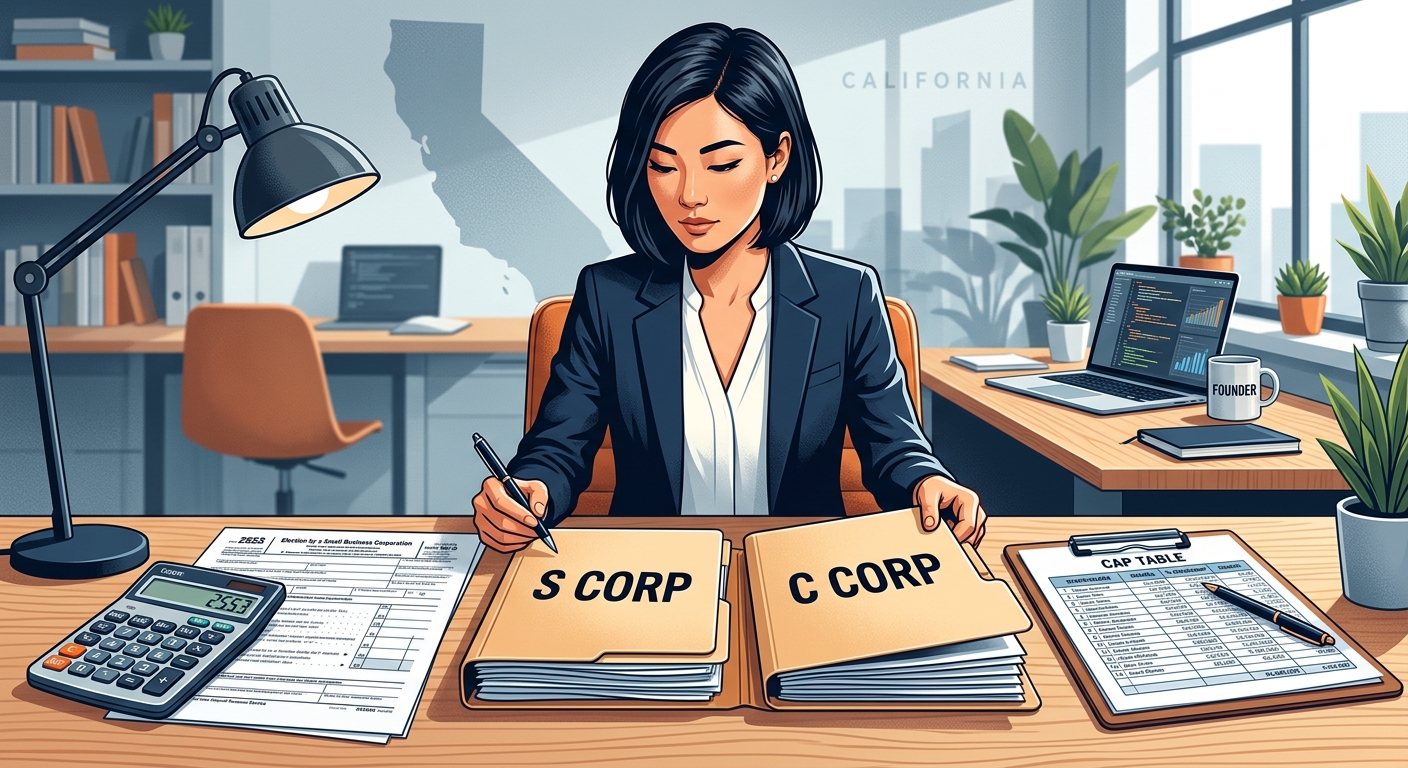
Meta description (145–155 characters): Startup s corp vs c corp decisions can cost founders five figures. See the tax math, QSBS traps, and CA fees before you file anything.
This information is current as of 5/10/2026. Tax laws change frequently. Verify updates with the IRS or FTB if reading this later.
If you pick the wrong entity in your first year, you usually do not notice it until two things happen: you raise money, or you finally turn a profit. By then, switching structures is paperwork plus real tax cost. For founders, the “startup s corp vs c corp” question is not academic. It determines whether your profits get double taxed, whether investors will walk, whether you can use QSBS on the exit, and how ugly your California filings get.
Here is the contrarian truth: most early-stage startups do not need an S Corp right away, and many do not benefit from one even when profitable. But many founders also default to a C Corp without understanding the tax drag when they are not raising VC and are paying themselves like a freelancer. The right answer depends on your funding plan, your compensation model, and your expected exit.
Quick Answer: When does startup s corp vs c corp actually matter?
Startup s corp vs c corp matters the moment you have (1) real profits, (2) real payroll, (3) outside shareholders, or (4) an exit plan that relies on qualified small business stock. In plain English: if you are bootstrapping and paying yourself a modest salary, the entity choice changes payroll taxes and deductions. If you are raising venture capital or aiming for a big equity exit, a C Corp is often the only viable structure because QSBS generally requires C Corp stock and investors typically need preferred shares.
Start with the non-negotiables: ownership, fundraising, and stock rules
Before you chase tax rate headlines, you need to pass the structural test. This is where most “startup s corp vs c corp” advice online is too shallow.
Why most venture-backed startups end up as C Corps
Investors care about control, liquidation preference, and future rounds. That usually means multiple classes of stock. S Corps are limited to one class of stock (differences in voting rights can be allowed, but economic rights must be the same), and they have shareholder eligibility restrictions. Those rules come from IRS guidance on S corporations and Internal Revenue Code (IRC) Section 1361.
In plain English: if you want preferred stock, foreign investors, institutional investors, or more complex equity terms, an S Corp becomes a box you will outgrow quickly.
Who can own S Corp stock and why startups trip here
- Shareholder types are restricted: generally individuals who are U.S. citizens or residents, certain trusts, and estates. Partnerships and most corporations cannot be shareholders.
- Shareholder count is capped: generally 100 shareholders.
- One class of stock: you cannot do true preferred economics inside an S Corp.
That is why C Corp is the default when fundraising is the plan. Not because it is “more legit,” but because the capital structure is flexible.
Bootstrapped founder reality check
If you are not raising venture capital and you are running a profitable service-based startup (agency, software consulting, fractional CFO, creator business, niche SaaS with small team), you are closer to a small business than a Silicon Valley venture play. Many business owners can use a pass-through structure for simplicity and payroll tax planning.
Key Takeaway: If your cap table requires preferred stock or you want non-U.S. shareholders, start as a C Corp. If you are owner-operated and profitable, S Corp or LLC taxed as S Corp can be worth modeling.
Tax layer #1: how profits get taxed (and when double tax is real)
The “C Corps are double taxed” line is true, but founders misuse it. Double tax becomes painful when a profitable C Corp distributes dividends. Many startups do not distribute dividends for years. They reinvest. So the question is not “double tax or not,” it is “how will cash actually come out of the business?”
C Corp tax basics in plain English
A C Corp pays corporate income tax on its profits. When it pays dividends to you personally, you pay tax again. The corporate tax rate is generally 21% federally. Dividends are generally taxed at qualified dividend rates plus potential Net Investment Income Tax (NIIT) in certain cases. For NIIT basics, see IRS NIIT Q&A.
S Corp tax basics in plain English
An S Corp is a pass-through. The business generally does not pay federal income tax at the entity level. The net income “passes through” to the owner’s personal return. But owners who work in the business must take a reasonable salary subject to payroll taxes. Distributions, if properly structured, can avoid self-employment tax. This is why “startup s corp vs c corp” becomes a payroll-tax conversation for many founders.
A simple example: $250,000 of profit, founder takes cash out
Assume you are a solo founder in California with a profitable consulting startup. You have $250,000 of net business income before paying yourself. You need $180,000 cash for life and taxes.
- S Corp approach: Pay yourself a W-2 salary of $120,000 and take $60,000 as distributions. The $120,000 salary is subject to payroll taxes. The distribution is not subject to self-employment tax if handled correctly. You still pay income tax on the pass-through profit.
- C Corp approach: Pay yourself $180,000 as wages or bonuses. That is deductible to the corporation, which can reduce or eliminate corporate taxable income. No dividend means the classic “double tax” does not show up yet.
Notice what happened: a lot of the double-tax fear disappears if compensation is paid as deductible wages. The trade-off is payroll taxes and compliance.
So why do founders still overpay in C Corps?
Because founders often do one of these:
- Leave profit in the C Corp and then pull it out later as dividends (bad when you are a closely held owner-operator).
- Mix personal spending into corporate accounts and create non-deductible distributions that function like dividends without clean documentation.
- Forget California’s extra friction: minimum franchise tax and state corporate tax structure.
Pro Tip: If your plan is “I will just pay myself salary and bonus,” you still need to run the numbers. An S Corp can reduce payroll tax on the distribution portion, but only if the salary is defensible.
The S Corp lever founders care about: payroll tax control (not magic income tax cuts)
The real reason founders ask “startup s corp vs c corp” is payroll taxes. Founders hear that S Corps can reduce self-employment tax. That is directionally correct, but only under specific conditions.
Reasonable compensation is the line you cannot cross
If you are an owner who performs services, the IRS expects a “reasonable” salary. There is no single formula, but the IRS looks at duties, hours, comparable wages, and distributions. The IRS has an entire guidance ecosystem for payroll and withholding, including IRS Publication 15 (Circular E).
What reasonable compensation looks like for common startup founders
- Bootstrapped SaaS founder doing sales, support, and product: often $90,000 to $160,000 depending on revenue and region.
- Agency founder who is the main billable consultant: often $110,000 to $200,000 because the owner is the product.
- Real estate tech founder with operators and staff doing most labor: may justify a lower salary if truly not providing most services.
Lowballing salary to increase distributions is one of the fastest ways to invite an exam. In startup s corp vs c corp planning, the IRS does not care that you are “early stage” if you are pulling $200,000 out and calling it distributions.
Example: payroll tax difference with real numbers
Assume your business nets $220,000 and you can justify a $110,000 salary.
- In an S Corp, the salary portion is subject to payroll taxes, while the remaining $110,000 as distribution is not subject to self-employment tax.
- In a default LLC taxed as a sole proprietor, the full $220,000 is generally subject to self-employment tax (with nuances and caps).
Even if you do not memorize every rate, the strategic takeaway is easy: the bigger the gap between reasonable salary and total profit, the more an S Corp can save in employment tax.
Where founders mess up the S Corp play
- No payroll system: paying “salary” without filing payroll returns is not salary.
- No payroll tax deposits: the IRS treats missed deposits harshly.
- Distribution chaos: random transfers with no shareholder distribution documentation.
- State mismatch: in California, forgetting the S Corp 1.5% tax and minimums.
Founders who want this done cleanly usually need help with payroll setup, bookkeeping, and quarterly planning. If you want a compliant system instead of a spreadsheet hack, our bookkeeping and payroll services are designed for owner-operators who need clean W-2s and defensible distributions.
QSBS is the real C Corp trump card: why startup exits are not taxed the same
For many founders, the best argument for a C Corp is qualified small business stock (QSBS), also called the Section 1202 gain exclusion. This is where “startup s corp vs c corp” becomes an exit-planning conversation, not an annual tax return conversation.
What QSBS is (and why it is so valuable)
QSBS is a federal tax rule under IRC Section 1202 that may allow you to exclude a large portion of gain when you sell qualifying C Corp stock held for more than five years, subject to rules and limitations. You can read the statutory framework on 26 U.S. Code Section 1202 (not IRS, but authoritative). For IRS-issued material on capital gains and stock sales, see IRS Publication 550.
Even without getting into every nuance, the business point is simple: QSBS can turn a massive exit into a far smaller federal tax bill.
QSBS requires C Corp stock, not S Corp stock
Generally, QSBS is tied to stock in a C Corp. If you operate as an S Corp, you do not have the same QSBS play in the same way. This is one of the reasons venture-backed startups almost always choose C Corp.
California twist: do not assume QSBS is tax-free in California
Federal rules and California rules are not always aligned. California is known for taxing QSBS gains even when federal law provides exclusion. Founders planning an exit need state planning early, not at signing.
Founder scenario: exit planning vs annual savings
Let’s say you are choosing between two imperfect options:
- Option A: S Corp saves you $8,000 to $14,000 per year in payroll taxes for 5 years. Total: maybe $40,000 to $70,000.
- Option B: C Corp qualifies for QSBS and reduces federal capital gains tax on a $6,000,000 exit by hundreds of thousands or more, depending on specifics.
That is why startups with real exit probability accept the admin burden of a C Corp. They are not optimizing April 15. They are optimizing the exit.
Key Takeaway: If your business is a lifestyle business, payroll tax planning can dominate. If you are building for a big equity exit, QSBS often dominates.
KDA Case Study: Bootstrapped founder avoids a bad C Corp year
Jordan is a California-based 1099 software consultant who spun up a micro-SaaS product on the side. In year two, the product took off and the business produced about $310,000 in net income. Jordan had formed a C Corp early because a blog said “startups should be C Corps,” but there was no fundraising, no investors, and no QSBS timeline that matched the business reality. The corporation was retaining cash, paying personal expenses through the business account, and issuing inconsistent draws that were not documented as wages, loans, or dividends.
KDA rebuilt the model and implemented a cleaner owner-operator structure: we planned a move away from the founder’s accidental C Corp approach, tightened payroll, cleaned up bookkeeping, and designed a compensation plan that aligned cash needs with deduction timing. We also built a 12-month forecast so Jordan could handle quarterly estimates and avoid surprises. The result was an estimated $18,700 in combined federal and California tax reduction and penalty avoidance in the first year of the new structure, primarily by eliminating avoidable corporate-level tax and cleaning up compensation. Jordan paid $6,500 for the strategy, cleanup, and coordination work, a 2.9x first-year return, with better compliance posture going forward.
Ready to see how we can help you? Explore more success stories on our case studies page to discover proven strategies that have saved our clients thousands in taxes.
California-specific friction: the fees and forms founders forget
California turns “startup s corp vs c corp” into a more expensive choice than in many other states because minimum taxes and entity-level taxes apply even when you are not profitable.
California minimum franchise tax is real
Many California entities face an $800 minimum franchise tax. That cost alone does not decide the structure, but it should be part of your burn-rate math. New entities may have limited relief in certain years depending on entity type and timing. Founders should verify current rules with the Franchise Tax Board.
S Corp vs C Corp California tax differences
- S Corps: generally pay 1.5% of net income in California (with minimums).
- C Corps: generally pay California corporate tax rates, plus minimums, and deal with dividend treatment when distributing profits.
In practice, the California layer often pushes founders toward “keep it simple and plan quarterly,” because the state cost is there either way once you are in entity territory.
AB 150 PTE election: useful if you are in pass-through land
If you are operating as an S Corp or partnership/LLC taxed as a partnership, you may be able to use California’s Pass-Through Entity (PTE) elective tax to work around the federal SALT cap in certain scenarios. This is complex and depends on your facts, but it is a meaningful planning lever for profitable California owners with itemized deductions. If you want the broader framework, see our comprehensive S Corp tax guide for California owners.
Step-by-step: how to choose between S Corp and C Corp as a founder
If you want a founder-friendly decision framework, use this. It is intentionally practical.
Decision table: startup s corp vs c corp
| Question | Leans S Corp | Leans C Corp |
|---|---|---|
| Are you raising VC in 12–24 months? | No | Yes |
| Do you need preferred stock or complex equity? | No | Yes |
| Is this an owner-operated cashflow business? | Yes | No |
| Is QSBS part of your exit plan? | Rarely | Often |
| Will you distribute profits annually? | Yes | No (retain cash) |
5-step process you can execute this week
- Write down your real plan
- Are you building a venture startup or an owner-operated business?
- Do you expect a meaningful stock sale in 5+ years?
- Estimate profit timing
- Year 1: loss, break-even, or profit?
- Year 2–3: likely net income range ($0, $100k, $300k, $1M)?
- Model compensation
- What salary would you pay someone else to do your job?
- How much cash do you need to pull out?
- Stress test your cap table
- Will you issue options, SAFEs, preferred, or bring in foreign holders?
- If yes, a C Corp is usually cleaner.
- Pick the structure and implement correctly
- If S Corp: file Form 2553 and run payroll like a real company.
- If C Corp: build clean compensation, expense policy, and avoid accidental dividends.
What if you already formed the wrong entity?
This is normal. Founders change structures all the time. The cost depends on what assets are inside, whether you have investors, and whether the entity has built-in gains. Restructures can trigger tax if not sequenced correctly. Start with a written plan and do not “DIY merge” entities without modeling the consequences.
Common mistake that triggers audits or penalties in early-stage entities
If you want to avoid the painful stuff, do not ignore this section. The most common “startup s corp vs c corp” failure is not choosing the wrong entity. It is choosing an entity and then operating like a sole proprietor anyway.
Red Flag Alert: paying yourself like a ghost employee
Founders often do this: they transfer money when they need it and call it “owner draw” without payroll. In an S Corp, that is a compliance problem because owner compensation rules exist. In a C Corp, it creates loan and dividend issues. Either way, the cleanup is expensive.
Red Flag Alert: mixing personal and business expenses
Meals, travel, home internet, and car expenses can be deductible, but only with documentation and business purpose. For ordinary and necessary business expenses, see IRS Publication 535. For vehicle rules and substantiation, see IRS Publication 463.
Red Flag Alert: ignoring quarterly estimates
Pass-through owners often owe quarterly estimated taxes. C Corp founders can still have personal estimates depending on wages and other income. Underpayment penalties are common and avoidable if you forecast cash and tax together.
Special situations and edge cases founders should plan for
Competitor articles rarely go here, but real founders live here.
If you are W-2 plus startup income
A W-2 job can cover withholding, but it can also push you into higher brackets and trigger phaseouts. If your spouse is also high-income, the marginal rate on startup pass-through profit can be brutal. This is where coordinated withholding and estimated payments matter more than entity theory.
If you have a real estate investor spouse
Real estate losses, depreciation, and passive activity rules can change your household tax picture. This often impacts whether you want income recognized personally (pass-through) or retained (C Corp). Real estate investors also need clean bookkeeping across entities so losses and basis are tracked correctly.
If you plan to operate in multiple states
Multi-state payroll and sales tax nexus can become your real problem long before federal income tax strategy does. Choose the entity that matches your operational reality, not the one that sounds best on Twitter.
Ready to Reduce Your Tax Bill?
KDA Inc. specializes in strategic tax planning for business owners, S Corps, LLCs, and high-net-worth individuals. Book a personalized consultation and walk away with a clear plan.
FAQ: fast answers founders ask after the entity decision
Can I switch from a C Corp to an S Corp later?
Sometimes, but it is not a casual switch. Eligibility rules apply, shareholders must consent, and there can be built-in gains tax considerations depending on assets and timing. Also, if you terminate an S election you can face a waiting period before re-electing S status.
Can I file an S election late?
Late election relief may be available under specific conditions. The practical point: do not assume you can “fix it later.” If S status matters for your year, file Form 2553 on time and keep proof of submission. Start with the IRS Form 2553 instructions.
Does an S Corp save income tax?
Not by itself. S Corp status changes how income is characterized between wages and distributions. The savings usually come from reducing employment taxes on the distribution portion while still paying a reasonable salary.
Is a C Corp always worse for a small profitable startup?
No. If you pay compensation correctly and you are reinvesting profits, a C Corp can be fine. It becomes painful when you want to distribute profits regularly and you do it in a dividend-like way.
Will choosing an S Corp scare off investors?
Often, yes, if you are pitching institutional capital. Many funds cannot or will not hold S Corp shares. If fundraising is likely, a C Corp structure avoids a midstream conversion that can create legal and tax complexity.
Book Your Tax Strategy Session
If your startup is profitable or about to raise money, your entity choice is not a formality. It is a five-year tax and exit plan. We will model your startup s corp vs c corp decision using your numbers, your cap table goals, and California friction, then give you a clean implementation checklist you can execute. Click here to book your consultation now.
Mic drop: The expensive part of entity selection is not the filing fee, it is the five years of tax consequences you lock in by guessing.
Top 3 takeaways (for email, social, or video)
- Startup s corp vs c corp is really about your exit plan and your payroll plan, not what your friend did.
- S Corps can save real payroll tax, but only if you run payroll correctly and pay a defensible salary.
- C Corps win when QSBS and fundraising are real, but California rules can still create state-level tax pain.
Direct blog link: https://kdainc.com/?p=0



