
Link: https://kdainc.com/irs-llc-lookup-s-c-corp-what-you-can-and-cant-verify/
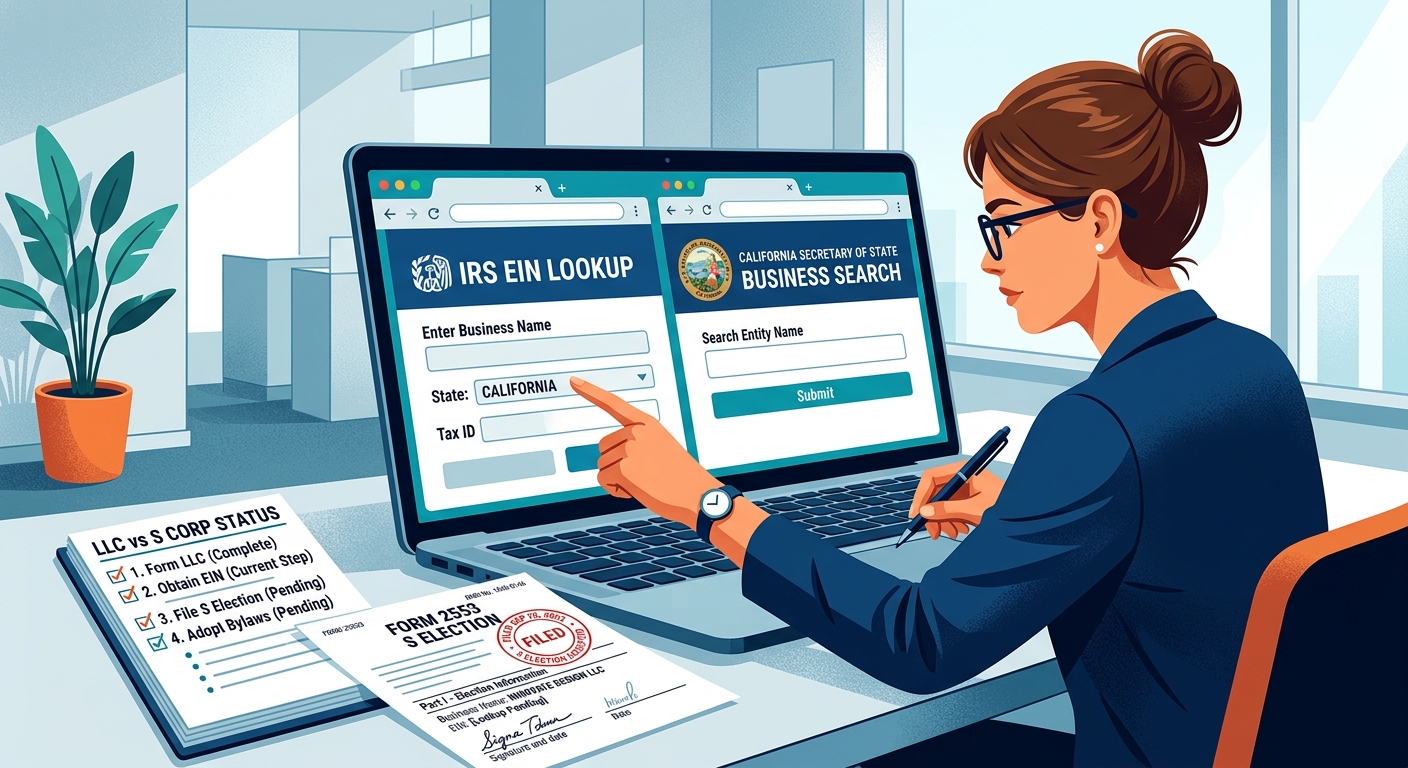
Most business owners think there is a simple “IRS LLC lookup” where you type a company name and instantly see “LLC” or “S Corp” like it is a credit score. That tool does not exist for the public. And the time to figure that out is not when a lender asks for proof, a new partner wants the cap table cleaned up, or the IRS sends a notice because your payroll and tax filings do not match.
This post explains what the irs llc lookup s c corp idea gets right, what it gets dangerously wrong, and the exact steps you can use to verify an entity’s legal status (state level) and tax status (IRS level) without guessing. We will also cover the real tax consequence: if you assume you are an S Corp but you never made a valid election, you may be paying the wrong taxes, running payroll you do not need, or missing payroll tax savings you thought you had.
This information is current as of 5/9/2026. Tax laws and administrative procedures change frequently. Verify updates with the IRS or your state agency if reading this later.
Quick Answer: Can You Do an IRS LLC Lookup for S Corp or C Corp Status?
You can verify an entity’s legal structure (LLC, corporation, partnership) through a state Secretary of State business search. But you generally cannot do a public “IRS lookup” that reveals whether a specific LLC is taxed as an S Corp or C Corp. To confirm tax status, you typically need internal documentation (accepted Form 2553, IRS notices, prior-year returns) or direct confirmation through authorized channels.
What the Phrase “IRS LLC Lookup S C Corp” Actually Means
People usually mean one of three things when they search for an “irs llc lookup s c corp”:
- They want to know the legal entity type (LLC vs corporation) for a vendor, competitor, or acquisition target.
- They want to know the tax classification (disregarded entity, partnership, S Corp, C Corp) because it affects contracting, 1099s, payroll, and tax estimates.
- They want proof for a bank, SBA loan package, investor due diligence, or an IRS/FTB inquiry.
Those are not the same problem. The state controls what the entity is. The IRS controls how the entity is taxed. You can be an LLC legally and still be taxed as an S Corp or C Corp if you elected it properly.
Plain-English definition: Legal status vs tax status
Legal status is your formation and filing type with the state (LLC, corporation, etc.). Tax status is how the IRS treats you for income tax filings (Schedule C, 1065 partnership return, 1120S S Corp return, or 1120 C Corp return). The IRS allows an LLC to choose its tax status under the “check-the-box” rules (see Form 8832 and Form 2553).
Why this matters: the mistake can cost real money
If you are a solo owner with $180,000 of net business profit and you think you are an S Corp, you might be splitting income between W-2 wages and distributions. If you are not actually an S Corp, the IRS can reclassify that as self-employment income and assess back self-employment tax, penalties, and interest. On $180,000, the tax swing can be five figures depending on facts.
Key Takeaway: Searching “irs llc lookup s c corp” is really a request for a verification workflow. You need a process, not a shortcut.
Step-by-Step: How to Verify an Entity’s Legal Type (LLC vs Corporation)
This is the part you can do publicly, and you should do it first because it sets the baseline. If the state says “corporation,” you are not dealing with an LLC. If the state says “LLC,” you still do not know whether it is taxed as S or C, but you do know what formation documents exist.
Step 1: Use the state Secretary of State business search
Every state has some version of a business entity search. In California, you will typically use the Secretary of State Business Search portal to confirm:
- Exact legal name (punctuation matters)
- Entity type (LLC, corporation, LP, LLP)
- Entity number (a key identifier for state filings)
- Status (active, suspended, dissolved)
- Agent for service of process
Step 2: Pull the entity’s public filings if you are doing due diligence
If you are buying a business, onboarding a major vendor, or becoming a partner, “active” is not enough. Look for:
- Articles of Organization (LLC) or Articles of Incorporation
- Statements of Information and any lapse history
- Any red flags like frequent address changes or recent reactivations
Step 3: Confirm good standing if California is involved
California has an additional trap: an entity can be active with the SOS but still be in trouble with the Franchise Tax Board (FTB). For California entity compliance, cross-check that franchise tax and filings are current. If you are a California business owner, our tax planning services routinely include entity hygiene reviews because “clean” entities are cheaper to operate and easier to defend.
If you are an owner-operator trying to make the LLC vs S Corp decision, read our LLC tax planning blueprint for California owners for the deeper strategy layer.
Pro Tip: Save PDFs of the state search results and any filings you download. Banks and partners often want proof, and screenshots disappear when portals update.
How to Verify an Entity’s IRS Tax Classification (This Is the Part People Get Wrong)
Here is the uncomfortable truth: there is no public IRS database where you can type “ABC Consulting LLC” and see whether it files a Form 1120S or Form 1120. The IRS treats entity tax classification as part of the taxpayer’s confidential account information.
What you can verify without special access
- EIN format and existence: You can validate whether an EIN “looks” correct, but that does not tell you entity type.
- W-9 classification that the entity provides: This is self-reported, not independently verified.
- Prior-year returns and acceptance notices: If you have them, they are stronger evidence than a W-9.
What you cannot reliably verify as a third party
- Whether an LLC made a valid S election (Form 2553) unless you see acceptance confirmation or authorized IRS account transcripts
- Whether an entity is “currently” treated as S if the election terminated (ownership changes, second class of stock, late filings, etc.)
- Whether an entity is a C Corp when it is legally an LLC (possible if it elected corporate taxation)
What the IRS uses to determine classification
For most LLCs, the IRS default classification rules are described in IRS guidance on business structures and the check-the-box system. Generally:
- Single-member LLC defaults to disregarded entity (Schedule C) unless it elects corporate treatment
- Multi-member LLC defaults to partnership (Form 1065) unless it elects corporate treatment
- S Corp status requires a timely and valid Form 2553 election and ongoing eligibility
To see the IRS explanation of entity types at a high level, use the IRS page on business structures: IRS business structures guidance.
Key Takeaway: The IRS does not offer a public “irs llc lookup s c corp.” If you need certainty, you need documentation or authorized IRS confirmation.
How to Confirm Your Own S Corp Election (If You Are the Owner)
If you are the owner, you are not stuck. You can confirm your tax status, but you have to use the right proof.
Proof hierarchy: what counts as “real” confirmation
- IRS acceptance notice for Form 2553: This is the gold standard. Many owners never save it.
- IRS business account transcript: Shows filing history and sometimes entity classification signals.
- Prior-year filed Form 1120S: Strong evidence, but still confirm acceptance if there was a late election situation.
- Payroll filings (Forms 941/940): Helpful context, but payroll alone does not prove S status.
Step-by-step: what to do if you cannot find your Form 2553 acceptance
- Check your email and old mail: Many acceptance letters were mailed to the address on the form.
- Check with your prior CPA or enrolled agent: Ask specifically for “Form 2553 acceptance letter” or “IRS CP261” if issued.
- Pull your IRS transcripts: If you have an IRS online account, download business-related transcripts where available. If not, your authorized tax pro can request them.
- Verify the first effective tax year: Owners sometimes think they elected for 2025, but the effective date is 2026 because the election was late or completed incorrectly.
Follow-up question: What if my LLC is taxed as an S Corp but my state file still says “LLC”?
That is normal. The legal entity stays an LLC. The tax election changes how you file taxes. You still have an LLC operating agreement, not corporate bylaws (unless you also formed a corporation). Your state business search will still show LLC. The IRS classification is separate.
Follow-up question: What if I have been filing 1120S but the IRS never accepted it?
This is where penalties show up. If the election was never valid, the IRS can treat the entity as its default classification and assess tax changes. Late election relief sometimes exists under IRS procedures depending on facts, but you need a professional to evaluate and document it. Do not assume “we filed it, so it is fine.”
KDA Case Study: LLC Owner Finds Out Their “S Corp” Was Never Real
Jasmine is a 1099 marketing consultant in California who formed “Jasmine Creative LLC” and was told by a friend that she should “be an S Corp” once she crossed $150,000 in profit. Her prior preparer started running payroll and filed an 1120S, but nobody could produce proof the IRS accepted the S election. When Jasmine applied for a mortgage, underwriting asked for confirmation of entity status. That is when the problem surfaced.
KDA reconstructed the timeline, pulled the business account transcript, and confirmed the election was not on file. We then mapped a fix: document reasonable compensation, evaluate late-election relief options, clean up payroll filings, and align California filings so the entity would not get hit with avoidable mismatch notices. The first-year impact was meaningful: Jasmine avoided an estimated $12,700 in reclassification exposure and penalty risk and put her tax filings on a defensible track. She paid $4,400 for advisory and cleanup work, which was a 2.9x risk-adjusted first-year return, and more importantly she got lender-ready documentation.
Ready to see how we can help you? Explore more success stories on our case studies page to discover proven strategies that have saved our clients thousands in taxes.
Common Mistakes That Turn “IRS LLC Lookup” Into an Audit Problem
This is the part most online articles skip. Verification errors become audit fuel because they create inconsistencies: you file one way, pay yourself another way, and issue 1099s that do not line up with how the IRS thinks the entity should behave.
Red Flag Alert: treating a W-9 as proof
A W-9 is a self-certification. If the vendor writes “S Corporation,” that does not guarantee the IRS has an active S election. For low-risk vendors, you may accept it. For large payments, acquisitions, or partner buy-ins, request stronger documentation.
Red Flag Alert: running payroll when you are not an S Corp
Only S Corp owners need to think about “reasonable compensation” as a compliance concept for owner wages. If you are a sole proprietor or disregarded LLC, you cannot W-2 yourself the same way. Mixing these systems can lead to messy filings and IRS notices.
Red Flag Alert: assuming the state knows your IRS tax status
The state business portal will not tell you whether an LLC elected S treatment. It is not designed to. If you need to know tax classification, you must verify through tax records.
Myth: “My accountant said I’m an S Corp, so I’m an S Corp”
An S election is a legal tax election. It is not a vibe. If Form 2553 was never filed, was filed late without relief, was filed with the wrong effective date, or eligibility was broken, you may not be an S Corp for that year.
Key Takeaway: Most “entity status” issues are really documentation issues. Clean documentation prevents audits and makes financing easier.
A Practical Verification Workflow for Business Owners (Use This Before Year-End)
If you are an owner, here is a clean process you can run in an hour that answers the “irs llc lookup s c corp” question for your own business.
1) Confirm your state legal status
- Pull your state entity search record
- Save proof of active status
- Confirm your legal name matches bank accounts and contracts
2) Gather your last two years of filed returns
- If you filed Schedule C, you were taxed as a sole proprietor or disregarded entity
- If you filed Form 1065, you were taxed as a partnership
- If you filed Form 1120S, you were treated as an S Corp (but still confirm the election)
- If you filed Form 1120, you were treated as a C Corp
3) Locate your election paperwork (Form 2553 or Form 8832)
Download the forms from IRS.gov so you know what you are looking for:
4) Cross-check payroll reality
If you are filing 1120S and taking distributions, confirm:
- Payroll was actually run (not just journal entries)
- Forms 941 were filed quarterly
- W-2 was issued correctly
5) Decide whether you are optimizing or just complying
Many business owners get stuck in a half-in, half-out situation: they formed an LLC, heard about S Corps, and made moves without a real plan. A better approach is to run a tax projection that compares your current classification to an S Corp election and includes:
- Reasonable salary expectations for your role
- Payroll cost and admin friction
- Self-employment tax savings potential
- California fees and franchise taxes
If you want a quick sanity check on profit levels, you can run your numbers through this small business tax calculator and then treat the result as a starting point for planning, not a final answer.
Key Takeaway: If you cannot put your election letter and last filed return in the same folder within 10 minutes, you have an avoidable risk.
Special Situations and Edge Cases Competitors Skip
This is where entity verification gets real. These are not rare; they just get ignored because they do not fit into “simple blog” content.
Edge case 1: Multi-member LLC that thinks it is an S Corp
Multi-member LLCs default to partnership taxation unless they make an election. If the LLC wants S treatment, it must first be treated as a corporation for tax purposes and then elect S status. The paperwork and effective dates matter. If you are a multi-member entity, you need to confirm the election chain is correct.
Edge case 2: Ownership changes that accidentally terminate S status
S Corps have eligibility rules, including limits on shareholders and types of owners. Certain ownership changes can terminate S status. If you took on an investor, issued a second class of equity economics, or transferred shares into an ineligible owner, your “S” may have ended without you realizing it.
Edge case 3: California suspension and revival
California entities can be suspended by the FTB. Even if the IRS classification is correct, suspension can freeze your ability to enforce contracts, obtain financing, and operate cleanly. Verification is not only federal.
Edge case 4: Lenders and the “prove it” problem
Even when everything is correct, lenders may still want:
- Entity status printout (SOS)
- Operating agreement or bylaws
- Prior-year returns
- Payroll reports
- Proof of S election acceptance
Pro Tip: Build a “lender-ready entity folder.” The time to create it is before you need the loan.
Ready to Reduce Your Tax Bill?
KDA Inc. specializes in strategic tax planning for business owners, S Corps, LLCs, and high-net-worth individuals. Book a personalized consultation and walk away with a clear plan.
FAQ: The Questions People Ask After They Search “IRS LLC Lookup S C Corp”
Can I look up if a business is an S Corp using the EIN?
Not through a public IRS search. Some verification can be done internally through authorized IRS channels or by reviewing the company’s tax documents. If you are a third party, request documentation from the business.
Does the IRS show entity type on a transcript?
Transcripts are account records and are generally available to the taxpayer or authorized representative. They can help confirm filing history and sometimes support classification confirmation, but you typically need proper authorization to access them.
If my LLC is taxed as an S Corp, do I have to change my state formation?
No. You can remain an LLC at the state level and be taxed as an S Corp at the federal level. The entity’s legal structure does not automatically change.
What if I never received a Form 2553 acceptance letter?
It happens. Start by checking with the preparer who filed it, then pull transcripts or request confirmation through authorized channels. If you cannot confirm acceptance, do not assume you are an S Corp for that tax year.
Is an LLC taxed as a C Corp common?
It is less common than S Corp elections for small owner-operators, but it exists. Some LLCs elect corporate taxation for specific planning reasons. The only way to confirm is documentation.
Will asking the IRS to confirm my entity status trigger an audit?
Requesting transcripts or confirming elections is normal. The bigger audit risk is running inconsistent filings, such as paying yourself like an S Corp while reporting like a sole proprietor.
Book Your Tax Strategy Session
If you searched “irs llc lookup s c corp” because you need certainty, not guesses, we can help. In a strategy session, we verify your entity status, locate or rebuild your election documentation, and map a clean plan so your payroll, returns, and California filings tell the same story. Book your personalized consultation here: book a consultation with KDA.
Mic drop: The IRS is not hiding your entity status from you; it is hiding it from everyone else, and that is why your documentation is the asset.



