
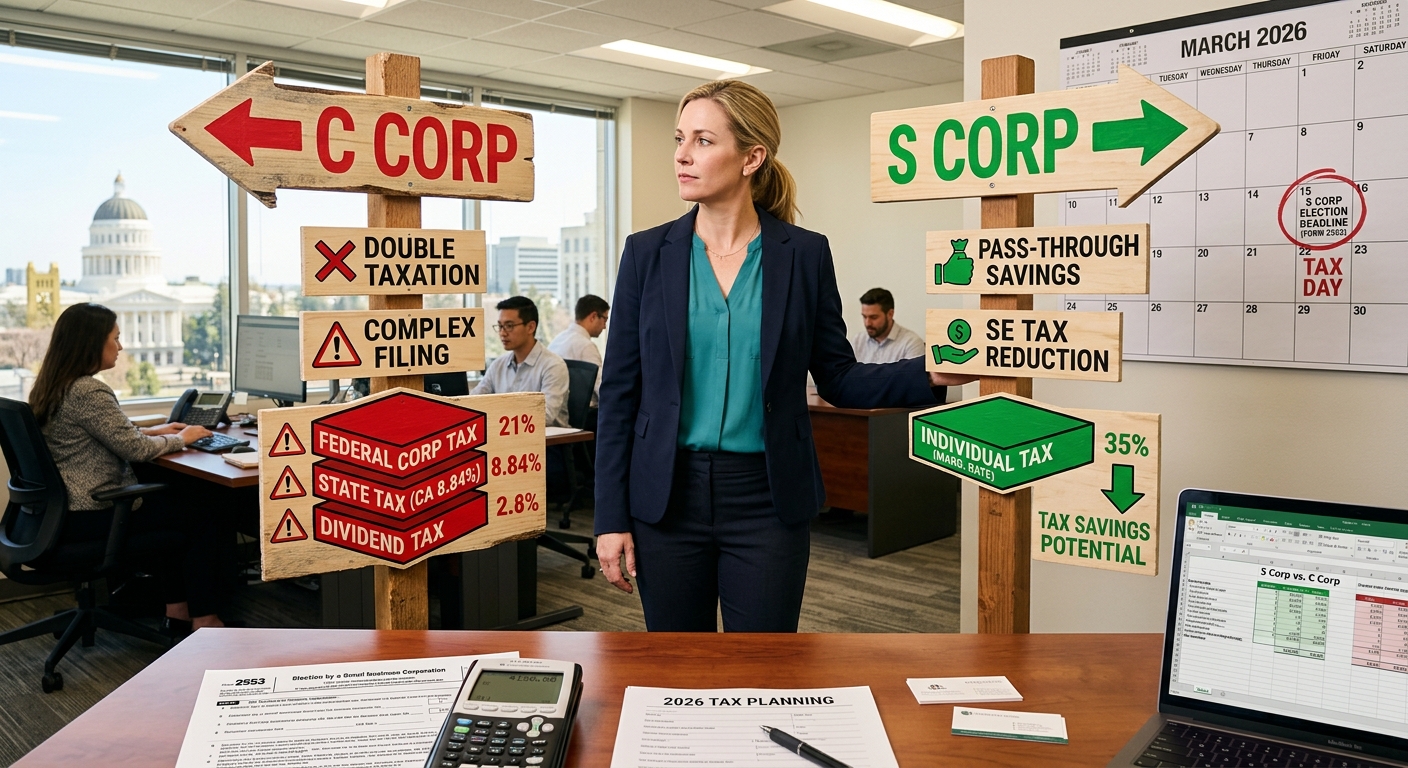
A Sacramento restaurant group owner called our office in April 2026 asking about converting from C Corp to S Corp status. She had been meaning to file for two years. Every month she waited cost her $3,417 in unnecessary double taxation, stacked California franchise tax, and lost QBI deductions. By the time she picked up the phone, the delay had already burned through $82,000. That is not a rounding error. That is a second location’s worth of capital, evaporated because of one missed filing window.
Here is the part that stings: the form itself takes 20 minutes to complete. The IRS charges nothing to file it. And yet thousands of California C Corp owners sit in the most expensive default entity structure in the country, paying five separate tax layers every single year they delay.
Quick Answer
Converting from C Corp to S Corp eliminates federal entity-level tax at 21%, removes dividend double taxation, cuts the California franchise tax rate from 8.84% to 1.5%, unlocks the permanent 20% QBI deduction under IRC Section 199A, and activates the AB 150 PTE election to bypass the $40,000 SALT cap. At $200,000 in annual profit, the S Corp structure saves $39,200 or more per year. Every month you stay in a C Corp past the March 15 deadline, you lose roughly $3,267 to $3,400 in avoidable taxes.
The Five Tax Layers That Bleed C Corp Owners Every Month They Delay Converting From C Corp to S Corp
Most business owners think the C Corp versus S Corp decision comes down to one number: the 21% federal corporate rate. That number is a trap. It is the first of five tax layers, and by the time all five stack up, the C Corp owner at $200,000 in profit is paying an effective rate near 47% while the S Corp owner sits around 27%.
Layer One: Federal Entity Tax at 21%
A C Corp pays 21% on every dollar of profit at the corporate level before any shareholder sees a dime. The S Corp pays 0% at the entity level. On $200,000, that is $42,000 gone before the owner takes a distribution. S Corp owners report income directly on their personal returns and skip this layer entirely.
Layer Two: Federal Dividend Double Taxation
After the C Corp pays its 21%, the remaining $158,000 gets taxed again when distributed as dividends. Qualified dividends face a 15% to 20% rate, plus the 3.8% Net Investment Income Tax under IRC Section 1411 for earners above $250,000 (married filing jointly). That adds another $23,700 to $37,500 in federal tax on the same income. S Corp distributions that exceed the reasonable salary are not subject to self-employment tax or NIIT in most cases.
Layer Three: California Franchise Tax Differential
California taxes C Corps at 8.84% of net income under the Revenue and Taxation Code. S Corps pay 1.5%, with a minimum of $800. On $200,000, that is $17,680 versus $3,000. The difference: $14,680 per year flowing straight out of the business for no operational benefit.
Layer Four: QBI Deduction Exclusivity
The Qualified Business Income deduction under IRC Section 199A, made permanent by the One Big Beautiful Bill Act (OBBBA), allows S Corp owners to deduct up to 20% of their qualified business income from taxable income. At $200,000 in profit with a $95,000 reasonable salary, the QBI deduction on the remaining $105,000 distribution saves roughly $5,040 at the 24% bracket. C Corp shareholders get zero access to this deduction. California does not conform to QBI under R&TC Section 17024.5, so this is a federal-only benefit, but it is still worth thousands annually.
Layer Five: AB 150 PTE Election
California’s AB 150 Pass-Through Entity tax election lets S Corp owners pay state income tax at the entity level, generating a dollar-for-dollar federal tax credit that bypasses the $40,000 SALT deduction cap imposed by the OBBBA. A C Corp owner cannot use this election. At $200,000 in profit, the AB 150 election saves an additional $2,800 to $4,200 depending on the owner’s marginal federal bracket.
Stack all five layers together and the annual gap between a C Corp and an S Corp at $200,000 in California profit lands between $39,200 and $48,700. Divide by twelve and every month of delay costs $3,267 to $4,058.
Why the March 15 Deadline Is the Most Expensive Date on the California Business Calendar
Form 2553 (Election by a Small Business Corporation) must be filed by March 15 of the tax year you want the S Corp election to take effect. Miss that date by even one day and you are locked into C Corp taxation for the entire calendar year. That is not a partial penalty. It is a full twelve months of double taxation.
Many business owners confuse this deadline with the tax filing extension deadline of October 15. Extensions do not apply to Form 2553. The election deadline is absolute unless you qualify for late election relief under Revenue Procedure 2013-30, which has its own set of strict requirements.
What Happens If You Miss the March 15 Window
If you file Form 2553 on March 16, your S Corp election takes effect on January 1 of the following year. That means you pay C Corp rates for the remainder of the current year. At $200,000 in annual profit, missing the deadline by a single day costs between $24,500 (for the remaining nine months) and $39,200 (for the full year if you file late in the prior year cycle).
Late Election Relief Under Rev. Proc. 2013-30
The IRS does provide a backdoor. Revenue Procedure 2013-30 allows late S Corp elections if you meet all of the following conditions: the entity intended to classify as an S Corp from the effective date, the failure to file was due to reasonable cause, the entity has not filed a tax return inconsistent with S Corp status, and less than three years and 75 days have passed since the intended effective date. You must include a reasonable cause statement with the late-filed Form 2553. If accepted, the IRS treats the election as timely. But “reasonable cause” is not guaranteed. The IRS can reject your explanation, and then you are stuck with C Corp status until the next filing window. For a deeper dive into every S Corp election nuance for California owners, our comprehensive S Corp tax strategy guide walks through every scenario.
California Requires Its Own Notification
Filing Form 2553 with the IRS is only half the job. California requires a separate notification to the Franchise Tax Board via Form 3560 (S Corporation Election or Termination/Revocation). Forgetting this step does not void your federal election, but it creates processing delays and potential penalties with the FTB. File both simultaneously to avoid confusion.
The Built-In Gains Tax Timing Trap That Catches Converting Owners Off Guard
The Built-In Gains (BIG) tax under IRC Section 1374 is the single biggest overlooked cost in any C Corp to S Corp conversion. When you convert, any appreciated assets inside the corporation are subject to a 21% federal tax if sold within the five-year recognition period following the conversion. California imposes its own BIG tax at the 1.5% S Corp rate on the same gains.
Want to see how the numbers shift at your specific profit level? Plug your business income into this small business tax calculator before making any conversion decisions.
How BIG Tax Works in Practice
Suppose your C Corp holds commercial real estate with a fair market value of $600,000 and a tax basis of $200,000. The built-in gain is $400,000. If you convert to an S Corp today and sell the property within five years, the corporation owes $84,000 in federal BIG tax (21% of $400,000) plus $6,000 in California BIG tax (1.5% of $400,000). That is $90,000 in taxes that would not apply if you either waited to sell or sold before converting.
Strategic Timing to Minimize BIG Tax Exposure
There are three approaches to handle BIG tax:
- Convert and hold. If you do not plan to sell appreciated assets within five years, the BIG tax becomes irrelevant. After the recognition period expires, all gains are taxed at normal S Corp pass-through rates with no entity-level tax.
- Sell before converting. If you plan to liquidate appreciated assets soon, sell them while still a C Corp. You will pay corporate tax on the gain, but you avoid the complexity of BIG tax calculations and the risk of triggering it accidentally.
- Offset with losses. Net operating losses and built-in losses recognized during the recognition period can offset built-in gains, reducing or eliminating the BIG tax. This requires careful tracking under IRC Section 1374(d).
Key Takeaway: The BIG tax does not make conversion a bad idea. It makes timing the conversion critical. Run a full asset appraisal before filing Form 2553 so you know exactly what exposure exists.
KDA Case Study: Sacramento Marketing Agency Owner Recovers $41,800 in Year One After Delayed Conversion
Rachel operated a digital marketing agency in Elk Grove, California, structured as a C Corp since 2019. Her accountant at the time told her the 21% corporate rate was “the best deal in the tax code.” By 2025, her agency was generating $215,000 in annual profit, and she was paying an effective total tax rate of 46.7% across all five layers.
When Rachel contacted KDA in January 2026, we ran a full five-layer projection. Her C Corp was costing her $43,800 more per year than an S Corp would. We identified $90,000 in built-in gains across her office equipment and a company vehicle, but since she had no plans to sell either asset within five years, the BIG tax exposure was functionally zero.
Here is what we implemented:
- Form 2553 filed February 12, 2026 with the IRS, well ahead of the March 15 deadline
- FTB Form 3560 filed simultaneously to notify California of the S Corp election
- Reasonable salary set at $95,000 based on industry benchmarks for marketing agency owners, documented under the nine-factor test from Revenue Ruling 59-221
- AE&P distribution of $32,000 cleaned out accumulated earnings and profits under IRC Section 1368(c) to prevent passive investment income issues
- AB 150 PTE election activated to bypass the SALT cap on her California state taxes
- Solo 401(k) established with $23,500 employee deferral plus 25% employer match on salary
- Dual depreciation schedules created to track California nonconformity under R&TC Sections 17250 and 24356 for bonus depreciation
Rachel’s first-year tax savings came to $41,800 on a $5,800 engagement fee, delivering a 7.2x return on investment. Over five years, the projected savings total $209,000, assuming stable revenue. Her effective tax rate dropped from 46.7% to 27.1%.
Ready to see how we can help you? Explore more success stories on our case studies page to discover proven strategies that have saved our clients thousands in taxes.
The Six Costliest Timing Mistakes When Converting From C Corp to S Corp in California
Mistake One: Assuming Extensions Apply to Form 2553
Tax filing extensions give you until October 15 to file your corporate return. They do not extend the March 15 deadline for Form 2553. This confusion costs more California business owners than any other single misunderstanding in entity planning. If your accountant tells you “we can file it with the extension,” find a new accountant.
Mistake Two: Ignoring Accumulated Earnings and Profits
When you convert from a C Corp to an S Corp, any accumulated earnings and profits (AE&P) from C Corp years carry forward into the S Corp. Under IRC Section 1368(c), distributions that exceed your Accumulated Adjustments Account (AAA) are treated as dividends to the extent of AE&P. This means you can end up paying dividend tax on S Corp distributions if you do not clean out the AE&P before or immediately after conversion. Additionally, if your S Corp has AE&P and passive investment income exceeds 25% of gross receipts for three consecutive years, your S Corp election can be automatically terminated under IRC Section 1362(d)(3).
Mistake Three: Setting an Unreasonable Salary
The IRS scrutinizes S Corp owner salaries aggressively. Per Watson v. Commissioner (T.C. Memo 2012-167), the salary must reflect what a comparable employee would earn for similar work. Setting your salary at $20,000 when industry data shows $90,000 for your role triggers reclassification of distributions as wages, plus back payroll taxes, penalties under IRC Section 6656, and accuracy-related penalties under IRC Section 6662. Our entity formation services include salary benchmarking documentation as part of every conversion engagement.
Mistake Four: Forgetting California Bonus Depreciation Nonconformity
California does not conform to federal bonus depreciation under IRC Section 168(k). Under R&TC Sections 17250 and 24356, California follows pre-2017 depreciation rules. If you claim 100% bonus depreciation on your federal return (now made permanent by the OBBBA) but fail to maintain separate California depreciation schedules, you will face FTB adjustments, amended returns, and potential penalties. Every C Corp to S Corp conversion must include a dual depreciation tracking system from day one.
Mistake Five: Skipping the BIG Tax Appraisal
If you convert without documenting the fair market value of all corporate assets on the conversion date, you have no defense against IRS claims about built-in gains. A qualified appraisal on the date of conversion establishes your baseline. Without it, the IRS can assign its own values, potentially inflating your BIG tax exposure by tens of thousands of dollars.
Mistake Six: Filing Form 2553 Without Checking IRC 1361(b) Eligibility
S Corps have strict eligibility requirements: no more than 100 shareholders, only individuals (no corporate or partnership shareholders except certain trusts and estates), one class of stock, and all shareholders must be U.S. citizens or residents. If your C Corp has even one disqualifying shareholder or a second class of stock embedded in your operating agreement, the IRS will reject the election. Worse, if the election is initially accepted and later found invalid, you face retroactive C Corp treatment plus penalties on all returns filed in the interim.
The OBBBA Changes That Make 2026 the Best Year to Convert
The One Big Beautiful Bill Act made several previously temporary provisions permanent, dramatically increasing the S Corp advantage:
- QBI deduction under IRC Section 199A is now permanent. Before the OBBBA, this deduction was scheduled to expire after 2025. California C Corp owners who convert now lock in this 20% deduction indefinitely.
- 100% bonus depreciation under IRC Section 168(k) is permanent. S Corp owners can fully expense qualifying assets in the year of purchase at the federal level (remember: California does not conform, so maintain dual schedules).
- Section 179 expensing limit increased to $2.5 million. This provides another avenue for immediate asset deduction that benefits S Corp pass-through owners directly.
- SALT cap set at $40,000. This makes the AB 150 PTE election even more valuable for California S Corp owners, as the PTE tax generates a full federal credit that bypasses this cap.
- Estate tax exemption raised to $15 million. For S Corp owners with succession plans, the stepped-up basis at death combined with the higher exemption provides significant estate planning advantages over C Corp structures.
Pro Tip: The permanence of QBI alone is worth the conversion. Before the OBBBA, some advisors recommended staying in a C Corp because QBI might expire. That argument is dead. The 20% deduction is here to stay, and every year you remain a C Corp is a year you cannot access it.
IRS Palantir SNAP AI: What the IRS Looks for After You Convert
The IRS Systematic New Audit Process (SNAP), powered by Palantir AI, cross-references multiple data streams after any entity reclassification. If you are converting from C Corp to S Corp, expect the following flags on the IRS radar:
- Salary-to-distribution ratio. SNAP compares your W-2 salary against total distributions. If distributions exceed salary by more than 60/40, your return gets flagged for potential unreasonable compensation review.
- Missing payroll filings. An S Corp that reports distributions but has no Form 941 quarterly payroll filings is an automatic audit trigger.
- Income drops post-conversion. If your C Corp reported $200,000 in revenue and your S Corp reports $120,000 the following year, SNAP flags the discrepancy for potential income shifting.
- Form 7203 basis tracking. Starting in 2021, shareholders must file Form 7203 (S Corporation Shareholder Stock and Debt Basis Limitations) to substantiate basis for loss deductions and distribution treatment. Missing this form triggers automated correspondence.
- AE&P distribution patterns. Large distributions in the year of conversion, especially when combined with low salary, generate audit selection scores.
This information is current as of May 2, 2026. Tax laws change frequently. Verify updates with the IRS or FTB if reading this later.
Ready to Reduce Your Tax Bill?
KDA Inc. specializes in strategic tax planning for business owners, S Corps, LLCs, and high-net-worth individuals. Book a personalized consultation and walk away with a clear plan.
Frequently Asked Questions About Converting From C Corp to S Corp
Can I convert my C Corp to an S Corp mid-year?
No. Form 2553 must be filed by March 15 for the election to take effect on January 1 of that year. If you file after March 15, the election takes effect on January 1 of the following year. There is no mid-year effective date for S Corp elections under IRC Section 1362(b). The only exception involves newly formed corporations that can elect within 75 days of formation.
Do I need a new EIN after converting?
No. Your Employer Identification Number stays the same. The entity itself does not change. You are simply changing the tax classification from C Corp to S Corp. Your bank accounts, contracts, and legal identity remain intact.
What is the minimum income level where conversion makes sense?
Generally, the S Corp advantage becomes meaningful at $60,000 to $75,000 in annual profit. Below that threshold, the payroll costs and administrative complexity of running an S Corp can outweigh the tax savings. Above $75,000, the savings from eliminating the 21% entity tax and accessing QBI typically exceed the additional compliance costs by a wide margin.
What happens to my C Corp net operating losses after conversion?
C Corp NOLs are suspended under IRC Section 1371(b) when you convert. They cannot be used against S Corp income. However, if you ever revoke the S Corp election and return to C Corp status, the NOLs become available again (subject to expiration rules). This is why running a thorough pre-conversion analysis matters. If your C Corp has significant NOLs, it may be worth using them before converting.
Can I undo the S Corp election if it does not work out?
Yes, but there is a cost. You can revoke the S Corp election by filing a written revocation statement signed by shareholders holding more than 50% of the stock under IRC Section 1362(d)(1). However, under IRC Section 1362(g), you cannot re-elect S Corp status for five years after revocation. At $200,000 in profit, the five-year lockout costs between $196,000 and $243,500 in additional taxes. Think carefully before revoking.
Does California automatically recognize my federal S Corp election?
No. You must file FTB Form 3560 separately with the California Franchise Tax Board. California generally follows the federal S Corp election for income tax purposes, but the notification is required. Failure to file Form 3560 can result in processing delays and penalties.
Book Your C Corp to S Corp Conversion Strategy Session
If you are still operating as a C Corp in California and your annual profit exceeds $60,000, every month of delay is costing you real money. The five-layer tax gap does not shrink on its own. It compounds. Book a personalized conversion analysis with our strategy team and we will show you the exact dollar amount you are losing, the BIG tax exposure on your assets, and the step-by-step timeline to complete your conversion before the next deadline. Click here to book your consultation now.
“The IRS does not charge you a penny to file Form 2553. The tax code charges you $39,000 a year for not filing it.”



