
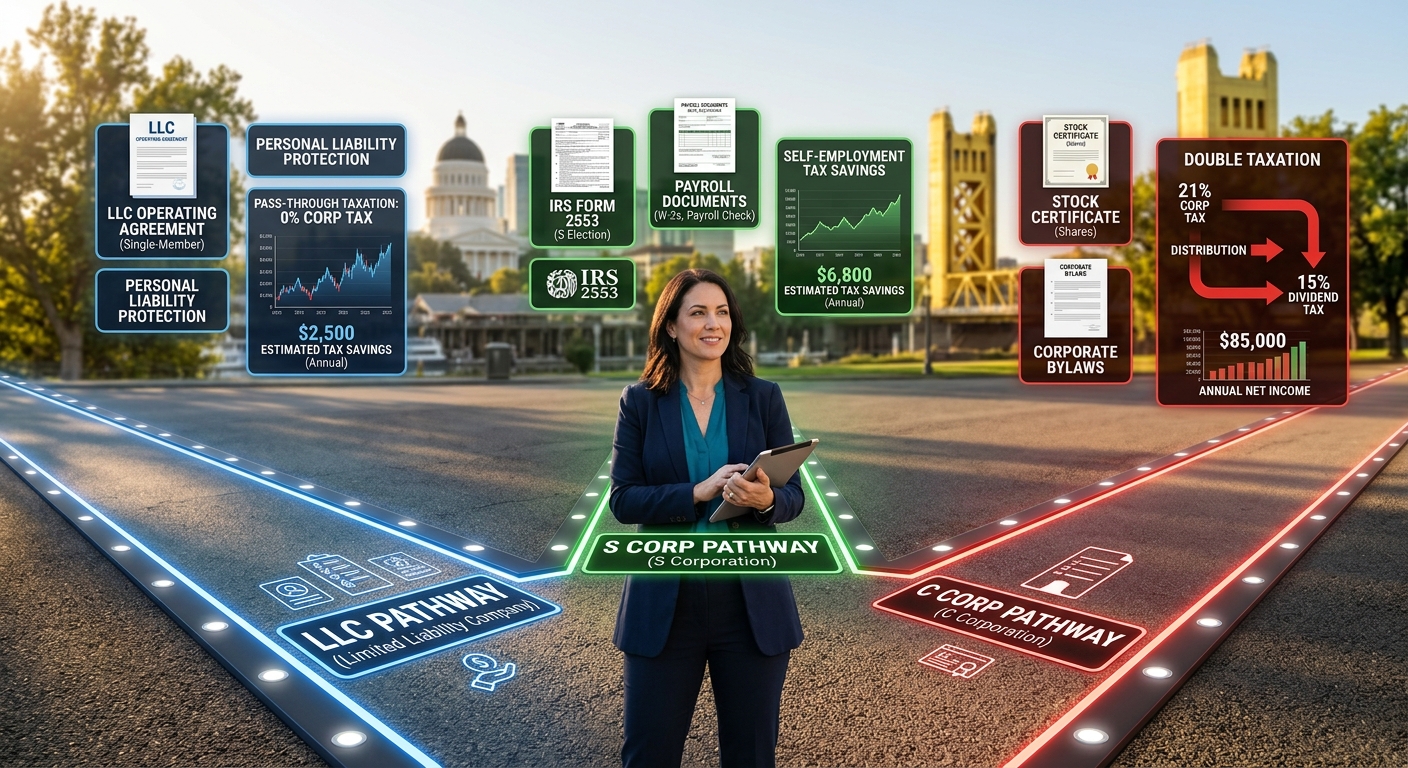
A Sacramento bakery owner asked her attorney which entity to pick. The attorney said “LLC.” Her CPA said “S Corp.” Her brother-in-law, who flipped one house in 2019, said “C Corp because of the 21% rate.” She listened to all three, filed nothing, and paid $14,200 more in combined federal and California taxes last year than she needed to. That is the real cost of the C Corp vs S Corp vs LLC debate when nobody actually runs the numbers across all five tax layers that matter in California.
This is not a vocabulary lesson. You will not find a paragraph here explaining that “LLC stands for Limited Liability Company.” Instead, you will get the exact dollar gap between each entity at three different profit levels, the five California-specific tax layers most advisors skip, the IRS forms and deadlines that lock in your savings or erase them, and a step-by-step process you can execute this quarter. If your business profit sits anywhere between $80,000 and $400,000, the wrong entity election is quietly siphoning thousands out of your bank account every single year.
Quick Answer
For most California business owners earning $80,000 or more in net profit, an LLC taxed as an S Corp delivers the lowest combined federal and state tax bill. A default LLC (taxed as a sole proprietorship or partnership) costs you 15.3% in self-employment tax on every dollar of profit. A C Corp subjects you to double taxation that can push your effective rate above 50%. An S Corp splits your income into a reasonable salary (subject to payroll taxes) and distributions (free from self-employment tax), saving $8,400 to $64,700 annually depending on your profit level. The right answer depends on your specific numbers, but the wrong answer is ignoring those numbers entirely.
The Five Tax Layers That Separate C Corp vs S Corp vs LLC in California
Most comparisons between these three entities stop at the federal level. That is why most comparisons are useless for California owners. Here are the five layers where the real money moves.
Layer 1: Federal Entity-Level Tax
A C Corp pays a flat 21% federal corporate income tax on every dollar of profit before any owner sees a dime. An S Corp and a default LLC both pass income through to the owner’s personal return, meaning zero entity-level federal tax. That 21% rate sounds low until you realize it is only the first toll booth on the highway.
Layer 2: Federal Double Taxation on Distributions
After the C Corp pays its 21% tax, the remaining profit is taxed again when distributed as dividends. Qualified dividends face a 15% to 23.8% rate (including the 3.8% Net Investment Income Tax under IRC Section 1411). That means a C Corp owner at the top bracket keeps roughly 59.8 cents of every dollar earned. An S Corp owner, by contrast, keeps the full distribution after paying income tax once. A default LLC owner also avoids double taxation but faces the self-employment tax problem in Layer 3.
Layer 3: Self-Employment Tax Exposure
A default LLC (sole proprietorship or partnership for tax purposes) subjects all net profit to the 15.3% self-employment tax (12.4% Social Security up to the $176,100 wage base in 2026, plus 2.9% Medicare with no cap, plus the 0.9% Additional Medicare Tax above $200,000 under IRC Section 3101(b)(2)). An S Corp limits that tax to just the owner’s reasonable salary. A C Corp avoids SE tax but creates double taxation. This layer alone creates an $8,400 to $18,000 annual gap between a default LLC and an S Corp at $100,000 to $200,000 profit levels.
Layer 4: California Franchise Tax Differential
California taxes C Corps at 8.84% of net income under Revenue and Taxation Code Section 23151. S Corps pay just 1.5% under R&TC Section 23802. Default LLCs pay the $800 minimum franchise tax plus a gross receipts fee that ranges from $900 (at $250,000+ gross receipts) to $11,790 (at $5,000,000+) under R&TC Section 17942. At $200,000 profit, a C Corp pays $17,680 in California franchise tax. An S Corp pays $3,000. A default LLC pays $800 plus whatever gross receipts fee applies. The franchise tax differential between a C Corp and S Corp at $350,000 profit is $25,655.
Layer 5: QBI Deduction and AB 150 PTE Election
The Qualified Business Income deduction under IRC Section 199A (made permanent by OBBBA) allows S Corp owners and LLC owners to deduct up to 20% of qualified business income from their federal taxable income. C Corp income does not qualify. Additionally, California’s AB 150 Pass-Through Entity (PTE) tax election allows S Corps and qualifying LLCs to pay a 9.3% entity-level tax that generates a dollar-for-dollar federal tax credit, effectively bypassing the $40,000 SALT deduction cap under OBBBA. C Corps cannot use the PTE election. This fifth layer alone can save an S Corp owner $4,000 to $12,000 annually compared to a C Corp.
Three-Entity Tax Comparison Table: California Owner at $200,000 Profit
| Tax Layer | C Corp | S Corp | Default LLC |
|---|---|---|---|
| Federal Entity Tax (21%) | $42,000 | $0 | $0 |
| Federal Dividend/Income Tax | $23,688 | $27,400 | $27,400 |
| Self-Employment Tax | $0 | $13,770 (salary only) | $24,885 (all profit) |
| California Franchise Tax | $17,680 | $3,000 | $1,700 |
| QBI Deduction Savings | $0 | -$6,160 | -$6,160 |
| AB 150 PTE Credit | $0 | -$3,400 | -$3,400 |
| Total Tax Burden | $83,368 | $34,610 | $44,425 |
| Annual Savings vs C Corp | — | $48,758 | $38,943 |
The S Corp saves $48,758 over the C Corp and $9,815 over the default LLC at $200,000 profit. That $9,815 gap between the S Corp and default LLC comes almost entirely from self-employment tax savings on the distribution portion. If you want to see how your specific profit level changes these numbers, plug your business income into this small business tax calculator and compare the results side by side.
Many business owners in California operate under a default LLC structure for years without realizing they are overpaying by $9,000 to $15,000 annually in unnecessary self-employment taxes. The fix is a single IRS form and a California notification. That is it.
The Six Costliest Entity Selection Mistakes California Owners Make
Choosing the wrong entity is not one mistake. It is usually a chain of smaller mistakes that compound into five and six figures of unnecessary tax over a decade. Here are the six most expensive ones.
Mistake 1: Falling for the 21% C Corp Rate Illusion
The 21% federal rate is a marketing number for politicians, not a tax rate you actually keep. After California’s 8.84% franchise tax and federal dividend taxation, a C Corp owner at $200,000 profit faces an effective rate above 41.6%. An S Corp owner at the same profit level faces an effective rate near 17.3%. The 21% number ignores the second layer of taxation and the California layer entirely. If anyone cites the 21% rate as a reason to choose a C Corp, ask them to calculate the effective rate after all five layers.
Mistake 2: Leaving Your LLC on Default Tax Treatment
Your LLC is not an entity for tax purposes. It is a legal wrapper. The IRS defaults a single-member LLC to Schedule C (sole proprietorship) and a multi-member LLC to Form 1065 (partnership). Both defaults subject 100% of profit to self-employment tax. Filing Form 2553 to elect S Corp taxation for your existing LLC changes only the tax treatment, not the legal structure. You keep your LLC’s liability protection and operating agreement while slashing your SE tax bill by $8,000 to $18,000 per year.
Mistake 3: Missing the March 15 Form 2553 Deadline
Form 2553 must be filed by March 15 of the year you want the S Corp election to take effect (or within 75 days of formation for new entities). Miss this deadline and you wait an entire year, paying full self-employment tax on every dollar of profit in the meantime. At $200,000 profit, that missed deadline costs $11,115 in unnecessary SE tax. The IRS does offer late election relief under Revenue Procedure 2013-30, but only if you meet strict reasonable cause requirements and file within 3 years and 75 days of the intended effective date.
Mistake 4: Setting an Unreasonable Salary
The IRS requires S Corp owner-employees to pay themselves a “reasonable salary” before taking distributions. Set it too low and you trigger audit scrutiny per Watson v. Commissioner. Set it too high and you eliminate the tax savings. The reasonable salary should reflect what you would pay someone in the open market to do your job. For most California small business owners, that falls between 40% and 60% of net profit. At $200,000 profit, a salary of $90,000 is defensible for many industries. A salary of $30,000 is not.
Mistake 5: Ignoring California Bonus Depreciation Nonconformity
California does not conform to federal bonus depreciation under Revenue and Taxation Code Sections 17250 and 24356. If you claim 100% bonus depreciation on your federal return (now permanent under OBBBA’s restoration of IRC Section 168(k)), you must maintain a separate California depreciation schedule using standard MACRS recovery periods. Failing to track dual depreciation creates incorrect state returns, potential penalties, and FTB audit exposure. This applies to all three entity types, but S Corp and LLC owners who also claim the AB 150 PTE election must be especially careful because the PTE calculation starts from California-adjusted income.
Mistake 6: Skipping the AB 150 PTE Election
California’s AB 150 allows qualifying S Corps and LLCs (taxed as partnerships or S Corps) to make a Pass-Through Entity tax election. The entity pays a 9.3% tax, and the owners receive a dollar-for-dollar credit against their California personal income tax plus a federal deduction that bypasses the $40,000 SALT cap established by OBBBA. At $200,000 profit, this election saves approximately $3,400 in federal taxes that a C Corp owner cannot access. Many owners who correctly elected S Corp status still miss this additional layer of savings because their CPA does not file the AB 150 election by the June 15 deadline.
Three Scenarios Where a C Corp Actually Wins
An S Corp wins in most situations, but honesty demands acknowledging the narrow scenarios where a C Corp is the better choice. For a deeper analysis of these dynamics, read our comprehensive S Corp tax strategy guide for California.
Scenario 1: Venture Capital Funding
S Corps are limited to 100 shareholders, all of whom must be U.S. citizens or residents, and the company can issue only one class of stock under IRC Section 1361(b). Venture capitalists require preferred stock with liquidation preferences, anti-dilution provisions, and participation rights. That makes an S Corp structurally incompatible with VC investment. If your growth plan requires institutional equity funding, a C Corp is the only viable path.
Scenario 2: Qualified Small Business Stock (QSBS) Exclusion
IRC Section 1202 allows C Corp shareholders to exclude up to $10 million (or 10 times their basis) in capital gains when selling qualified small business stock held for more than five years. This exclusion applies only to C Corps, and California does not conform to it under R&TC Section 18152.5. However, if you plan to sell the company and your projected gain exceeds $10 million, the federal QSBS exclusion could save more than any S Corp advantage. Crunch both scenarios before deciding.
Scenario 3: Full Profit Retention Below $250,000
If your business retains all profits for growth (no distributions to owners) and accumulated earnings stay below $250,000, the C Corp’s 21% flat rate may beat the S Corp’s pass-through rate at higher individual tax brackets. But the moment you distribute those retained earnings, double taxation kicks in. And the accumulated earnings tax under IRC Section 531 penalizes C Corps that retain earnings beyond the reasonable needs of the business. This scenario works only for short-term growth phases, not permanent structures.
Our entity formation services help California owners evaluate all three scenarios and choose the structure that saves the most over a five-year projection, not just the current year.
KDA Case Study: Elk Grove Restaurant Group Owner Cuts $41,200 in Year One
Marcus ran a two-location restaurant group in Elk Grove, California, generating $245,000 in combined net profit. His attorney had set up a C Corp during formation in 2021, and Marcus never questioned it. His CPA filed Form 1120 every year and distributed the remaining profit as dividends. Marcus paid $51,450 in total federal corporate tax, $21,658 in California franchise tax at 8.84%, and $18,922 in federal dividend tax on distributions. His total annual tax bill across all layers was $92,030.
KDA ran a five-layer analysis comparing his current C Corp structure to an LLC taxed as an S Corp. We filed Form 2553 with a late election under Revenue Procedure 2013-30, filed FTB Form 3560 with California, set a reasonable salary at $110,000 based on MGMA restaurant management benchmarks, activated the AB 150 PTE election, implemented a Solo 401(k) with a $23,500 employee deferral plus $27,500 employer contribution, and set up dual federal and California depreciation schedules for $85,000 in kitchen equipment placed in service during 2025.
Marcus’s new total tax bill: $50,830. That is $41,200 in first-year savings. KDA’s engagement fee was $5,800, producing a 7.1x return on investment. Projected five-year savings: $206,000 assuming stable revenue and no additional optimization. Marcus went from the most expensive entity structure in California to the least expensive one by changing his tax classification, not his business operations.
Ready to see how we can help you? Explore more success stories on our case studies page to discover proven strategies that have saved our clients thousands in taxes.
The Eight-Step Entity Selection and Conversion Process
Whether you are starting fresh or converting an existing entity, here is the exact sequence that protects your savings and keeps you compliant.
Step 1: Run a Five-Layer Tax Projection
Before touching any IRS form, calculate your total tax burden under all three entity types at your current profit level. Include federal entity tax, federal personal income tax, self-employment or payroll taxes, California franchise tax, and QBI/AB 150 savings. If the S Corp does not save at least $5,000 annually, the administrative costs of payroll may not justify the election.
Step 2: Verify S Corp Eligibility Under IRC Section 1361(b)
Confirm your business meets S Corp requirements: no more than 100 shareholders, all U.S. citizens or resident aliens, only one class of stock, and no corporate or partnership shareholders. Most single-owner LLCs and small partnerships clear these requirements easily.
Step 3: Evaluate Built-In Gains Tax (C Corp Conversions Only)
If you are converting from a C Corp, assets held at the time of conversion may trigger Built-In Gains (BIG) tax under IRC Section 1374 if sold within five years. Assess the fair market value of all business assets versus their tax basis. If you hold significant appreciated inventory, equipment, or real property, time your conversion carefully to minimize BIG tax exposure.
Step 4: Clean Up Accumulated Earnings and Profits (C Corp Conversions Only)
C Corps carry accumulated earnings and profits (AE&P) under IRC Section 312. After converting to S Corp status, AE&P can contaminate distributions under IRC Section 1368(c), causing them to be taxed as dividends instead of tax-free returns of basis. Distribute or eliminate AE&P before or immediately after conversion to avoid this trap.
Step 5: File Form 2553 with the IRS
Submit IRS Form 2553 by March 15 of the desired effective year. For new entities, file within 75 days of formation. Attach all required shareholder consents. If you missed the deadline, file under Revenue Procedure 2013-30 with a reasonable cause statement explaining the late election. The IRS approves the majority of timely late election requests.
Step 6: Notify California FTB with Form 3560
California requires a separate S Corp election notification via FTB Form 3560. This is not automatic when you file federal Form 2553. Missing this step means California treats your entity as a C Corp even if the IRS recognizes your S Corp election, creating a mismatch that triggers franchise tax at 8.84% instead of 1.5%.
Step 7: Establish Reasonable Salary and Payroll
Set up payroll for all owner-employees. The salary must be reasonable per Watson v. Commissioner. Use industry salary surveys, BLS data, and comparable local compensation to determine the right number. File quarterly Form 941, annual Form 940, and California DE 9 and DE 9C. Issue W-2s to all owner-employees. Payroll costs typically run $50 to $150 per month through a service provider.
Step 8: Activate AB 150 PTE Election and Set Up Dual Depreciation
File the AB 150 PTE election by June 15 to bypass the $40,000 SALT cap. Simultaneously establish dual depreciation schedules, one for federal returns using 100% bonus depreciation under IRC Section 168(k) and one for California returns using standard MACRS recovery periods under R&TC Sections 17250 and 24356. This dual tracking is mandatory for California S Corps and LLCs.
What About OBBBA Permanent Changes in 2026?
The One Big Beautiful Bill Act made several provisions permanent that directly affect the C Corp vs S Corp vs LLC decision. Here is what matters.
Permanent QBI Deduction Under IRC Section 199A
The 20% Qualified Business Income deduction is now permanent. This benefits S Corp owners and LLC owners but provides zero benefit to C Corp owners. At $200,000 profit with a $90,000 salary, the QBI deduction on the $110,000 distribution saves approximately $6,160 in federal tax annually. Over 10 years, that is $61,600 that C Corp owners simply cannot access.
100% Bonus Depreciation Restored Under IRC Section 168(k)
OBBBA restored 100% first-year bonus depreciation permanently. All three entity types can claim this on federal returns. However, California does not conform, so every California business owner must maintain separate depreciation schedules regardless of entity type. The practical impact: S Corps and LLCs can deduct the full cost of qualifying assets on federal returns while spreading the deduction over standard recovery periods on California returns.
$40,000 SALT Cap with AB 150 PTE Bypass
OBBBA raised the SALT deduction cap from $10,000 to $40,000. S Corps and LLCs using the AB 150 PTE election can bypass this cap entirely, gaining an additional federal deduction that C Corps cannot access. At higher income levels, this bypass saves $3,000 to $12,000 annually in federal taxes.
$15 Million Estate Exemption with Portability
OBBBA made the $15 million per-person federal estate tax exemption permanent ($30 million for married couples with portability under IRC Section 2010(c)(4)). While this applies regardless of entity type, S Corp ownership can be more easily transferred into irrevocable trusts for estate planning because S Corp shares receive a stepped-up basis at death under IRC Section 1014. C Corp shares also receive stepped-up basis, but the double taxation during life means less wealth available to transfer.
IRS Enforcement: What Palantir SNAP AI Flags in 2026
The IRS now uses Palantir’s SNAP (Strategic Network Analysis Platform) artificial intelligence system to cross-reference entity filings, payroll records, and individual returns. Here is what triggers additional scrutiny for each entity type.
S Corp Red Flags
- Salary-to-distribution ratios below 40% when comparable W-2 compensation for the same role is higher
- Missing Form 941 quarterly payroll filings alongside Form 1120-S showing significant profit
- Form 7203 (S Corp stock basis tracking) discrepancies that suggest distributions exceeding basis
- Late Form 2553 filings without corresponding reasonable cause documentation
C Corp Red Flags
- Accumulated earnings above $250,000 without documented business justification (IRC Section 531)
- Personal expenses classified as corporate deductions
- Below-market loans to shareholders under IRC Section 7872
- Excessive compensation to owner-employees used to avoid dividend classification
Default LLC Red Flags
- Schedule C losses for three or more consecutive years triggering hobby loss analysis under IRC Section 183
- Large deductions relative to gross income without supporting documentation
- Inconsistent income reporting between 1099-K/1099-NEC records and Schedule C
Pro Tip: The cheapest audit defense is accurate recordkeeping from day one. Keep every receipt, log every mile, and reconcile your books monthly. The IRS is not looking for honest mistakes. They are looking for patterns that suggest intentional underreporting.
Decision Framework: Which Entity Is Right for You?
Choose a Default LLC If:
- Your net profit is below $60,000 annually
- You want maximum simplicity with no payroll requirements
- You are testing a business idea and may shut down within 12 months
- Your business generates net losses (pass-through losses offset other income)
Choose an LLC Taxed as S Corp If:
- Your net profit exceeds $80,000 annually
- You can justify a reasonable salary and are willing to run payroll
- You plan to operate for at least three years
- You want the QBI deduction, AB 150 PTE election, and SE tax savings
- You have no plans to seek venture capital or issue multiple stock classes
Choose a C Corp If:
- You need VC funding or plan to issue preferred stock
- You qualify for and intend to claim the QSBS Section 1202 exclusion
- You will retain all profits below $250,000 for growth with no distributions
- You plan an IPO or acquisition exit within five years
Should I Convert My Existing C Corp?
If you currently operate as a C Corp and none of the three C Corp win scenarios apply to you, the conversion math almost always favors an S Corp election. A $200,000-profit California C Corp owner who converts saves $48,758 in year one. Even after accounting for BIG tax exposure and AE&P cleanup, the five-year savings typically exceeds $200,000. The conversion requires Form 2553, FTB Form 3560, AE&P distribution, payroll setup, and AB 150 activation. It takes 60 to 90 days from start to finish.
Ready to Reduce Your Tax Bill?
KDA Inc. specializes in strategic tax planning for business owners, S Corps, LLCs, and high-net-worth individuals. Book a personalized consultation and walk away with a clear plan.
Frequently Asked Questions
Can I Change My LLC’s Tax Classification Without Forming a New Entity?
Yes. Filing IRS Form 2553 changes only your tax classification from default (sole proprietorship or partnership) to S Corp. Your LLC remains intact as a legal entity with the same EIN, operating agreement, and liability protection. You do not need to dissolve and re-form.
What Is the Minimum Income to Make an S Corp Election Worth It?
The breakeven point where S Corp payroll costs (typically $600 to $1,800 per year) are offset by self-employment tax savings is approximately $60,000 to $80,000 in net profit. Below that threshold, the administrative burden outweighs the tax savings. Above $80,000, the savings accelerate rapidly.
Does California Conform to the Federal QBI Deduction?
No. California does not conform to IRC Section 199A. The QBI deduction reduces only your federal taxable income. Your California taxable income remains unchanged. This means California S Corp owners benefit from QBI on the federal side while still paying the 1.5% California franchise tax on full net income.
What Happens If I Revoke My S Corp Election?
You revert to C Corp status (or default LLC status if you are an LLC). Under IRC Section 1362(g), you cannot re-elect S Corp status for five tax years after revocation. At $200,000 profit, that five-year lockout costs approximately $243,790 in additional taxes. Revoke only after running a complete five-layer projection confirming C Corp treatment saves more.
Can a Multi-Member LLC Elect S Corp Status?
Yes, but all members must consent, all must be U.S. citizens or residents, and the LLC cannot have more than 100 members. The LLC must also meet the one-class-of-stock requirement, meaning all members receive distributions proportional to ownership. If your operating agreement provides for preferred returns or different distribution waterfalls, you may need to amend it before filing Form 2553.
How Does the AB 150 PTE Election Work for LLCs Taxed as S Corps?
The LLC (taxed as an S Corp) pays a 9.3% entity-level tax to California. Each owner receives a nonrefundable credit against their California personal income tax equal to their share of the PTE tax paid. The PTE tax payment is deductible on the entity’s federal return, bypassing the $40,000 SALT cap. The election must be made annually by June 15 and cannot be revoked for that tax year once made.
This information is current as of April 30, 2026. Tax laws change frequently. Verify updates with the IRS or FTB if reading this later.
“The IRS does not penalize you for choosing the cheapest legal structure. It penalizes you for not choosing at all.”
Book Your Entity Strategy Session
If you are running a California business as a default LLC or a C Corp and your profit exceeds $80,000, you are almost certainly paying thousands more in taxes than you need to. We will run your five-layer comparison, identify the exact savings available, and handle every form from 2553 to AB 150. No guessing. No generic advice. Just the numbers. Click here to book your entity strategy consultation now.



