
Quick Answer
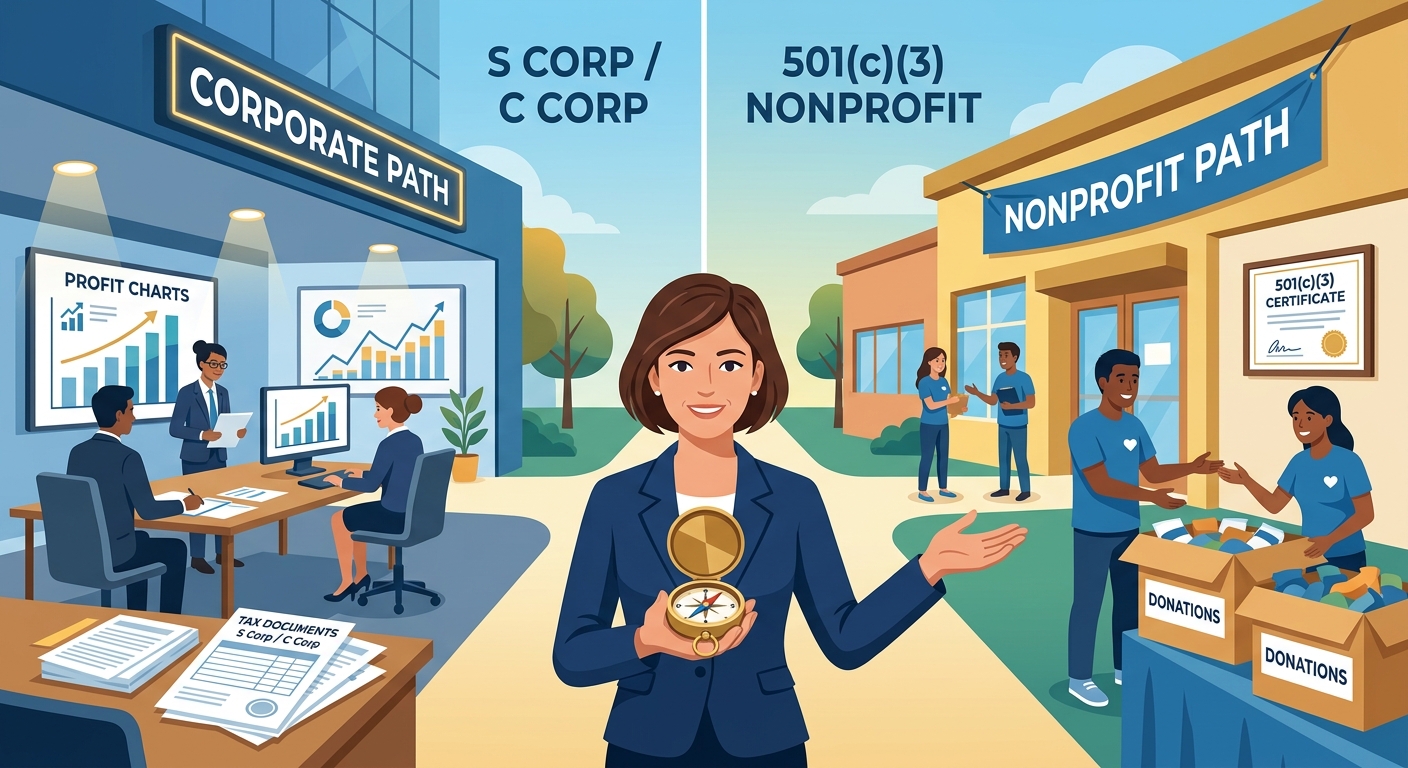
A C or S Corp and nonprofits serve fundamentally different purposes under the tax code, and choosing the wrong structure can cost California founders tens of thousands of dollars every year. C Corps pay federal tax at 21% plus California’s 8.84% franchise tax. S Corps pass income through to shareholders, paying only 1.5% at the state level and qualifying for the permanent QBI deduction under IRC Section 199A. Nonprofits organized under IRC Section 501(c)(3) pay zero federal and zero California income tax on mission-related activities, but they cannot distribute profits to founders or board members. The entity you pick locks in your tax obligations, your ability to raise capital, and your personal liability exposure for years. Most California founders lose between $11,000 and $48,000 annually because they never compare all three structures side by side before filing their articles of incorporation.
This information is current as of April 30, 2026. Tax laws change frequently. Verify updates with the IRS or FTB if reading this later.
Why Comparing a C or S Corp and Nonprofits Changes Everything for California Founders
Here is a fact that surprises most people walking into our office for the first time: roughly 40% of new California businesses file their formation documents without ever running a side-by-side tax projection across all three entity types. They pick the structure their attorney defaults to, or they copy what a friend did, or they assume nonprofits only work for charities. Every one of those shortcuts costs real money.
The IRS treats each structure differently at every level. A C Corporation files Form 1120 and pays a flat 21% federal corporate income tax under IRC Section 11. Profits distributed as dividends get taxed again on the shareholder’s personal return, typically at 15% to 23.8% when the Net Investment Income Tax under IRC Section 1411 kicks in. That is double taxation, and it compounds fast.
An S Corporation files Form 1120-S but pays zero federal entity-level tax. Income, losses, deductions, and credits flow through to the shareholders on Schedule K-1. In California, the S Corp pays a 1.5% franchise tax on net income under Revenue and Taxation Code Section 23802(b), plus the $800 minimum franchise tax under R&TC 23153. Compare that to the C Corp’s 8.84% rate, and the state-level savings alone can reach $14,680 on $200,000 of profit.
A nonprofit corporation organized under California Corporations Code Section 5110 and granted tax-exempt status under IRC Section 501(c)(3) pays zero federal income tax and zero California franchise tax on income related to its exempt purpose (see IRS 501(c)(3) exemption requirements). But the tradeoff is absolute: no founder, director, or officer can receive a share of the organization’s profits. Compensation must be reasonable and documented. The IRS enforces this through excise taxes under IRC Section 4958 on “excess benefit transactions,” and penalties can reach 200% of the excess amount.
Understanding these differences is not optional. It is the first decision that shapes your tax bill, your fundraising options, and your exit strategy for the life of your organization.
Five-Layer Tax Comparison: C Corp vs S Corp vs Nonprofit in California
Most comparisons you find online only look at one or two tax layers. That is why they mislead people. California business owners face at least five distinct tax layers, and the right entity structure minimizes the total burden across all of them. For a deeper dive into S Corp mechanics specifically, see our complete guide to S Corp tax strategy in California.
Layer 1: Federal Entity-Level Tax
C Corps pay 21% on every dollar of profit. S Corps pay 0%. Nonprofits with 501(c)(3) status pay 0% on mission-related income. On $200,000 of profit, the C Corp hands $42,000 to the IRS before any shareholder sees a dime.
Layer 2: Federal Double Taxation on Distributions
After the C Corp pays its 21%, dividends paid to shareholders face a second tax at 15% to 23.8%. On $200,000 profit, the remaining $158,000 distributed as qualified dividends triggers an additional $23,700 at the 15% rate. S Corp distributions from the Accumulated Adjustments Account (AAA) are not subject to a second layer of federal tax, provided the shareholder has sufficient basis tracked on Form 7203. Nonprofits do not distribute profits at all, so this layer does not apply.
Layer 3: California Franchise Tax Rate Differential
C Corps pay 8.84% of net income to the Franchise Tax Board. S Corps pay 1.5%. Nonprofits pay $0 on exempt-purpose income (though they still owe the $800 minimum franchise tax in most cases unless they qualify for a first-year exemption). On $200,000 profit:
- C Corp California tax: $17,680
- S Corp California tax: $3,000
- Nonprofit California tax: $0 to $800
Layer 4: QBI Deduction Exclusivity Under IRC Section 199A
The One Big Beautiful Bill Act (OBBBA) made the Qualified Business Income deduction permanent. S Corp shareholders can deduct up to 20% of qualified business income, reducing their effective federal rate by roughly 4 to 7 percentage points depending on income level. C Corps do not qualify because the deduction only applies to pass-through income. Nonprofits are exempt entities and do not generate QBI. On $200,000 of S Corp profit (after reasonable salary), the QBI deduction can save $6,000 to $8,400 in federal tax. Want to see how your numbers shake out? Run your figures through this small business tax calculator to estimate the impact.
Layer 5: AB 150 PTE Election for SALT Cap Bypass
California’s AB 150 Pass-Through Entity tax election allows S Corps (and other qualifying pass-through entities) to pay a 9.3% entity-level tax that generates a dollar-for-dollar federal deduction, effectively bypassing the $40,000 SALT cap under OBBBA. C Corps already deduct state taxes at the entity level, so they do not need this workaround. Nonprofits are not pass-through entities and cannot elect AB 150. For S Corp owners in high-tax brackets, this election recovers $4,000 to $12,000 annually that would otherwise be lost to the SALT cap.
Side-by-Side Tax Comparison Table at $200,000 Profit
| Tax Layer | C Corp | S Corp | Nonprofit (501(c)(3)) |
|---|---|---|---|
| Federal Entity Tax | $42,000 (21%) | $0 | $0 |
| Federal Dividend / Distribution Tax | $23,700 (15% on remainder) | $0 (AAA distributions) | N/A (no distributions) |
| California Franchise Tax | $17,680 (8.84%) | $3,000 (1.5%) | $0 to $800 |
| QBI Deduction Savings | $0 | ($7,200 savings) | N/A |
| AB 150 PTE SALT Recovery | N/A | ($6,400 savings) | N/A |
| Total Annual Tax | $83,380 | $39,780 (effective after QBI + AB 150) | $0 to $800 |
Key Takeaway: The S Corp saves $43,600 over the C Corp at $200,000 profit. The nonprofit pays almost nothing, but you cannot take any of that $200,000 home as profit. The right choice depends entirely on your goals.
Five Costliest Entity Selection Mistakes California Founders Make
Choosing between a C Corp, S Corp, or nonprofit is not just a tax decision. It is a structural decision that affects fundraising, compensation, exit planning, and IRS compliance for years. If you are evaluating your options, our entity formation services walk you through every step. Here are the five mistakes we see most often.
Mistake 1: Forming a Nonprofit to Avoid Taxes on a For-Profit Business
This is the most dangerous misconception. Some founders believe they can run a profitable business, call it a nonprofit, and pay zero tax. The IRS sees through this immediately. Under IRC Section 501(c)(3), your organization must be organized and operated exclusively for exempt purposes: charitable, religious, educational, scientific, literary, or certain other categories listed in the statute. If the IRS determines your “nonprofit” is operating a commercial business for the benefit of its founders, it will revoke your exemption retroactively and assess back taxes plus penalties. In 2025, the IRS revoked over 275,000 tax-exempt statuses for organizations that failed to file Form 990 for three consecutive years alone. Using a nonprofit shell for a profit-motivated business is not a loophole. It is a federal crime under IRC Section 7206.
Mistake 2: Defaulting to a C Corp When an S Corp Saves $39,000+ Annually
Attorneys who incorporate businesses often file as C Corps by default because it requires no additional IRS election. The founder never learns about Form 2553, the S Corp election form, until years of double taxation have already accumulated. At $200,000 in annual profit, that default costs $43,600 per year. Over five years, the founder has overpaid by $218,000. Filing Form 2553 by March 15 of the tax year (or using late election relief under Revenue Procedure 2013-30) eliminates the double taxation layer entirely.
Mistake 3: Ignoring Unrelated Business Income Tax (UBIT) for Nonprofits
Nonprofits are not exempt from all taxes. If a 501(c)(3) organization operates a business that is not substantially related to its exempt purpose, the income from that business is subject to Unrelated Business Income Tax under IRC Sections 511 through 514. The federal UBIT rate mirrors the corporate rate at 21%. California imposes its own UBIT. The organization reports this on Form 990-T. Many nonprofit founders discover UBIT the hard way when they launch a revenue-generating side operation and assume it is covered by their exemption. It is not.
Mistake 4: Choosing an S Corp When You Need Multiple Classes of Stock for Investors
S Corps are limited to one class of stock under IRC Section 1361(b)(1)(D). If your growth plan involves raising venture capital, issuing preferred shares, or bringing in institutional investors, an S Corp will not work. VC-backed startups almost always need a C Corp structure to accommodate preferred stock, convertible notes, and SAFE agreements. If fundraising is your primary objective, the C Corp’s double taxation may be the cost of accessing capital markets. However, if you are self-funded and profitable, the S Corp’s five-layer tax advantage dominates.
Mistake 5: Failing to Run a Five-Year Projection Before Filing
Entity selection is a long-term decision. The five-year re-election lockout under IRC Section 1362(g) means that if you revoke your S Corp election, you cannot re-elect for five tax years without IRS permission. Converting a nonprofit to a for-profit entity requires dissolving the nonprofit and distributing assets to another exempt organization, not to the founders. Running a five-year tax projection that compares all three structures at your realistic income levels is the single most valuable exercise before you file anything with the Secretary of State or the IRS.
When a Nonprofit Actually Makes Sense (and When It Does Not)
Nonprofits are powerful structures, but only when the mission genuinely qualifies. Here is the decision framework.
A Nonprofit Makes Sense If:
- Your primary purpose is charitable, educational, religious, or scientific
- You do not intend to distribute profits to any individual
- You plan to accept tax-deductible donations under IRC Section 170
- You are willing to comply with annual Form 990 reporting and public disclosure requirements
- Your compensation structure passes the “reasonable compensation” test under IRC Section 4958
- You expect to apply for grants from foundations or government agencies that require 501(c)(3) status
A Nonprofit Does Not Make Sense If:
- Your goal is personal wealth creation or business profit
- You want to sell the organization someday (nonprofits cannot be sold for personal gain)
- You need flexibility to raise equity capital from investors
- Your revenue comes primarily from commercial activities unrelated to an exempt purpose
- You want to pay yourself a percentage of profits rather than a fixed salary
Pro Tip: Some founders use a hybrid model: a for-profit S Corp that operates the revenue-generating business and a separate 501(c)(3) nonprofit that handles the charitable mission. The S Corp can make tax-deductible charitable contributions to the nonprofit under IRC Section 170, and the nonprofit can pursue grants and donations independently. This dual-entity approach gives you profit extraction rights through the S Corp and tax-exempt fundraising power through the nonprofit, all without compromising either structure’s legal standing.
California-Specific Nonprofit Rules
California requires nonprofit corporations to file Form 199 (California Exempt Organization Annual Information Return) or Form 199N (the e-Postcard for small organizations) with the FTB annually. Organizations with gross receipts exceeding $50,000 must file the full Form 199. Additionally, nonprofits that solicit donations in California must register with the Attorney General’s Registry of Charitable Trusts and file Form CT-2 (Annual Registration Renewal Fee Report). Failure to maintain these filings can result in suspension of the organization’s tax-exempt status by the FTB and potential penalties from the Attorney General’s office.
KDA Case Study: Sacramento Founder Saves $38,400 with the Right Entity Structure
A Sacramento-based entrepreneur came to KDA in early 2026 with a problem. He had launched a workforce development training company two years earlier as a C Corporation because his attorney filed it that way by default. He also operated a small mentorship nonprofit on the side. The C Corp was generating $195,000 in annual profit. The nonprofit was running on $45,000 in annual donations and a $30,000 grant.
His C Corp tax bill was brutal. Between the 21% federal corporate tax ($40,950), California’s 8.84% franchise tax ($17,238), and the dividend tax on distributions he needed to pay himself ($17,835 at 15% on the after-tax remainder), his total annual tax load exceeded $76,000.
KDA restructured the operation. First, we filed Form 2553 for late S Corp election under Revenue Procedure 2013-30 and submitted FTB Form 3560 to California. We set a reasonable salary at $92,000 based on BLS data for training program directors in the Sacramento metro area, satisfying Watson v. Commissioner standards. The remaining $103,000 flowed through as S Corp distributions taxed only at the individual level with no self-employment tax.
Next, we activated the AB 150 PTE election to bypass the $40,000 SALT cap, recovering $7,200 in federal deductions. We implemented the permanent QBI deduction under IRC Section 199A, saving an additional $6,800. For the nonprofit, we ensured Form 990 compliance, registered with the Attorney General, and separated all commercial training revenue into the S Corp to avoid UBIT exposure on the nonprofit side.
Year-one results: total tax savings of $38,400. KDA’s engagement fee was $5,800. That is a 6.6x first-year return on investment. Projected five-year savings: $192,000. The founder kept his nonprofit intact for grant eligibility and charitable donations while extracting profit legally through the S Corp.
Ready to see how we can help you? Explore more success stories on our case studies page to discover proven strategies that have saved our clients thousands in taxes.
The OBBBA Permanent Changes That Affect All Three Entity Types in 2026
The One Big Beautiful Bill Act signed into law in 2025 made several provisions permanent that directly impact how C Corps, S Corps, and nonprofits operate in California.
Permanent QBI Deduction Under IRC Section 199A
The 20% Qualified Business Income deduction is now permanent for pass-through entities, including S Corps. This deduction was originally set to expire after 2025 under the Tax Cuts and Jobs Act. OBBBA made it permanent, giving S Corp owners a reliable planning tool. C Corps and nonprofits do not qualify. Note that California does not conform to the QBI deduction under R&TC Section 17201, so the savings are federal only.
100% Bonus Depreciation Restored Under IRC Section 168(k)
OBBBA restored 100% first-year bonus depreciation for qualifying assets placed in service. This benefits both C Corps and S Corps that purchase equipment, vehicles, or other depreciable property. California does not conform to federal bonus depreciation under R&TC Sections 17250 and 24356, so businesses must maintain dual depreciation schedules. Nonprofits can claim depreciation on assets used in unrelated business activities reported on Form 990-T, but most exempt-purpose assets are not depreciable for tax purposes.
$40,000 SALT Cap With AB 150 Workaround
OBBBA raised the SALT deduction cap from $10,000 to $40,000 for married filing jointly. S Corps can bypass this cap entirely through California’s AB 150 PTE election. C Corps deduct state taxes at the entity level and are not affected by the individual SALT cap. Nonprofits do not pay individual-level taxes on organizational income, so the SALT cap is generally irrelevant.
$15 Million Per-Person Estate Tax Exemption
OBBBA made the elevated estate tax exemption permanent at $15 million per person ($30 million for married couples using portability under IRC Section 2010(c)(4)). This affects founders of all entity types who are building wealth. S Corp and C Corp shares are includable in the taxable estate. Nonprofit founders do not “own” the organization, so nonprofit assets are not part of the founder’s estate.
IRS Palantir SNAP AI Enforcement
The IRS continues expanding its Palantir-powered SNAP AI system to cross-reference entity filings, compensation levels, and income patterns. For S Corp owners, the system flags salary-to-distribution ratios that appear unreasonable. For C Corp shareholders, it tracks dividend distributions against reported corporate income. For nonprofits, it monitors compensation reported on Form 990 Schedule J against comparable organizations in the same geographic area and revenue range. Getting your entity structure right is no longer just about tax savings. It is about audit-proofing your filing position.
Eight-Step Entity Selection Process for California Founders
Whether you are starting fresh or restructuring an existing organization, follow this process to select the right entity.
- Define Your Primary Purpose – Is this a profit-seeking business or a mission-driven organization? If profit is the goal, eliminate nonprofit from consideration immediately. If the mission qualifies under IRC Section 501(c)(3) and you do not need profit distributions, nonprofit may be the strongest structure.
- Run a Five-Year Tax Projection – Model your expected revenue and expenses for five years. Compare total tax liability under C Corp, S Corp, and (if applicable) nonprofit structures. Include all five California tax layers.
- Evaluate Fundraising Needs – If you need venture capital or multiple classes of stock, C Corp is likely required. If you are self-funded, S Corp dominates. If you need tax-deductible donations and grants, nonprofit is the path.
- Assess Exit Strategy – C Corps and S Corps can be sold, merged, or taken public. Nonprofits cannot be sold for personal gain. If you plan to build equity and sell someday, a for-profit entity is mandatory.
- Verify IRS Eligibility – S Corps must meet requirements under IRC Section 1361(b): 100 or fewer shareholders, one class of stock, all shareholders must be U.S. citizens or residents, and no corporate or partnership shareholders. Nonprofits must pass the organizational and operational tests under IRC Section 501(c)(3). C Corps have no ownership restrictions.
- File Formation Documents – For California corporations, file Articles of Incorporation with the Secretary of State (Form ARTS-GS for general stock corporations or Form ARTS-PB for public benefit nonprofits). For LLCs electing S Corp treatment, file Articles of Organization (Form LLC-1) and then submit Form 2553 to the IRS.
- Submit Federal Elections – S Corps: File Form 2553 by March 15 of the tax year the election should take effect. Nonprofits: File Form 1023 or Form 1023-EZ for 501(c)(3) determination. C Corps: No additional election needed. The default classification applies.
- Activate California-Specific Compliance – File FTB Form 3560 for S Corp elections. Register nonprofits with the Attorney General. Set up payroll for S Corp reasonable salary. Activate AB 150 PTE election if applicable. Establish dual depreciation schedules for California nonconformity.
Key Takeaway: Steps 1 and 2 are where most founders go wrong. They skip the purpose analysis and the projection, then lock themselves into a structure that costs thousands every year.
Ready to Reduce Your Tax Bill?
KDA Inc. specializes in strategic tax planning for business owners, S Corps, LLCs, and high-net-worth individuals. Book a personalized consultation and walk away with a clear plan.
Frequently Asked Questions
Can I Convert a Nonprofit to an S Corp or C Corp?
Not directly. A 501(c)(3) nonprofit cannot convert to a for-profit entity. You must dissolve the nonprofit, distribute remaining assets to another exempt organization (as required by California Corporations Code Section 6615 and IRS regulations), and then form a new for-profit entity separately. You cannot transfer nonprofit assets to yourself or to a new for-profit company you own.
Can a Nonprofit Own an S Corp or C Corp?
A nonprofit cannot be a shareholder in an S Corp because IRC Section 1361(b)(1)(B) limits shareholders to individuals, certain trusts, and estates. However, a nonprofit can own shares in a C Corp. Dividends received from the C Corp may be subject to UBIT if the investment is debt-financed under IRC Section 514.
What Happens If My Nonprofit Earns Too Much Commercial Revenue?
If a substantial part of your nonprofit’s activities are unrelated to its exempt purpose, the IRS may revoke your tax-exempt status entirely. Even if the commercial revenue does not trigger revocation, it is subject to UBIT at the 21% corporate rate. The safer approach is to spin off commercial operations into a separate for-profit entity (S Corp or C Corp) and keep the nonprofit focused on its exempt mission.
Is the $800 California Minimum Franchise Tax Waived for Nonprofits?
Nonprofits with tax-exempt status from the FTB are generally exempt from the $800 minimum franchise tax. However, the exemption must be granted by the FTB separately from the IRS determination. File FTB Form 3500 (or 3500A for organizations with federal determination letters) to request California tax-exempt status. Until the FTB grants the exemption, the $800 minimum applies.
Should I Use the Hybrid S Corp Plus Nonprofit Model?
The hybrid model works well when you have both a genuine charitable mission and a profit-generating business. The S Corp handles revenue, pays you a salary, and distributes profits. The nonprofit pursues grants, accepts donations, and fulfills the charitable purpose. The two entities must operate independently with separate boards, bank accounts, and records. The IRS scrutinizes arrangements where a for-profit entity controls or financially benefits from a related nonprofit.
What Is the Reasonable Salary Requirement for S Corp Owners?
The IRS requires S Corp shareholder-employees to pay themselves a reasonable salary before taking distributions. “Reasonable” means comparable to what someone with similar experience, in a similar role, in the same geographic area would earn. The IRS uses data from the Bureau of Labor Statistics, industry surveys, and comparable wage reports. Setting your salary too low triggers reclassification of distributions as wages, plus back payroll taxes, penalties, and interest. Watson v. Commissioner remains the landmark case on this issue. Use BLS Occupational Employment and Wage Statistics for your metro area as a starting benchmark.
Book Your Entity Structure Strategy Session
If you are trying to figure out whether a C Corp, S Corp, or nonprofit is the right fit for your California business or organization, stop guessing. The wrong choice can cost you $38,000 or more every single year, and switching later is expensive and complicated. Book a personalized consultation with KDA’s strategy team and get a five-year tax projection across all three entity types, tailored to your exact income, goals, and fundraising plans. Click here to book your consultation now.
“The IRS does not care which entity you picked. It only cares whether you followed the rules for the one you chose.”



