
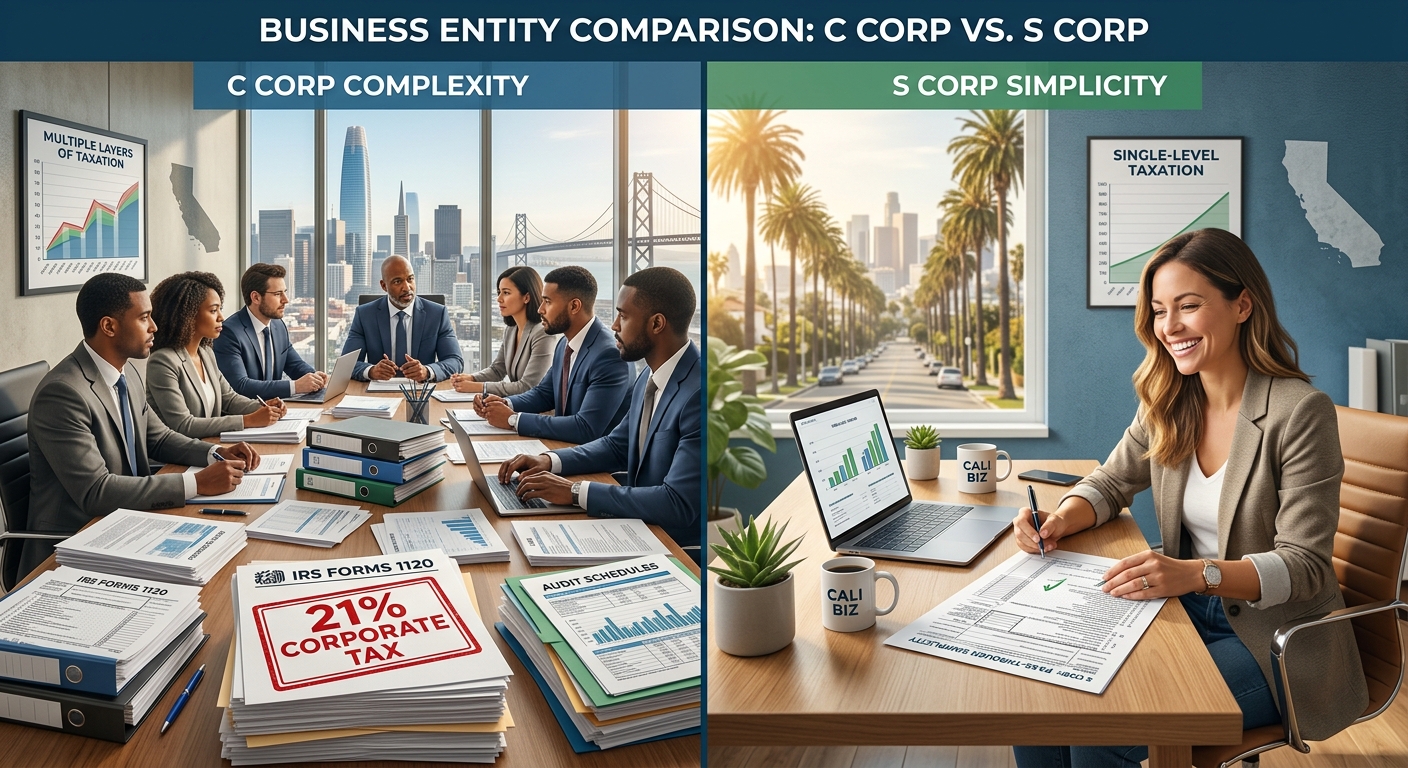
Most California Business Owners Pick Their Entity Structure the Same Way They Pick a Restaurant: Based on Whatever Someone Else Recommended
A Sacramento LLC owner walked into our office last March with a simple question: what is a C Corp and S Corp, and which one should I be? She had been running her consulting business for four years as a default LLC taxed as a sole proprietorship. Nobody had ever explained the difference. Nobody had shown her the numbers. And that silence had cost her $47,200 in unnecessary taxes over those four years.
She is not unusual. According to IRS Statistics of Income data, over 60% of California LLCs never file Form 2553 to elect S Corporation status, even when the math overwhelmingly favors it. The gap between choosing the right entity and the wrong one is not theoretical. It shows up on your tax return every single year as thousands of dollars you did not have to pay.
Quick Answer
A C Corporation is a separate legal entity that pays its own federal income tax at a flat 21% rate, and shareholders pay tax again when profits are distributed as dividends. An S Corporation is a pass-through entity where profits flow directly to the owner’s personal return with zero entity-level federal tax, plus eligibility for the 20% Qualified Business Income deduction under IRC Section 199A. For most California business owners earning $60,000 or more in annual profit, the S Corp structure saves $8,400 to $64,700 per year depending on income level.
What Is a C Corp and S Corp: The Core Tax Mechanics Explained
Before you can choose the right entity, you need to understand how each one actually works under the tax code. These are not just labels. They are fundamentally different tax systems that determine how every dollar of profit gets taxed.
C Corporation Tax Mechanics
A C Corporation (sometimes called a “regular corporation”) is the default classification when you incorporate with the Secretary of State. The IRS treats it as a completely separate taxpayer from you personally. Here is how the money flows:
- Step 1: Your business earns $200,000 in profit
- Step 2: The corporation pays 21% federal income tax under IRC Section 11, which equals $42,000
- Step 3: California charges 8.84% corporate franchise tax under Revenue and Taxation Code Section 23151, which equals $17,680
- Step 4: The remaining $140,320 gets distributed to you as a dividend
- Step 5: You pay federal qualified dividend tax at 15% to 20% on that distribution, plus the 3.8% Net Investment Income Tax under IRC Section 1411
- Step 6: California taxes that dividend at your marginal income tax rate up to 13.3%
That is six layers of taxation on the same dollar of profit. At $200,000, the effective combined rate lands around 46.9%. You started with $200,000 and kept roughly $106,200.
S Corporation Tax Mechanics
An S Corporation is not a different type of company. It is a tax election you make by filing IRS Form 2553. The business itself pays zero federal income tax. Instead, all profit passes through to your personal tax return on Schedule K-1. Here is the same $200,000 scenario:
- Step 1: You pay yourself a reasonable salary of $90,000 (subject to payroll taxes)
- Step 2: The remaining $110,000 flows to you as a distribution with zero self-employment tax and zero payroll tax
- Step 3: California charges only 1.5% franchise tax under R&TC Section 23802, which equals $3,000 on net income
- Step 4: You claim the 20% QBI deduction under permanent IRC Section 199A on the qualifying income, saving an additional $8,800 to $22,000 depending on your total taxable income
- Step 5: You elect into AB 150 Pass-Through Entity (PTE) tax to bypass the $40,000 SALT cap
At $200,000, the effective combined rate lands around 27.3%. You kept roughly $145,400. That is a $39,200 difference on the same income, in the same state, doing the same work.
Side-by-Side Tax Comparison Table
| Business Profit | C Corp Total Tax | S Corp Total Tax | Annual S Corp Advantage |
|---|---|---|---|
| $100,000 | $38,400 | $20,800 | $17,600 |
| $200,000 | $93,800 | $54,600 | $39,200 |
| $350,000 | $178,300 | $113,600 | $64,700 |
If you want to see how your specific income level compares, run your numbers through this small business tax calculator to estimate your total tax under each structure.
The Five Tax Layers That Separate C Corps From S Corps in California
The comparison above only tells part of the story. Many business owners look at the C Corp’s flat 21% federal rate and assume it is automatically lower than their personal income tax rate. That comparison ignores four additional layers that stack on top of each other in California.
Layer 1: Federal Entity-Level Tax (21% vs. 0%)
C Corps pay a flat 21% federal corporate income tax under IRC Section 11 before any money reaches you. S Corps pay 0% at the entity level. Every dollar of C Corp profit starts 21 cents behind before you even see it.
Layer 2: Federal Dividend Double Taxation
When C Corp profits are distributed as dividends, you pay qualified dividend rates of 15% to 20% plus the 3.8% Net Investment Income Tax under IRC Section 1411. S Corp distributions are not dividends. They are returns of already-taxed income and carry zero additional federal tax (assuming sufficient stock basis tracked on Form 7203).
Layer 3: California Franchise Tax Differential (8.84% vs. 1.5%)
California charges C Corps an 8.84% franchise tax on net income under R&TC Section 23151. S Corps pay only 1.5% under R&TC Section 23802. On $200,000 of profit, that difference alone is $14,680 every year. California also adds a gross receipts fee under R&TC Section 17942 for LLCs ranging from $900 to $11,790 depending on total California gross receipts.
Layer 4: QBI Deduction Exclusivity Under IRC Section 199A
The Qualified Business Income deduction lets S Corp owners deduct up to 20% of their business income from federal taxable income. This deduction was made permanent by the One Big Beautiful Bill Act (OBBBA) signed in 2025. C Corp shareholders get zero QBI deduction. At $200,000 in profit, the QBI deduction can save an S Corp owner $8,800 or more in federal tax. Important note: California does not conform to the federal QBI deduction, so this benefit applies only on your federal return.
Layer 5: AB 150 Pass-Through Entity Election
California’s AB 150 allows S Corps to pay state income tax at the entity level and claim a dollar-for-dollar credit on the owner’s personal return. This effectively bypasses the $40,000 SALT deduction cap (raised from $10,000 under OBBBA). C Corps cannot use this workaround because they are not pass-through entities. For California owners in high-tax brackets, this single election can save $3,000 to $12,000 annually.
Five Costliest Mistakes When Choosing Between a C Corp and an S Corp
Understanding what is a C Corp and S Corp on paper is one thing. Avoiding the traps that cost real money is another. These five mistakes account for over 80% of the unnecessary tax we see when California owners walk into our office.
Mistake 1: Believing the 21% C Corp Rate Is Lower Than Your Personal Rate
This is the single most expensive misconception in entity selection. The 21% C Corp rate is only the first layer of tax. After California’s 8.84% franchise tax and federal/state dividend taxes on distributions, total effective rates on distributed C Corp income range from 42% to 52%. Your personal rate as an S Corp owner with QBI and AB 150 applied typically ranges from 25% to 35%. The “lower” C Corp rate actually costs you more.
Mistake 2: Letting Your Attorney Choose Your Entity Without Tax Projections
Attorneys default to C Corporations because that is the standard incorporation structure. They are trained in liability protection, not tax optimization. If your attorney filed your Articles of Incorporation without running a five-year tax projection, you may be overpaying by $17,600 to $64,700 every single year. Filing Form 2553 to elect S Corp status takes one page and costs nothing at the IRS. The savings start immediately.
Mistake 3: Missing the March 15 Form 2553 Deadline
To elect S Corp status for the current tax year, Form 2553 must be filed by March 15 of that year. Miss this deadline and you default to C Corp taxation for the entire year. The good news: Revenue Procedure 2013-30 provides late election relief if you can demonstrate reasonable cause. But you have to know the relief exists, and you have to file the correct paperwork.
Mistake 4: Failing to Set a Reasonable Salary
S Corp owners must pay themselves a reasonable salary for the services they provide. The IRS defines “reasonable” based on industry benchmarks, geographic location, experience, and hours worked. In Watson v. Commissioner, the Tax Court upheld the IRS position that unreasonably low salaries trigger reclassification of distributions as wages plus penalties and interest. A forensic accountant in Sacramento earning $200,000 in business profit who pays herself $40,000 in salary is waving a red flag at every IRS algorithm.
Mistake 5: Ignoring California’s Bonus Depreciation Nonconformity
The OBBBA restored 100% bonus depreciation at the federal level under IRC Section 168(k). But California does not conform. Under R&TC Sections 17250 and 24356, California requires its own separate depreciation schedule. If you claim full bonus depreciation on your federal return without maintaining a dual depreciation schedule for California, you will face FTB adjustments, penalties, and a corrected return that could cost $2,000 to $15,000 in state tax and professional fees.
Three Scenarios Where a C Corp Actually Wins
The S Corp advantage applies to the majority of California small business owners. But there are three narrow situations where maintaining C Corp status makes strategic sense. Before you elect S Corp status, verify that none of these apply to you.
Scenario 1: You Have a Signed VC Term Sheet
Venture capital firms require C Corp status because they need to issue preferred stock classes. S Corporations are limited to one class of stock under IRC Section 1361(b)(1)(D). If you are actively raising institutional capital, converting to an S Corp would disqualify your entity immediately. Keep C Corp status until your funding round closes and re-evaluate.
Scenario 2: You Qualify for QSBS Under IRC Section 1202
Qualified Small Business Stock allows C Corp shareholders to exclude up to $10 million (or 10 times their basis) in capital gains when they sell stock held for more than five years. This is a powerful exit strategy for founders planning to sell their company. Critical warning: California does not conform to the federal QSBS exclusion under R&TC Section 18152.5, so you will still owe California capital gains tax of up to 13.3% on the sale. Run the numbers before assuming QSBS saves you more than S Corp pass-through taxation would have saved annually.
Scenario 3: You Are Retaining All Earnings Below $250,000
If your business retains all profits and distributes nothing to shareholders, the C Corp’s 21% flat rate can be lower than the S Corp owner’s personal rate. But the IRS imposes an accumulated earnings tax under IRC Section 531 on retained earnings above $250,000 without a documented business purpose. This adds a 20% penalty tax on top of the 21% corporate rate, destroying any retention advantage. This strategy only works temporarily and requires rigorous documentation.
KDA Case Study: Elk Grove Consulting Firm Owner Saves $41,400 in Year One
Marcus, a 39-year-old IT consulting firm owner in Elk Grove, California, had been operating as a single-member LLC taxed as a sole proprietorship for five years. His business generated $225,000 in annual profit. He paid self-employment tax on every dollar, had no retirement plan, and had never heard of the QBI deduction or AB 150 PTE election.
When Marcus came to KDA, we ran a five-layer tax projection comparing his current structure against an S Corp election. The results were stark. His current annual tax burden was $78,400. With an S Corp election, reasonable salary set at $105,000 (benchmarked against Robert Half and Glassdoor data for Sacramento-area IT consultants), AB 150 PTE activation, a Solo 401(k) contribution of $23,500, and dual federal/California depreciation schedules, his projected tax dropped to $37,000.
That is a $41,400 savings in year one. Marcus paid $5,800 for our full entity formation and restructuring engagement. His first-year ROI was 7.1 to 1. Over five years, the projected cumulative savings exceed $207,000, assuming stable income and current tax law.
The S Corp election was filed under Rev. Proc. 2013-30 late election relief since Marcus had missed the March 15 deadline. FTB Form 3560 was filed separately for California. Payroll was set up through a third-party provider within two weeks. The entire process from initial consultation to fully operational S Corp took 45 days.
Ready to see how we can help you? Explore more success stories on our case studies page to discover proven strategies that have saved our clients thousands in taxes.
OBBBA 2025: Permanent Tax Law Changes That Affect Your Entity Decision
The One Big Beautiful Bill Act signed in 2025 made several temporary tax provisions permanent. These changes directly affect the C Corp vs. S Corp calculation for California owners. For a complete breakdown of how these changes impact S Corp strategy, see our comprehensive S Corp tax strategy guide for California.
QBI Deduction Made Permanent
The 20% Qualified Business Income deduction under IRC Section 199A was originally set to expire after 2025. OBBBA made it permanent. This means S Corp owners will continue receiving this deduction indefinitely. C Corp shareholders remain excluded. Over a 10-year career, this single provision saves the average S Corp owner earning $200,000 in profit roughly $88,000 in federal taxes that C Corp owners never see.
100% Bonus Depreciation Restored
OBBBA restored 100% first-year bonus depreciation under IRC Section 168(k). S Corp owners can deduct the full cost of qualifying equipment and improvements in the year placed in service. C Corp owners get this benefit too, but the depreciation creates a deduction inside the corporation that reduces taxable income before the 21% entity tax. The S Corp owner gets the deduction on their personal return where it offsets income taxed at their marginal rate. Remember: California does not conform to bonus depreciation, so maintain dual schedules.
SALT Cap Raised to $40,000
OBBBA raised the state and local tax deduction cap from $10,000 to $40,000. For California S Corp owners using AB 150 PTE, this cap is effectively bypassed entirely because the PTE tax is paid at the entity level and credited against personal tax liability. C Corp owners cannot access this bypass.
Section 179 Increased to $2.5 Million
The expensing limit under Section 179 increased to $2.5 million. Both C Corps and S Corps benefit, but S Corp owners see the deduction reduce personal taxable income directly rather than reducing corporate income subject to 21% tax and eventual double taxation on distribution.
Estate Exemption Raised to $15 Million
The federal estate tax exemption increased to $15 million per person ($30 million for married couples with portability under IRC Section 2010(c)(4)). This matters for entity selection because S Corp stock passing to heirs receives a stepped-up basis, while C Corp stock passing to heirs still carries embedded double taxation on accumulated earnings.
How the IRS Monitors Entity Selection in 2026
The IRS deployed its Palantir-based SNAP AI system to cross-reference entity classifications against income patterns. Understanding what triggers scrutiny helps you structure your entity correctly from day one.
Salary-to-Distribution Ratio Flags
If your S Corp reports $200,000 in profit but only $30,000 in W-2 wages, the SNAP system flags the return for potential unreasonable compensation. The IRS compares your salary against Bureau of Labor Statistics data, industry-specific databases, and geographic cost-of-living indexes. Keep your salary at or above the 25th percentile for your role, location, and experience level.
Entity Reclassification Pattern Detection
Frequent entity changes (C Corp to S Corp to C Corp) trigger automated review. The five-year re-election lockout under IRC Section 1362(g) exists specifically to prevent entity shopping. If you revoke your S Corp election, you cannot re-elect for five tax years without a Private Letter Ruling at $15,300 or IRS consent.
Missing Form 7203 Basis Tracking
S Corp shareholders must file Form 7203 (S Corporation Shareholder Stock and Debt Basis Limitations) to track their stock basis. If your distributions exceed your basis, the excess is taxed as capital gains. The SNAP system cross-references K-1 distributions against 7203 filings. Missing this form does not just create a paperwork problem. It can reclassify tax-free distributions as taxable income.
Eight Steps to Choose and Implement the Right Entity Structure
Whether you are starting a new business or restructuring an existing one, this eight-step process ensures you pick the right entity and execute it correctly.
- Run a five-layer tax projection. Calculate your total tax under both C Corp and S Corp structures including federal entity tax, state franchise tax, dividend/distribution tax, QBI eligibility, and AB 150 PTE impact. Do not make this decision without seeing your actual numbers.
- Verify S Corp eligibility under IRC Section 1361(b). You must be a domestic corporation, have no more than 100 shareholders, issue only one class of stock, and have only eligible shareholders (individuals, certain trusts, and estates). No partnerships, corporations, or nonresident aliens can be shareholders.
- File Form 2553 by March 15. This is the S Corp election form. File it with the IRS by March 15 of the tax year you want the election to take effect. If you missed the deadline, file under Rev. Proc. 2013-30 with a reasonable cause statement.
- File FTB Form 3560 with California. California requires a separate S Corp election notification filed with the Franchise Tax Board. The federal Form 2553 alone does not cover California. Missing this step means California treats you as a C Corp even if the IRS accepts your S Corp election.
- Set up payroll with a reasonable salary. Benchmark your salary using industry data from Robert Half, MGMA (for medical professionals), or BLS Occupational Employment Statistics. Document the methodology. Pay yourself through a registered payroll provider that handles W-2s, withholding, and quarterly filings.
- Activate AB 150 PTE election. Elect into California’s Pass-Through Entity tax by making the election on your S Corp’s California return. This allows the entity to pay state tax and pass a credit to shareholders, bypassing the SALT cap.
- Set up a Solo 401(k) or SEP-IRA. S Corp owners can contribute as both employer and employee. For 2026, the combined contribution limit is $69,000 (plus $7,500 catch-up if over 50). This reduces taxable income on both federal and California returns.
- Establish dual depreciation schedules. Maintain one depreciation schedule for federal (with 100% bonus depreciation under IRC 168(k)) and a separate schedule for California (which does not conform under R&TC 17250/24356). This prevents FTB adjustments and penalties.
Ready to Reduce Your Tax Bill?
KDA Inc. specializes in strategic tax planning for business owners, S Corps, LLCs, and high-net-worth individuals. Book a personalized consultation and walk away with a clear plan.
Frequently Asked Questions
Can an LLC Elect S Corp Status Without Incorporating?
Yes. An LLC can file Form 8832 to elect corporate tax classification, then immediately file Form 2553 to elect S Corp status. You keep your LLC legal structure and liability protections while gaining S Corp tax treatment. This is the most common path for California small business owners.
What Is the Minimum Income Level Where an S Corp Makes Sense?
The general threshold is $60,000 in annual net business profit. Below that level, the payroll costs and compliance expenses of running an S Corp may offset the self-employment tax savings. Above $60,000, the savings accelerate rapidly. At $100,000, expect to save at least $8,400 annually.
Does California Tax S Corps Differently Than the Federal Government?
Yes, significantly. California charges a 1.5% franchise tax on S Corp net income (minimum $800) versus 8.84% for C Corps. California does not conform to the federal QBI deduction, so you get no state-level QBI benefit. California also does not conform to federal bonus depreciation, requiring separate depreciation schedules. And California requires its own S Corp election filing (FTB Form 3560) separate from the federal Form 2553.
What Happens If I Elect S Corp and Then Want to Go Back to C Corp?
You can revoke the S Corp election at any time with shareholder consent under IRC Section 1362(d)(1). But once revoked, you cannot re-elect for five tax years under IRC Section 1362(g). At $200,000 in annual profit, the five-year cost of that lockout is approximately $196,000 in additional taxes. Do not revoke without running a full projection first.
Do I Need a New EIN If I Convert From C Corp to S Corp?
No. Your EIN stays the same. The S Corp election is a tax classification change, not a new entity formation. Your bank accounts, contracts, and vendor relationships remain unchanged.
Will the QBI Deduction Actually Stay Permanent?
Under current law, yes. OBBBA made the IRC Section 199A deduction permanent with no sunset date. Future legislation could always change this, but as of April 2026, there are no pending bills to repeal or modify the QBI deduction. Plan your entity structure based on current law while staying informed about legislative changes.
This information is current as of 4/29/2026. Tax laws change frequently. Verify updates with the IRS or FTB if reading this later.
Book Your Entity Structure Strategy Session
If you are still running your California business as a default LLC or C Corporation and have never seen a five-layer tax projection comparing your options, you are almost certainly overpaying. The difference between the right entity and the wrong one is $17,600 to $64,700 every single year. Our team will run your specific numbers across all five tax layers, benchmark your reasonable salary, evaluate your AB 150 eligibility, and build you a clear, compliant roadmap to the structure that keeps the most money in your pocket. Click here to book your entity strategy consultation now.
“The IRS does not charge you a penalty for choosing the wrong entity. They just let you overpay forever.”



