
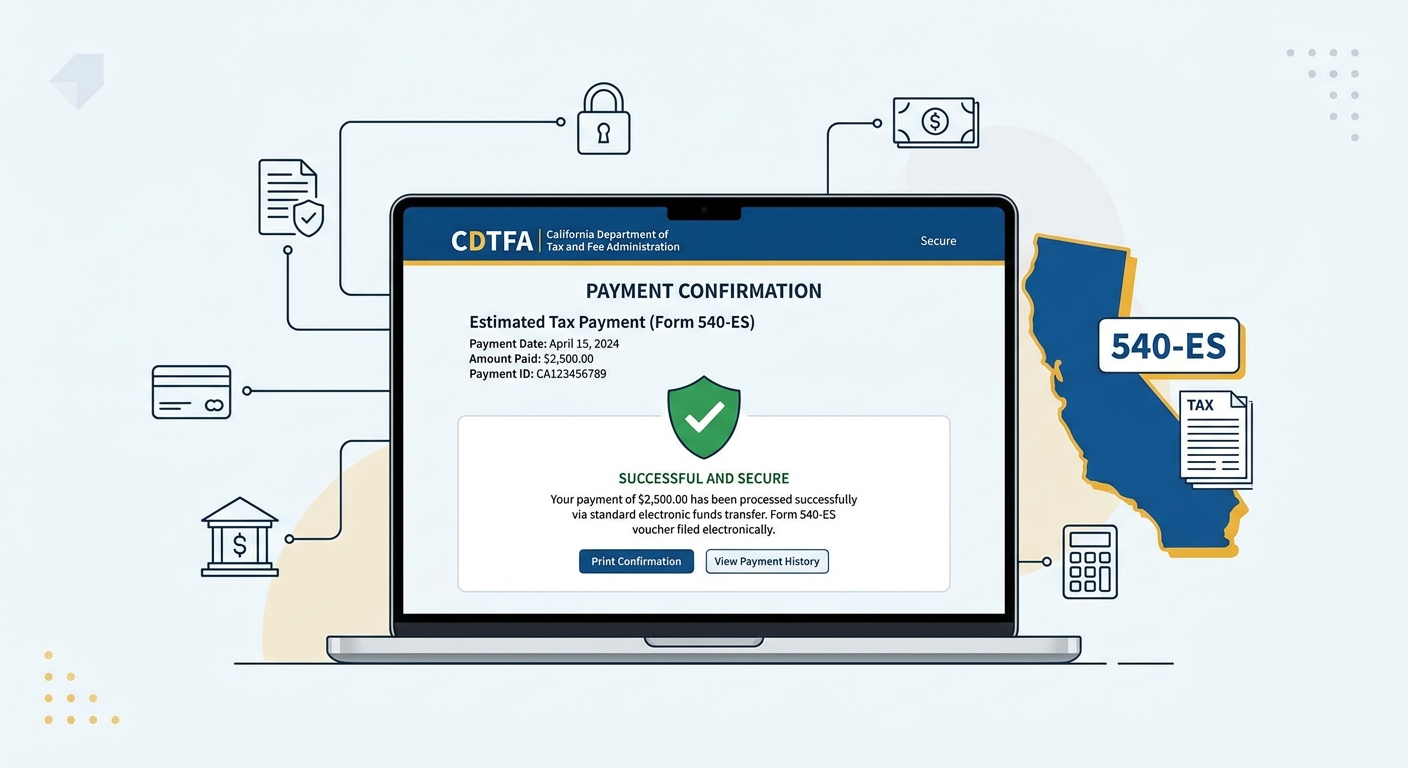
You just calculated your California estimated tax payment for the quarter. Now you’re staring at Form 540-ES, trying to figure out if you need to mail a check like it’s 1997 or if there’s actually a faster way to get this done. Here’s the truth most California taxpayers don’t realize: you can skip the envelope, the stamp, and the anxiety about whether your payment will arrive on time. 540 ES online payment options exist, and they’re faster, more secure, and give you instant proof of payment.
If you’re a high-income W-2 employee with stock compensation, a business owner with fluctuating quarterly profits, or a real estate investor managing multiple properties, estimated tax payments aren’t optional. California’s Franchise Tax Board expects you to pay as you earn. Miss a payment or underpay, and you’re looking at penalties that compound every quarter. The good news? You can handle your entire 540-ES obligation online in under five minutes once you know the process.
Quick Answer
540-ES online payment refers to making California estimated tax payments electronically through the FTB’s Web Pay system, your bank’s bill pay service, or the official FTB mobile app. This method eliminates mailing delays, provides instant confirmation, and allows you to schedule payments in advance to avoid late penalties.
Why California Estimated Tax Payments Matter More Than You Think
California operates on a pay-as-you-go system. If you expect to owe $500 or more in state tax after withholding and credits, you’re required to make quarterly estimated payments. This hits several taxpayer groups especially hard:
- Self-employed professionals: 1099 contractors, consultants, freelancers with no employer withholding
- Business owners: S Corp shareholders, LLC members, sole proprietors with net profit over $50,000
- Real estate investors: Rental income recipients, property flippers, 1031 exchange participants
- High-income W-2 employees: Those with RSUs, stock options, bonuses, or side income pushing total liability above $500
The penalty for underpayment isn’t trivial. California charges interest on the unpaid amount from the due date until you pay. For 2026, that rate sits at 5% annually, compounded daily. On a $10,000 underpayment across four quarters, you’re looking at roughly $250 in avoidable penalties.
What Triggers the Estimated Tax Requirement?
You must make estimated payments if:
- Your total California tax liability exceeds $500 after subtracting withholding and credits
- Your withholding will be less than the smaller of: 90% of your current year tax, or 100% of your prior year tax (110% if AGI exceeds $150,000 or $75,000 if married filing separately)
Many taxpayers only discover this requirement after filing their annual return and getting hit with an underpayment penalty notice from the FTB. By then, it’s too late to fix. The smarter approach? Calculate your estimated liability in January and set up automatic quarterly payments.
The Three Ways to Make a 540-ES Online Payment
California gives you three primary electronic payment methods. Each has specific advantages depending on your situation.
Method 1: FTB Web Pay (The Official Route)
Web Pay is the Franchise Tax Board’s direct payment portal. You don’t need to create an account or log in. Here’s the step-by-step process:
- Navigate to ftb.ca.gov/pay and select “Web Pay for Individuals”
- Choose payment type: Select “Estimated Tax” from the dropdown menu
- Enter your information: Social Security Number, payment amount, tax year, and quarter (Q1, Q2, Q3, or Q4)
- Provide bank details: Routing number and account number for direct debit from checking or savings
- Select payment date: You can pay immediately or schedule up to one year in advance
- Review and confirm: You’ll receive a confirmation number instantly. Save this for your records.
Web Pay accepts payments up to $999,999 per transaction. The funds withdraw on the date you specify, and the FTB credits your account the same day. There’s no fee for using this service.
Pro Tip: If you’re paying for the current quarter, schedule your payment 2-3 business days before the deadline. This gives you buffer room in case of bank delays, but still counts as timely if it posts by the due date.
Method 2: Bank Bill Pay (The Hands-Off Approach)
Most major banks offer bill pay services that let you schedule recurring payments to the FTB. This works well if you have predictable quarterly amounts and want full automation.
Setup process:
- Log into your bank’s online platform
- Add FTB as a payee: Use “Franchise Tax Board – Estimated Tax” and include your SSN in the account number field
- Enter payment amount and set it to recur quarterly on the 15th of April, June, September, and January
- Confirm the first payment manually, then let the system handle the rest
The limitation here: your bank mails a physical check to the FTB. Transit time varies by institution. Some banks cut the check immediately; others wait 3-5 days. This introduces risk if you’re cutting it close to the deadline. For maximum safety, schedule bank bill pay payments at least 10 days before the quarterly due date.
Method 3: FTB Mobile App (The On-the-Go Option)
California launched the MyFTB mobile app in 2024. It replicates Web Pay functionality but works from your phone. Download it from the App Store or Google Play, then follow the same steps as Web Pay.
The app offers one advantage over the browser version: push notifications. If you enable them, you’ll get reminders 7 days before each quarterly deadline. This prevents the “I forgot to pay” situation that triggers penalties.
The 2026 California Estimated Tax Payment Deadlines You Can’t Miss
California estimated tax follows a different schedule than federal. Missing even one payment triggers penalties, so mark these dates:
| Payment Period | Income Earned | Due Date |
|---|---|---|
| 1st Quarter | January 1 – March 31 | April 15, 2026 |
| 2nd Quarter | April 1 – May 31 | June 16, 2026 |
| 3rd Quarter | June 1 – August 31 | September 15, 2026 |
| 4th Quarter | September 1 – December 31 | January 15, 2027 |
Notice the quirk: the second quarter payment covers only two months, while the third quarter covers three. California doesn’t align with the federal calendar. If you’re making both federal and California estimated payments, double-check which deadline applies to which jurisdiction.
Key Takeaway: If the 15th falls on a weekend or holiday, the deadline moves to the next business day. In 2026, June 15 falls on a Monday, so no extension applies.
How to Calculate Your California Estimated Tax Payment
The FTB provides Form 540-ES with a worksheet, but here’s the practical shortcut most tax professionals use:
The Safe Harbor Method
Pay 100% of your prior year California tax liability (110% if your AGI exceeded $150,000). Divide that amount by four and pay each quarter. This guarantees you avoid underpayment penalties, even if your current year income spikes.
Example: Sarah, a software engineer in San Francisco, owed $18,000 in California tax for 2025. Her AGI was $185,000. For 2026, she needs to pay 110% of that liability, or $19,800. Divided by four, her quarterly payment is $4,950. Even if she gets a $50,000 bonus in Q3 that increases her actual 2026 liability to $24,000, she won’t face penalties because she met the safe harbor threshold.
The Annualized Income Method
If your income fluctuates significantly by quarter, you can calculate payments based on actual income earned in each period. This prevents overpaying in slow quarters.
This method requires more work. You’ll need to track income and deductions quarterly, then apply California’s tax rates to each period. Most taxpayers skip this unless they have extreme variability, like a real estate agent who closes most deals in Q4 or a consultant with one large contract in Q2.
For detailed calculation help specific to your situation, explore our tax planning services designed for California residents with complex income streams.
KDA Case Study: Real Estate Investor
Marcus, a Bay Area real estate investor, owns four rental properties and typically closes 2-3 fix-and-flip deals per year. In 2025, he underpaid his California estimated tax by $8,200 because he didn’t account for a large capital gain from a property sale in October. The FTB assessed a $340 underpayment penalty on his 2025 return.
In January 2026, Marcus met with KDA to implement a proactive strategy. We set up automatic 540-ES online payments through Web Pay using the 110% safe harbor method based on his 2025 liability. His quarterly payment: $5,775. We also built a mid-year review into his calendar. When he closed two flips in June generating $95,000 in profit, we recalculated his exposure and increased his Q3 and Q4 payments to $8,200 each.
Result: Marcus paid $28,150 in estimated tax throughout 2026. His actual liability came to $29,800. He owed $1,650 at filing time but avoided all underpayment penalties. He saved the $340 penalty from the prior year plus an estimated $280 he would have owed in 2026 without adjustments. Total first-year tax planning savings: $620. His KDA advisory retainer: $2,400. But the real value? Peace of mind knowing his quarterly obligations were handled automatically, and no surprise penalty notices.
Ready to see how we can help you? Explore more success stories on our case studies page to discover proven strategies that have saved our clients thousands in taxes.
Red Flag Alert: Common 540-ES Payment Mistakes That Trigger Penalties
Even with online payment options, taxpayers still make costly errors. Watch for these:
Mistake 1: Paying the Wrong Tax Year
When you’re in September 2026 making your Q3 payment, the tax year is still 2026. But if you’re making a January 2027 payment for Q4 of the prior year, you need to specify 2026 as the tax year, not 2027. Web Pay has a dropdown for this. Select incorrectly, and your payment gets misapplied.
Mistake 2: Using the Wrong Quarter Code
Web Pay asks which quarter you’re paying. If you’re paying in April for Q1, select Q1. If you’re paying late in May for Q1, you still select Q1. The quarter refers to the period the payment covers, not when you’re submitting it.
Mistake 3: Assuming Bank Bill Pay is Instant
Your bank might show the payment as “processed” immediately, but the FTB doesn’t receive funds until the check clears. For legal purposes, the payment date is when the FTB receives and posts the payment, not when you initiated it. This can create a 5-10 day gap. If you’re using bank bill pay, initiate payments at least two weeks before the deadline.
Mistake 4: Forgetting to Account for Withholding
If you’re a W-2 employee with side income, your employer already withholds California tax from your wages. Your estimated payment only needs to cover the gap between your withholding and total tax liability. Don’t calculate 100% of your total tax and pay that as estimated payments, or you’ll massively overpay.
Mistake 5: Making Unequal Payments Without Using the Annualized Method
The safe harbor assumes equal quarterly payments. If you pay $2,000 in Q1, $3,000 in Q2, $1,500 in Q3, and $4,000 in Q4, the FTB calculates penalties based on when income was actually earned. Unless you’re using the annualized income method on Form 540-ES and attaching the worksheet to your return, unequal payments can still trigger penalties even if your total matches your liability.
What Happens If You Miss a 540-ES Payment Deadline?
Life happens. You forget a payment, or cash flow gets tight, and you skip a quarter. Here’s what to expect:
The FTB calculates an underpayment penalty using IRS-like methodology. They figure the amount you should have paid, the amount you actually paid, and the number of days late. Interest accrues daily at the current rate (5% annually for 2026).
Example: You owe $4,000 for Q2, due June 16, 2026. You don’t pay until September 15 when you remember at the Q3 deadline. That’s 91 days late. The penalty calculation: $4,000 x 5% x (91/365) = $50.00. Not catastrophic, but avoidable.
If you realize you missed a payment, don’t wait until tax filing season. Log into Web Pay immediately and submit the payment with the correct quarter designation. This stops the interest clock. Then, when you file your return, the FTB will calculate the actual penalty and include it in your balance due.
Can You Get Penalties Waived?
California offers first-time penalty abatement if you meet these criteria:
- You haven’t had any penalties in the prior three tax years
- You filed all required returns
- You’ve paid or arranged to pay all tax due
To request abatement, call the FTB at 800-852-5711 after you receive the penalty notice. Have your confirmation numbers from your 540-ES online payments ready to prove you’ve now established a compliant payment pattern.
Special Situations: When Standard 540-ES Rules Don’t Apply
You Sold a Business or Property Mid-Year
Capital gains from asset sales create large one-time tax liabilities. California taxes long-term capital gains as ordinary income, with rates up to 13.3% for high earners. If you sold a business for $400,000 profit in June, your California tax on that gain alone could be $53,200.
Standard quarterly payments won’t cover this. Make a large estimated payment in the quarter you recognize the gain. Use the annualized income method on your return to show the income concentration and avoid penalties for earlier quarters when you paid less.
You Moved to California Mid-Year
California taxes you as a resident from your move-in date forward. If you relocated in July, you’re only liable for income earned as a California resident from July through December. Your first estimated payment would be due September 15 for the Q3 period, covering July and August income.
Don’t use the prior year safe harbor method if you weren’t a California resident last year. Instead, project your California-source income for the partial year and make estimated payments based on that amount.
You’re Part of a Partnership or S Corporation
Pass-through income from partnerships and S Corps flows to your personal return. The entity doesn’t pay California income tax; you do. But timing gets tricky. If the business makes a large distribution in Q4, your estimated payment for Q4 (due January 15, 2027) needs to account for that income.
Best practice: coordinate with your business CPA to get quarterly K-1 estimates. Use those to adjust your 540-ES payments throughout the year rather than waiting until year-end when you see final numbers.
How to Confirm Your 540-ES Online Payment Posted Correctly
After you submit a payment through Web Pay, you’ll see a confirmation screen with a 17-digit confirmation number. Screenshot it or print it immediately. This is your proof of payment.
Within 3-5 business days, the payment should appear on your FTB account. To verify:
- Go to MyFTB.ca.gov and create an account if you haven’t already
- Link your SSN and verify your identity
- Navigate to “Account Summary” and look for the posted payment under the correct tax year and quarter
- If it doesn’t appear within 7 days, call FTB at 800-852-5711 with your confirmation number
The FTB updates accounts overnight, but during peak periods (mid-April, mid-June), processing can lag. As long as you have the confirmation number and initiated the payment by the deadline, you’re protected even if the FTB’s internal posting is delayed.
Should You Overpay or Underpay Your Estimated Taxes?
This comes down to cash flow preference and risk tolerance.
Overpaying pros: You eliminate penalty risk, and you’ll get a refund when you file. If you’re bad at saving for tax time, forced overpayment acts like a savings account.
Overpaying cons: You’re giving California an interest-free loan. That money could be invested, used for business growth, or kept liquid for emergencies. On a $10,000 overpayment sitting with the FTB for six months, you’re losing $250-300 in potential returns if invested conservatively at 5%.
Underpaying pros: You keep cash working for you throughout the year. If you’re disciplined, you can invest the deferred tax amount and earn returns before the April deadline.
Underpaying cons: Penalties and interest erase any gains if you underpay below the safe harbor threshold. You also risk owing a large balance at filing time, which can strain cash flow in Q1 of the following year.
The strategic middle ground: pay 100-110% of prior year liability throughout the year via automatic 540-ES online payments, then reassess in December. If you know you’ll owe significantly more, make a voluntary Q4 adjustment. If you’ve overpaid, skip the January payment or reduce it. This keeps you compliant while optimizing cash flow.
California-Specific Considerations for High Earners
California’s top marginal rate of 13.3% kicks in at $1 million for single filers and $1,198,024 for married filing jointly (2026 brackets). If you’re in this range, estimated tax planning becomes critical.
Mental Health Services Tax (Additional 1% Surcharge)
Income over $1 million faces an extra 1% tax for mental health services. This increases your effective top rate to 14.3%. Many high earners forget to factor this into estimated payments, leading to underpayment penalties. If your income crosses the threshold, recalculate your quarterly obligation using 14.3% for the excess amount.
Stock Compensation Timing Issues
RSUs vest throughout the year, often in quarterly or monthly tranches. Your employer withholds federal tax but might underwithhold for California. Check your pay stub after each vest. If California withholding is less than 10-11% of the RSU value, you need to make up the difference with estimated payments.
For example: you vest $40,000 in RSUs in March. Your employer withholds $3,200 for California (8%). You’re actually in the 11% bracket, so you’re short $1,200. Make a Q1 estimated payment of at least $1,200 to cover the gap.
Can You Deduct California Estimated Tax Payments on Your Federal Return?
Not anymore. The Tax Cuts and Jobs Act capped state and local tax (SALT) deductions at $10,000 total per year, covering property tax, state income tax, and sales tax combined. For most California residents, property tax alone consumes the entire $10,000 cap.
Your California estimated payments don’t reduce your federal taxable income. They’re just prepayments against your state liability. When you file your federal return, you can deduct state income tax paid up to the $10,000 cap, but that typically includes your prior year balance due payment and withholding, not the current year’s estimated payments.
The SALT cap expires after 2025 under current law, but Congress extended it through 2028 in late 2025 legislation. Unless you have unusually low property tax, don’t count on deducting your 540-ES payments federally.
Ready to Reduce Your Tax Bill?
KDA Inc. specializes in strategic tax planning for business owners, S Corps, LLCs, and high-net-worth individuals. Book a personalized consultation and walk away with a clear plan.
Frequently Asked Questions About 540-ES Online Payments
Can I pay my California estimated tax with a credit card?
Yes, but it costs you. California contracts with third-party processors that charge 2.3-2.5% of the payment amount. On a $5,000 payment, that’s $115-125 in fees. You’d need a credit card that earns more than 2.5% back to break even. Most cards cap rewards at 2%, making this a money-losing proposition unless you’re meeting a minimum spend requirement for a signup bonus.
What if I make four equal payments but my income drops significantly?
You’ll get a refund when you file. The FTB doesn’t penalize overpayment. If you realize mid-year that you’re drastically overpaying, you can reduce or skip later quarterly payments. Just make sure your total payments still meet the safe harbor threshold (100% or 110% of prior year tax) to avoid underpayment penalties.
Do I need to file Form 540-ES if I pay online?
No. Form 540-ES is only required if you’re mailing a check. When you use Web Pay or another electronic method, the FTB receives all necessary information digitally. The form serves as a payment voucher for paper filers. Save yourself the paperwork and pay electronically.
Can I change my scheduled payment after submitting it?
Only if the payment date hasn’t passed yet. Log back into Web Pay, go to “Payment History,” find the scheduled payment, and select “Cancel.” Then submit a new payment with the corrected amount or date. Once a payment processes, you can’t reverse it through the system. You’d need to contact the FTB directly and request a refund or credit to a different tax year.
What if I have both wage income and self-employment income?
Your W-2 withholding counts toward your total California liability. Calculate your total expected tax, subtract what your employer is already withholding, and pay the difference through estimated payments. For example: total expected tax is $15,000, employer withholds $9,000, you need to make $6,000 in estimated payments throughout the year, or $1,500 per quarter.
The Bottom Line: Automate Your 540-ES Payments and Never Think About Them Again
California’s estimated tax system punishes procrastinators and rewards planners. The 540-ES online payment infrastructure makes compliance simple, but only if you actually use it.
Here’s your action plan:
- Calculate your 2026 California tax liability using the safe harbor method (100% or 110% of 2025 tax)
- Divide by four to get your quarterly payment amount
- Set up recurring payments through FTB Web Pay on the 10th of April, June, September, and January
- Review mid-year if your income situation changes significantly
- Save your confirmation numbers for every payment
Do this once in January, and you’re done for the year. No penalty notices, no scrambling at the deadline, no mailing checks. Your obligation is handled automatically every quarter, and you can focus on earning income instead of managing tax payments.
This information is current as of 4/28/2026. Tax laws change frequently. Verify updates with the IRS or FTB if reading this later.
Get Your California Estimated Tax Strategy Dialed In
If you’re still uncertain whether your estimated payment strategy is costing you money in penalties or tying up cash unnecessarily, it’s time to get expert guidance. Our team specializes in California tax compliance for high earners, business owners, and investors who want proactive planning, not reactive surprises. Click here to book your personalized tax strategy session and get complete clarity on your quarterly obligations before the next deadline hits.



