
Quick Answer
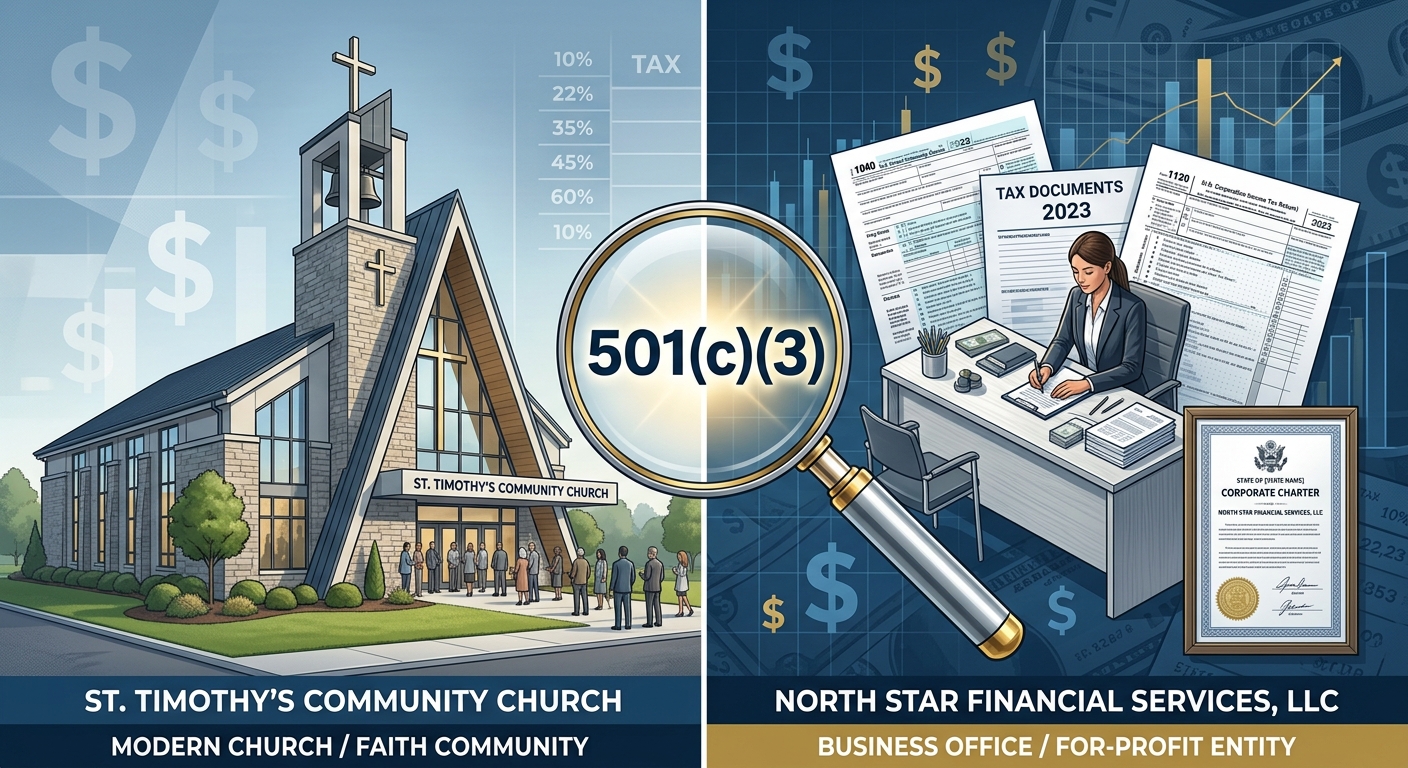
A church is neither a C Corp nor an S Corp. Churches are tax-exempt organizations under IRC Section 501(c)(3), which means they occupy an entirely separate tax classification from for-profit corporate entities. If you are searching is a church a C Corp or S Corp because you are a pastor, ministry leader, or business owner trying to structure a faith-based venture, this distinction matters more than you think. Picking the wrong entity structure for your ministry-related business could cost you between $8,400 and $31,000 per year in unnecessary taxes, penalties, and lost deductions.
Why People Confuse Churches With C Corps and S Corps
The confusion usually starts with incorporation. When a church files articles of incorporation with the state, it technically becomes a nonprofit corporation. The word “corporation” triggers the assumption that the church is a C Corp or S Corp. It is not.
A C Corporation (C Corp) is a for-profit entity taxed under Subchapter C of the Internal Revenue Code. It pays corporate income tax at 21% on profits, and shareholders pay a second layer of tax when those profits are distributed as dividends. An S Corporation (S Corp) is a for-profit entity that elects pass-through taxation under Subchapter S, meaning profits flow directly to shareholders and are taxed once on personal returns. Neither of these structures applies to churches.
A church organized under IRC Section 501(c)(3) pays zero federal income tax on revenue tied to its exempt purpose. That includes tithes, offerings, donations, and revenue from activities substantially related to its religious mission. Churches do not file Form 1120 (the C Corp return) or Form 1120-S (the S Corp return). Most churches are not even required to file Form 990, the annual information return that other nonprofits must submit, thanks to an automatic exemption under IRC Section 6033(a)(3)(A)(i).
Here is where the question is a church a C Corp or S Corp becomes genuinely dangerous. When pastors or ministry leaders start a side business, launch a for-profit arm of the church, or set up a faith-based consulting practice, they sometimes assume the church’s tax-exempt umbrella covers everything. It does not. That assumption can trigger double taxation, self-employment tax exposure, and IRS scrutiny that a proper entity election would have prevented.
The Three Entity Buckets the IRS Cares About
The IRS classifies organizations into three broad buckets:
- Tax-exempt entities (churches, charities, foundations) under IRC Section 501(c)(3)
- C Corporations taxed under Subchapter C at the corporate level
- S Corporations and other pass-through entities (partnerships, LLCs) taxed under Subchapter S or Subchapter K
A church sits firmly in the first bucket. But the moment a pastor or church leader generates income outside the church’s exempt purpose, that income needs its own entity, and that entity will be a C Corp, an S Corp, an LLC, or a sole proprietorship. Understanding this distinction is the foundation of proper entity formation for anyone operating in both the nonprofit and for-profit worlds.
When Church Leaders Actually Need an S Corp or C Corp
Here is the scenario that drives most people to search is a church a C Corp or S Corp. A pastor earns a salary from the church, but also runs a speaking business, writes books, consults with other ministries, or operates a faith-based coaching practice. That income is not tax-exempt. It is self-employment income, and it gets hammered with a 15.3% self-employment tax on top of ordinary income tax.
Consider Pastor David in Riverside, California. He earns $85,000 from his church (reported on a W-2 with a housing allowance under IRC Section 107) and another $120,000 from his speaking and consulting business. Without proper entity structuring, that $120,000 hits Schedule C, and he owes $16,956 in self-employment tax alone before a single dollar of income tax.
If Pastor David forms an LLC and elects S Corp status by filing Form 2553, he can pay himself a reasonable salary of $65,000 from the consulting business and take the remaining $55,000 as an S Corp distribution. The distribution is not subject to self-employment tax. His savings:
- Self-employment tax saved: $55,000 x 15.3% = $8,415 per year
- QBI deduction under IRC Section 199A: Up to $11,000 additional federal savings
- AB 150 PTE election (California): Up to $4,200 in state tax offset
- Total first-year advantage: $12,600 to $23,600
For a deeper breakdown of how S Corp elections work across different income levels, see our comprehensive S Corp tax strategy guide for California.
The Housing Allowance Trap
One of the most valuable tax benefits for pastors is the minister’s housing allowance under IRC Section 107. This allows ordained ministers to exclude a portion of their church salary from income tax (though not from self-employment tax). However, this exclusion applies only to compensation received for ministerial services. It does not apply to S Corp distributions from a for-profit consulting business.
Pastors who try to funnel their for-profit business income through the church to claim the housing allowance on that income are committing tax fraud. The IRS has aggressively pursued these cases, and the penalties start at 20% of the underpayment plus interest.
Unrelated Business Income Tax: When Churches Actually Pay Tax
Churches are not immune from all taxation. When a church generates income from activities unrelated to its religious mission, that income is subject to Unrelated Business Income Tax (UBIT) under IRC Sections 511 through 514.
Examples of unrelated business income for churches:
- Renting church parking lots to commuters on weekdays ($15,000 to $60,000/year in urban California)
- Operating a coffee shop or bookstore that serves the general public beyond the congregation
- Selling advertising in church bulletins or websites
- Generating income from debt-financed property under IRC Section 514
UBIT is taxed at the corporate rate of 21%, and the church must file Form 990-T to report it. This is the one scenario where a church’s income gets treated similarly to a C Corp. But here is the critical difference: the church itself does not become a C Corp. It remains a 501(c)(3) that happens to owe tax on one specific income stream.
Many business owners who also serve as church leaders fail to separate these income streams properly. They co-mingle church revenue with for-profit business revenue, creating a UBIT exposure for the church and a self-employment tax disaster for themselves.
The $31,000 Co-Mingling Mistake
When a pastor runs a for-profit consulting business through church accounts, three things go wrong simultaneously:
- The church owes UBIT on the consulting revenue at 21% ($120,000 x 21% = $25,200)
- The pastor owes self-employment tax on income that should have been structured through an S Corp ($16,956)
- The church risks losing its tax-exempt status under IRC Section 501(c)(3) if private inurement is found
Total exposure: $31,000+ per year in unnecessary taxes, plus the existential risk of losing the church’s exempt status entirely. Want to see how different income levels affect your tax burden? Run your numbers through this small business tax calculator to estimate the impact.
Five Costliest Mistakes When Mixing Church and Business Entities
Understanding that a church is not a C Corp or S Corp is only the starting point. The real damage happens when church leaders make one of these five structural errors.
Mistake 1: Running For-Profit Activity Through the Church EIN
Using the church’s Employer Identification Number (EIN) for a for-profit side business is one of the fastest ways to trigger an IRS examination. The church’s EIN is tied to its 501(c)(3) determination letter. When for-profit revenue shows up under that EIN, IRS computers flag the inconsistency. The fix costs $2,500 to $8,000 in professional fees to untangle, plus back taxes and penalties.
Mistake 2: Claiming the Housing Allowance on S Corp Distributions
The housing allowance under IRC Section 107 applies only to compensation for ministerial services. S Corp distributions from a consulting business do not qualify. Pastors who claim the exclusion on non-qualifying income face a 20% accuracy-related penalty under IRC Section 6662 plus the tax they should have paid.
Mistake 3: Skipping the S Corp Election Entirely
Church leaders who operate for-profit businesses as sole proprietors leave $8,400 to $16,800 on the table annually in unnecessary self-employment tax. The Form 2553 S Corp election takes 15 minutes to complete. The math is not close.
Mistake 4: Ignoring California Franchise Tax on the S Corp
In California, an S Corp pays a minimum franchise tax of $800 per year under Revenue and Taxation Code Section 23153, plus 1.5% of net income. Church leaders who form S Corps for their side businesses but fail to file California Form 100S face penalties of $210 per shareholder per month under IRC Section 6699, plus interest on unpaid state taxes. The church itself is exempt from franchise tax, but the S Corp is not.
Mistake 5: Failing to Separate Payroll Systems
Church employees are on the church’s payroll, typically processed through Form 941. When a pastor also runs an S Corp, that S Corp needs its own separate payroll system, its own Form 941, its own W-2, and its own state filings. Combining both payrolls under one entity creates misreporting issues that the IRS can trace instantly through its Palantir SNAP AI matching system.
KDA Case Study: Sacramento Pastor Saves $24,800 With Proper Entity Separation
Pastor James in Sacramento led a mid-sized congregation while running a thriving leadership coaching practice that generated $145,000 annually. For three years, he reported the coaching income on Schedule C, paying $19,864 in self-employment tax each year on top of his federal and California income taxes. He had never considered whether he needed an S Corp because he assumed his church’s nonprofit status somehow covered his consulting work.
When he came to KDA, we immediately identified three problems: Schedule C reporting with full self-employment tax exposure, no QBI deduction optimization, and zero California AB 150 PTE election benefits. Our team formed a California LLC, filed Form 2553 for S Corp election, established reasonable salary at $70,000, and structured distributions of $75,000 annually. We also activated the AB 150 PTE election to bypass the SALT cap on his state taxes.
Results in year one:
- Self-employment tax savings: $10,373 (eliminated SE tax on $75,000 in distributions)
- QBI deduction savings: $7,200 (20% deduction on qualified business income)
- AB 150 PTE benefit: $3,800 in California tax offset
- Additional deductions captured: $3,427 (home office, professional development, travel)
- Total year-one savings: $24,800
- KDA engagement fee: $4,800
- ROI: 5.2x first-year return
- Projected five-year savings: $118,000
Pastor James kept his church role completely separate. His W-2 from the church continued to include the housing allowance under IRC Section 107. His S Corp handled only the consulting income with its own EIN, payroll, and bank accounts. No co-mingling, no UBIT risk, no jeopardy to the church’s exempt status.
Ready to see how we can help you? Explore more success stories on our case studies page to discover proven strategies that have saved our clients thousands in taxes.
Church vs. C Corp vs. S Corp: Side-by-Side Comparison
The following table breaks down the key differences between a 501(c)(3) church, a C Corporation, and an S Corporation across the metrics that matter most for church leaders considering is a church a C Corp or S Corp for their various income streams.
| Factor | 501(c)(3) Church | C Corporation | S Corporation |
|---|---|---|---|
| Federal Income Tax | $0 on exempt income | 21% flat corporate rate | $0 at entity level (pass-through) |
| Self-Employment Tax | Not applicable to entity | Not applicable (W-2 wages) | Only on salary, not distributions |
| CA Franchise Tax | Exempt under R&TC 23701d | 8.84% of net income | 1.5% of net income ($800 min) |
| QBI Deduction (Section 199A) | Not applicable | Not eligible | Up to 20% deduction |
| AB 150 PTE Election | Not applicable | Not eligible | Eligible (SALT cap bypass) |
| Housing Allowance (Section 107) | Yes, for ordained ministers | Not available | Not available |
| Annual Filing Requirement | None for most churches | Form 1120 + CA Form 100 | Form 1120-S + CA Form 100S |
| Double Taxation Risk | None | Yes (corporate + dividend) | None |
This comparison makes the answer to is a church a C Corp or S Corp unmistakable. A church is neither. But the for-profit income that church leaders earn outside the church absolutely needs one of these structures, and in most cases, the S Corp wins by $8,400 to $23,600 per year at common income levels.
OBBBA Permanent Changes That Affect Church Leaders in 2026
The One Big Beautiful Bill Act (OBBBA) made several permanent changes to the tax code that directly impact church leaders who also operate for-profit businesses:
- Permanent QBI deduction under IRC Section 199A: The 20% qualified business income deduction is now permanent, making S Corp election even more valuable for pastors with consulting or speaking income
- 100% bonus depreciation restored permanently: Church leaders who purchase equipment, vehicles, or technology for their for-profit businesses can deduct the full cost in year one (California does not conform under R&TC 17250/24356, requiring dual depreciation schedules)
- Section 179 limit increased to $2.5 million: Larger asset purchases qualify for immediate expensing
- SALT cap raised to $40,000: This provides some relief, but the AB 150 PTE election remains the superior strategy for California S Corp owners
- Estate exemption at $15 million: Relevant for church leaders with significant accumulated wealth
- Enhanced charitable deduction: Non-itemizers can now deduct up to $2,000 in charitable contributions, which affects giving patterns for church congregations
California’s bonus depreciation nonconformity remains a critical trap. If Pastor James purchases a $60,000 vehicle for his consulting business and deducts the full amount federally, California only allows the standard MACRS depreciation schedule. He must maintain dual depreciation records or face FTB adjustment and penalties.
How to Set Up the Right Entity Structure as a Church Leader
If you are a pastor, ministry director, or church leader with for-profit income, here is the exact process to structure your entities correctly:
Step 1: Identify All Income Streams
List every source of income: church salary, speaking fees, book royalties, consulting income, coaching revenue, real estate investments, and any other business activity. Classify each as either ministerial (eligible for housing allowance) or non-ministerial (needs its own entity).
Step 2: Form a Separate LLC for For-Profit Income
File Articles of Organization with the California Secretary of State. Obtain a separate EIN from the IRS. Open a dedicated business bank account. This LLC should have no connection to the church’s legal structure or finances.
Step 3: Elect S Corp Status
File Form 2553 with the IRS by March 15 of the tax year (or within 75 days of formation). File California Form 3560 to confirm the S election at the state level. If you missed the deadline, Rev. Proc. 2013-30 allows retroactive elections up to 3 years and 75 days late with reasonable cause.
Step 4: Establish Reasonable Salary
Set your S Corp salary at a level that reflects what you would pay someone else to do the same work. For pastors with consulting businesses generating $100,000 to $200,000, reasonable salary typically falls between $55,000 and $85,000. Take remaining profits as distributions.
Step 5: Set Up Separate Payroll
Your S Corp needs its own payroll system, quarterly Form 941 filings, annual W-2 issuance, and California DE 9/DE 9C filings. This payroll is completely separate from your church compensation.
Step 6: Activate the AB 150 PTE Election
File the AB 150 Pass-Through Entity elective tax election by the original due date of your S Corp return. This allows your S Corp to pay California income tax at the entity level, generating a dollar-for-dollar federal tax credit that bypasses the $40,000 SALT cap.
Step 7: Maintain Bulletproof Separation
Never deposit for-profit revenue into church accounts. Never use church staff, equipment, or facilities for your for-profit business without a written, fair-market-value lease agreement. Never claim the housing allowance on S Corp income. Document everything.
What If Your Church Operates a For-Profit Subsidiary?
Some churches form for-profit subsidiaries to manage commercial activities like daycare centers, bookstores, conference facilities, or media production companies. In these cases, the subsidiary is typically structured as a C Corp (not an S Corp) because the church, as a 501(c)(3), cannot be a shareholder of an S Corp under IRC Section 1361(b)(1)(B), which restricts S Corp ownership to individuals, certain trusts, and estates.
This means if a church wants to own and control a for-profit entity, the C Corp structure is the only option. The C Corp pays 21% federal income tax on profits, plus 8.84% California franchise tax. Combined with potential dividend taxation when distributions reach individuals, the effective tax rate can exceed 47%.
The better strategy in many cases is for the church leader personally (not the church as an entity) to own the for-profit business as an S Corp. This avoids the S Corp shareholder restriction, eliminates double taxation, and preserves the QBI deduction. The church can still benefit indirectly through increased tithes from the leader’s higher after-tax income.
Ready to Reduce Your Tax Bill?
KDA Inc. specializes in strategic tax planning for business owners, S Corps, LLCs, and high-net-worth individuals. Book a personalized consultation and walk away with a clear plan.
Frequently Asked Questions
Can a Church Elect S Corp Status?
No. A church is a 501(c)(3) tax-exempt organization and cannot elect S Corp or C Corp status. These are for-profit entity classifications under Subchapter S and Subchapter C of the Internal Revenue Code. They are fundamentally incompatible with tax-exempt status.
Does a Church File a Corporate Tax Return?
Churches do not file Form 1120 (C Corp return) or Form 1120-S (S Corp return). Most churches are also exempt from filing Form 990 under IRC Section 6033(a)(3)(A)(i). However, churches with unrelated business income exceeding $1,000 must file Form 990-T.
Can a Pastor Own an S Corp?
Yes. A pastor can personally own an S Corp for for-profit business activities outside the church. The S Corp must be completely separate from the church’s legal and financial structure. The pastor’s church salary remains on the church’s payroll with housing allowance eligibility, while the S Corp handles consulting, speaking, or other business income.
What Happens If I Run My Business Through the Church?
Running for-profit activities through a church creates three simultaneous tax problems: UBIT exposure for the church (21% tax on unrelated business income), potential private inurement triggering loss of 501(c)(3) status, and full self-employment tax exposure for the individual. The combined cost can exceed $31,000 per year on $120,000 of business income.
Is a Church a Nonprofit Corporation?
Yes, a church is typically incorporated as a nonprofit corporation under state law. However, “nonprofit corporation” is a state-level legal classification. The federal tax treatment depends on whether the organization qualifies under IRC Section 501(c)(3), which provides tax-exempt status. Being a nonprofit corporation and being a C Corp or S Corp are completely different classifications.
Do I Need a Separate EIN for My S Corp If I Am a Pastor?
Absolutely. Your S Corp must have its own EIN, entirely separate from the church’s EIN. Using the church’s EIN for your for-profit business is a compliance violation that can trigger an IRS examination of both entities. Apply for a new EIN at IRS.gov/EIN. It takes five minutes and costs nothing.
This information is current as of April 18, 2026. Tax laws change frequently. Verify updates with the IRS or FTB if reading this later.
“The IRS does not care what you call your organization. It cares how you structured it, what income flows through it, and whether you filed the right forms. Get those three things right, and the tax code works for you instead of against you.”
Book Your Tax Strategy Session for Church Leaders and Ministry Entrepreneurs
If you are a pastor, ministry leader, or faith-based entrepreneur earning income outside your church role, you are almost certainly overpaying taxes by thousands of dollars every year. The fix is not complicated, but it requires the right entity structure, proper separation, and a strategist who understands both nonprofit and for-profit tax law. Book a personalized consultation with our team and walk away with a clear plan to protect your church’s exempt status while keeping more of your hard-earned business income. Click here to book your consultation now.



