
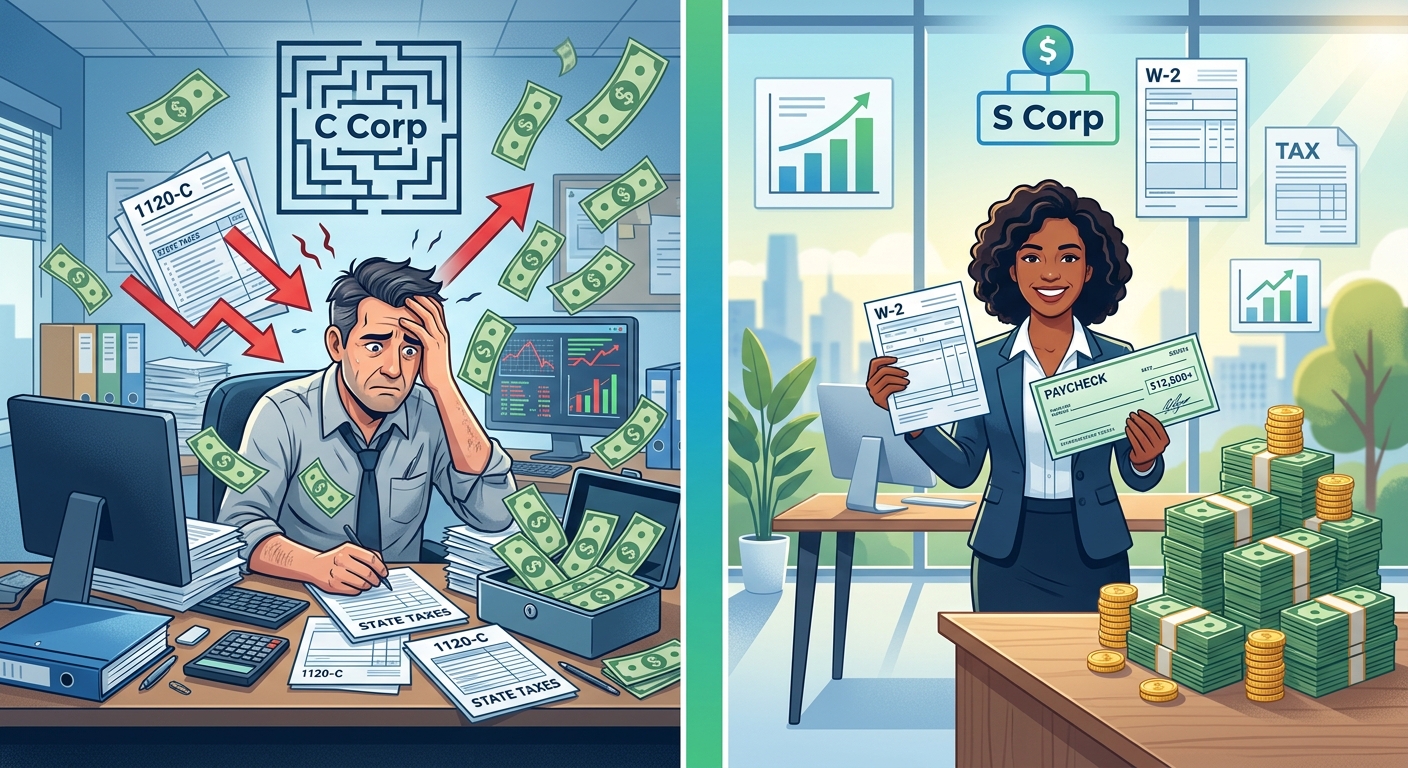
Your W-2 Paycheck Tells You Everything About the C Corp vs S Corp Decision
A California business owner earning $200,000 in profit through a C Corp paid herself a W-2 salary last year and then watched 47.1% of that profit vanish across five separate tax layers. Her neighbor, running an identical business through an S Corp, kept $38,900 more of the same income. The difference had nothing to do with revenue, effort, or industry. It came down to one IRS form filed three years earlier.
The C-Corp vs S-Corp W-2 question is not about theory. It is about how your paycheck gets taxed, how your distributions get taxed, and whether you are paying yourself through the most expensive pipeline the tax code offers or the most efficient one. Every dollar that lands on your W-2 carries a tax consequence that changes dramatically depending on which entity issues that paycheck.
Quick Answer
Both C Corps and S Corps require owner-employees to receive a W-2 salary. The critical difference is what happens to the profits above that salary. In a C Corp, leftover profits face corporate tax at 21% federally plus 8.84% in California, and then get taxed again as dividends when distributed. In an S Corp, profits above a reasonable salary pass through to your personal return with zero entity-level federal tax, a 1.5% California franchise tax, and no double taxation. For a California business owner earning $200,000, that structural gap costs $38,900 per year in the wrong entity.
How the W-2 Works Inside a C Corp vs an S Corp
Both entity types require you to run payroll and issue yourself a W-2 if you work in the business. That part is identical. The IRS expects a reasonable salary in both structures, and California’s Employment Development Department (EDD) expects payroll tax compliance regardless of entity type. But the similarity ends at payroll.
C Corp W-2 Mechanics
When a C Corp pays you a salary, that salary is a deductible business expense for the corporation. So far, so good. The problem starts with what remains after your salary. The leftover profit sits inside the corporation and gets taxed at 21% federally under IRC Section 11(b), plus 8.84% at the California level under Revenue and Taxation Code Section 23151. That is a combined 29.84% entity-level tax before you touch a dime of it personally.
When you eventually pull those after-tax profits out as dividends, you face federal qualified dividend rates of 15% to 23.8% (including the 3.8% Net Investment Income Tax under IRC Section 1411), plus California’s 13.3% top individual rate, which treats dividends as ordinary income. The result is effective double taxation exceeding 47% on the same dollar of profit.
S Corp W-2 Mechanics
An S Corp also pays you a salary on a W-2. That salary carries the same payroll taxes: Social Security at 12.4% (split between employer and employee) up to $176,100 in 2026, and Medicare at 2.9% with no cap. But the profit above your salary passes through to your individual return on Schedule K-1. There is no entity-level federal tax. California imposes just a 1.5% franchise tax on net income under R&TC Section 23802. No double taxation. No dividend layer. No 8.84% corporate rate.
Many business owners assume the W-2 salary portion is the expensive part. It is not. The expensive part is what happens to the money above the salary, and that is where the C Corp vs S Corp W-2 decision creates a gap measured in tens of thousands of dollars annually.
The Five-Layer Tax Comparison: C Corp vs S Corp W-2 at Three Income Levels
Understanding the C-Corp vs S-Corp W-2 tax difference requires seeing all five layers side by side. Here is how the math plays out for a California business owner at three common profit levels, assuming a reasonable salary of 40% to 50% of net income.
$100,000 Net Profit
| Tax Layer | C Corp | S Corp |
|---|---|---|
| Federal Entity Tax (21% vs 0%) | $10,500 | $0 |
| California Entity Tax (8.84% vs 1.5%) | $4,420 | $750 |
| Federal Dividend Tax on Distribution | $6,375 | $0 |
| California Dividend Tax (ordinary rate) | $5,658 | $0 |
| QBI Deduction Savings (S Corp only) | $0 | -$2,200 |
| Total Additional Tax in C Corp | $29,903 vs $13,275 = $16,628 gap | |
$200,000 Net Profit
| Tax Layer | C Corp | S Corp |
|---|---|---|
| Federal Entity Tax | $21,000 | $0 |
| California Entity Tax | $8,840 | $1,500 |
| Federal Dividend Tax | $12,750 | $0 |
| California Dividend Tax | $11,316 | $0 |
| QBI Deduction Savings | $0 | -$4,400 |
| Total Gap | $38,906 S Corp advantage | |
$350,000 Net Profit
| Tax Layer | C Corp | S Corp |
|---|---|---|
| Federal Entity Tax | $36,750 | $0 |
| California Entity Tax | $15,470 | $2,625 |
| Federal Dividend Tax | $22,313 | $0 |
| California Dividend Tax | $19,803 | $0 |
| QBI Deduction Savings | $0 | -$7,700 |
| Total Gap | $64,261 S Corp advantage | |
These numbers assume the owner takes all after-tax profit as distributions. If a C Corp retains earnings, the dividend layer is delayed but not eliminated. The accumulated earnings tax under IRC Section 531 can impose a 20% penalty on profits retained beyond the reasonable needs of the business, typically anything above $250,000.
Want to see how your own business profit breaks down after taxes? Plug your numbers into this small business tax calculator to estimate your take-home under each entity structure.
The W-2 Salary Sweet Spot: Why Getting This Wrong Costs You Either Way
The IRS requires that S Corp owner-employees receive a “reasonable salary” before taking distributions. This is the single most scrutinized element of S Corp taxation, and it is where many business owners either overpay or trigger audit flags. The C-Corp vs S-Corp W-2 salary decision is not about minimizing your paycheck to zero. It is about finding the number that keeps you compliant while maximizing the distribution channel.
What the IRS Considers Reasonable
There is no fixed formula in the tax code. The IRS uses factors from Revenue Ruling 74-44 and the landmark Watson v. Commissioner case to evaluate reasonable compensation. Those factors include the nature of the work you perform, your training and experience, comparable salaries in your industry and region, time devoted to the business, and the company’s dividend history.
For most California service-based businesses generating $150,000 to $250,000 in profit, a reasonable salary typically falls between $60,000 and $100,000. Setting it too low invites IRS reclassification of distributions as wages, which triggers back payroll taxes, penalties, and interest. Setting it too high wastes the primary tax advantage of the S Corp structure.
The Salary-Distribution Split in Practice
Consider a marketing consultant earning $180,000 through an S Corp. She pays herself a $75,000 W-2 salary. Payroll taxes on that salary total approximately $11,475 (employer and employee combined). The remaining $105,000 passes through as a distribution on her K-1, subject to income tax but exempt from the 15.3% self-employment tax. That distribution channel saves her $16,065 in payroll taxes alone compared to running the same income through a sole proprietorship or single-member LLC taxed as a disregarded entity.
In a C Corp, the same $180,000 would face the full five-layer taxation stack. Even if she took the same $75,000 salary, the remaining $105,000 would be taxed at 21% federally plus 8.84% in California at the corporate level, then taxed again when distributed as dividends. The C Corp structure adds roughly $34,200 in total tax on that same $180,000 compared to the S Corp.
Our tax planning services help California business owners model the exact salary-distribution split that minimizes total tax while staying within IRS compliance boundaries.
Five Costliest C Corp vs S Corp W-2 Mistakes
These are the errors that cost California business owners $8,000 to $50,000 per year. Each one is preventable with proper planning.
Mistake 1: Defaulting to C Corp Because Your Attorney Set It Up That Way
Many business owners form a corporation through an attorney who files Articles of Incorporation with the California Secretary of State. By default, that corporation is a C Corp. Unless someone files Form 2553 with the IRS to elect S Corp status, you are stuck in the most expensive tax structure for small businesses. The fix takes one form and a March 15 deadline. Missing that deadline costs you an entire year of S Corp savings, though Rev. Proc. 2013-30 provides late election relief within 3 years and 75 days if you meet three requirements.
Mistake 2: Setting Your S Corp Salary at $0 or Near-Zero
Some business owners take their entire profit as distributions and skip the W-2 entirely. The IRS has successfully reclassified these distributions as wages in cases like Radtke v. United States, resulting in back payroll taxes plus the failure-to-deposit penalty of up to 15%. A $200,000 profit with zero salary could generate $30,600 in back payroll taxes plus $4,590 in penalties.
Mistake 3: Ignoring the California Franchise Tax Differential
California taxes C Corp income at 8.84% under R&TC Section 23151. S Corps pay just 1.5% under R&TC Section 23802. On $200,000 in profit, that is $17,680 vs. $3,000. The $14,680 state-level gap alone exceeds the cost of professional tax preparation for most businesses. Add the California gross receipts fee under R&TC Section 17942 for LLCs, and the entity selection math becomes even more critical.
Mistake 4: Missing the AB 150 PTE Election
California’s Pass-Through Entity tax election under Assembly Bill 150 allows S Corps to pay a 9.3% entity-level tax that generates a dollar-for-dollar federal deduction, effectively bypassing the $40,000 SALT deduction cap imposed by OBBBA. C Corps cannot use this election. A California S Corp owner with $200,000 in pass-through income could save $6,510 or more through AB 150 that is completely unavailable to C Corp shareholders. For a deeper breakdown of how this election works, see our comprehensive S Corp tax strategy guide.
Mistake 5: Forgetting California’s Bonus Depreciation Nonconformity
OBBBA permanently restored 100% federal bonus depreciation. California does not conform under R&TC Sections 17250 and 24356. This means every asset you expense federally must carry a separate California depreciation schedule. Both C Corps and S Corps face this issue, but S Corp owners who fail to maintain dual depreciation schedules often discover the problem during an FTB audit, resulting in recaptured depreciation, back taxes, and penalties exceeding $5,000 on a single equipment purchase.
KDA Case Study: Sacramento IT Firm Owner Escapes the C Corp W-2 Trap
Derek, a 41-year-old IT consulting firm owner in Sacramento, had been operating as a C Corp for six years. His accountant had never discussed entity alternatives. Derek’s firm generated $215,000 in annual profit. He paid himself a $95,000 W-2 salary and took the remaining $120,000 as dividends.
His annual tax burden under the C Corp structure included $25,200 in federal corporate tax, $10,766 in California corporate tax, $14,280 in federal dividend tax on distributions, $12,672 in California tax on dividends treated as ordinary income, and standard payroll taxes on his salary. His total effective tax rate exceeded 46%.
KDA restructured Derek’s entity to an S Corp, set his reasonable salary at $85,000 based on industry comparables for IT consulting managers in the Sacramento region, and activated the AB 150 PTE election. The remaining $130,000 in profit now passes through on his K-1 with zero entity-level federal tax and only 1.5% California franchise tax. His QBI deduction under IRC Section 199A saves an additional $5,200 annually.
First-year results: Derek saved $41,800 in total tax. He paid KDA $5,200 for entity conversion, payroll setup, and ongoing compliance. That is an 8.0x return on investment in year one, with projected savings of $209,000 over five years.
Ready to see how we can help you? Explore more success stories on our case studies page to discover proven strategies that have saved our clients thousands in taxes.
OBBBA Permanent Changes That Shift the C Corp vs S Corp W-2 Math
The One Big Beautiful Bill Act made several provisions permanent that directly affect how the C-Corp vs S-Corp W-2 decision plays out in 2026 and beyond.
Permanent QBI Deduction Under IRC Section 199A
The 20% Qualified Business Income deduction is now permanent. This deduction applies exclusively to pass-through entities, meaning S Corps, partnerships, and sole proprietorships. C Corp shareholders get zero benefit from QBI. On $200,000 in pass-through income, the QBI deduction saves approximately $8,800 in federal tax annually. Over a 10-year business lifecycle, that is $88,000 in savings that C Corp owners never access.
100% Bonus Depreciation Restored Permanently
Federal bonus depreciation is back to 100% for qualifying assets. Both C Corps and S Corps benefit federally, but the California nonconformity issue means you need dual depreciation schedules regardless of entity type. The real advantage for S Corp owners is that accelerated depreciation reduces pass-through income, which directly lowers individual tax rates instead of just reducing corporate-level tax that gets taxed again on distribution.
Section 179 Increased to $2.5 Million
The maximum Section 179 deduction jumped from $1.25 million to $2.5 million under OBBBA. California still caps Section 179 at $25,000 under R&TC Section 17255. S Corp owners benefit more because the federal deduction flows through to reduce individual taxable income in one layer, while C Corp owners see the deduction reduce corporate income that still faces the dividend tax layer upon distribution.
$40,000 SALT Cap
OBBBA set the state and local tax deduction cap at $40,000, up from $10,000. California S Corp owners can bypass this cap entirely through the AB 150 PTE election. C Corp owners have no equivalent bypass mechanism. For high-income California business owners, this structural advantage alone can save $6,000 to $15,000 annually.
Three Narrow Scenarios Where a C Corp W-2 Structure Actually Wins
The S Corp is not universally superior. Three specific situations make the C Corp the better choice.
Scenario 1: Venture Capital Funding
If you are raising institutional capital, investors typically require preferred stock classes. S Corps are limited to one class of stock under IRC Section 1361(b)(1)(D). VC firms will not invest in an S Corp because they cannot create the liquidation preferences and conversion rights their fund structures require. If you are pursuing Series A or later funding, the C Corp is mandatory.
Scenario 2: Qualified Small Business Stock (QSBS) Under Section 1202
C Corp shareholders may exclude up to $10 million in capital gains or 10 times their basis when they sell QSBS held for more than five years. The exclusion can reach 50%, 75%, or 100% depending on when the stock was acquired. S Corps are ineligible for QSBS treatment. If you plan to sell your business for $5 million or more and hold the stock for five years, the Section 1202 exclusion can save more than the cumulative S Corp advantage.
Scenario 3: Full Profit Retention Below $250,000
A C Corp that retains all profits pays only the 21% federal rate plus 8.84% California rate with no dividend layer. If you never distribute the money, you avoid double taxation. However, the accumulated earnings tax under IRC Section 531 imposes a 20% penalty on retained earnings exceeding the reasonable needs of the business, typically capped at $250,000. This strategy has a short shelf life for most small businesses.
What If You Are Currently in the Wrong Entity?
If you are operating as a C Corp and the math shows you should be in an S Corp, the conversion process involves eight steps specific to California.
- Evaluate Built-In Gains Exposure: Under IRC Section 1374, any assets that appreciated during C Corp years face a five-year recognition period. Identify all assets with built-in gain and calculate potential BIG tax exposure.
- Eliminate Accumulated Earnings and Profits (AE&P): Distribute AE&P before or immediately after the S election to avoid dividend treatment on future distributions under IRC Section 1368(c).
- Restructure Stock: S Corps allow only one class of stock with up to 100 shareholders, all of whom must be U.S. citizens or residents. Eliminate any preferred stock or foreign shareholders.
- File Form 2553: Submit to the IRS by March 15 for the election to take effect January 1 of the current year. Late filings require Rev. Proc. 2013-30 relief.
- File FTB Form 3560: California requires a separate S Corp election filing with the Franchise Tax Board.
- Establish Payroll: Set up W-2 payroll at a reasonable salary before taking any distributions.
- Activate AB 150 PTE Election: File the election by the original due date of the S Corp return (March 15) for the first eligible tax year.
- Create Dual Depreciation Schedules: Maintain separate federal and California depreciation records for all assets due to bonus depreciation nonconformity.
The conversion process takes 45 to 90 days when handled professionally. Attempting it through consumer software like TurboTax or H&R Block is not possible because those platforms cannot file Form 2553, evaluate BIG tax exposure, or manage AE&P distributions.
Will Switching Trigger an IRS Audit?
Filing Form 2553 itself does not trigger an audit. However, the IRS Palantir SNAP AI system cross-references Form 2553 filings against prior-year returns. If your C Corp filed Form 1120 last year and your new S Corp files Form 1120-S this year, the IRS system flags the transition to verify consistent treatment. Having professional documentation of the election date, shareholder consent, and reasonable salary calculation reduces audit risk to near zero.
The bigger audit risk comes from not switching. C Corp owners who pay themselves unreasonably low salaries and take large distributions face the same scrutiny as S Corp owners. The difference is that C Corp audit adjustments often result in double taxation on reclassified amounts, while S Corp adjustments typically involve payroll tax reclassification without the corporate-level tax layer.
Ready to Reduce Your Tax Bill?
KDA Inc. specializes in strategic tax planning for business owners, S Corps, LLCs, and high-net-worth individuals. Book a personalized consultation and walk away with a clear plan.
Frequently Asked Questions
Can I Be a W-2 Employee of My Own S Corp?
Yes. If you perform services for your S Corp, you must be paid a reasonable W-2 salary. You cannot be an independent contractor of your own S Corp. The salary must reflect what someone with your skills and experience would earn doing similar work in your geographic area.
Do Both C Corps and S Corps Have to Run Payroll?
Yes. Any corporation that pays wages to employees, including owner-employees, must run payroll, withhold federal and state income taxes, withhold and match Social Security and Medicare taxes, and file quarterly payroll returns (Form 941 federally, DE 9/DE 9C in California). The payroll obligations are identical between C Corps and S Corps.
What Happens to My Health Insurance Premium in Each Entity?
C Corp shareholders who are also employees can receive health insurance as a tax-free fringe benefit under IRC Section 106. The corporation deducts the premium, and the employee pays no tax on it. S Corp shareholders who own more than 2% must include health insurance premiums on their W-2 as wages (Box 1 only, not subject to FICA), and then deduct the amount on Line 17 of their Form 1040. The net tax impact is similar, but the reporting mechanics differ.
Is There a Minimum Profit Level Where S Corp Makes Sense?
Generally, if your net profit exceeds $50,000 to $60,000 annually, the self-employment tax savings from an S Corp election outweigh the additional compliance costs of running payroll and filing Form 1120-S. Below that threshold, the administrative costs may eat most of the savings. The C-Corp vs S-Corp W-2 question becomes most impactful at $100,000 and above, where savings range from $16,000 to $64,000 annually depending on total profit.
Can I Convert Mid-Year?
Form 2553 filed after March 15 takes effect the following January 1 unless you qualify for late election relief under Rev. Proc. 2013-30. Mid-year conversions are only possible through a prospective election, which creates a split-year filing requirement: a short-year Form 1120 for the C Corp period and a short-year Form 1120-S for the S Corp period. This adds complexity and cost. Planning ahead to file by March 15 is always preferable.
Does California Treat the S Corp Election Differently Than the IRS?
California requires a separate S Corp election filing through FTB Form 3560, imposes a 1.5% franchise tax on S Corp income instead of the 8.84% C Corp rate, does not conform to federal bonus depreciation, and applies a gross receipts fee for LLCs that elected S Corp status. Filing with the IRS alone is not sufficient. You must also file with the FTB to receive S Corp treatment at the state level.
This information is current as of April 17, 2026. Tax laws change frequently. Verify updates with the IRS or FTB if reading this later.
“The tax code does not reward loyalty to the wrong entity. It rewards the owner who picks the right structure and runs payroll correctly.”
Book Your C Corp to S Corp W-2 Strategy Session
If your C Corp W-2 is costing you $16,000 to $64,000 a year in unnecessary taxes, that is not a problem you research your way out of. It is a problem you solve with a professional who has converted hundreds of California businesses from C Corp to S Corp. Book a personalized consultation with our strategy team, and we will model your exact tax savings, set your reasonable salary, and build your conversion timeline. Click here to book your consultation now.



