
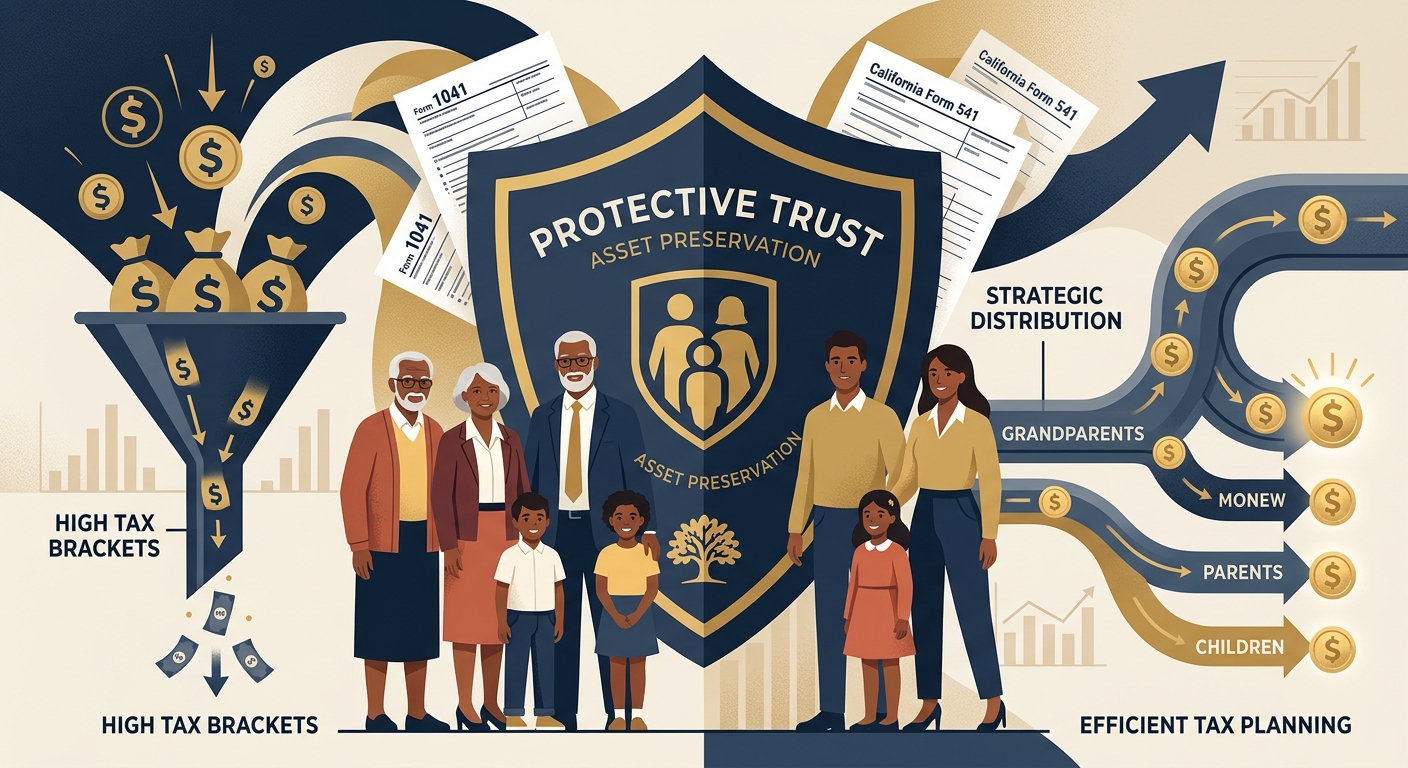
The $8,300 Question Every California Family Gets Wrong About Trust Taxes
A family trust sitting in a filing cabinet does not automatically pay taxes. It also does not automatically avoid them. The answer to does a family trust pay taxes depends entirely on the type of trust, who controls it, whether income stays inside the trust or flows out to beneficiaries, and which state you live in. Get that answer wrong in California, and you can lose $8,300 or more every single year to a compressed tax bracket most families never knew existed.
Here is the part that catches people off guard: the IRS treats trusts as their own taxpayers once certain conditions are met. That means trusts have their own tax brackets, their own filing requirements, and their own penalties for noncompliance. The 2026 federal trust tax brackets hit the top 37% rate at just $15,200 in income. Compare that to an individual who does not reach 37% until $626,350. That is a 41-to-1 compression ratio, and it is the single biggest reason families overpay on trust income every year.
Quick Answer
Yes, a family trust can pay taxes, but it depends on the trust type. A revocable (living) trust does not file its own return or pay its own taxes while the grantor is alive. All income is reported on the grantor’s personal Form 1040. An irrevocable trust, however, is a separate taxpayer that files Form 1041 and pays taxes on any income it retains. In California, the trust also owes state taxes on Form 541, including a potential $800 minimum franchise tax. The strategic move is distributing income to beneficiaries in lower tax brackets, which can save $8,300 or more annually.
Revocable vs. Irrevocable: Two Trusts, Two Completely Different Tax Rules
The first thing you need to understand is that the IRS draws a hard line between revocable and irrevocable trusts. The tax treatment could not be more different.
How Revocable (Living) Trusts Are Taxed
A revocable trust, sometimes called a living trust, is the most common estate planning tool in California. While the person who created the trust (the grantor) is alive and mentally competent, the IRS considers the trust a “grantor trust” under IRC Sections 671 through 679. That means the trust itself does not file a separate tax return and does not pay any taxes on its own.
All income earned by the trust’s assets, whether that is rental income, dividends, interest, or capital gains, flows directly onto the grantor’s personal Form 1040. The trust’s tax identification number is the grantor’s Social Security Number. There is no Form 1041. There is no separate state filing. The trust is essentially invisible to the IRS for income tax purposes.
This is where many families relax and assume the question of does a family trust pay taxes has a simple “no” answer. But that assumption falls apart the moment the grantor passes away or becomes incapacitated.
How Irrevocable Trusts Are Taxed
The moment a revocable trust becomes irrevocable, usually upon the grantor’s death, the IRS treats it as a completely separate taxpayer. The trust must:
- Obtain its own Employer Identification Number (EIN) from the IRS
- File a federal Form 1041 (U.S. Income Tax Return for Estates and Trusts) annually
- File California Form 541 (California Fiduciary Income Tax Return)
- Pay taxes on any income retained inside the trust at compressed trust tax rates
- Issue Schedule K-1 forms to beneficiaries for any income distributed to them
Trusts created as irrevocable from the start, such as irrevocable life insurance trusts (ILITs), charitable remainder trusts, or intentionally defective grantor trusts (IDGTs), follow their own specific rules. Some qualify as grantor trusts despite being irrevocable, while others are taxed as separate entities from day one.
The Triggering Events That Change Everything
Four events commonly flip a trust from grantor status to separate-taxpayer status:
- Death of the grantor — the most common trigger for a revocable trust
- Incapacity of the grantor — when the grantor can no longer manage the trust
- Specific trust terms — some trusts convert to irrevocable status on a set date
- Original creation as irrevocable — certain trusts are irrevocable from the beginning
For a deeper look at the full scope of estate and trust planning strategies in California, our comprehensive California estate and legacy tax planning guide walks through every major trust type and its tax treatment.
The Compressed Trust Tax Bracket Trap: Why Trusts Pay More Than People
This is the section that costs California families the most money. The IRS designed trust tax brackets to be punishingly compressed, and most successor trustees have no idea this is happening until they see the bill.
2026 Federal Trust Tax Brackets
| Taxable Income | Tax Rate |
|---|---|
| $0 to $3,150 | 10% |
| $3,151 to $11,450 | 24% |
| $11,451 to $15,200 | 35% |
| Over $15,200 | 37% |
An individual taxpayer does not hit the 37% bracket until $626,350 in taxable income. A trust hits 37% at $15,200. That means a trust retaining just $25,000 in income pays a federal effective rate above 30%, while a single filer with $25,000 in income pays roughly 12%.
Now layer California on top. The state taxes trust income at rates up to 13.3%, with an additional 1% Mental Health Services surcharge for income over $1 million. California also imposes an $800 minimum franchise tax on trusts under Revenue and Taxation Code Section 17935. There is no special bracket for trust income in California. Every dollar retained in the trust faces the same rate schedule as individuals, but the compressed federal brackets mean the combined federal-state effective rate on retained trust income can exceed 50%.
If you want to estimate how different income levels would be taxed, run the numbers through this federal tax calculator to compare trust-level versus individual-level taxation on the same dollar amount.
The $8,300 Annual Overpayment in Real Numbers
Here is a concrete example. A family trust retains $50,000 in investment income (dividends, interest, capital gains). If that income stays inside the trust:
- Federal tax at compressed trust rates: approximately $16,308
- California tax at trust rates: approximately $4,565
- Net Investment Income Tax (3.8% NIIT): $1,900
- Total trust-level tax: approximately $22,773
If that same $50,000 is distributed to a beneficiary in the 22% federal bracket:
- Federal tax: approximately $11,000
- California tax: approximately $3,100
- NIIT: potentially $0 (depends on beneficiary’s total income)
- Total beneficiary-level tax: approximately $14,100
Annual savings from distribution: $8,673. Over five years, that compounds to more than $43,000 in unnecessary taxes paid simply because income sat inside the trust instead of flowing to beneficiaries.
Does a Family Trust Pay Taxes in California? Five State-Specific Traps
California adds layers of complexity that do not exist in most other states. Many investors and capital partners managing family wealth through trusts discover these traps only after filing incorrectly.
Trap 1: The $800 Minimum Franchise Tax
Every irrevocable trust that is required to file a California return owes a minimum $800 franchise tax under R&TC Section 17935, regardless of whether the trust earned any income. This applies even if the trust had a net loss. The only exception is for the first year the trust is created, and even that exception has conditions.
Trap 2: Trustee Residency Determines Filing Obligation
California determines trust filing obligations based on the residency of the fiduciary (trustee) and the residency of the beneficiaries, not just where the trust was created. Under R&TC Section 17742, if a California resident is a trustee or if California-resident beneficiaries exist, the trust may owe California tax on all its income, even income from out-of-state sources. This catches families who move out of California but leave a California-based trustee in place.
Trap 3: No Capital Gains Preference at the State Level
While federal law taxes long-term capital gains at preferential rates (0%, 15%, or 20%), California taxes capital gains as ordinary income at rates up to 13.3%. A trust selling an appreciated asset generates capital gains taxed at the compressed federal trust rate plus up to 13.3% at the California level. This can push the combined effective rate on trust-level capital gains above 50%.
Trap 4: The California Throwback Rule
Under R&TC Section 17745, California can tax accumulated trust income when it is eventually distributed to a California-resident beneficiary, even if the income was earned years ago and the trust was located in another state at the time. This “throwback tax” can surprise beneficiaries with unexpected California tax bills on distributions they thought were tax-free.
Trap 5: AB 150 PTE Election Does Not Apply to Most Trusts
The California passthrough entity (PTE) elective tax under AB 150, which allows S Corps and partnerships to bypass the $40,000 SALT deduction cap under OBBBA, generally does not extend to trusts. Families expecting to use the PTE election to reduce trust-level state taxes will find this workaround unavailable.
KDA Case Study: Bay Area Family Saves $14,200 by Restructuring Trust Distributions
Margaret and David, a retired couple in the Bay Area, created a revocable living trust 18 years ago. When David passed away in early 2025, their attorney helped Margaret file the proper paperwork, but nobody discussed the tax implications of the trust becoming partially irrevocable.
The irrevocable portion held $1.2 million in investment assets generating approximately $72,000 in annual income (dividends, interest, and realized capital gains). For the first full year after David’s passing, all $72,000 stayed inside the trust. The result was a combined federal and California tax bill of $31,400 on that income alone.
When Margaret’s adult children referred her to KDA, our premium advisory team immediately identified the problem. We restructured the trust’s distribution schedule to flow $60,000 of the $72,000 to Margaret and her two adult children as beneficiaries. Only $12,000 in income was retained inside the trust for reserve purposes.
The results in year one:
- Previous trust-level tax on $72,000: $31,400
- New combined tax (trust retains $12,000, beneficiaries receive $60,000): $17,200
- First-year savings: $14,200
- KDA advisory fee: $4,200
- ROI: 3.4x first-year return
- Projected five-year savings: $62,000
We also activated the 65-day election under IRC Section 663(b), which allows trustees to make distributions within the first 65 days of the new tax year and treat them as if they were made in the prior year. This gave Margaret flexibility to time distributions for maximum tax efficiency without rushing year-end decisions.
Ready to see how we can help you? Explore more success stories on our case studies page to discover proven strategies that have saved our clients thousands in taxes.
Five Costliest Mistakes Families Make When Their Trust Owes Taxes
These are the errors we see most often at KDA, and every one of them is preventable.
Mistake 1: Using the Deceased Grantor’s SSN After Death
After the grantor passes, the trust must obtain a new EIN. Continuing to use the deceased person’s Social Security Number on trust income triggers IRS matching errors, delayed refunds, and potential fraud flags. The penalty exposure starts at $280 per incorrect information return under IRC Section 6721 and can escalate to $3,783,500 per year for large trusts filing multiple forms.
Mistake 2: Retaining All Income Inside the Trust
Successor trustees who do not distribute income to beneficiaries pay the highest possible tax rate on every dollar. For a trust earning $50,000, the difference between full retention and strategic distribution is $8,300 or more annually. Many trustees do not realize they have discretion to distribute income and default to holding everything inside the trust.
Mistake 3: Missing the 65-Day Election
IRC Section 663(b) allows a trustee to make distributions within the first 65 days of a new tax year and elect to treat those distributions as if they were made in the prior tax year. This election must be made on the trust’s Form 1041 by the filing deadline (including extensions). Families who miss this window lose an entire year of distribution planning flexibility. The election is made by checking a box on Form 1041, and yet most trustees never hear about it.
Mistake 4: Ignoring California Form 541 Filing Requirements
California requires irrevocable trusts to file Form 541 even when the trust has minimal income, because the $800 minimum franchise tax applies regardless. Failing to file generates a penalty of 5% of the tax due per month (up to 25%) plus interest. Trustees who assume the federal filing handles everything discover the California Franchise Tax Board sends its own notices.
Mistake 5: Failing to Allocate Capital Gains to Distributions
Under Treasury Regulation 1.643(a)-3, capital gains are generally allocated to the trust corpus and are not included in distributable net income (DNI) unless the trust document, state law, or a consistent trustee practice directs otherwise. Many trust documents allow capital gains to be distributed to beneficiaries, but the trustee never exercises that option. This means capital gains trapped in the trust face the compressed 37% rate plus 3.8% NIIT plus 13.3% California tax, a combined rate exceeding 54%.
OBBBA Permanent Changes That Affect Family Trust Taxation in 2026
The One Big Beautiful Bill Act (OBBBA), signed into law in 2025, made several changes that directly impact how a family trust pays taxes going forward.
Permanent $15 Million Estate Tax Exemption
The federal estate tax exemption is now permanently set at approximately $15 million per person (indexed for inflation). This reduces the urgency of certain irrevocable trust structures designed primarily for estate tax avoidance. However, trusts created for asset protection, income tax management, and generation-skipping transfer (GST) purposes remain valuable.
$40,000 SALT Deduction Cap
The SALT deduction cap, previously $10,000, was raised to $40,000 under OBBBA and made permanent. For trusts, this cap applies to the trust entity itself. Trusts paying California franchise tax and state income tax may still exceed this cap, creating a federal deduction limitation.
Permanent QBI Deduction
The Qualified Business Income (QBI) deduction under IRC Section 199A is now permanent. Trusts that own interests in pass-through businesses (S Corps, partnerships, sole proprietorships) can claim the QBI deduction on the trust return. However, the deduction is subject to the same wage and property limitations, and trusts hit the phase-out thresholds at the compressed trust income levels, meaning most trusts with significant business income will face limitations far sooner than individual taxpayers.
100% Bonus Depreciation Restored Permanently
OBBBA restored 100% first-year bonus depreciation permanently at the federal level. However, California continues to disallow bonus depreciation under R&TC Sections 17250 and 24356. Trusts holding real estate or business assets must maintain dual depreciation schedules, one for federal and one for California, creating additional compliance complexity.
How to Report Family Trust Income: Step-by-Step Filing Guide
If you are a successor trustee filing for the first time, here is exactly what you need to do.
Step 1: Determine If the Trust Needs Its Own Tax Return
If the grantor is alive and the trust is revocable, no separate return is needed. Report all trust income on the grantor’s Form 1040. If the grantor has passed or the trust is irrevocable, proceed to Step 2.
Step 2: Obtain an EIN
Apply online at IRS.gov/EIN. You will need the trust document, the trustee’s personal information, and the trust’s formation date. The process takes about 10 minutes and the EIN is issued immediately.
Step 3: Gather Income Documentation
Collect all 1099 forms issued to the trust (1099-DIV, 1099-INT, 1099-B, 1099-R), rental income records, business income statements, and any other income sources. Contact financial institutions to update account ownership from the deceased grantor’s SSN to the trust’s new EIN.
Step 4: Calculate Distributable Net Income (DNI)
DNI, defined under IRC Section 643(a), determines the maximum amount of income that can be taxed to beneficiaries when distributed. It generally includes dividends, interest, rents, and business income but excludes capital gains unless allocated to distributions. This calculation is the most critical step for tax planning purposes.
Step 5: Make Strategic Distributions Before Year-End
Distribute income to beneficiaries in lower tax brackets to avoid the compressed trust rates. Remember the 65-day election under IRC 663(b) gives you until March 6 of the following year to make additional distributions that count for the prior tax year.
Step 6: File Federal Form 1041 and California Form 541
Form 1041 is due April 15 for calendar-year trusts (or the 15th day of the fourth month after the trust’s fiscal year ends). You can request a 5.5-month extension using Form 7004. California Form 541 follows a similar deadline. Issue Schedule K-1 forms to all beneficiaries showing their share of trust income.
Does a Family Trust Pay Taxes Differently Based on Trust Type?
Not all trusts are treated the same way. Here is a quick comparison of the most common family trust structures and their tax treatment.
| Trust Type | Files Own Return? | Tax Rate Applied | California Filing? |
|---|---|---|---|
| Revocable Living Trust (grantor alive) | No (reported on Form 1040) | Grantor’s individual rate | No separate filing |
| Irrevocable Trust (non-grantor) | Yes (Form 1041) | Compressed trust rates (37% at $15,200) | Form 541 + $800 minimum |
| Intentionally Defective Grantor Trust (IDGT) | No (reported on grantor’s 1040) | Grantor’s individual rate | No separate filing |
| Charitable Remainder Trust (CRT) | Yes (Form 5227) | Tax-exempt on retained income | Form 541-B |
| Qualified Personal Residence Trust (QPRT) | Depends on grantor trust status | Grantor’s rate or trust rate | Depends on structure |
What If My Family Trust Has Not Filed a Return in Years?
This situation is more common than you might expect. A parent passes away, the children become successor trustees, and nobody tells them the trust now needs to file its own tax return. Years go by with unfiled Form 1041s and Form 541s accumulating penalties.
The good news: the IRS offers first-time penalty abatement for trusts with a clean compliance history. The bad news: California’s Franchise Tax Board is less forgiving, and the $800 annual minimum franchise tax accrues regardless of income.
The correction process involves:
- Obtaining an EIN (if not already done)
- Reconstructing income records for all unfiled years
- Filing delinquent Form 1041s and Form 541s
- Requesting penalty abatement (federal) and filing penalty waiver requests (California)
- Setting up prospective compliance going forward
Interest on unpaid taxes cannot be waived, but penalties often can. For a trust owing $5,000 per year in taxes across three unfiled years, the penalty exposure alone can reach $11,250 (25% maximum late-filing penalty times three years) before interest.
Ready to Reduce Your Tax Bill?
KDA Inc. specializes in strategic tax planning for business owners, S Corps, LLCs, and high-net-worth individuals. Book a personalized consultation and walk away with a clear plan.
Frequently Asked Questions About Family Trust Taxes
Does a revocable trust need to file a tax return while the grantor is alive?
No. A revocable trust is a grantor trust under IRC Sections 671-679. All income is reported on the grantor’s personal Form 1040 using the grantor’s Social Security Number. No separate Form 1041 is required.
When does a family trust start owing taxes on its own?
A family trust begins owing taxes as a separate entity when the trust becomes irrevocable, typically upon the grantor’s death. At that point, the trust must obtain an EIN and file Form 1041 (federal) and Form 541 (California) annually.
Can I avoid the compressed trust tax brackets?
Yes. The most effective strategy is distributing income to beneficiaries in lower tax brackets. The 65-day election under IRC Section 663(b) gives trustees additional time to plan distributions. Capital gains can also be allocated to distributions under certain trust provisions and Treasury Regulation 1.643(a)-3.
Does California tax trust income from other states?
Potentially, yes. Under R&TC Section 17742, California can tax trust income based on trustee residency and beneficiary residency. If the trustee or non-contingent beneficiaries are California residents, the trust may owe California tax on all income regardless of source.
What is the 65-day election and why does it matter?
The 65-day election under IRC Section 663(b) allows a trustee to make distributions within the first 65 days of a new tax year and treat them as if they were made in the prior year. This provides crucial flexibility for year-end tax planning without rushing distributions before December 31.
How much does California charge in minimum trust taxes?
California imposes an $800 minimum franchise tax on irrevocable trusts under R&TC Section 17935. This is owed every year the trust exists, regardless of whether the trust earned income. Some trusts may also owe the $800 during their first year, depending on when they were created.
What happens if I inherited a trust and never filed taxes for it?
You need to obtain an EIN, reconstruct income records, and file delinquent federal Form 1041s and California Form 541s for all missed years. Federal first-time penalty abatement may be available. California penalties are harder to waive, and the $800 minimum franchise tax accrues annually regardless.
Does the OBBBA change how family trusts are taxed?
Yes. The OBBBA made the $15 million estate tax exemption permanent, raised the SALT cap to $40,000, made the QBI deduction permanent, and restored 100% bonus depreciation. However, California continues to disallow bonus depreciation, requiring dual depreciation schedules for trusts holding depreciable assets.
This information is current as of April 16, 2026. Tax laws change frequently. Verify updates with the IRS or FTB if reading this later.
Book Your Family Trust Tax Strategy Session
If your family trust has been quietly overpaying taxes because nobody restructured distributions after a loved one passed, that money is recoverable. The compressed trust tax brackets punish inaction, and every year you wait costs thousands more. Book a personalized consultation with our trust and estate strategy team. We will review your trust’s income, filing status, and distribution plan to find the fastest path to lower taxes and full compliance. Click here to book your consultation now.
“The IRS designed trust tax brackets to punish procrastination. Every dollar sitting inside your trust instead of flowing to beneficiaries is taxed at rates that would make a millionaire wince.”



