
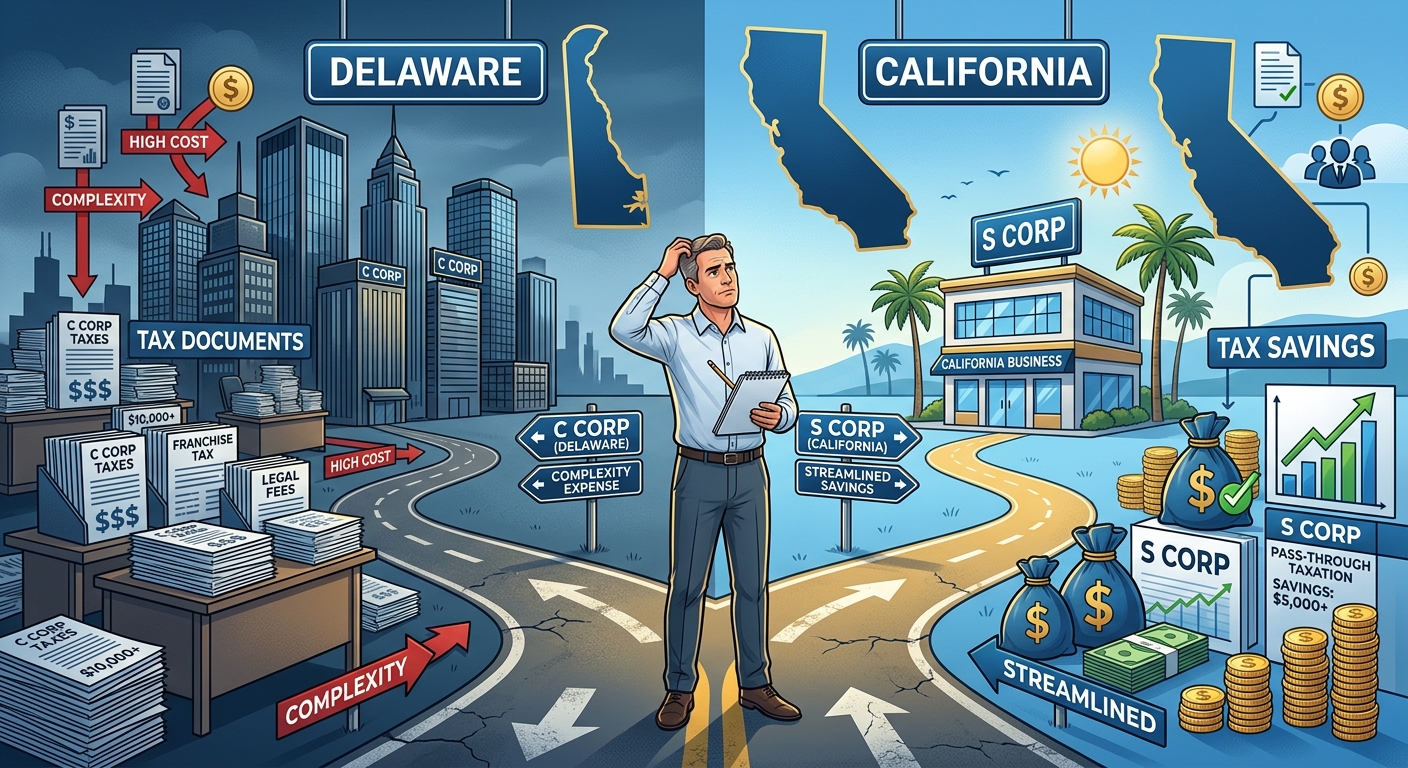
The Delaware Incorporation Myth That Costs California Business Owners $37,400 Every Year
A business attorney in San Jose told a marketing agency owner last year to incorporate in Delaware because “that is where all the big companies are.” The owner followed the advice, formed a Delaware C Corp, registered as a foreign corporation in California, and started operating. Twelve months later, that owner paid $37,400 more in combined federal and state taxes than a neighbor running the same size agency through a California S Corp. The difference had nothing to do with legal protections and everything to do with picking the wrong entity in the wrong state for the wrong reasons.
If you are comparing a C Corp vs S Corp Delaware incorporation and you live and operate in California, you are asking the right question at the worst possible time to get it wrong. Delaware incorporation is a legitimate tool for venture-backed startups chasing institutional capital. For the other 94% of California business owners pulling $100,000 to $400,000 in annual profit, it is an expensive detour that triggers double taxation, dual-state compliance fees, and zero additional liability protection you would not already get from a simple California entity.
Quick Answer
Delaware C Corps face double taxation at the federal level (21% corporate rate plus up to 23.8% on dividends) and owe California franchise tax at 8.84% on all income earned in the state, regardless of where the entity is incorporated. A California S Corp passes income directly to the owner, avoids double taxation, qualifies for the permanent 20% QBI deduction under IRC Section 199A, and pays only 1.5% California franchise tax. For a business earning $200,000 in net profit, the S Corp structure saves $27,900 to $37,400 annually depending on salary split and filing status.
Why California Business Owners Keep Falling for the Delaware Trap
Delaware earned its reputation as the corporate capital of America for real reasons. The Court of Chancery specializes in business disputes. The Delaware General Corporation Law provides flexible governance rules. Nearly 68% of Fortune 500 companies are incorporated there, according to the Delaware Division of Corporations. Those facts are accurate and completely irrelevant to a California-based business owner earning $200,000 through a consulting firm, medical practice, or e-commerce store.
The “Prestige” Argument Falls Apart Fast
Large companies incorporate in Delaware because they need multiple share classes to attract venture capital, a predictable body of corporate case law for complex governance disputes, and the ability to issue stock to hundreds or thousands of shareholders. S Corporations are limited to 100 shareholders and one class of stock under IRC Section 1361(b)(1). If your business has one to five owners and no plans to raise institutional equity, the Delaware C Corp advantages evaporate on day one.
Many business owners hear “incorporate in Delaware” from attorneys who specialize in corporate formation but not tax strategy. The formation attorney collects a fee. The business owner collects a tax bill that grows every single year.
The Double Registration Problem
If you incorporate in Delaware but operate in California, you must register as a foreign corporation with the California Secretary of State. That means you pay Delaware’s annual franchise tax (minimum $400 for C Corps, plus the authorized shares method that can push costs to $2,500 or more), California’s $800 minimum franchise tax, a California registered agent fee, and a Delaware registered agent fee. Before you earn your first dollar of profit, you are spending $1,600 to $3,800 in annual compliance costs that a straightforward California S Corp avoids entirely.
C Corp vs S Corp Delaware: The Five-Layer Tax Comparison California Owners Need to See
The real damage of the Delaware C Corp decision shows up across five distinct tax layers. Each one compounds the others, and the total gap widens as your business grows. Our entity formation services help California business owners model these numbers before they commit to a structure they will regret.
Layer 1: Federal Corporate Tax (C Corp Only)
A C Corp pays a flat 21% federal corporate income tax on net profit under IRC Section 11. An S Corp pays zero entity-level federal tax. On $200,000 of net profit, the C Corp pays $42,000 in federal corporate tax before the owner sees a dime. The S Corp pays $0 at the entity level.
Layer 2: California Franchise Tax
California taxes C Corps at 8.84% of net income under Revenue and Taxation Code Section 23151. California taxes S Corps at 1.5% of net income under R&TC Section 23802. On $200,000 of profit, the C Corp pays $17,680 in California franchise tax. The S Corp pays $3,000. That is a $14,680 gap on this layer alone.
Layer 3: Federal Dividend Tax (C Corp Only)
After the C Corp pays its corporate taxes, the remaining profit distributed to the owner gets taxed again as qualified dividends. At the 15% qualified dividend rate (for owners earning under $492,300 in 2026), the owner pays an additional $21,048 in federal tax on the $140,320 remaining after corporate tax and state tax. The S Corp owner pays federal tax only once, on the pass-through income reported on Schedule K-1.
Layer 4: QBI Deduction (S Corp Only)
The One Big Beautiful Bill Act made the Qualified Business Income deduction permanent under IRC Section 199A. S Corp owners can deduct up to 20% of their qualified business income from their personal tax return. On $200,000 of S Corp profit (after reasonable salary), this deduction can reduce taxable income by $20,000 to $28,000. C Corp shareholders get zero QBI deduction. At a 32% marginal federal rate, that is $6,400 to $8,960 in additional tax savings the S Corp owner captures and the C Corp owner permanently loses.
Layer 5: AB 150 PTE Election (S Corp Only)
California’s AB 150 pass-through entity tax election allows S Corp owners to bypass the $40,000 SALT deduction cap (made permanent under the OBBBA). The S Corp pays 9.3% of income as an entity-level tax, and the owner claims a dollar-for-dollar credit on their California personal return. The net effect is a full state tax deduction at the federal level that C Corp shareholders cannot access. On $200,000 of income, this saves approximately $4,100 in federal taxes. Want to see how these layers affect your specific situation? Run your numbers through this small business tax calculator to estimate the impact on your bottom line.
Total Five-Layer Comparison at $200,000 Profit
| Tax Layer | Delaware C Corp | California S Corp |
|---|---|---|
| Federal Corporate Tax | $42,000 | $0 |
| California Franchise Tax | $17,680 | $3,000 |
| Federal Dividend Tax | $21,048 | $0 |
| QBI Deduction Savings | $0 | ($7,680) |
| AB 150 PTE Savings | $0 | ($4,100) |
| Delaware Compliance Costs | $2,500 | $0 |
| Total Annual Tax Burden | $83,228 | $45,820 |
| Annual S Corp Advantage | $37,408 | |
Over five years, that gap exceeds $187,000, not counting the additional payroll tax savings the S Corp owner captures through the salary-distribution split. For a deep dive into how these S Corp mechanics work together, read our complete guide to S Corp tax strategy in California.
Three Narrow Scenarios Where Delaware C Corp Actually Wins
Honesty matters more than persuasion. There are exactly three situations where a Delaware C Corp makes strategic sense for a California-based business owner. If your business does not fit one of these three boxes, Delaware incorporation is costing you money.
Scenario 1: Venture Capital and Multiple Share Classes
If you plan to raise institutional capital from venture funds that require preferred stock, anti-dilution provisions, and board governance structures familiar to Silicon Valley attorneys, Delaware C Corp is the standard. S Corps cannot issue preferred shares or have more than 100 shareholders. A Series A raise from Sequoia or Andreessen Horowitz will require Delaware C Corp formation. This applies to roughly 0.5% of new businesses formed each year.
Scenario 2: Qualified Small Business Stock Under Section 1202
IRC Section 1202 allows founders of qualifying C Corps to exclude up to $10 million (or 10x their basis) in capital gains when they sell shares held for at least five years. The stock must be original issue, the corporation must be a C Corp at the time of issuance, and the business must operate in an active trade or business with gross assets under $50 million. If you plan to build and sell a company for $5 million or more and are willing to absorb the double taxation for five to ten years, the Section 1202 exclusion can offset those costs. This is a legitimate play for tech founders building for acquisition.
Scenario 3: Full Profit Retention With No Distributions
If your business retains 100% of its profits for reinvestment and you never plan to distribute dividends, the 21% flat corporate rate is lower than the top individual rate of 37%. However, the IRS applies the accumulated earnings tax under IRC Section 531 at 20% on profits retained beyond the reasonable needs of the business (generally $250,000 for most corporations). This narrow window works for capital-intensive businesses with legitimate reinvestment needs and closes fast once distributions begin.
Five Costliest C Corp vs S Corp Delaware Mistakes California Owners Make
Every week, we see California business owners walking into the same traps. These five mistakes account for over 80% of the unnecessary tax burden we correct in initial client consultations.
Mistake 1: Incorporating in Delaware for “Asset Protection”
Delaware offers no additional asset protection for a single-owner operating company based in California. California courts apply California law to businesses operating within the state. The veil-piercing standards, liability exposure, and creditor protections are determined by where you conduct business, not where you file articles. A California LLC or California S Corp provides identical liability protection with simpler compliance and lower fees.
Mistake 2: Ignoring the California Clawback on Delaware Entities
California taxes all income earned within the state, regardless of where the entity is incorporated. Revenue and Taxation Code Section 23101 defines “doing business” broadly enough to capture virtually any California-operated company. Your Delaware C Corp still pays 8.84% California franchise tax on every dollar earned from California operations. You are not avoiding California tax. You are adding Delaware tax on top of it.
Mistake 3: Missing the S Corp Election Window
If you already formed a Delaware or California C Corp, you can elect S Corp status by filing IRS Form 2553 by March 15 of the tax year you want the election to take effect. Miss that deadline and you wait an entire year, losing $27,000 to $37,000 in tax savings. If you missed it, Rev. Proc. 2013-30 allows late election relief within three years and 75 days if you filed consistently as an S Corp.
Mistake 4: Setting an Unreasonable S Corp Salary
The IRS requires S Corp owner-employees to pay themselves a “reasonable salary” under the guidelines established in Watson v. Commissioner. Setting your salary too low triggers IRS reclassification of distributions as wages, plus back employment taxes, penalties, and interest. Setting it too high eliminates the payroll tax savings. The sweet spot is generally 40% to 60% of net profit for service-based businesses, adjusted for industry norms and comparable compensation data from the Bureau of Labor Statistics.
Mistake 5: Skipping California’s Bonus Depreciation Adjustment
The OBBBA made 100% federal bonus depreciation permanent. California does not conform. Under R&TC Sections 17250 and 24356, California limits bonus depreciation and caps Section 179 at $25,000. Every California business owner operating a Delaware C Corp or California S Corp must maintain dual depreciation schedules, one for federal and one for state, or face audit adjustments and penalties. This is the single most commonly missed compliance item we see in new client files.
KDA Case Study: Sacramento E-Commerce Owner Saves $41,200 by Ditching Delaware
Marcus ran a direct-to-consumer supplement brand through a Delaware C Corp. His formation attorney had recommended Delaware for “credibility with investors,” even though Marcus had no plans to raise outside capital. After three years of operation, Marcus was earning $280,000 in net profit and paying a combined tax burden of $118,400 annually across federal corporate tax, California franchise tax at 8.84%, federal dividend tax on distributions, Delaware annual franchise tax, and dual registered agent fees.
KDA restructured Marcus into a California S Corp. We filed Form 2553 for immediate S Corp election, dissolved the Delaware entity, set a reasonable salary at $115,000 based on BLS data for supplement industry executives, activated the AB 150 PTE election for the SALT cap bypass, established a Solo 401(k) with $23,500 in annual deferrals plus employer contributions, and built dual depreciation schedules for his $45,000 in warehouse equipment.
In year one, Marcus’s total tax burden dropped to $77,200, a savings of $41,200. His KDA engagement cost $5,800, producing a first-year ROI of 7.1x. Over five years, the projected savings exceed $206,000, not including the additional retirement account growth from the Solo 401(k) contributions that were impossible under his old C Corp structure.
Ready to see how we can help you? Explore more success stories on our case studies page to discover proven strategies that have saved our clients thousands in taxes.
The 8-Step Process to Convert From Delaware C Corp to California S Corp
If you are currently operating a Delaware C Corp in California and want to capture the S Corp advantage, here is the exact conversion process we execute for clients.
Step 1: Evaluate Built-in Gains Exposure
Under IRC Section 1374, any appreciated assets held at the time of S Corp election are subject to a built-in gains (BIG) tax if sold within five years. Calculate the fair market value of all assets on the conversion date and compare to tax basis. If you have significant appreciated inventory, real estate, or intellectual property, the BIG tax may affect your conversion timeline.
Step 2: Eliminate Accumulated Earnings and Profits
C Corps that convert to S Corp status carry over their accumulated earnings and profits (AE&P). Under IRC Section 1368(c), distributions from an S Corp with AE&P follow a complex ordering rule that can trigger dividend taxation. Distribute all AE&P as a taxable dividend before or during the conversion year to start clean.
Step 3: File Form 2553 With the IRS
Submit Form 2553 by March 15 of the year you want the election effective. All shareholders must consent. Verify your entity meets S Corp eligibility: 100 or fewer shareholders, one class of stock, all shareholders are U.S. citizens or residents, and no corporate or partnership shareholders.
Step 4: File California Form 3560
California requires a separate S Corp election filing with the Franchise Tax Board. Submit Form 3560 (S Corporation Election or Termination/Revocation) to ensure California recognizes your federal S Corp election.
Step 5: Dissolve the Delaware Entity
File a Certificate of Dissolution with the Delaware Division of Corporations. Pay any outstanding Delaware franchise taxes. Cancel your Delaware registered agent. This eliminates the annual $400 to $2,500 Delaware compliance cost permanently.
Step 6: Set Up California Payroll
Register with the California Employment Development Department. Establish quarterly payroll at a reasonable salary amount. File Form 941 quarterly with the IRS and DE 9/DE 9C with the EDD.
Step 7: Activate AB 150 PTE Election
File the AB 150 pass-through entity tax election by the original due date of the S Corp’s first California return (March 15 or the extended deadline). Make the first estimated PTE tax payment by June 15. Missing this election in the first year means losing $4,100 or more in federal tax savings.
Step 8: Build Dual Depreciation Schedules
Create separate federal and California depreciation schedules for all existing assets. Federal allows 100% bonus depreciation permanently under the OBBBA. California limits bonus depreciation under R&TC 17250/24356 and caps Section 179 at $25,000. Track both schedules going forward to avoid audit adjustments.
What If You Already Formed in Delaware This Year?
If you formed a Delaware C Corp in 2026 and have not yet filed any tax returns, you may be able to elect S Corp status retroactively to the date of incorporation. File Form 2553 immediately. If the entity has been in existence for less than two months and 15 days, you can elect for the current tax year. If you missed that window, use Rev. Proc. 2013-30 for late election relief, but act quickly because the relief window closes at three years and 75 days from the intended effective date.
If you formed in a prior year and have been operating as a C Corp, you will need to address the AE&P issue described in Step 2 above and evaluate the BIG tax exposure in Step 1. The conversion is almost always worth it for California-based service businesses, but the timing and sequencing matter enormously.
Does Delaware Offer Better Legal Protections Than California?
For publicly traded companies and multi-billion-dollar enterprises, yes. The Delaware Court of Chancery provides specialized expertise in corporate governance disputes, and its body of case law is the most developed in the country. For a California business owner running a consulting firm, medical practice, construction company, or e-commerce brand with one to ten employees, this advantage is theoretical at best.
California provides robust corporate and LLC protections under the California Corporations Code. Your personal assets are protected from business liabilities as long as you maintain corporate formalities (separate bank accounts, annual meetings, proper capitalization). You do not need Delaware incorporation to achieve this. You need a properly maintained California entity and a tax strategy that keeps more of your money in your pocket.
Ready to Reduce Your Tax Bill?
KDA Inc. specializes in strategic tax planning for business owners, S Corps, LLCs, and high-net-worth individuals. Book a personalized consultation and walk away with a clear plan.
Frequently Asked Questions
Can I Be an S Corp in Delaware?
Yes. S Corp election is a federal tax classification under IRC Section 1362. You can incorporate in any state and elect S Corp status by filing Form 2553 with the IRS. However, if you operate in California, incorporating in Delaware simply adds compliance costs and dual-state fees without tax advantages. Form your entity in California and elect S Corp status there.
Is Delaware Franchise Tax Cheaper Than California?
Delaware’s minimum franchise tax for C Corps is $400 annually. California’s minimum franchise tax is $800. However, Delaware’s authorized shares method can push the Delaware franchise tax to $2,500 or more for companies with large authorized share counts. More importantly, if you operate in California, you pay both Delaware and California taxes, making the total compliance cost higher than a California-only entity.
What About Nevada Instead of Delaware?
Nevada has no state corporate income tax and no franchise tax. However, California taxes all income earned from California operations regardless of where the entity is formed. If you operate in California, incorporating in Nevada does not save you a single dollar in California taxes. It only adds Nevada compliance costs on top of your existing California obligations. The same logic applies to Wyoming, South Dakota, and every other “tax-friendly” state.
How Long Does It Take to Convert From C Corp to S Corp?
The IRS typically processes Form 2553 within 60 days. California’s Form 3560 processes within 30 to 45 days. The entire conversion, including payroll setup, AB 150 election, and Delaware dissolution, takes 45 to 90 days when managed properly. The critical deadline is March 15 for current-year elections.
Will Converting to S Corp Trigger an Audit?
Entity conversions do not independently trigger audits. However, the IRS cross-references Form 2553 elections against filed returns using the Palantir SNAP AI system. If your first S Corp return shows an unreasonable salary or inconsistent income reporting compared to prior C Corp returns, audit risk increases. Setting a defensible salary based on BLS compensation data and maintaining clean records from day one minimizes this risk to near zero.
What Is the OBBBA and How Does It Affect This Decision?
The One Big Beautiful Bill Act, signed into law in 2025, made several temporary tax provisions permanent. For this decision, the most relevant changes are the permanent 20% QBI deduction under IRC Section 199A (S Corp only), permanent 100% bonus depreciation (with California nonconformity), the $40,000 SALT deduction cap (making AB 150 PTE critical for S Corp owners), and the increased $2.5 million Section 179 deduction limit. Every one of these provisions benefits S Corp owners more than C Corp shareholders.
This information is current as of April 16, 2026. Tax laws change frequently. Verify updates with the IRS or FTB if reading this later.
Book Your Entity Strategy Session
If you are operating a Delaware C Corp in California and suspect you are overpaying by $20,000 or more each year, stop guessing. Our team has converted hundreds of California business owners from C Corp to S Corp structures and recovered an average of $34,000 in first-year savings. We will model your specific numbers, evaluate your BIG tax exposure, and build a conversion timeline that captures every available dollar. Click here to book your entity strategy session now.



