
You just closed a $145,000 contract. Your first thought? “How much of this stays in my pocket?” If you’re a California taxpayer, that answer gets complicated fast. Between federal brackets, California’s progressive tax system, and the state’s unique add-ons, you could be looking at an effective rate anywhere from 9.3% to 13.3% on your state return alone.
Here’s what most taxpayers miss: California’s tax rate isn’t one number. It’s a layered system that changes based on your income level, filing status, and entity structure. A W-2 employee earning $75,000 faces a vastly different rate than a business owner pulling $200,000 in S Corp distributions. And if you’re not planning around these brackets, you’re leaving money on the table.
Quick Answer
California’s tax rate for 2026 ranges from 1% to 13.3% depending on your taxable income and filing status. Single filers pay 1% on the first $10,412, scaling up to 13.3% on income over $698,271. Married filing jointly thresholds are roughly double. California uses nine tax brackets, making it one of the most progressive state tax systems in the U.S.
California Tax Brackets for 2026: The Full Picture
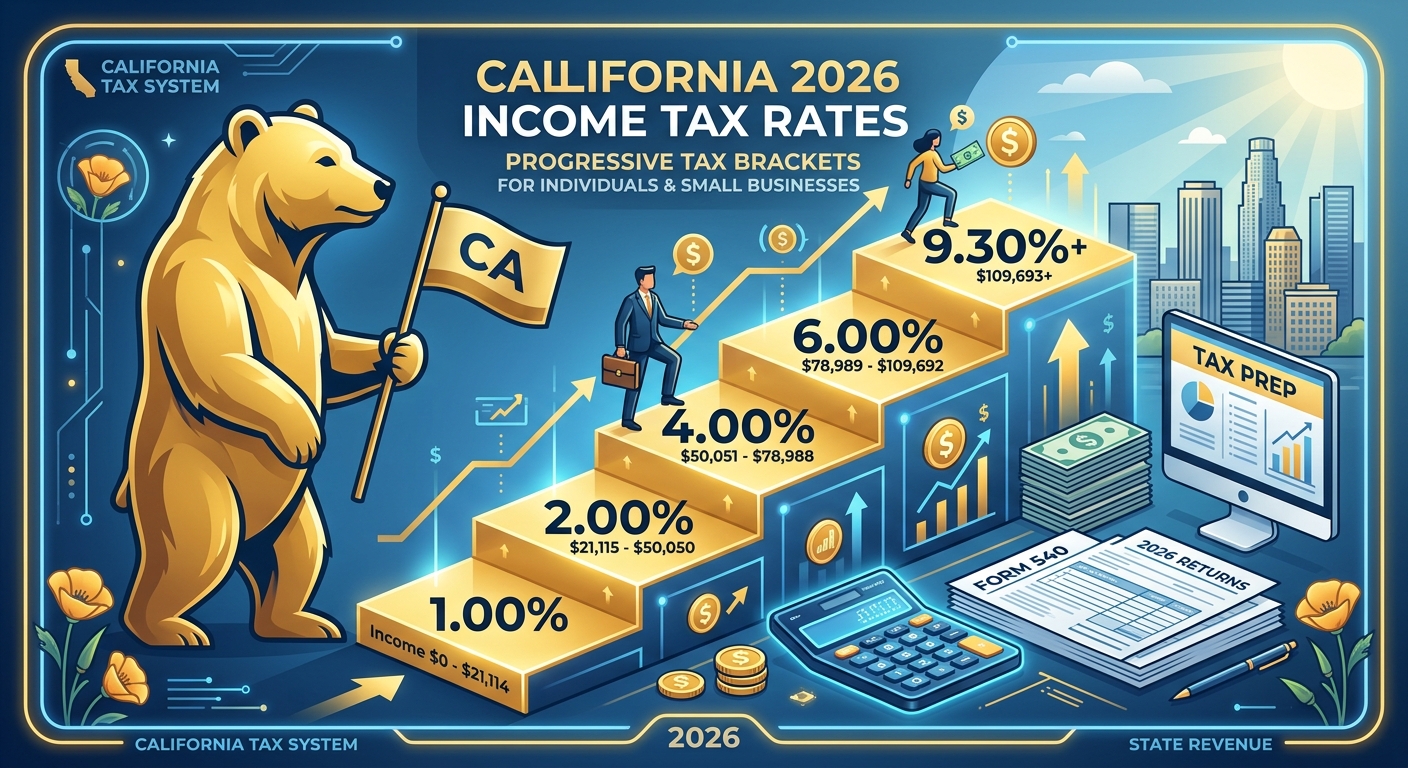
California operates a nine-bracket progressive tax system. That means your income is taxed in layers, not at a flat rate. If you earn $100,000 as a single filer, you don’t pay 9.3% on all of it. You pay 1% on the first chunk, 2% on the next, and so on until you hit the bracket that captures your top dollar.
2026 California Tax Brackets (Single Filers)
| Taxable Income Range | Tax Rate | Tax Owed on This Bracket |
|---|---|---|
| $0 – $10,412 | 1% | Up to $104.12 |
| $10,413 – $24,684 | 2% | Up to $285.44 |
| $24,685 – $38,959 | 4% | Up to $570.96 |
| $38,960 – $54,081 | 6% | Up to $907.26 |
| $54,082 – $68,350 | 8% | Up to $1,141.44 |
| $68,351 – $349,137 | 9.3% | Up to $26,113.08 |
| $349,138 – $418,961 | 10.3% | Up to $7,191.78 |
| $418,962 – $698,271 | 11.3% | Up to $31,561.98 |
| $698,272+ | 13.3% | 13.3% on all income above |
Key Takeaway: A single filer earning $100,000 pays an effective California tax rate of approximately 5.8% ($5,815 total), not the 9.3% marginal rate their top dollar falls into.
2026 California Tax Brackets (Married Filing Jointly)
| Taxable Income Range | Tax Rate |
|---|---|
| $0 – $20,824 | 1% |
| $20,825 – $49,368 | 2% |
| $49,369 – $77,918 | 4% |
| $77,919 – $108,162 | 6% |
| $108,163 – $136,700 | 8% |
| $136,701 – $698,274 | 9.3% |
| $698,275 – $837,922 | 10.3% |
| $837,923 – $1,396,542 | 11.3% |
| $1,396,543+ | 13.3% |
Married couples benefit from roughly doubled bracket thresholds, but the top 13.3% rate still kicks in at incomes above $1.4 million.
How California’s Tax Rate Hits Different Taxpayers
Understanding the brackets is step one. Step two is recognizing how your income type and entity structure changes what you actually pay. A $150,000 salary gets taxed very differently than $150,000 in business profit, rental income, or capital gains.
W-2 Employees: The Straightforward Path
If you’re a salaried employee, your California income tax gets withheld automatically. Your employer uses the W-4 withholding form to estimate your state liability. But here’s the trap: California withholding tables assume you have no other income. If you freelance on the side, own rental properties, or sold stock at a gain, you could owe thousands more at filing time.
Example: Sarah, a software engineer in San Francisco, earns $120,000 in W-2 wages. Her employer withholds approximately $6,800 for California taxes. But Sarah also runs a consulting side hustle that nets $30,000. That extra income pushes her into the 9.3% bracket, and she owes an additional $2,790 at tax time because her employer couldn’t withhold for self-employment income.
Self-Employed and 1099 Contractors: The Estimated Tax Requirement
If you’re self-employed, no one withholds California tax for you. That means quarterly estimated payments to the Franchise Tax Board (FTB). Miss these deadlines, and you’ll face underpayment penalties starting at 5% annually.
Estimated Tax Deadlines for 2026:
- Q1 (Jan 1 – Mar 31): Due April 15, 2026
- Q2 (Apr 1 – May 31): Due June 16, 2026
- Q3 (Jun 1 – Aug 31): Due September 15, 2026
- Q4 (Sep 1 – Dec 31): Due January 15, 2027
Most tax pros recommend paying 110% of last year’s total California tax liability if your income is steady, or 90% of the current year’s expected liability if income dropped. This safe harbor method prevents penalties even if you underestimate.
Need help planning quarterly payments and reducing your overall tax burden? Explore our tax planning services to build a strategy that keeps you compliant and saves you money.
S Corp and LLC Owners: Entity Structure Matters
Business owners have the most flexibility in managing California’s tax rate, but only if they structure correctly. An LLC taxed as a sole proprietorship pays the full 9.3% to 13.3% on net profit. An S Corp owner, by contrast, splits income into salary (subject to full tax) and distributions (not subject to California payroll taxes).
Example: Marcus owns a digital marketing agency structured as an S Corp. His business nets $200,000. He pays himself a reasonable salary of $80,000 and takes $120,000 in distributions. While both amounts are subject to California income tax, the distributions avoid the 15.3% self-employment tax federally and reduce his overall effective rate.
Marcus pays approximately $7,200 in California tax on his salary and $11,160 on his distributions, totaling $18,360. If he had stayed a sole proprietor, he’d owe the same California tax but an additional $18,360 in federal self-employment tax (15.3% x $120,000). His S Corp election saves him over $18,000 annually.
What Most Taxpayers Get Wrong About California’s Tax Rate
Even seasoned business owners make these mistakes. Avoid them and you’ll keep more of what you earn.
Mistake #1: Confusing Marginal Rate with Effective Rate
Your marginal rate is the percentage you pay on your last dollar of income. Your effective rate is your total tax divided by total income. If you earn $100,000 and pay $5,815 in California tax, your effective rate is 5.8%, even though your marginal rate is 9.3%.
Red Flag Alert: Don’t let marginal rate fear stop you from earning more. Moving from a 9.3% bracket to a 10.3% bracket doesn’t mean all your income gets taxed at the higher rate. Only the dollars above the threshold do.
Mistake #2: Ignoring California’s Mental Health Services Tax
California imposes an additional 1% tax on taxable income exceeding $1 million for the Mental Health Services Act. This means high earners effectively pay 14.3% (13.3% + 1%) on income above the million-dollar mark. Most taxpayers don’t realize this until they file.
Example: A real estate investor sells a property and realizes a $1.2 million capital gain. She expects to pay 13.3% on the gain ($159,600), but the actual bill is $162,600 because the extra 1% applies to the $200,000 over the $1 million threshold.
Mistake #3: Failing to Plan for Alternative Minimum Tax (AMT)
California has its own AMT system separate from federal AMT. If you claim large deductions for depreciation, incentive stock options, or certain tax credits, you could trigger AMT and owe more than the standard calculation suggests. California’s AMT rate is 7%, which might actually lower your liability if you’re in a higher bracket, but it eliminates many deductions.
Pro Tip: If you’re subject to California AMT, accelerate income into the AMT year and defer deductions to non-AMT years. This strategy flips conventional tax planning but saves thousands when AMT applies.
Mistake #4: Missing the Standard Deduction Opportunity
California’s standard deduction for 2026 is $5,363 for single filers and $10,726 for married filing jointly. These amounts are far lower than federal standard deductions, meaning many California taxpayers benefit from itemizing on their state return even if they take the standard deduction federally.
If your mortgage interest, property taxes, and charitable contributions exceed the California standard deduction, file Schedule CA to itemize. This could reduce your taxable income by $5,000 to $15,000 depending on your situation.
Special Situations: How California’s Tax Rate Changes
Not all income gets treated the same. California taxes capital gains, retirement distributions, and business income differently depending on how you structure and time your transactions.
Capital Gains: No Special Rate in California
Unlike the federal system, California does not offer preferential long-term capital gains rates. Whether you hold stock for one day or ten years, the gain is taxed as ordinary income at your marginal rate. This makes California one of the least favorable states for investors.
Example: You sell $50,000 in Apple stock after holding it for three years. Federally, you’d pay 15% long-term capital gains tax ($7,500). In California, that $50,000 gets added to your ordinary income and taxed at your marginal rate. If you’re in the 9.3% bracket, you owe an additional $4,650 to California.
Strategy: Consider establishing residency in a no-income-tax state like Nevada or Texas before selling appreciated assets if the gain is large enough to justify the move. Domicile changes require careful documentation, but the savings can exceed $50,000 on a $500,000 gain.
Retirement Income: California Taxes It Fully
California taxes all retirement distributions as ordinary income: 401(k) withdrawals, IRA distributions, and pension payments. There’s no exclusion for seniors, no matter your age. The only exception is Social Security benefits, which California does not tax.
If you’re planning retirement and expect to pull $80,000 annually from your IRA, budget for approximately $4,500 in California state tax on top of federal liability.
Pass-Through Entity Tax (PTET): A Workaround for Business Owners
California offers a Pass-Through Entity Tax election that allows S Corps and partnerships to pay state tax at the entity level. This converts a non-deductible personal state tax into a deductible business expense for federal purposes, effectively creating a workaround to the $10,000 SALT deduction cap.
How It Works: Your S Corp elects to pay California tax on its income before distributions. You get a credit for the amount paid when you file your personal return, so you’re not double-taxed. But federally, your business deducts the PTET payment, reducing taxable income.
Example: Your S Corp earns $300,000. Normally, you’d pay $27,900 in California tax personally (9.3% effective). With PTET, your S Corp pays the $27,900 directly and deducts it on the federal 1120-S. That deduction saves you approximately $6,138 federally (22% bracket), making your true California tax cost $21,762 instead of $27,900.
For detailed guidance on leveraging PTET and other California-specific strategies, visit our California Business Owner Tax Strategy Hub.
KDA Case Study: Small Business Owner Reduces California Tax by $8,400
James runs a construction company in Sacramento structured as a sole proprietorship LLC. In 2025, he netted $185,000 and paid $17,205 in California income tax plus $26,775 in federal self-employment tax. He assumed this was just the cost of doing business.
KDA converted James’s LLC to an S Corp election in January 2026. We set his reasonable salary at $90,000 and classified the remaining $95,000 as distributions. This adjustment eliminated self-employment tax on the $95,000 distribution, saving him $14,535 federally. We also elected PTET, which created an additional $3,200 federal deduction. Finally, we restructured his home office deduction using actual expense method rather than simplified, adding $2,700 in California deductions.
Total California and federal tax savings: $18,900 in year one. James paid KDA $3,500 for entity conversion, ongoing compliance, and strategic planning. His first-year ROI was 5.4x, and he’ll continue saving $15,000+ annually going forward.
Ready to see how we can help you? Explore more success stories on our case studies page to discover proven strategies that have saved our clients thousands in taxes.
How to Calculate Your California Tax Bill
You don’t need a CPA to estimate your California tax liability. Follow this process and you’ll get within $500 of your actual bill.
Step 1: Calculate Your Federal Adjusted Gross Income (AGI)
Start with your total income: wages, business profit, rental income, capital gains, retirement distributions. Subtract above-the-line deductions like HSA contributions, self-employed health insurance, and IRA contributions. This number is your federal AGI and serves as the starting point for California.
Step 2: Adjust for California-Specific Differences
California doesn’t conform to all federal tax rules. Add back any federal deductions California doesn’t allow, such as:
- State and local tax deduction (already excluded federally due to SALT cap, but California adds it back differently)
- Certain depreciation methods like bonus depreciation
- Section 199A Qualified Business Income deduction (California does not recognize this 20% federal deduction)
Subtract California-specific deductions like:
- Disaster loss deduction
- Adoption costs
Step 3: Apply California Standard or Itemized Deduction
Compare your California itemized deductions (mortgage interest, property taxes capped at $10,000, charitable contributions, medical expenses over 7.5% of AGI) to the standard deduction ($5,363 single, $10,726 married). Take whichever is higher.
Step 4: Calculate Tax Using Bracket Table
Apply the nine-bracket system to your California taxable income. Use the tables above to calculate tax owed in each bracket cumulatively.
Step 5: Subtract Credits
California offers several credits that directly reduce your tax bill:
- Child and Dependent Care Credit (up to $1,083 for two or more dependents)
- Renter’s Credit ($60 single, $120 married if income under $49,220 single/$98,440 married)
- Senior Head of Household Credit ($1,390 if you’re 65+ and qualify)
- Dependent Parent Credit ($467 per dependent parent living with you)
Pro Tip: Many California taxpayers miss the renter’s credit simply because they don’t know it exists. If you rent your primary residence and meet income limits, claim this on Form 540, Line 48. It’s a dollar-for-dollar reduction in tax owed.
Do I Need to Pay Estimated Taxes to California?
Yes, if you expect to owe more than $500 in California tax after withholding and credits. This typically applies to:
- Self-employed individuals and 1099 contractors
- Business owners (S Corp, LLC, partnership)
- Real estate investors with significant rental income
- Anyone with substantial investment income or capital gains
California estimated tax payments are due quarterly using Form 540-ES. You can pay online through the FTB website, by mail, or through most tax software.
Safe Harbor Rule: Pay 110% of your prior year’s total California tax (or 90% of current year’s expected liability), and you’ll avoid underpayment penalties even if you underestimate. This rule is especially helpful in high-income years when calculating exact quarterly amounts becomes difficult.
How Does California’s Tax Rate Compare to Other States?
California’s 13.3% top rate is the highest in the nation. For context:
- Texas, Florida, Nevada: 0% state income tax
- New York: 10.9% top rate (lower than California)
- Oregon: 9.9% top rate
- Arizona: 4.5% flat rate
High earners in California can pay more in state tax than total federal tax in low-tax states. A single filer earning $1 million pays approximately $130,000 in California state tax alone. That same person in Texas pays zero.
This disparity drives significant migration among retirees and business owners. If you’re considering relocating, understand that California’s Franchise Tax Board aggressively audits residency changes. You’ll need to prove you severed California ties completely: changed driver’s license, voter registration, sold or rented your California home, and spent fewer than 45 days in the state post-move.
What Happens If I Don’t Pay My California Taxes?
California’s Franchise Tax Board has some of the most aggressive collection powers in the country. Unlike the IRS, which must go through federal court to seize assets, the FTB can issue bank levies and wage garnishments administratively.
Penalties You’ll Face
- Failure to File: 5% per month, up to 25% of unpaid tax
- Failure to Pay: 0.5% per month, up to 25% of unpaid tax
- Underpayment of Estimated Tax: Variable rate, currently around 5% annually
- Accuracy-Related Penalty: 20% if the FTB determines you substantially understated income
Red Flag Alert: If you owe California back taxes and ignore FTB notices, they will suspend your business license, professional license, and even your driver’s license. California is one of only a handful of states with this authority. A $5,000 tax debt can shut down your entire business if left unaddressed.
What to Do If You Owe
The FTB offers installment agreements for balances up to $25,000 with automatic approval if you’re current on filing all returns. You can set up payments online in under 10 minutes. For balances over $25,000, you’ll need to submit financial statements and negotiate terms, but agreements are routinely approved if you demonstrate good faith.
If you’re facing FTB collection action, contact a tax professional immediately. KDA handles California tax resolution cases daily and can negotiate penalty abatement, installment plans, and even offers in compromise when appropriate.
California Tax Planning: How to Pay Less Legally
Now that you understand how California’s tax rate works, here are five strategies to reduce your liability without moving out of state.
1. Maximize Retirement Contributions
Contributions to traditional 401(k), SEP IRA, or Solo 401(k) reduce California taxable income dollar-for-dollar. A business owner in the 9.3% bracket who maxes out a Solo 401(k) at $69,000 saves $6,417 in California taxes alone, plus federal savings.
2. Elect S Corp Status and Use PTET
As demonstrated in the case study above, S Corp elections combined with PTET create substantial federal and state tax savings for business owners netting over $60,000 annually.
3. Time Capital Gains Strategically
Since California taxes capital gains as ordinary income, consider spreading large asset sales across multiple years to avoid pushing into higher brackets. Selling a $300,000 appreciated property in one year could cost $39,900 in California tax (13.3% if it pushes you over $698,271). Splitting the sale across two years using an installment sale could drop your marginal rate to 9.3%, saving $12,000.
4. Relocate Before Liquidation Events
If you’re planning to sell a business, exit a partnership, or exercise a large stock option grant, consider establishing residency in a no-tax state first. California requires you to be a non-resident for the entire tax year to avoid taxation on such events, but careful planning can save six figures on a large transaction.
5. Use a Donor-Advised Fund for Charitable Giving
Contribute appreciated stock to a donor-advised fund (DAF) and you avoid capital gains tax while receiving a California charitable deduction. This strategy is especially powerful in high-income years when you need deductions but haven’t yet identified specific charities to support.
Example: You hold $50,000 in Tesla stock purchased for $10,000. Selling triggers $40,000 in capital gains and $3,720 in California tax (9.3%). Instead, contribute the stock directly to a DAF. You avoid the $3,720 California tax and receive a $50,000 charitable deduction, saving an additional $4,650 in California taxes if you itemize. Total savings: $8,370.
Ready to Reduce Your Tax Bill?
KDA Inc. specializes in strategic tax planning for business owners, S Corps, LLCs, and high-net-worth individuals. Book a personalized consultation and walk away with a clear plan.
Frequently Asked Questions
Does California tax Social Security benefits?
No. California is one of the few high-tax states that does not tax Social Security retirement benefits. However, all other retirement income (401(k), IRA, pension) is fully taxable.
What is California’s sales tax rate?
California’s base sales tax rate is 7.25%, but local jurisdictions add district taxes that push the total rate to 7.25% – 10.75% depending on location. Los Angeles County averages 9.5%, while San Francisco is 8.625%.
Do I pay California tax if I work remotely for a California company but live in another state?
No. If you’re a non-resident performing services entirely outside California, you don’t owe California income tax, even if your employer is based in California. However, if you’re a California resident working remotely for an out-of-state employer, you owe California tax on all income.
How do I know if I’m a California resident for tax purposes?
You’re a California resident if you’re in the state for other than a temporary or transitory purpose, or if you’re domiciled in California but outside for a temporary purpose. The FTB uses a facts-and-circumstances test examining where you live, where your family resides, where you vote, where your vehicles are registered, and where you maintain your closest connections.
Can I deduct state income tax on my federal return?
Yes, but only up to $10,000 combined for all state and local taxes (SALT cap). This limitation makes high-tax states like California especially expensive for high earners, since property taxes alone often exceed $10,000, leaving no room to deduct state income tax federally.
Stop Overpaying California Taxes
If you’re a California taxpayer earning over $60,000, you’re likely paying more than necessary. The strategies in this guide can save you thousands, but implementing them requires careful planning, entity structuring, and compliance with both FTB and IRS rules.
Don’t leave money on the table because you’re not sure where to start. Book a personalized consultation with our California tax strategy team and we’ll analyze your situation, identify specific deductions and credits you’re missing, and build a custom plan to reduce your effective rate. Click here to book your consultation now.
This information is current as of 4/16/2026. Tax laws change frequently. Verify updates with the IRS or FTB if reading this later.



