
Quick Answer
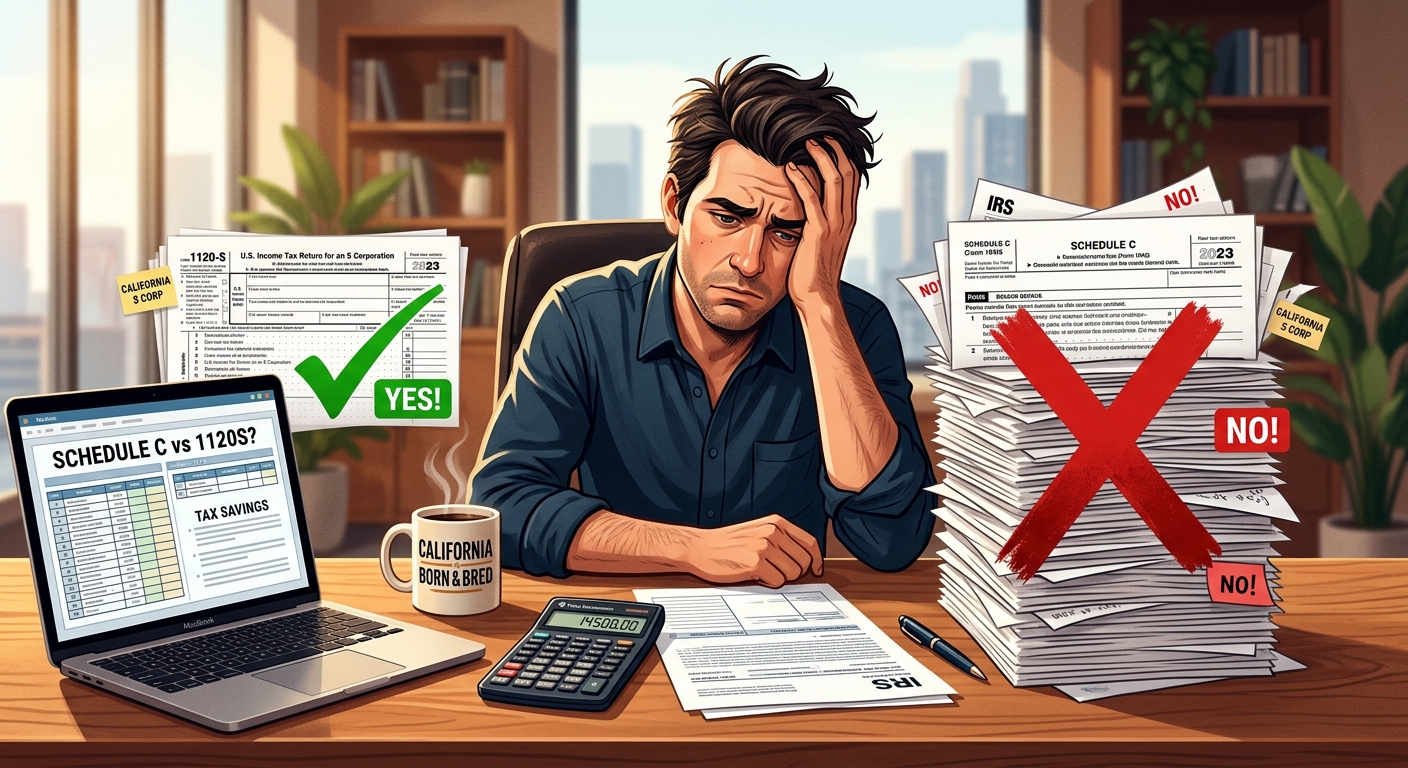
If you elected S Corp status for your LLC or corporation, you do not file a Schedule C tax form for S Corp income. Schedule C (Form 1040) is exclusively for sole proprietors and single-member LLCs that have not elected S Corp treatment. S Corporations file Form 1120-S at the entity level and distribute income to shareholders via Schedule K-1. Filing the wrong form costs California business owners an average of $8,200 to $24,600 per year in overpaid self-employment tax, missed QBI deductions, and IRS penalty exposure. Here is how to avoid every dollar of that damage.
Why So Many California Business Owners Confuse the Schedule C Tax Form for S Corp Filing
The confusion starts the day you form your LLC. California defaults every single-member LLC to disregarded entity status, which means the IRS expects you to file Schedule C on your personal Form 1040. You report all revenue, subtract expenses, and pay self-employment tax on every dollar of net profit at 15.3% (12.4% Social Security plus 2.9% Medicare). On $150,000 in net profit, that is $21,194 in self-employment tax alone, before federal and state income tax even touch you.
When you elect S Corp status by filing Form 2553 with the IRS, the entire filing structure changes. Your business now files its own return on Form 1120-S (U.S. Income Tax Return for an S Corporation). Your share of profit flows through to you on Schedule K-1, not Schedule C. The distinction is not cosmetic. It determines whether you owe self-employment tax on all of your profit, or only on the reasonable salary you pay yourself through W-2 payroll.
The problem is that thousands of California business owners file Form 2553, receive their approval letter, and then continue filing Schedule C the following April because nobody told them the filing changed. The IRS processes both returns without immediately flagging the mismatch, but the damage compounds silently: you overpay self-employment tax, you miss the Qualified Business Income (QBI) deduction on distributions, and you create an audit trail that contradicts your own election.
Key Takeaway: The moment your S Corp election takes effect, Schedule C is dead to your business. Every dollar of profit must flow through Form 1120-S and Schedule K-1 instead.
The Real Dollar Cost of Filing Schedule C After Your S Corp Election
This is not a theoretical problem. Let us walk through three income levels to show how filing the wrong form destroys your tax position.
Scenario 1: $80,000 Net Profit
Filing Schedule C: You report $80,000 on Schedule C, pay $11,304 in self-employment tax, and owe approximately $9,600 in federal income tax. Total federal burden: approximately $20,904.
Filing Form 1120-S correctly: You pay yourself a reasonable salary of $45,000, generating $6,885 in total payroll tax (split between employer and employee shares). The remaining $35,000 passes through as a distribution with zero self-employment tax. Your QBI deduction under IRC Section 199A saves you another $1,400. Total federal burden: approximately $15,485.
Annual cost of filing the wrong form: $5,419.
Scenario 2: $150,000 Net Profit
Filing Schedule C: Self-employment tax of $21,194 plus federal income tax of approximately $22,500. Total: roughly $43,694.
Filing Form 1120-S correctly: Reasonable salary of $70,000 generates $10,710 in payroll tax. The $80,000 distribution passes through tax-free for employment purposes. QBI deduction saves $3,200. Total: roughly $30,010.
Annual cost of filing the wrong form: $13,684.
Scenario 3: $250,000 Net Profit
Filing Schedule C: Self-employment tax hits the Social Security wage base cap at $176,100 (2026), so you pay $22,166 in SE tax plus the 0.9% Additional Medicare Tax on earnings above $200,000. Federal income tax adds approximately $42,000. Total: roughly $64,666.
Filing Form 1120-S correctly: Reasonable salary of $95,000 generates $14,535 in payroll tax. The $155,000 distribution avoids all employment tax. QBI deduction saves $6,200. Total: roughly $42,335.
Annual cost of filing the wrong form: $22,331.
Many business owners assume the IRS will catch and correct the mismatch. They will not. The IRS processes what you file. If you send in a Schedule C after electing S Corp status, they collect the excess self-employment tax and move on. It is your responsibility to file correctly, and our tax preparation and filing services exist specifically to prevent this kind of silent overpayment.
Want to see how the numbers play out at your specific profit level? Plug your figures into this small business tax calculator to estimate the difference between Schedule C and S Corp filing.
Schedule C vs. Form 1120-S: The Side-by-Side Breakdown
Understanding exactly what changes when you move from Schedule C to Form 1120-S prevents the most expensive filing errors California business owners make.
| Factor | Schedule C (Sole Prop / SMLLC) | Form 1120-S (S Corporation) |
|---|---|---|
| Who files it | Individual on Form 1040 | Entity files separately; K-1 to shareholders |
| Self-employment tax | 15.3% on all net profit | Only on W-2 salary (not distributions) |
| QBI deduction eligibility | Yes, on net profit | Yes, on K-1 income (distributions) |
| Payroll required | No | Yes, reasonable salary mandatory |
| Filing deadline | April 15 (with 1040) | March 15 (Form 1120-S); K-1 feeds April 15 |
| California form | Schedule CA / Form 540 | Form 100S (CA S Corp return) |
| Franchise tax | $800 LLC fee + gross receipts | 1.5% of net income (min $800) |
| Audit risk for mismatch | High if S Corp election exists | Standard when filed correctly |
The critical detail most taxpayers miss: Form 1120-S is due on March 15, a full month before your personal return. If you file late, the IRS imposes a penalty of $220 per shareholder per month (for 2026 returns), up to 12 months. For a single-shareholder S Corp that files three months late, that is $660 in penalties for a form you did not even know you owed. For a deeper look at how the S Corp election reshapes your entire tax filing strategy, read our comprehensive S Corp tax strategy guide for California.
What About California Form 100S?
California does not accept Form 1120-S. Your S Corporation must file Form 100S with the Franchise Tax Board (FTB), and it owes a minimum of 1.5% of net income or $800, whichever is greater. If you are still filing Schedule C on your federal return while your S Corp election is active, you are likely also filing the wrong state return, which means you may owe the $800 minimum franchise tax plus penalties for the unfiled Form 100S. The FTB charges $18 per shareholder per month for late-filed S Corp returns under Revenue and Taxation Code Section 19172.
What Happens to Your LLC Gross Receipts Fee?
When your LLC elects S Corp status, you stop owing the graduated gross receipts fee under R&TC Section 17942 (which runs from $0 to $11,790 depending on revenue). Instead, you owe the 1.5% net income tax under R&TC Section 23802(b). For most LLCs earning between $250,000 and $5,000,000 in gross receipts, the S Corp election reduces your California entity-level tax. But if you keep filing Schedule C, the FTB may assess both the LLC fee and the S Corp franchise tax, doubling your state burden until you correct the filing.
Five Costliest Schedule C Filing Mistakes After S Corp Election
These are the errors we see most often in California, and every one of them costs real money.
Mistake 1: Filing Schedule C for the Full Year After a Mid-Year Election
If your S Corp election was effective January 1, the entire year belongs on Form 1120-S. There is no split-year Schedule C. Some taxpayers file Schedule C for January through March (before they received their approval letter) and Form 1120-S for the rest of the year. The IRS does not allow this. The election date, not the approval date, controls your filing obligation. If the election is effective January 1, every dollar of that year’s income goes on Form 1120-S.
Mistake 2: Not Setting Up Payroll Before Filing
You cannot file Form 1120-S without paying yourself a reasonable W-2 salary. If you elected S Corp status but never set up payroll, you have a compliance gap the IRS will flag. The fix is to establish payroll retroactively (if still in the same year) or prospectively. But if you file Schedule C instead because payroll seems complicated, you forfeit the entire self-employment tax savings that motivated the election in the first place.
Mistake 3: Reporting S Corp Distributions on Schedule C
S Corp distributions are not self-employment income. They appear on Schedule K-1, Box 16, Code D, and flow to your personal return as non-SE income. If you report these amounts on Schedule C, the IRS assesses self-employment tax on money that should have been tax-free for employment purposes. On a $100,000 distribution, that is $15,300 in unnecessary tax.
Mistake 4: Missing the QBI Deduction on K-1 Income
The Qualified Business Income deduction under IRC Section 199A allows eligible taxpayers to deduct up to 20% of their qualified business income. When you file Schedule C, the QBI deduction applies to your net profit. When you file Form 1120-S correctly, the QBI deduction applies to your K-1 income (which excludes your W-2 salary). The deduction amount changes based on which form you use, and filing the wrong one often means claiming the wrong QBI amount, triggering an IRS adjustment letter or losing deduction dollars entirely.
Mistake 5: Ignoring the California Bonus Depreciation Nonconformity
California does not conform to federal bonus depreciation under R&TC Sections 17250 and 24356. If you file Schedule C and claim 100% bonus depreciation (now permanently restored under OBBBA), your California return must add back the entire federal bonus depreciation amount and substitute California’s $25,000 Section 179 cap. When you file Form 1120-S, this adjustment happens on Form 100S. If you file the wrong federal form, you likely also miscalculate the California depreciation adjustment, creating a dual-error that compounds over every year the asset depreciates.
Key Takeaway: Each of these five mistakes creates a separate audit trail. Combined, they can trigger IRS Palantir SNAP AI pattern detection, which cross-references your Form 2553 election against your actual filing behavior.
KDA Case Study: Sacramento Consultant Recovers $24,600 After Switching From Schedule C to Form 1120-S
A Sacramento-based IT consultant came to KDA after three years of filing Schedule C on net profit averaging $185,000. He had filed Form 2553 and received his S Corp approval letter in 2023, but his previous preparer continued filing Schedule C through 2025 because “it was simpler.”
When we reviewed his returns, the damage was clear. Over three years, he overpaid $38,400 in self-employment tax by reporting all profit on Schedule C instead of splitting it between W-2 salary and K-1 distributions. He also missed $14,800 in cumulative QBI deductions and owed $2,640 in late-filing penalties for three years of unfiled Forms 1120-S.
KDA filed amended federal returns (Form 1040-X) for all three years, prepared the delinquent Forms 1120-S with reasonable cause statements, and established compliant payroll going forward. We set his reasonable salary at $82,000 and structured $103,000 as annual distributions.
Results in the first corrected year: $24,600 in recovered tax savings. Total KDA engagement fee: $4,800. That is a 5.1x first-year ROI, with projected savings of $73,800 over the next three years assuming stable income.
Ready to see how we can help you? Explore more success stories on our case studies page to discover proven strategies that have saved our clients thousands in taxes.
How to Correct Your Filing If You Used Schedule C After Electing S Corp
If you have been filing Schedule C after your S Corp election took effect, here is the step-by-step process to fix it.
Step 1: Confirm Your S Corp Election Date
Pull your Form 2553 acceptance letter from the IRS. The effective date on the letter determines when your Schedule C obligation ended and your Form 1120-S obligation began. If you cannot find the letter, request a copy from the IRS by calling the Business and Specialty Tax Line at (800) 829-4933 or by submitting Form 4506-T (Request for Transcript of Tax Return).
Step 2: Prepare Delinquent Forms 1120-S
For every tax year after your election effective date where you filed Schedule C instead of Form 1120-S, you must now prepare and file the correct S Corp return. Include a reasonable cause statement explaining why the return is late. First-time penalty abatement under IRM 20.1.1.3.6 may apply if you have a clean compliance history.
Step 3: Amend Your Personal Returns
File Form 1040-X for each affected year. Remove the Schedule C income and replace it with the Schedule K-1 amounts from your newly filed Forms 1120-S. This recalculates your self-employment tax to zero (on the distribution portion) and adjusts your QBI deduction.
Step 4: Establish or Correct Payroll
If you never ran payroll, you need to file delinquent Forms 941 (Employer’s Quarterly Federal Tax Return) for each quarter. Pay the employer and employee shares of FICA plus any penalties. The IRS requires W-2 wages for every S Corp shareholder-employee with no exceptions. See IRS guidance on S Corporation compensation for the specific rules.
Step 5: File Corrected California Returns
Prepare delinquent Forms 100S with the FTB for each year. Amend your California Form 540 to remove the Schedule CA adjustments that corresponded to your incorrect Schedule C filing. Pay the 1.5% franchise tax on net income for each year, and request abatement of any penalties under R&TC Section 19132 if you have reasonable cause.
Step 6: Set Up Ongoing Compliance
Going forward, your annual filing calendar looks like this: Form 1120-S and Form 100S due March 15, Schedule K-1 issued to shareholders by March 15, quarterly payroll tax returns (Form 941) due the last day of the month following each quarter, and your personal Form 1040 due April 15 incorporating the K-1.
Key Takeaway: The IRS generally allows amended returns for up to three years from the original filing date. If you filed Schedule C for 2023, 2024, and 2025, you still have time to recover most of the overpaid tax. Waiting past the three-year window forfeits your refund claim permanently under IRC Section 6511.
OBBBA Changes That Make the Schedule C to Form 1120-S Switch Even More Valuable in 2026
The One Big Beautiful Bill Act (OBBBA) signed into law in 2025 made several permanent changes that amplify the value of filing as an S Corp instead of on Schedule C.
Permanent QBI Deduction
The 20% Qualified Business Income deduction under Section 199A was set to expire after 2025. OBBBA made it permanent. This means the annual savings from properly structuring your K-1 income (rather than Schedule C profit) to maximize QBI will continue indefinitely.
100% Bonus Depreciation Restored
OBBBA restored 100% first-year bonus depreciation, which had been phasing down since 2023. This matters because the depreciation flows through your Form 1120-S and onto your K-1. If you file Schedule C, you claim depreciation there instead, and California’s nonconformity under R&TC 17250 creates a different adjustment on Schedule CA than on Form 100S. Filing the correct form ensures your depreciation schedules align properly at both the federal and state level.
$40,000 SALT Cap
The state and local tax deduction cap increased from $10,000 to $40,000 under OBBBA. However, California’s AB 150 Pass-Through Entity (PTE) tax election allows S Corps to pay state tax at the entity level, bypassing the SALT cap entirely. If you file Schedule C, you cannot use the PTE election because Schedule C income is reported on your personal return, not through an entity. The PTE election is only available to entities that file Form 100S. On $200,000 of California taxable income, the PTE election saves approximately $6,510 beyond what the new $40,000 SALT cap allows.
$2,500,000 Section 179 Limit
OBBBA raised the federal Section 179 deduction limit to $2,500,000. California still caps Section 179 at $25,000. Whether you file Schedule C or Form 1120-S, the federal deduction limit is the same. But the California adjustment is calculated differently on Form 100S versus Schedule CA. Filing the wrong form often means the wrong California depreciation number, which triggers FTB notices.
Do I Need to Amend If I Only Filed Schedule C for One Year?
Yes. Even a single year of filing the wrong form creates a mismatch between your Form 2553 election and your actual tax returns. The IRS Palantir SNAP AI system flags discrepancies between entity elections and filed forms. A single-year correction is straightforward: file the delinquent Form 1120-S, amend your 1040, and establish payroll going forward. The cost of correction is almost always less than the cost of the overpaid tax.
Can I Revoke My S Corp Election and Go Back to Schedule C?
You can revoke your S Corp election by filing a revocation statement with the IRS, signed by shareholders holding more than 50% of the outstanding shares (see IRS S Corporation guidance). The revocation can be effective on the first day of the current tax year (if filed by March 15) or on a specified future date. Once revoked, your LLC reverts to disregarded entity status, and you resume filing Schedule C.
However, revoking solely to avoid the complexity of Form 1120-S is a $5,000 to $22,000 annual mistake at most income levels. The self-employment tax savings, QBI optimization, and PTE election benefits far outweigh the added filing requirements. Revocation makes sense only if your profit has dropped below $40,000, you no longer want to run payroll, or your business structure has fundamentally changed.
Will Filing the Wrong Form Trigger an Audit?
Filing Schedule C after an active S Corp election does not guarantee an audit, but it creates three specific red flags:
- Election-to-filing mismatch: The IRS SNAP system cross-references your Form 2553 approval against your filed returns. A Schedule C where a Form 1120-S should exist is a data anomaly.
- Missing Form 1120-S: The IRS expects an annual return from every active S Corporation. If no Form 1120-S arrives, the system generates a delinquency notice (CP259) within 12 to 18 months.
- Self-employment tax inconsistency: If you previously filed Form 1120-S and then switch back to Schedule C without revoking, the income level and tax treatment change dramatically, which flags your return for manual review.
The safest path is to file the correct form from the day your election takes effect. If you are already behind, correcting the record proactively (before the IRS contacts you) almost always results in better penalty outcomes.
Ready to Reduce Your Tax Bill?
KDA Inc. specializes in strategic tax planning for business owners, S Corps, LLCs, and high-net-worth individuals. Book a personalized consultation and walk away with a clear plan.
Frequently Asked Questions
Can I file both Schedule C and Form 1120-S in the same year?
Only if you have two separate businesses: one that operates as a sole proprietorship or disregarded LLC, and another that operates as an S Corporation. A single business entity cannot file both forms for the same income. If your LLC elected S Corp status, all of that LLC’s income goes on Form 1120-S.
What if my S Corp election was rejected or never processed?
If the IRS rejected your Form 2553 or never processed it, Schedule C remains your correct filing form. Request a copy of your entity status by calling the IRS at (800) 829-4933 or pulling a Business Account Transcript online. If the election was rejected, you may refile under Rev. Proc. 2013-30 for late election relief.
How do I determine a reasonable salary for my S Corp?
The IRS does not publish a specific formula. Reasonable salary is based on comparable wages for similar services in your industry, geographic area, and experience level. Resources include the Bureau of Labor Statistics Occupational Employment and Wage Statistics, industry salary surveys, and job postings for equivalent positions. A common benchmark is 35% to 50% of net profit, but this varies significantly by industry. Setting salary too low invites IRS reclassification of distributions as wages under IRC Section 3121(d).
Does the S Corp election affect my California estimated tax payments?
Yes. As an S Corp shareholder, your estimated tax payments shift. The entity pays the 1.5% franchise tax with Form 100-ES. You personally still make estimated payments on your Form 540-ES for the income flowing through on your K-1. Additionally, if you elect AB 150 PTE treatment, the entity makes the PTE tax payments, and you claim the credit on your personal return. This is a fundamentally different payment structure than the quarterly Schedule SE estimates you made when filing Schedule C.
What is the deadline to file Form 2553 for the current year?
Form 2553 must be filed no later than two months and 15 days after the beginning of the tax year (March 15 for calendar-year entities). Filing after March 15 makes the election effective for the following tax year. Late election relief under Rev. Proc. 2013-30 may apply if you meet the requirements within three years and 75 days of the intended effective date.
Can I deduct the cost of switching from Schedule C to Form 1120-S?
Yes. Professional fees paid to accountants and tax preparers for setting up your S Corp filing structure, amending prior returns, and establishing payroll are deductible as ordinary and necessary business expenses under IRC Section 162. These fees can be deducted on your Form 1120-S in the year paid.
This information is current as of April 13, 2026. Tax laws change frequently. Verify updates with the IRS or FTB if reading this later.
Book Your S Corp Filing Correction Session
If you elected S Corp status but have been filing Schedule C, every month you wait costs you hundreds in unnecessary self-employment tax. Our team will review your election status, calculate exactly how much you have overpaid, and build a correction plan that recovers every recoverable dollar. Stop leaving $8,000 to $24,000 on the table every year. Click here to book your consultation now.
“The IRS will never call you to say you filed the wrong form and overpaid. That call has to come from your tax strategist.”



