
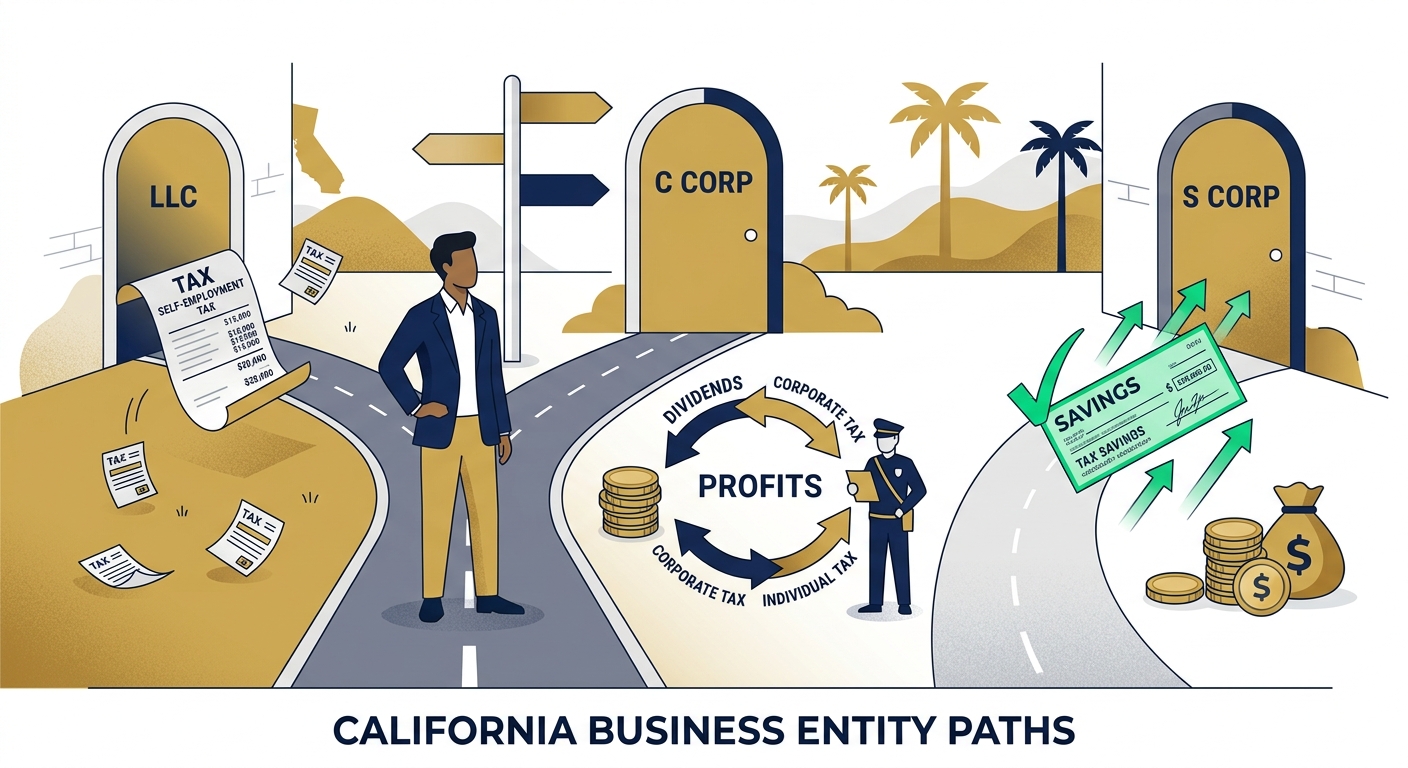
The $42,600 Entity Choice That Separates Smart California Business Owners From Everyone Else
A Sacramento restaurant owner called us last March with a problem she did not know she had. She had been running her $220,000-per-year catering business as a single-member LLC for six years. She thought she was protected. She thought she was saving money. She was wrong on both counts. Her LLC vs C or S Corp decision, or rather her failure to make one, had cost her $42,600 in unnecessary self-employment tax over those six years. That money was gone. And she is not alone.
Roughly 70 percent of California business owners we consult with are operating under the wrong entity structure. Not because they are careless, but because nobody sat them down and showed them the actual math. The difference between an LLC, a C Corp, and an S Corp is not theoretical. It is $7,100 to $48,000 per year in real tax dollars, depending on your profit level. And if you are reading this in 2026, the stakes just got higher thanks to permanent changes under the One Big Beautiful Bill Act (OBBBA).
Quick Answer
For most California business owners earning $60,000 or more in annual profit, the S Corp election delivers the lowest total tax bill by eliminating self-employment tax on distributions while preserving pass-through taxation. A standard LLC subjects all net income to 15.3% self-employment tax. A C Corp triggers double taxation at a combined federal and state rate that can exceed 47%. The S Corp splits income between a reasonable salary (taxed for payroll) and distributions (not taxed for payroll), saving $4,400 to $16,300 per year at common income levels.
How Each Entity Actually Gets Taxed in California
Before you can compare LLC vs C or S Corp structures, you need to understand what happens to every dollar of profit inside each one. This is where most online advice falls apart. They give you theory. Here is the math.
The LLC Tax Stack
A single-member LLC is a disregarded entity for federal tax purposes. That means all net income flows to your personal Form 1040 on Schedule C. You pay ordinary income tax on the entire amount. But here is the part that bleeds you dry: you also pay 15.3% self-employment tax on the first $168,600 of net earnings (2026 threshold) and 2.9% Medicare tax on everything above that. There is no splitting. There is no shelter. Every dollar of profit gets hit.
On top of that, California charges an $800 annual franchise tax under Revenue and Taxation Code (R&TC) Section 17941. If your gross receipts exceed $250,000, you also owe a graduated gross receipts fee under R&TC Section 17942 that tops out at $11,790. That fee is not deductible against the franchise tax. It stacks on top.
At $200,000 in net profit, a California single-member LLC owner pays roughly $24,725 in self-employment tax alone, before income tax even enters the picture. Add federal income tax, California income tax at up to 13.3%, and the franchise tax and fee layers, and your total effective rate can exceed 50%.
The C Corp Tax Trap
A C Corporation pays federal income tax at a flat 21% rate under IRC Section 11. California adds 8.84% under R&TC Section 23151. That is 29.84% at the entity level before you touch the money.
When you take that profit out as a dividend, you pay tax again. Qualified dividends are taxed at 0%, 15%, or 20% federally depending on your bracket. California does not recognize the qualified dividend rate, so it taxes dividends as ordinary income at up to 13.3%. Add the 3.8% Net Investment Income Tax (NIIT) for higher earners, and your combined effective rate on distributed C Corp profits can climb above 47%.
That is double taxation in its purest form. The entity pays. Then you pay. Two bites from the same apple.
The S Corp Advantage
An S Corporation is a pass-through entity, just like an LLC. Profits flow to your personal return on Schedule K-1. No entity-level federal tax. California charges a reduced 1.5% net income tax under R&TC Section 23802(b) instead of the 8.84% C Corp rate, plus the $800 minimum franchise tax.
The critical difference: S Corp distributions are not subject to self-employment tax. You pay yourself a reasonable salary, which gets hit with payroll taxes (the employer and employee shares of FICA). Everything above that salary flows to you as a distribution, free of the 15.3% self-employment tax.
At $200,000 in profit with a $75,000 reasonable salary, you save roughly $14,663 per year in self-employment tax compared to a standard LLC. That is $73,315 over five years. Many business owners we work with do not realize how much this gap compounds over time.
LLC vs C or S Corp: Side-by-Side Tax Comparison at Three Income Levels
Numbers tell the real story. Here is what a California business owner actually pays under each structure at $100,000, $200,000, and $350,000 in annual net profit. These figures include federal income tax, California income tax, self-employment or payroll tax, franchise tax, and all applicable fees.
| Tax Component | LLC ($200K Profit) | C Corp ($200K Profit) | S Corp ($200K Profit) |
|---|---|---|---|
| Federal Income Tax | $33,244 | $42,000 (entity) + $15,288 (dividends) | $33,244 |
| Self-Employment / Payroll Tax | $24,725 | $0 (salary optional) | $11,475 (on $75K salary) |
| CA Income / Franchise Tax | $15,434 | $17,680 (entity) + $12,614 (dividends) | $15,434 + $3,000 (1.5%) |
| CA LLC Fee | $800 + gross receipts fee | N/A | $800 |
| Estimated Total Tax | $75,003 | $87,582 | $63,953 |
| Annual Savings vs LLC | Baseline | -$12,579 (costs more) | +$11,050 |
At $100,000 in profit, the S Corp advantage narrows to roughly $4,400 per year. At $350,000, it expands to over $16,300. The C Corp loses at every income level for owners who need to take profit out of the business. Want to see exactly how your numbers shake out? Plug your business profit into this small business tax calculator to estimate your total tax under each structure.
The only scenario where a C Corp wins is when you plan to retain all earnings inside the company for years, pursue venture capital funding, or qualify for the Qualified Small Business Stock (QSBS) exclusion under IRC Section 1202, which can shelter up to $10 million in capital gains at exit.
Five Costliest Entity Selection Mistakes California Business Owners Make
Choosing the wrong structure is expensive. Staying in the wrong structure is even worse. Here are the five mistakes we see most often, and what they actually cost.
Mistake 1: Defaulting to LLC Because It Was Easiest to Set Up
The LLC is the default recommendation from LegalZoom, your friend who “knows business,” and roughly half the internet. And it is a fine liability shield. But as a tax structure for a profitable business, it is the most expensive option available. Every dollar of net income gets hit with self-employment tax. At $150,000 in profit, that is $18,131 per year in payroll taxes you could partially avoid with an S Corp election. Over five years, that is $90,655 in unnecessary tax. Filing Form 2553 with the IRS costs nothing. The mistake of not filing it costs thousands.
Mistake 2: Choosing C Corp for the 21% Rate Without Understanding Double Taxation
The 21% federal C Corp rate sounds attractive on paper. It is lower than the top individual rate of 37%. But that rate only applies to money kept inside the corporation. The moment you pay yourself a dividend, bonus, or distribution, the second layer of tax kicks in. Most small business owners need their profits to live on. Double taxation is not a theoretical risk for them. It is an annual certainty. For a deeper breakdown of how entity selection interacts with S Corp strategy, see our comprehensive S Corp tax guide for California.
Mistake 3: Setting an Unreasonable S Corp Salary
Some business owners elect S Corp status and then pay themselves a $12,000 salary on $300,000 in profit. The IRS calls that unreasonable, and they are right. If the IRS reclassifies your distributions as wages, you owe back payroll taxes plus penalties and interest. The safe zone is generally 35% to 45% of net profit, adjusted for industry norms and the owner’s role. An S Corp with a $12,000 salary on $300,000 profit is a bigger audit target than a standard LLC, according to IRS audit selection criteria under IRS Publication 535.
Mistake 4: Ignoring California’s Bonus Depreciation Nonconformity
Under OBBBA, federal bonus depreciation is now permanently restored to 100%. That means you can deduct the full cost of qualifying equipment and assets in the year they are placed in service. But California does not conform. Under R&TC Sections 17250 and 24356, California requires its own depreciation schedule. If you claim $200,000 in federal bonus depreciation, California will not recognize it. You must maintain dual depreciation schedules, one federal and one state, or risk FTB penalties and incorrect California taxable income calculations.
Mistake 5: Missing the AB 150 PTE Election Window
California’s AB 150 Pass-Through Entity (PTE) tax election allows S Corps and partnerships to pay state income tax at the entity level, generating a credit that bypasses the federal SALT deduction cap. Under OBBBA, the SALT cap is now permanently set at $40,000. For a California S Corp owner in the top bracket, the PTE election can recover $6,500 or more per year in otherwise lost deductions. The election must be made by the original due date of the return, and estimated payments must begin during the tax year. Miss the window, and the savings vanish for the entire year. Our entity formation services include full PTE election setup and estimated payment scheduling.
OBBBA Permanent Changes That Shift the LLC vs C or S Corp Calculus in 2026
The One Big Beautiful Bill Act made several temporary provisions permanent and introduced new rules that directly affect entity selection. Here is what matters for your LLC vs C or S Corp decision right now.
Permanent QBI Deduction
The Qualified Business Income (QBI) deduction under IRC Section 199A is now permanent. S Corp and LLC owners (but not C Corp shareholders) can deduct up to 20% of qualified business income, subject to W-2 wage and property limitations for higher earners. At $200,000 in qualified income, this deduction is worth up to $40,000 in reduced taxable income, saving roughly $8,800 to $14,800 depending on your bracket. C Corp owners get none of this.
100% Bonus Depreciation Restored Permanently
Federal bonus depreciation had been phasing down from 100% in 2022 to 80%, 60%, 40%, and eventually zero. OBBBA reversed this entirely and made 100% bonus depreciation permanent. This is a major advantage for capital-intensive businesses, but remember: California does not conform. You still need dual depreciation tracking for state purposes.
$2.5 Million Section 179 Limit
The Section 179 expensing limit jumped from $1,160,000 to $2,500,000 under OBBBA. California still caps Section 179 at $25,000 under R&TC Section 17255. That creates a potential $2,475,000 gap between your federal and state deductions in a single year. S Corps and LLCs both benefit from this federally, but the California gap demands careful planning.
$40,000 SALT Cap
The state and local tax deduction cap increased from $10,000 to $40,000 under OBBBA. For California taxpayers paying 9.3% to 13.3% in state income tax, this helps but does not eliminate the problem. The AB 150 PTE election remains the primary workaround for S Corp and partnership owners. C Corp owners cannot use the PTE election because the entity pays its own state tax directly.
KDA Case Study: Riverside Consulting Firm Owner Saves $38,200 With S Corp Restructure
David ran a management consulting practice in Riverside, California, structured as a single-member LLC. His net profit in 2025 was $245,000. He had been operating this way for four years because his original attorney told him “an LLC is all you need.”
When David came to KDA, we ran a full entity comparison analysis. His LLC was costing him $28,946 per year in self-employment tax. By electing S Corp status through Form 2553, setting a reasonable salary of $95,000, and restructuring his distributions, we reduced his annual payroll tax obligation to $14,535. That is a $14,411 annual savings in payroll taxes alone.
We also implemented the AB 150 PTE election, recovering an additional $7,280 in SALT deductions that had been lost under the previous $10,000 cap. We corrected his depreciation schedules to properly separate federal and California treatment on $38,000 in equipment, avoiding a potential FTB adjustment of $4,200. We set up a Solo 401(k) with employer contributions of $23,000, reducing his taxable income further.
Total first-year tax savings: $38,200. KDA’s engagement fee: $4,800. That is a 7.9x return on investment in year one, with the S Corp savings compounding every year going forward. David’s projected five-year savings exceed $182,000.
Ready to see how we can help you? Explore more success stories on our case studies page to discover proven strategies that have saved our clients thousands in taxes.
When a C Corp Actually Wins the LLC vs C or S Corp Debate
The S Corp is the right answer for most California business owners earning $60,000 or more in profit. But there are three narrow scenarios where a C Corp structure outperforms.
Scenario 1: Venture Capital and Outside Investment
S Corps cannot have more than 100 shareholders, cannot issue multiple classes of stock, and cannot have non-U.S. shareholders. Venture capital firms need preferred stock with liquidation preferences. If you plan to raise institutional money, the C Corp is your only realistic option. The trade-off is double taxation now for a potential QSBS exclusion of up to $10 million in tax-free gains at exit under IRC Section 1202.
Scenario 2: Long-Term Retained Earnings Strategy
If your business generates substantial profits that you plan to reinvest entirely without distributions for five or more years, the 21% C Corp rate can be advantageous as a deferral mechanism. But beware the accumulated earnings tax under IRC Section 531, which imposes an additional 20% penalty on earnings retained beyond the reasonable needs of the business (generally $250,000 for most corporations).
Scenario 3: Fringe Benefit Optimization
C Corp shareholder-employees can receive tax-free fringe benefits including health insurance, group-term life insurance up to $50,000, and dependent care assistance without these being added to taxable income. S Corp shareholders owning more than 2% lose most of these tax-free fringe benefit advantages under IRC Section 1372. For owners with $15,000 or more in annual fringe benefit costs, this differential can partially offset the double-taxation disadvantage.
The 8-Step Process to Switch From LLC to S Corp in California
If you have read this far and the math points to an S Corp election, here is exactly how to make it happen. This is not a vague overview. This is the process we execute for clients at KDA through our tax planning services.
- Verify your LLC qualifies. You need one class of membership interest, 100 or fewer members, all U.S. citizen or resident members, and no entity members (other than certain trusts and estates). See IRC Section 1361(b) for the complete eligibility list.
- File Form 2553 with the IRS. This must be filed by March 15 of the year you want the election to take effect, or within 2 months and 15 days of forming the LLC. Late elections are possible under Rev. Proc. 2013-30 if filed within 3 years and 75 days.
- Obtain California S Corp recognition. California automatically recognizes your federal S Corp election. No separate state filing is required. However, confirm with the FTB that your account reflects S Corp status.
- Set up payroll. You must run payroll and pay yourself a reasonable salary. Register with the EDD for California employer taxes. File Form DE-1 for state payroll registration.
- Establish your reasonable salary. Research comparable salaries for your role and industry. Document your methodology. The IRS compares officer compensation using the RCReporter database and Bureau of Labor Statistics data.
- Set up dual depreciation schedules. Create separate federal and California depreciation tracking for all business assets. This is non-negotiable due to California’s nonconformity with bonus depreciation.
- Elect AB 150 PTE treatment. Make the PTE election on your S Corp return and begin estimated PTE tax payments during the tax year. This bypasses the $40,000 SALT cap.
- Update your bookkeeping system. Your chart of accounts, distribution tracking, and officer compensation records must reflect S Corp treatment. Sloppy books are the number one reason S Corp audits go sideways.
Will Switching to an S Corp Trigger an Audit?
This is the most common fear we hear, and it is almost entirely unfounded. The IRS does not audit businesses for making an S Corp election. What triggers audits is unreasonable compensation, inconsistent reporting, and sloppy documentation.
According to IRS Data Book statistics, S Corps with total assets under $250,000 were audited at a rate of 0.2% in recent years. That is 1 in 500. The audit rate for Schedule C filers (which includes most LLCs) was 0.8%, or four times higher. Electing S Corp status actually reduces your audit exposure in most cases because your income reporting becomes more structured and transparent.
The IRS Palantir SNAP AI system flags returns with mathematical inconsistencies, not returns that make legitimate tax elections. File correctly, document your salary justification, and maintain clean books. That is the entire audit prevention strategy.
Ready to Reduce Your Tax Bill?
KDA Inc. specializes in strategic tax planning for business owners, S Corps, LLCs, and high-net-worth individuals. Book a personalized consultation and walk away with a clear plan.
Frequently Asked Questions About LLC vs C or S Corp Selection
Can I Change My Entity Structure Mid-Year?
No. Under IRC Section 1362(a)(2), an S Corp election filed after March 15 takes effect the following tax year. You cannot retroactively change your entity structure for the current year unless you qualify for late election relief under Rev. Proc. 2013-30. Plan your entity changes before the March 15 deadline each year.
Do I Need a Separate EIN When I Elect S Corp Status?
If your LLC already has an EIN and you are electing S Corp treatment without changing the entity’s legal structure, you generally keep the same EIN. However, if you are dissolving an LLC and forming a new corporation, you need a new EIN. Apply at IRS.gov/EIN. It takes five minutes.
What If My Profit Fluctuates Year to Year?
S Corp status is most beneficial when annual profit consistently exceeds $60,000. If your income swings between $30,000 and $150,000, you can still benefit in high-profit years. However, you must maintain payroll and file Form 1120-S every year regardless of income, which adds compliance cost. If your average profit is below $50,000, an LLC may be simpler and cheaper after accounting for payroll processing fees.
Can I Have an S Corp and Still Qualify for the QBI Deduction?
Yes. The QBI deduction under IRC Section 199A applies to S Corp income flowing through on your K-1. It is now permanent under OBBBA. The deduction is 20% of qualified business income, subject to W-2 wage and UBIA limitations for taxpayers above the income thresholds ($191,950 single, $383,900 married filing jointly for 2026). C Corp income does not qualify for QBI.
How Does the California Gross Receipts Fee Apply to S Corps?
S Corps in California do not pay the graduated gross receipts fee under R&TC Section 17942. That fee applies only to LLCs. S Corps pay the 1.5% net income tax (minimum $800) instead. For businesses with gross receipts over $500,000, this distinction alone can save $1,000 to $6,000 per year compared to maintaining LLC status.
Is It Too Late to Elect S Corp Status for 2026?
The regular deadline was March 15, 2026 for a 2026-effective election. If you missed it, you can file Form 2553 now for a January 1, 2027 effective date. Alternatively, if you qualify under Rev. Proc. 2013-30 (filed within 3 years and 75 days, consistent S Corp treatment on all returns), you may still obtain retroactive relief. Contact a tax strategist immediately to evaluate your options.
This information is current as of April 13, 2026. Tax laws change frequently. Verify updates with the IRS or FTB if reading this later.
Book Your Entity Structure Review
If you are still running your California business as a default LLC and wondering whether the S Corp election makes sense for your specific income level, industry, and growth plans, stop guessing. The math is either in your favor or it is not, and we can show you in one session. Book a personalized consultation with our strategy team, and we will run your numbers through a full LLC vs C or S Corp analysis, identify your exact annual savings, and map out the implementation steps. Click here to book your consultation now.
“The IRS does not reward you for paying more tax than you owe. The right entity structure is not a loophole. It is a decision.”



