
Quick Answer
A county property tax appeal 2025 is the single most underused legal process available to homeowners, landlords, and real estate investors who are paying taxes on an inflated assessed value. If your county assessor says your home is worth $620,000 but recent comparable sales show $540,000, you could be overpaying by $1,000 to $4,800 every single year. Filing an appeal is free in most jurisdictions, takes less than two hours of preparation, and succeeds more often than most people realize. Nationally, roughly 30 to 40 percent of all property tax appeals result in a reduction, and in California, that success rate climbs even higher when homeowners bring solid comparable sales data to the hearing.
Why Your County Assessment Is Probably Wrong Right Now
Property taxes across the United States rose 3.7 percent in 2025, pushing the average annual bill to $4,427, according to ATTOM Data Solutions. That increase outpaced the Consumer Price Index, which means homeowners are losing purchasing power to a tax that is supposed to reflect fair market value but often does not.
Here is the core problem. County assessors use mass appraisal models. They plug in neighborhood averages, square footage multipliers, and age-based depreciation tables. They do not walk through your kitchen, notice the water damage in the basement, or account for the fact that the house next door sold $85,000 below the Zillow estimate. Their models lag behind real market conditions by 12 to 24 months, which means your assessed value can be inflated during a cooling market or understated during a surge.
In California specifically, Proposition 13 caps annual assessed value increases at 2 percent unless a property changes ownership or undergoes new construction. But supplemental assessments, change-of-ownership reassessments, and Prop 19 portability transfers create constant reassessment events that can spike your bill overnight. If you bought your home in 2023 or 2024 at a market peak and values have since softened even 5 to 10 percent, your current assessed value could be $30,000 to $80,000 higher than what the property would actually sell for today.
That gap translates directly into overpaid taxes. At a typical California effective tax rate near 1.1 percent (combining the base 1 percent rate plus local bonds, Mello-Roos districts, and special assessments), a $50,000 overvaluation costs you roughly $550 per year. On a $75,000 overvaluation, that climbs to $825 annually. Over a five-year hold period, you are handing the county $2,750 to $4,125 you never owed.
How the County Property Tax Appeal Process Actually Works
The appeal process varies by state, but the framework is consistent. You are formally asking the county to re-examine your assessed value and lower it based on evidence you provide. In California, the process runs through the Assessment Appeals Board (AAB), a quasi-judicial body that operates at the county level. In other states, it may be called the Board of Equalization, the Board of Review, or the Tax Tribunal.
Step 1: Get Your Assessment Notice
Every county mails an annual assessment notice, typically between January and May depending on the state. In California, the Assessor mails notices by August 1 for the upcoming fiscal year. This notice shows your property’s assessed value, the land-to-improvement split, and any exemptions applied (such as the homeowner’s exemption, which reduces assessed value by $7,000 in California).
Step 2: Gather Comparable Sales Data
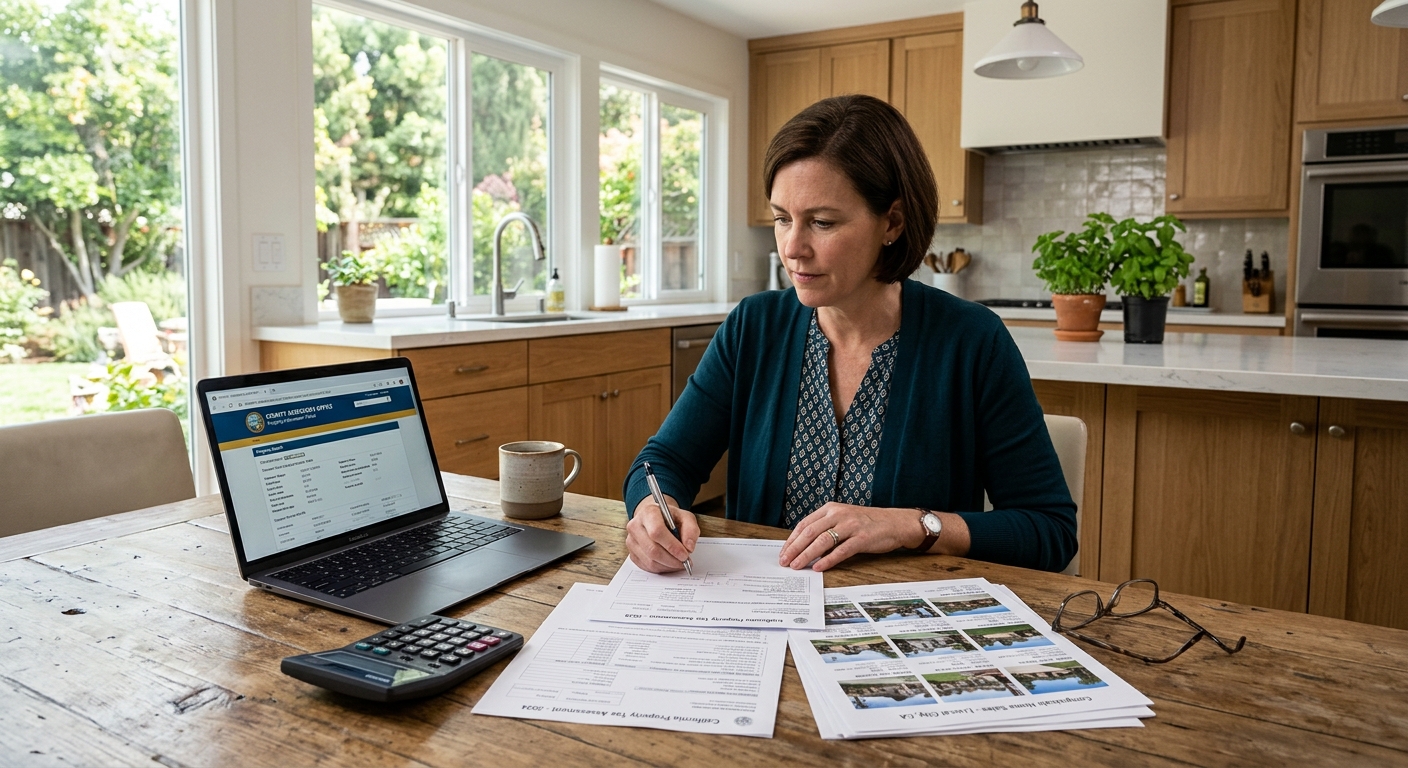
This is where most appeals are won or lost. You need three to five recent comparable sales (within six months and within one mile of your property) that demonstrate your assessed value exceeds fair market value. Pull data from your county recorder’s office, Redfin, Zillow, or the MLS. Focus on properties with similar square footage, lot size, bedroom and bathroom count, age, and condition.
Adjustments matter. If a comparable sold for $520,000 but has a pool and your property does not, you need to adjust that sale downward by $15,000 to $25,000 to reflect the missing amenity. If a comparable has a smaller lot, adjust upward. The more granular your adjustments, the stronger your case.
Step 3: File the Appeal
In California, you file an Assessment Appeal Application (Form AAS) with your county’s Clerk of the Board. The filing window runs from July 2 through November 30 in most counties (some close September 15). Filing is free. The form requires your property’s Assessor Parcel Number (APN), your opinion of value, and a brief statement of why the current value is too high.
For real estate investors with multiple properties, each parcel requires its own appeal application. A portfolio owner with four rental properties should file four separate appeals if all four are overassessed.
Step 4: Attend the Hearing
The AAB schedules a hearing, typically within 12 to 18 months of filing (backlogs vary by county). You present your comparable sales analysis, photos of property condition issues, and any independent appraisal you obtained. The county assessor presents their defense. The board issues a decision, which can reduce your value, keep it the same, or in rare cases increase it (called a “cross-appeal” scenario in some states).
Pro Tip: In California, if the AAB does not hear your case within two years of filing, the value automatically defaults to the lower of either your opinion of value or the assessor’s value. This rule, found in Revenue and Taxation Code Section 1604, gives homeowners significant leverage.
Step 5: Collect the Refund or Reduction
If you win, the county recalculates your tax bill at the new assessed value. In California, the reduced value applies to the fiscal year in question, and you receive a refund for any overpayment. The reduced value also becomes the new base year value going forward, saving you money for every year you own the property.
Five Situations Where a County Property Tax Appeal Saves You the Most Money
Not every property is a strong appeal candidate. Here are the five scenarios where filing pays off the most.
Scenario 1: You Bought at a Market Peak
If you purchased a home in 2022 or 2023 at the height of pandemic-era pricing and local values have softened 5 to 15 percent, your assessed value is likely stuck at or near the purchase price. In California, the assessor sets the new base year value at the purchase price plus any transfer taxes. If the market has since dropped, you have a strong case for a Proposition 8 temporary reduction (also known as a “decline in value” reassessment).
Example: David bought a three-bedroom home in Sacramento for $585,000 in March 2023. By January 2025, comparable sales in his neighborhood averaged $520,000. His assessed value remained at $591,000 (original price plus the 2 percent annual Prop 13 increase). David filed a decline-in-value appeal and received a reduction to $525,000, saving him $726 per year in property taxes.
Scenario 2: Your Property Has Physical Deficiencies
Foundation cracks, outdated electrical systems, deferred maintenance, flood damage, and structural issues all reduce fair market value. The county assessor’s mass appraisal model does not account for these property-specific conditions. If you document these issues with photos, contractor estimates, or inspection reports, you can argue that your property’s value is below the assessed amount.
Scenario 3: New Construction or Remodel Was Over-Assessed
When you add square footage, remodel a kitchen, or build an accessory dwelling unit (ADU), the assessor issues a supplemental assessment based on the estimated cost of the improvement. The problem is that cost does not always equal value. A $150,000 kitchen remodel might only add $90,000 in market value. If the assessor added the full $150,000 to your assessed value, you are overpaying on $60,000 of phantom value.
Scenario 4: Comparable Sales Prove Your Value Is Too High
This is the most common appeal scenario. Even without a market decline or physical deficiency, your assessed value may simply be higher than what similar homes are selling for. Three solid comparable sales that average 8 to 12 percent below your assessed value give you a strong foundation for an appeal.
Scenario 5: Income-Producing Property Is Over-Valued
For rental properties and commercial real estate, the assessor may use an income approach to value (capitalizing the property’s net operating income). If your actual rent collections are lower than what the assessor assumed, or if your vacancy rate is higher, the resulting value should be lower. This is especially relevant for real estate tax preparation clients who have detailed income and expense records from their Schedule E filings.
If you want to estimate how a property tax reduction interacts with your overall federal tax picture, run your numbers through this federal tax calculator to see the combined impact on your bottom line.
The Five Costliest Property Tax Appeal Mistakes
Filing an appeal is straightforward, but these five errors can cost you the reduction you deserve.
Mistake 1: Missing the Filing Deadline
In California, the standard filing window closes November 30 (or September 15 in some counties). Miss it by one day, and you lose the entire year’s appeal rights. There is no extension, no late filing relief, and no reasonable cause exception. Mark your calendar for July 2 and file early.
Mistake 2: Using “My Taxes Are Too High” as Your Argument
This is the number-one reason appeals fail. In Cook County, Illinois, roughly 80 percent of recent certificate-of-error applications were denied because the sole argument was “taxes too high.” That is not a valid basis for an assessment reduction. You must demonstrate that the assessed value exceeds fair market value using comparable sales, income data, or cost analysis. The tax rate is set by the taxing authority, not the assessor.
Mistake 3: Choosing Bad Comparables
If your comparable sales are more than a mile away, more than six months old, or differ significantly in size, age, or condition without proper adjustments, the appeal board will dismiss them. Quality beats quantity. Three well-matched, properly adjusted comparables are worth more than ten poorly selected ones.
Mistake 4: Ignoring the Income Approach for Rental Properties
If you own a duplex, fourplex, or commercial building, relying solely on comparable sales is a mistake. The assessor may have used an income approach to set your value. If you do not counter with your own income capitalization analysis showing lower net operating income, higher vacancy rates, or higher capitalization rates, you are fighting with one hand tied behind your back.
Mistake 5: Skipping the Informal Review
Most counties offer an informal review process before the formal hearing. In California, you can request a meeting with the assessor’s appraiser to discuss your value. Many reductions are negotiated at this stage without ever reaching the AAB. Skipping this step means you lose a free opportunity to settle quickly and avoid a 12-to-18-month hearing wait.
Red Flag Alert: Some property tax appeal companies charge contingency fees of 30 to 50 percent of your first-year savings. On a $1,200 annual reduction, that means you pay $360 to $600 for something you could have done yourself in two hours. Know what you are paying before you hire anyone.
California-Specific Rules That Change the Appeal Equation
California operates under a unique property tax framework that creates both opportunities and traps for appeal filers.
Proposition 13 Base Year Value System
Under Prop 13, your property’s assessed value is set at the purchase price (the “base year value”) and can only increase by a maximum of 2 percent per year under Section 51 of the Revenue and Taxation Code. This means your assessed value can fall significantly behind market value during a boom, but it can also exceed market value during a correction. The Proposition 8 temporary reduction mechanism allows you to request a reduction to current fair market value when the market drops below your factored base year value.
Proposition 19 Portability and Reassessment Changes
Since April 2021, Prop 19 changed how inherited properties and primary residence transfers are reassessed. If you inherited property and the reassessment pushed your tax bill from $2,000 to $8,000 per year, you may have grounds for an appeal if the reassessed value exceeds the property’s actual market value at the date of transfer.
The SALT Cap and Property Tax Deductibility
Under the One Big Beautiful Bill Act (OBBBA), the state and local tax (SALT) deduction cap increased from $10,000 to $40,000 for taxpayers with modified adjusted gross income below $500,000. This means your property tax payments are more likely to be fully deductible now than they were under the old $10,000 cap. However, a lower assessed value still saves you real dollars, because the deduction only offsets a portion of the tax at your marginal rate. Paying $8,000 in property taxes versus $6,500 still costs you $1,500 more out of pocket, even if the deduction reduces the after-tax cost.
AB 150 PTE Election Interaction
For S Corp and LLC owners who elected into California’s pass-through entity (PTE) tax under AB 150, property taxes paid on business-use real estate may factor into your overall state tax picture. A lower assessed value reduces the property tax component, potentially improving your net PTE benefit. This is a planning consideration that most property tax appeal guides completely ignore.
KDA Case Study: Sacramento Investor Saves $4,200 per Year Across a Three-Property Portfolio
Marcus, a W-2 engineer earning $185,000 per year, owned three rental properties in Sacramento County with a combined assessed value of $1,420,000. He purchased all three between 2021 and 2023. By mid-2025, comparable sales in his target neighborhoods showed values had softened 8 to 12 percent from peak levels.
Marcus came to KDA for help with his annual real estate tax preparation and mentioned his property tax bills felt high. Our team pulled comparable sales data for all three properties, prepared adjusted sales comparison grids, and filed three separate Assessment Appeal Applications with the Sacramento County Clerk of the Board before the November 30 deadline.
Here is what happened:
- Property 1 (duplex): Assessed value reduced from $510,000 to $455,000. Annual savings: $605.
- Property 2 (single-family rental): Assessed value reduced from $485,000 to $430,000. Annual savings: $605.
- Property 3 (triplex): Assessed value reduced from $425,000 to $370,000. Annual savings: $605.
Additionally, KDA identified that Marcus had never filed for a Proposition 8 decline-in-value reassessment on Property 1, which was purchased in 2021 and had been over-assessed for two full years. We filed for a retroactive correction and secured a $2,385 refund for the prior two years of overpayment.
Total first-year impact: $4,200 in annual ongoing savings plus $2,385 in retroactive refunds, for a combined $6,585 benefit. Marcus paid KDA $1,800 for the portfolio appeal preparation and tax integration work, delivering a 3.7x first-year return on investment.
Ready to see how we can help you? Explore more success stories on our case studies page to discover proven strategies that have saved our clients thousands in taxes.
What If My Appeal Gets Denied?
A denial does not mean you are out of options. In California, you can refile the following year if new comparable sales support a lower value. You can also request a review of the AAB’s decision if you believe procedural errors occurred during the hearing. In some states, you can escalate to a state-level tax tribunal or file a judicial appeal in superior court, though the cost and complexity increase significantly.
The most important thing after a denial is to understand why you lost. Did the board find your comparables unpersuasive? Did the assessor’s income analysis outweigh your sales comparison? Did you fail to make proper adjustments? Fixing these issues and refiling the next year often produces a different result.
Can I Appeal Even If My Home Value Went Up?
Yes, and this is one of the most misunderstood aspects of the process. A rising market does not mean your assessed value is correct. If your assessed value increased by $40,000 but comparable sales only support a $25,000 increase, you still have grounds for a partial reduction. The question is never whether your home went up or down. The question is whether the assessed value matches what a willing buyer would pay a willing seller in an arm’s-length transaction as of the lien date (January 1 in California).
Should I Hire a Property Tax Appeal Firm or Do It Myself?
For a straightforward single-family home with clear comparable sales, you can do this yourself. The process is designed for homeowners to navigate without professional help. Download your county’s appeal form, gather three to five comparable sales, make reasonable adjustments, and present your case.
For complex situations (multi-unit properties, commercial buildings, properties with income approach valuations, or inherited properties with Prop 19 reassessment issues) working with a professional makes sense. The key is to understand the fee structure before you sign. Avoid any firm that charges more than 30 percent of your first-year savings. Many reputable firms charge flat fees between $300 and $1,500 per parcel depending on complexity.
Ready to Reduce Your Tax Bill?
KDA Inc. specializes in strategic tax planning for business owners, S Corps, LLCs, and high-net-worth individuals. Book a personalized consultation and walk away with a clear plan.
Frequently Asked Questions
How long does a property tax appeal take from filing to decision?
In California, expect 12 to 18 months from filing to hearing. Some counties move faster, others slower. Under Revenue and Taxation Code Section 1604, if the AAB does not hear your case within two years, the value defaults to the lower of your opinion of value or the assessor’s value.
Will filing an appeal increase my property taxes?
In most states, including California, the appeal board cannot raise your assessed value above the amount on the current roll. However, some states allow “cross-appeals” where the assessor requests an increase. Check your state’s rules before filing.
Can I appeal my property tax assessment every year?
Yes. There is no limit on how many years in a row you can file. If your value remains above market value after a successful appeal, you should file again the following year for further reduction.
Do I need a formal appraisal to win an appeal?
No. Most successful appeals rely on comparable sales analysis prepared by the homeowner. A formal appraisal (costing $300 to $500) can strengthen your case but is not required. For properties valued over $1 million or commercial properties, an appraisal is highly recommended.
What if I live in a state without Proposition 13 protections?
Every state has a property tax appeal process, even those without assessment caps. In states with annual reassessment (like Texas or Georgia), appeals are even more critical because your assessed value resets to market value each year. If the market softens, your assessed value may not adjust downward automatically. You must file to capture the reduction.
Does a property tax reduction affect my homeowner’s insurance?
No. Assessed value and insured replacement cost are completely different numbers. Your insurance covers the cost to rebuild your home, which is based on construction costs, not market value. Lowering your assessed value has zero impact on your insurance coverage or premiums.
This information is current as of April 12, 2026. Tax laws change frequently. Verify updates with the IRS or FTB if reading this later.
Book Your Property Tax Review and Strategy Session
If you own property in California and suspect your assessed value does not match what your home or investment property would actually sell for, stop overpaying. Our team reviews your assessment, pulls comparable sales, and identifies whether a formal appeal makes sense for your specific situation. For investors with multiple properties, we coordinate the appeal process alongside your annual tax preparation to maximize every dollar. Click here to book your consultation now.



